
Homeschool
Homeschool Preschool Curriculum: How to Choose in 2026 (Playing Preschool vs The Good and the Beautiful vs Blossom & Root vs Pod Squad)
Preschool at home is seven domains, 20 to 90 minutes a day by age, and a rhythm that repeats. Here is what to cover, how the six philosophies differ, and how Playing Preschool, The Good and the Beautiful, Blossom & Root, and Pod Squad compare on price and fit.
Pod Squad Program TeamSeptember 10, 2026Updated September 28, 2026 46 min read

Key Takeaways
- Preschool is seven domains, not a stack of workbooks. Early-learning standards from NAEYC and every US state agree on the territory: language and literacy, math thinking, physical and fine motor, social-emotional skills, approaches to learning, creative arts, and science and nature. A good curriculum touches all seven every week, mostly through play.
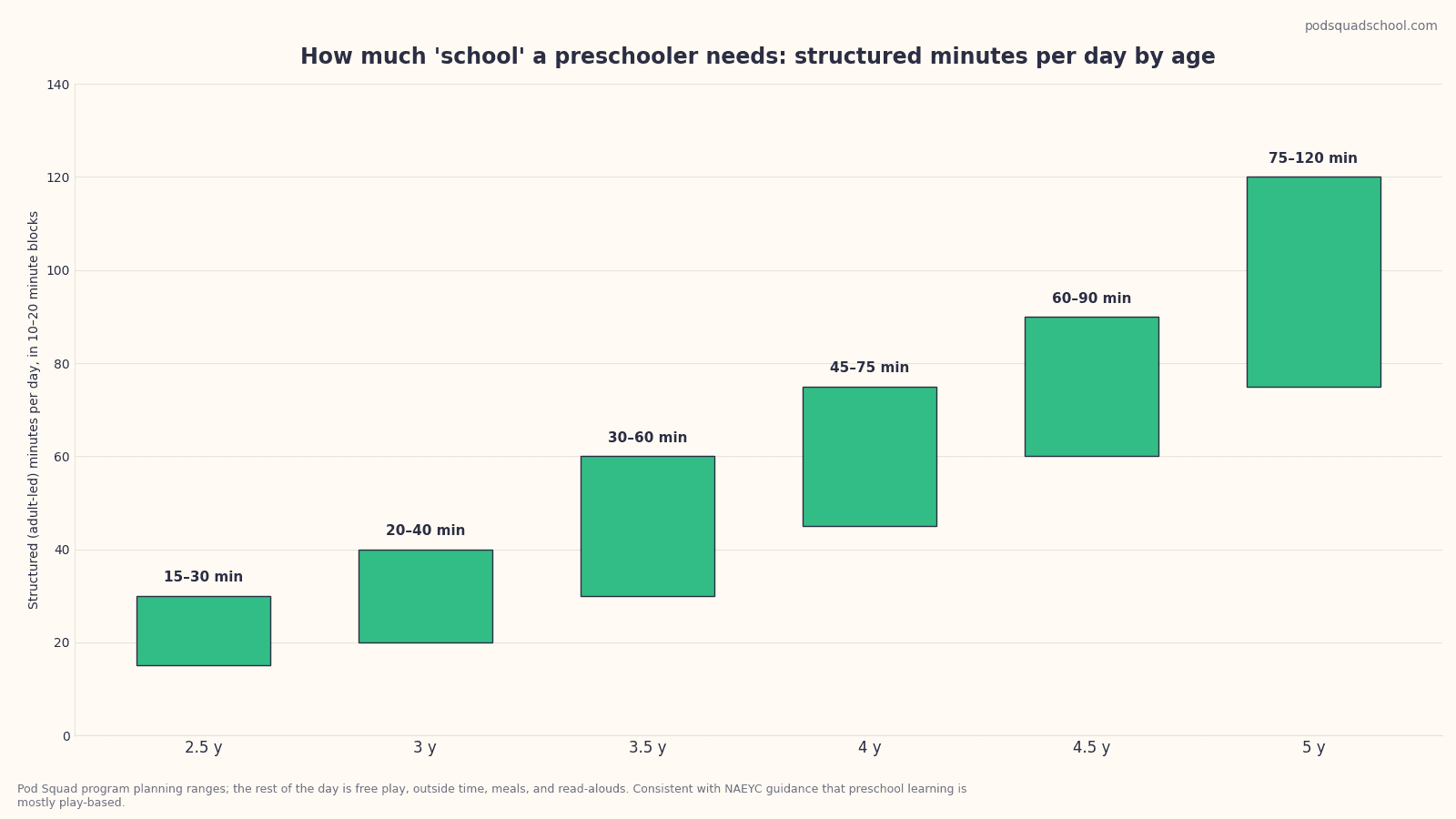
- The right amount of structured time is smaller than you think. About 20 to 30 minutes a day at 2.5, 45 to 60 at 3.5, and up to 90 at 4.5, always split into short blocks. Reading aloud, outside time, and meals are on top of that, and they do more than the table ever will.
- The four programs parents actually compare cost wildly different amounts. Playing Preschool Year 1 is listed at $39.90 and Blossom & Root Early Years Volume 1 around $22 at the time of check, September 2026; The Good and the Beautiful Preschool runs roughly $45 to $50 for the printed set; Pod Squad is $99 a month for the first kid ($50 for each sibling) after 7 free days. The cheaper PDFs give you a plan; the membership gives you a plan, printables, meals, adventures, and reminders. Only one of those is right for your family and your budget.
- Philosophy matters less than fit. Play-based, Montessori, Charlotte Mason, Waldorf, classical, and unschooling all produce kindergartners who are fine. Choose the one you will actually run on a Tuesday when everyone is tired.
- Most US states do not regulate homeschooling before compulsory school age. Florida has no requirement before age 6. Check your state, then stop worrying about compliance and start worrying about outside time.
- A portfolio is the only record you need. A folder, a dated photo a week, and one sentence about what your kid did. It takes four minutes a week and it is what kindergarten teachers and future you actually want.
- The three most expensive mistakes are all free to fix. Too much table time, buying too much, and skipping outside time cost families more joy than any curriculum ever saved them.
You do not have to be a homeschooler to need a preschool curriculum. Maybe your kid is 3 and the local preschool has a waitlist longer than a Publix line on Sunday. Maybe you have a 2.5-year-old at home while an older sibling is at school and you want the mornings to have a shape. Maybe you are homeschooling on purpose and want to do it right from the start. Or maybe your kid does go to preschool three mornings a week and you want the other two mornings to count.
This post is for all of you. It explains what preschool actually has to cover, how much time that really takes at each age, how the six big philosophies differ, and how the four programs parents most often compare stack up: Playing Preschool, The Good and the Beautiful, Blossom & Root, and Pod Squad. We built Pod Squad, so read that section with your eyes open. We will tell you plainly when a $22 PDF is the right answer.
If you only read one thing, read the minutes-by-age table and the mistakes section. Preschool at home fails from too much, not too little.
What parents are actually searching for (2026)
We pulled the search demand behind this topic to see what parents want when they type "homeschool preschool curriculum" and its neighbors into Google. Google Ads hides volume for many keywords about young children, so several of these rows use clickstream estimates (labeled). The pattern is clear anyway: parents search for specific program names far more than for the generic category, and the generic category is wide open.
| Keyword | US searches/mo | Difficulty | What they want |
|---|---|---|---|
| the good and the beautiful | 90,500 | 17 | Reviews, samples, and price of one specific Christian program |
| homeschool curriculum | 74,000 | 61 | The big roundup; mostly parents of school-age kids |
| montessori | 74,000 | 48 | What the philosophy is; whether to do it at home |
| homeschool preschool curriculum | 6,600 | 14 | A plan for a 3- or 4-year-old at home; the primary query here |
| preschool curriculum | 6,600 | 33 | What preschool should cover; often teachers and parents both |
| blossom and root | 6,600 | 8 | Reviews and samples of a secular, nature-leaning program |
| best homeschool curriculum | 5,400 | 8 | A shortlist with a verdict; CPC $14.53, so publishers pay for it |
| charlotte mason | 5,400 | n/a | What the method is; living books, nature study, short lessons |
| unschooling | 5,400 | n/a | Whether no curriculum is a curriculum |
| playing preschool | 2,900 | 2 | Reviews and price of Susie Allison's program; up 22% year over year |
| pre k homeschool curriculum | 2,400 | 0 | Same as the primary query, one year older |
| how to homeschool | 2,400 | 22 | The very first step; legal and practical |
| homeschool schedule | 1,600 | 3 | A daily and weekly rhythm they can copy |
| homeschool preschool | 1,000 | 12 | Whether it is even a thing, and how to start |
| preschool at home | 480 | 1 | A parent who is not calling it homeschool yet |
| toddler homeschool curriculum | ≈203 (clickstream) | n/a | A plan for a 2-year-old, which barely exists as a category |
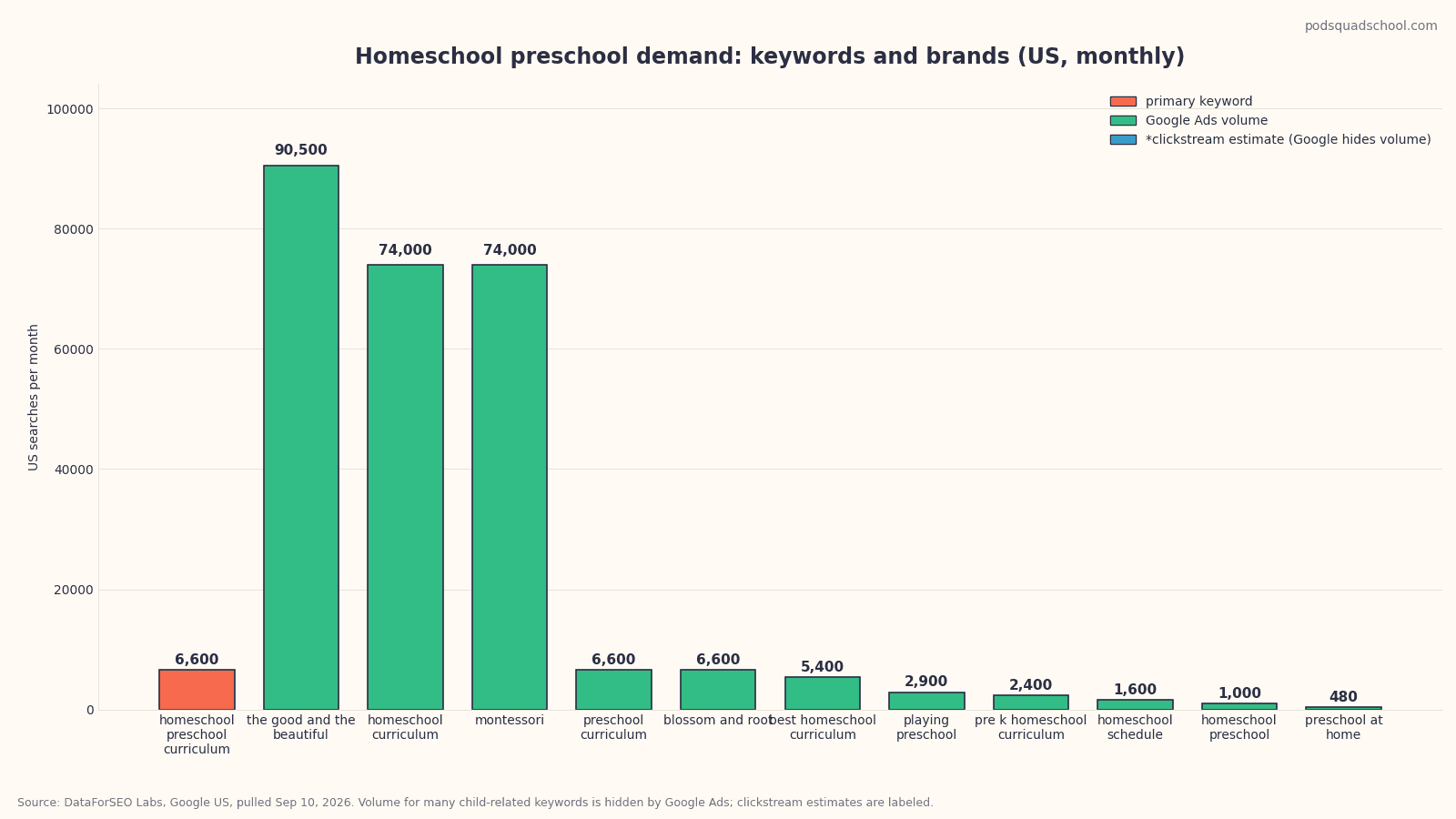
Source: DataForSEO Labs, Google US, pulled September 10, 2026.
Two things jump out. First, the brand names dwarf the category. "The good and the beautiful" alone gets almost 14 times the searches of "homeschool preschool curriculum". Parents are not asking "what should preschool cover"; they are asking "is this specific box worth buying". That is a signal that the market has done a good job selling products and a poor job explaining the underlying need. If you understand the seven domains and the minutes-by-age numbers below, you can evaluate any program in ten minutes, including ones that do not exist yet.
Second, the difficulty scores on the generic queries are low. "Pre k homeschool curriculum" has a difficulty of 0, "preschool at home" is 1, "homeschool schedule" is 3. Those are questions with no authoritative answer ranking, which usually means the top results are affiliate roundups that list twelve programs and pick none. The gap is a post that says what preschool needs to be, gives real minutes and real activities by age, compares the actual options with their actual prices, and tells you which one to choose based on your family instead of the writer's commission. That is what we tried to write.
What a preschool curriculum actually needs to cover
Every US state publishes early learning standards for ages 3 to 5, and NAEYC (the National Association for the Education of Young Children) publishes the position statements that most of those standards lean on. Strip away the jargon and they all describe the same seven domains. A curriculum that skips one is incomplete, no matter how pretty the PDF. A home that touches all seven in a week, mostly through play, meals, and time outside, is doing preschool whether or not anyone bought anything.
Here is each domain, what it looks like at 2.5, 3.5, and 4.5, and two or three activities you can run with things already in your kitchen. For each activity: what to set out, what to say, roughly how long it holds attention, and what the kid is learning.
Language and literacy
This is the biggest domain and the one most parents over-invest in with worksheets and under-invest in with talk. The research is unambiguous: the number of back-and-forth conversational turns a young child has each day predicts vocabulary and later reading better than any flashcard. Harvard's Center on the Developing Child calls it "serve and return". Your kid serves (points, babbles, asks), you return (name it, expand it, ask one real question), and the loop keeps going.
At 2.5, literacy is being read to daily, hearing a lot of words, singing, and starting to notice that print exists. At 3.5, it is rhyming, recognizing a few letters (usually the first letter of their name), retelling a story, and scribbling that starts to look like writing. At 4.5, it is knowing most uppercase letters, hearing beginning sounds, writing their name in wobbly capitals, and following a three-step direction.
- Read aloud, twice a day, 10 to 15 minutes each. Set out: three books your kid chose from a basket of eight. Say: "Which one first?" then read it, pausing to let them fill in a repeated line. What they learn: vocabulary, story structure, print awareness, the pleasure of books. Age note: at 2.5, expect to read the same book four times; that is the point.
- Letter of the week, 5 minutes, at 3.5 and up. Set out: one big uppercase letter on paper, a chunky crayon, and a salt tray (a baking sheet with a quarter cup of table salt). Say: "This is B. It says buh. Trace it with your finger, then find something in this room that starts with buh." What they learn: letter shape, letter sound, the idea that letters map to things. Age note: at 2.5 skip the tracing entirely and just point letters out on cereal boxes. Our post on letter tracing worksheets covers when tracing helps and when it is just frustration.
- Story retell with three objects, 5 to 10 minutes. Set out: after reading a familiar book, three toys that stand in for the characters. Say: "Tell me what happened to the bear." What they learn: sequencing, narrative language, memory. Age note: at 2.5 you tell it and they hold the toys; at 4.5 they tell it and you ask "and then what?"
Math thinking
Preschool math is not worksheets with numerals. It is counting real things, comparing more and less, sorting by attribute, noticing patterns, and talking about shape and position. Kids who spend three years counting crackers, sorting socks, and stacking blocks arrive at kindergarten with number sense; kids who traced numerals arrive knowing what a 7 looks like.
- Snack counting, 3 minutes, every day. Set out: a small plate and the snack. Say: "How many crackers do you want? Five? Let's count them out. One, two..." What they learn: one-to-one correspondence, cardinality (the last number said is how many there are). Age note: at 2.5 count to three or four and stop; at 4.5 ask "if you eat two, how many are left?"
- Sock sort, 10 minutes. Set out: the clean laundry basket. Say: "Can you find the sock that matches this one?" What they learn: matching, attributes, the vocabulary of same and different. Age note: this is also a Squad Job in Pod Squad's Toddler program (Laundry Helper), because real chores are the best math manipulatives you already own.
- Block build with a challenge, 15 to 20 minutes. Set out: wooden blocks or Duplo. Say: "Can you build something taller than this cup?" then "Now something with exactly four blocks." What they learn: measurement language, counting, spatial reasoning, balance. Age note: at 2.5 the challenge is just "build and knock down" and that is legitimate engineering.
- Pattern walk, 10 minutes outside. Set out: nothing. Say: "Let's step, step, jump. Step, step, jump. What comes next?" What they learn: patterns are the foundation of algebra. Age note: 3.5 and up.
Physical and fine motor
Fine motor comes from big motor. A kid who climbs, hangs, carries heavy things, and crawls develops the shoulder and core stability that lets a hand hold a pencil later. Pushing pencil work before the body is ready produces a fisted grip and a kid who hates writing. Our activities for 2-year-olds post has a deeper list, but the basics are these.
- Heavy work, 15 minutes, daily. Set out: a laundry basket with three books in it, or a small watering can. Say: "Can you carry this to the porch for me?" What they learn: core strength, proprioception, the satisfaction of a real job. Age note: at 2.5 keep the load under a couple of pounds.
- Tongs and pom-poms, 10 minutes. Set out: a bowl of large pom-poms (bigger than a toilet-paper tube's opening for kids under 3; anything smaller stays out of reach) and a pair of kitchen tongs or a strawberry huller. Say: "Can you move all the red ones into the cup?" What they learn: pincer strength, hand-eye coordination, color sorting. Age note: at 4.5 switch to tweezers and dried chickpeas, with an adult sitting right there.
- Playdough with tools, 20 minutes. Set out: a fist of homemade playdough (2 cups flour, half a cup of salt, 2 tablespoons oil, three-quarters of a cup of water; taste-safe for under 3), a rolling pin, a butter knife, and a garlic press. Say nothing for the first five minutes; then, "What are you making?" What they learn: hand strength, bilateral coordination, planning. Age note: the garlic press is the best hand-strength tool in your kitchen.
- Outside, 60 to 120 minutes, every day it is not lightning. This is not optional and it is not a break from the curriculum. It is most of the curriculum for a 2.5-year-old.
Social-emotional
This is the domain kindergarten teachers say matters most and the one no worksheet can teach. It covers naming feelings, waiting a turn, recovering from disappointment, asking for help, and beginning to notice that other people have feelings too. It is taught through your responses to real moments, and through pretend play, which is where kids rehearse being a person.
- Feelings check at lunch, 2 minutes. Set out: lunch. Say: "My morning was a little frustrating because the printer jammed. How was yours?" What they learn: feelings have names, grown-ups have them too, and talking about them is normal. Age note: at 2.5 offer two choices: "Was your morning happy or grumpy?"
- Pretend kitchen or doctor kit, 20 to 30 minutes. Set out: a few real props (an old phone, a real wooden spoon, a bandage box). Say: "I think Bear has a tummy ache. Can you help him?" What they learn: empathy, role-taking, language, sequencing. Age note: at 4.5 this can run an hour with a friend and that hour is worth more than any lesson.
- Wait timer, ongoing. Set out: a sand timer or the Block Timer in the app. Say: "You can have the blue cup when the sand runs out." What they learn: waiting has an end, and they can survive it. Age note: 3 minutes is a long time at 2.5.
Approaches to learning
This is the quiet domain: curiosity, persistence, attention, flexibility, and the willingness to try something that might not work. You do not teach it directly. You protect it by not interrupting a kid who is concentrating, by letting a tower fall without fixing it, by asking "what could you try?" instead of showing the answer. Guided play is built for this: the adult sets out the materials and an invitation, the kid keeps the choices, and the adult talks with the kid instead of quizzing. Our play-based learning post walks through the research.
- The 10-minute rule. When your kid is deep in something, do not talk. Set a timer for yourself. Ten minutes of uninterrupted concentration at age 3 is a real skill being built.
- Broken-thing box, 20 minutes, 3.5 and up. Set out: an old remote or flashlight with the batteries removed, a real (small) screwdriver, an adult within arm's length. Say: "I wonder what is inside." What they learn: persistence, tool use, cause and effect. Age note: batteries and any part that fits through a toilet-paper tube go straight into a jar out of reach.
Creative arts
Art at this age is process, not product. Nobody needs a construction-paper turkey. They need materials, time, and an adult who says "tell me about it" instead of "what is it?" Music is here too: singing every day, moving to rhythm, banging on pots.
- Easel paper and two colors, 20 minutes. Set out: one big sheet taped to the table, two cups of washable paint, one fat brush. Say: nothing until they are done, then "Tell me about your painting." What they learn: color mixing, mark making, the wrist and shoulder movements that precede writing. Age note: at 2.5 expect it on their arms; put them in an old shirt.
- Pot-and-spoon band, 10 minutes. Set out: three pots, two wooden spoons, a colander. Say: "Can you play loud? Now quiet. Now fast." What they learn: rhythm, dynamics, following a direction through movement.
- Song of the week. Pick one and sing it at the same moment every day (getting in the car, washing hands). By Friday your kid knows every word and you have taught vocabulary, rhythm, and memory without a table.
Science and nature
Preschool science is noticing, predicting, and asking "what happens if". It is not facts about planets. The best lab is the backyard, the kitchen sink, and the weather. A weekly Wonder Lab moment (Pod Squad's name for it; you can call it whatever you like) is plenty.
- Sink or float, 15 minutes. Set out: a dish tub with three inches of water, six household objects (a spoon, a cork, a crayon, a lemon, a rock, a plastic lid). An adult within arm's length of the water the whole time. Say: "Will this one sink or float? Let's find out." What they learn: prediction, testing, vocabulary (heavy, light, hollow). Age note: at 2.5 this is just water play with a side of vocabulary and that is fine.
- Make it rain, 10 minutes. Set out: a clear jar of water, a layer of shaving cream on top, blue food coloring in a small cup with a dropper. Say: "The cloud is getting heavy. What do you think will happen?" What they learn: clouds, weight, cause and effect. Age note: the dropper is a fine-motor bonus.
- Nature table, ongoing. Set out: a tray by the door. Every walk, one thing comes home (a leaf, a shell, a seed pod). Say: "Where should we put it?" What they learn: observation, classification, seasonal change. Age note: nothing that fits through a toilet-paper tube stays on a table a 2-year-old can reach.
- Plant one bean. A clear cup, a wet paper towel, a dried bean. Check it every morning. This is a two-week science unit for the price of a bean.
How many minutes a day, by age
Here is the number most parents get wrong. They plan a two-hour preschool morning for a 3-year-old, it falls apart at minute 25, and they conclude they are bad at this. They are not. The kid's attention span is working exactly as designed.
The guide below is for structured, adult-planned time: the block where you set something out with a purpose. Reading aloud, outside play, meals, and free play are separate and should add up to far more.
| Age | Structured minutes a day | Block length | Number of blocks | What fills the rest of the day |
|---|---|---|---|---|
| 2 to 2.5 | 15 to 20 | 5 to 10 min | 2 | Free play, outside, two read-alouds, snack, nap |
| 2.5 to 3 | 20 to 30 | 10 min | 2 to 3 | Same, plus one Squad Job (a real chore, kid-sized) |
| 3 to 3.5 | 30 to 45 | 10 to 15 min | 3 | Same, plus pretend play with a friend when you can |
| 3.5 to 4 | 45 to 60 | 15 min | 3 to 4 | Same, plus a letter of the week (5 minutes of it) |
| 4 to 4.5 | 60 to 75 | 15 to 20 min | 4 | Same, plus longer projects that span two days |
| 4.5 to 5 | 75 to 90 | 15 to 20 min | 4 to 5 | Same, plus early name writing and simple games with rules |
What a block looks like
A block has four parts and takes less prep than it sounds.
- Set out. One invitation on the table before the kid arrives: a tray of playdough and a garlic press; a bin of dried pasta and a scoop; a book and three animals. Two minutes of your time, usually the night before.
- Say. One sentence that opens the door without closing it. "I wonder what the garlic press does to playdough" beats "Make a snake."
- Watch. Stay near, talk when they talk, narrate what you see ("You pushed really hard and it came out in strings"). Do not quiz.
- Stop while it is good. When the kid drifts, the block is over. Do not extend it to hit a number. Ten good minutes beat twenty-five that end in tears.
Every block in Pod Squad's Toddler and Preschool programs is written in exactly that shape: what to set out, what to say, what to watch for, and what to do when it falls apart, with a note for your kid's exact age. If you are building your own, use the same four headings on an index card.
Reading aloud is separate, and bigger
Whatever the structured number is, add 20 to 30 minutes of reading aloud on top, split into two or three sittings. The AAP recommends reading together daily from infancy, and there is no age in the preschool years where it stops being the single highest-return activity in the house. A 4.5-year-old who has heard 1,000 books and never traced a letter is in better shape for kindergarten than one who has done the reverse.
The philosophies, compared
Parents searching "montessori", "charlotte mason", and "unschooling" together with "preschool" are trying to pick a team. You do not have to. Every serious approach agrees on the fundamentals for ages 2 to 5: short lessons or none, lots of outside, real materials, daily read-alouds, almost no worksheets. They differ on how much the adult plans, how much the environment is prepared, and what the aesthetic is.
| Philosophy | Core idea | Adult's role | Typical materials | Daily structured time at 3.5 | Good fit if you | Watch out for |
|---|---|---|---|---|---|---|
| Play-based (guided play) | Kids learn through play the adult sets up and extends | Sets out invitations, narrates, asks one real question | Everyday household stuff, sensory bins, blocks, books | 30 to 45 min in blocks | Want low prep and a kid who leads | Drift into no structure at all if you skip planning |
| Montessori | A prepared environment with self-correcting materials; the child works independently | Prepares the shelf, demonstrates once, steps back | Child-height shelves, trays, real tools, specific manipulatives | 60 to 120 min "work cycle" (self-chosen) | Have space and like order; kid likes to repeat tasks | Cost of materials; rigidity if you copy a school instead of the principles |
| Charlotte Mason | Living books, nature study, short lessons, habit training | Reads aloud, leads nature walks, models habits | Picture books, a nature journal, watercolors | Under 20 min of formal lessons before age 6 | Love books and the outdoors | Almost no formal early years; some parents feel they are doing nothing |
| Waldorf | Rhythm, imagination, handwork; academics delayed to about 7 | Holds a strong daily and weekly rhythm; models practical work | Natural materials, silks, beeswax, wooden toys, baking | Rhythm all day, zero formal lessons | Want a slow, seasonal, screen-free home | Late letters worry some parents; aesthetic can get expensive |
| Classical | Grammar stage: memory, chants, facts, phonics early | Teaches directly, uses memory work and recitation | Phonics readers, memory songs, some workbooks | 30 to 60 min direct instruction | Want early reading and structure | Too much table time for most 3-year-olds; watch the body |
| Unschooling | Child-led entirely; learning follows interest | Provides resources and says yes a lot | Whatever the kid is into | 0 planned | Trust your kid and have a rich home environment | Gaps you do not notice; hard when interests are narrow |
A few honest notes on each.
Play-based is where the developmental research sits, from NAEYC's position statement on developmentally appropriate practice to the AAP's 2018 clinical report "The Power of Play" to the LEGO Foundation's reviews of learning through play. It is also what Playing Preschool and Pod Squad are. Its weakness is that "play-based" can become a label for "we did nothing today" if nobody plans the invitations.
Montessori works beautifully at home when you take the principles (real tools, child-height storage, let them finish) and skip the catalog. You do not need a $400 pink tower. You need a low shelf, a small pitcher, and the patience to let a 3-year-old pour their own water and wipe up the spill.
Charlotte Mason for the early years is basically "read good books, go outside, build habits". That is excellent advice. Blossom & Root leans this way. If you want structure, you will add it yourself.
Waldorf gets rhythm right. A predictable week (baking day, painting day, walk day) is calming for young children and for parents. If the late-academics piece worries you, borrow the rhythm and add a letter of the week anyway. Nobody will arrest you.
Classical programs are often excellent for ages 6 and up. Before 5, many of them ask for more sitting than a preschooler's body can give. If you go this way, halve the table time and double the outside time.
Unschooling a preschooler is very close to what everyone else is doing anyway, since preschool is mostly life. The difference is whether you check the seven domains at the end of the week. We would.
You can mix
Most families end up with a play-based spine, a Montessori shelf, a Charlotte Mason nature table, and a Waldorf rhythm. That is not indecision. That is a home.
The four programs, compared
Here are the four programs parents most often compare for preschool at home, with prices from each publisher's official page. Prices are stated as listed at the time of check, September 2026; they change, so click through before you buy. We wrote this and we sell one of them; we have tried to be as fair as we know how.
Playing Preschool (Busy Toddler)
Susie Allison's program is a PDF with 19 two-week units, about 2.5 to 5 years, secular and play-based, no worksheets, built around materials you already own. Year 1 is listed at $39.90 (on sale for $29.90 at the time of check) and the Year 1 and 2 bundle at $69.80 ($54.80 on sale) on the official Playing Preschool page. Each day has a book, a poem or song, a math or literacy activity, and an art or sensory activity, with a short shopping list per unit. It is the best-known example of the "you do not need a curriculum, but here is a very good one anyway" school of thought.
What it does not do: meals, printables, reminders, outings, or notes for your kid's exact age. You bring the calendar, the printer, and the kitchen. For a lot of families that is exactly right.
The Good and the Beautiful Preschool
A printed, Christian course set from The Good and the Beautiful, roughly $45 to $50 for the physical set per the publisher's listing at the time of check, with a companion app of songs and videos. It is beautifully produced, gentle, and does more direct teaching (letters, sounds, early phonics) than the play-based programs. Faith content is woven throughout, which is the point for the families who choose it and the reason others do not.
What it does not do: it is not secular and does not pretend to be; it is more table time than a 3-year-old's body may want (pair it with a lot of outside); and it does not touch meals, outings, or reminders.
Blossom & Root Early Years
Secular, Charlotte Mason and Waldorf-leaning, 36-week PDF volumes from Blossom & Root. Volume 1 (ages 2 to 4) is listed around $22 and Volume 2 (pre-K) around $45 at the time of check. It is heavy on picture books, nature study, art, and rhythm, and light on anything that looks like school. The book lists are long and the library will carry most of them. If you want a slow, beautiful, outdoorsy early childhood with a gentle spine, this is the cheapest good answer on the list.
What it does not do: minimal direct literacy or math instruction (by design), no printables to speak of, and nothing for meals, outings, or the day-to-day logistics.
Pod Squad
Pod Squad is not a PDF; it is a membership and an app. It is $99 a month for the first kid after 7 free days, siblings 50% off (two kids are $149 a month), 10% off for every friend you bring, two months free on annual plans, and a 30-day money-back guarantee on the first paid month. See pricing for the current numbers. It includes the daily plan (a themed week with blocks written for your kid's exact age), the printables (worksheets, Words of the Week posters, I Spy cards, sorting mats, a Little Wins tracker), Nourish menus (one family menu sized per kid, allergy-aware, choking-safe cuts), a Thursday adventure at a real place near you, the app with reminders and a Block Timer, and optional squads with friends you already have. It runs from the newborn weeks to the first day of kindergarten, so the same account covers the baby and the 4-year-old, and big brothers and sisters 6 and up come along free as helpers.
What it does not do: it is not cheap; a year is $1,188 for one kid month to month (or $990 on an annual plan). It is not a workbook and will not teach reading by drill. It is secular in the program itself, with a faith layer you can turn on, and it is the only one of the four that also covers the baby years before preschool and the afternoons and weekends of a kid in daycare, so it works whether or not you are homeschooling.
Side by side
| Playing Preschool | The Good and the Beautiful Preschool | Blossom & Root Early Years | Pod Squad | |
|---|---|---|---|---|
| Price (listed at time of check) | $39.90 Year 1; $69.80 bundle (sale $29.90 / $54.80) | About $45 to $50 printed set | About $22 Vol 1; about $45 Vol 2 | $99/mo for the first kid after 7 free days; siblings 50% off |
| Format | PDF you print or read on a tablet | Printed book set plus app | App and website, printables on tap | |
| Prep time | 10 to 15 min a day plus a shopping trip per unit | 5 to 10 min a day | 15 to 30 min a week (library run) | About 2 min; set out what the block says |
| Faith stance | Secular | Christian throughout | Secular | Secular program; optional faith layer |
| Printables | None by design | Included in the set | Minimal | Weekly, one tap |
| Meals and snacks | No | No | No | Yes, Nourish, sized per kid |
| Community | Large online following | Large online following | Online community | Optional squads with your own friends |
| App and reminders | No | Companion app (songs and videos) | No | Yes; reminders, Block Timer, portfolio |
| Adventures and outings | No | No | Nature walks suggested | Weekly, sorted by distance from home |
| Ages covered | About 2.5 to 5 | Preschool (about 3 to 5) | 2 to 4, then pre-K | Newborn to kindergarten |
| Philosophy | Play-based | Gentle direct instruction, faith-based | Charlotte Mason and Waldorf-leaning | Guided play, personalized by Homie |
Last verified: September 2026.
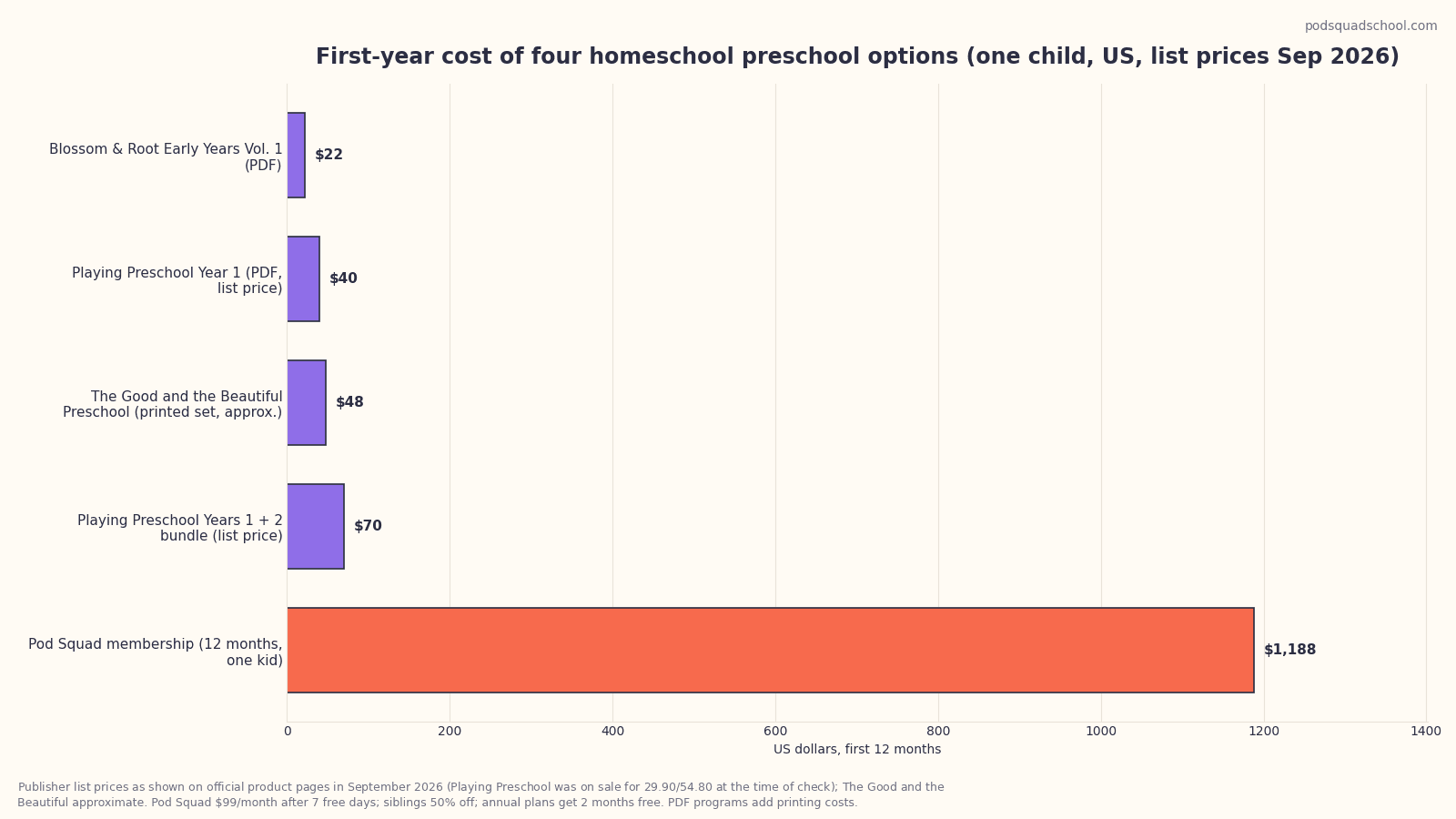
What the first year actually costs
The chart makes the point without commentary: three of these are a one-time purchase under $70 and one is a $1,188 subscription. The honest question is not "which is cheaper" but "what am I buying with the difference". With a PDF you buy a plan and supply the calendar, the printer, the meals, the outings, and the adjustment to your kid's exact age yourself. With Pod Squad you buy the plan plus that layer, at roughly $3.25 a day. If the layer is what makes the difference between running preschool and meaning to, it is worth it. If you already have it in your head and your kitchen, buy the $22 PDF and spend the rest on library late fees and a good pair of rain boots.
A decision flow: if you want X, choose Y
Read down until one fits.
- If your budget is under $50 and you like planning, choose Playing Preschool for a play-based, secular year, or Blossom & Root Volume 1 for a slower, more nature-and-books year. Both are excellent. Pick by aesthetic: Playing Preschool feels like a busy kitchen table; Blossom & Root feels like a walk in the woods.
- If faith is central to your home and you want it in the curriculum, choose The Good and the Beautiful, then add an hour outside a day to balance the table time.
- If your kid is under 2.5, do not buy a preschool curriculum. Read, go outside, do real chores together, run one sensory bin a day. Our sensory bin ideas post is a whole year of them. If you want a plan anyway, Pod Squad's Toddler Squad starts at about 20 months and is built for exactly this age.
- If the hard part is not knowing what to do but remembering to do it, choose Pod Squad. Reminders, the printable already waiting, the menu already made. That is what you are paying for.
- If you have two or more kids under 6, choose Pod Squad or Playing Preschool. Pod Squad puts every kid on one account with age-specific notes side by side and gives siblings 50% off; Playing Preschool works fine with a 2.5- and a 4-year-old at the same table if you stretch the activities yourself.
- If your kid goes to preschool part-time and you want the other days to count, choose Pod Squad's after-pickup and weekend rhythms, or just run the seven-domain checklist above with library books and a bin. You do not need a full curriculum for two mornings.
- If you want Montessori specifically, none of the four is Montessori. Buy a low shelf, read one good Montessori-at-home book, and use any of the four for the weekly theme.
- If you are not sure, download Pod Squad's free sample (a Week 1 worksheet and a Wonder Lab card), read the free sample pages Playing Preschool and Blossom & Root both post, and run one day of each. Your kid will tell you.
A weekly rhythm that holds up
A curriculum tells you what. A rhythm tells you when, and rhythm is what makes preschool at home survive the third week. Steal the Waldorf idea of one anchor per day and hang everything else on it.
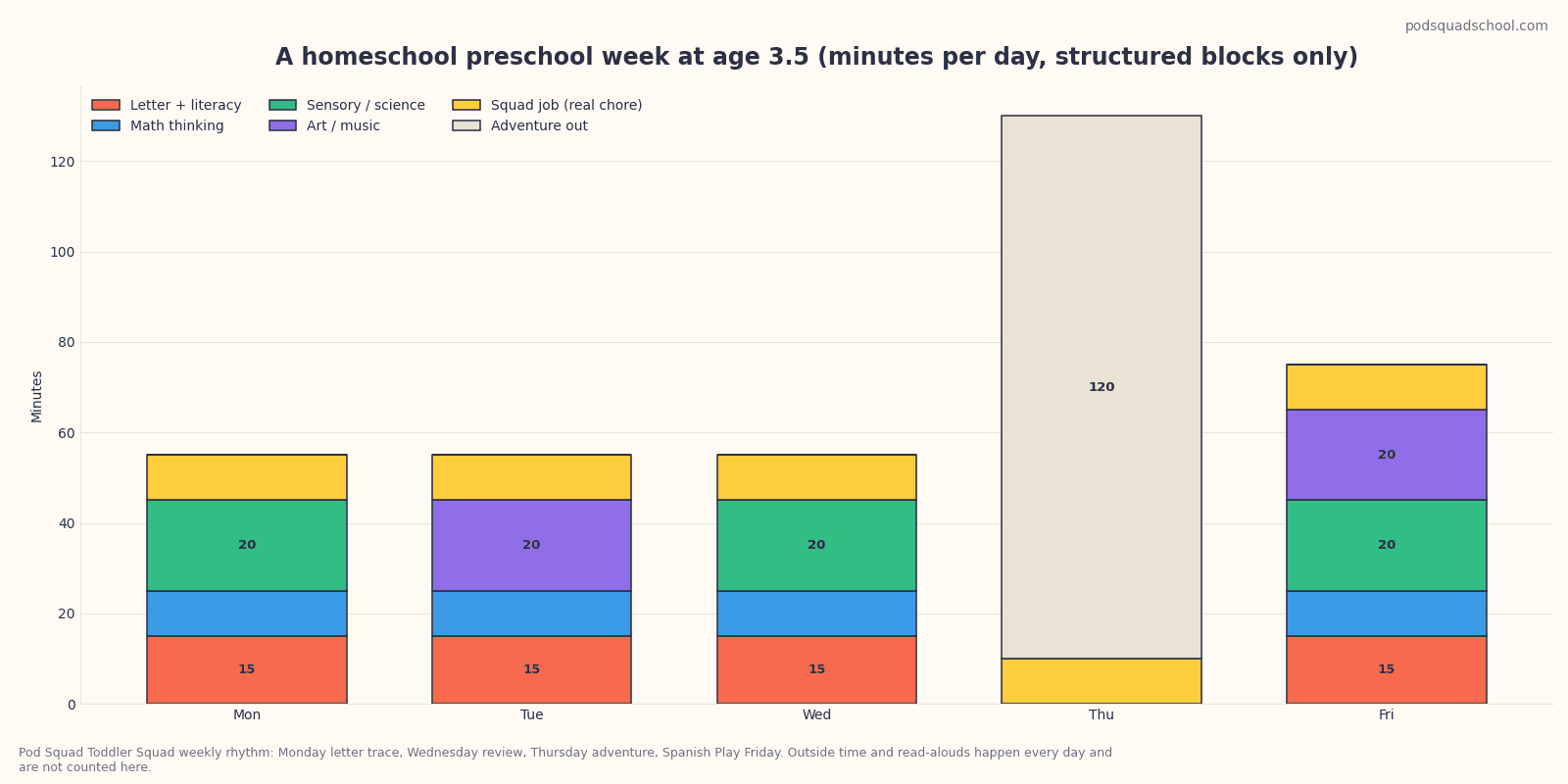
| Day | Anchor | Morning blocks | Afternoon |
|---|---|---|---|
| Monday | New theme and letter | Introduce the theme with a book; letter trace (5 min) at 3.5+; sensory bin tied to theme | Outside 60+ min; read-aloud |
| Tuesday | Squad Job day | Real chore at kid size (wash-up station, water plants); math block with the same materials | Outside; pretend play; read-aloud |
| Wednesday | Wonder Lab and letter review | One science moment; letter review (5 min); art block | Library run; outside; read-aloud |
| Thursday | Adventure | Leave the house: park, fire station, farm, grocery store tour, museum | Nap or quiet; talk about what you saw; read-aloud |
| Friday | Music and Spanish play, wins | Songs of the week; a few Spanish words through play; log the week's wins in the portfolio | Outside; free play; read-aloud |
The daily skeleton
The same shape every day, so nobody has to think:
- Breakfast and a song (the song of the week, sung while you stir the oatmeal).
- Block 1, right after breakfast, when attention is highest.
- Outside, 45 to 90 minutes, rain jackets if needed.
- Snack and counting (the counting is the math).
- Block 2, then free play while you make lunch.
- Lunch and a feelings check.
- Rest or nap, then read-aloud.
- Block 3 at 3.5 and up (skip at 2.5), often art or pretend.
- Outside again if you can, or a walk to the mailbox.
- Dinner, bath, read-aloud, bed.
That is it. The blocks move; the skeleton does not.
State rules, briefly
Most US states do not regulate homeschooling before compulsory school age, and compulsory school age runs from 5 to 8 depending on the state. That means for the vast majority of preschool-age families, there is nothing to file, no hours to log, and no assessment to pass. Florida, where Pod Squad started, has no requirement before age 6; you do not notify anyone that you are doing preschool at home with a 3-year-old, because legally you are just parenting.
Check your own state's compulsory attendance age (your state department of education website will have it) and, if your kid is approaching it, read the homeschool notification rules so you are ready. A few states start compulsory attendance at 5, and a few have rules about withdrawing a child who has been enrolled in a public pre-K. If you are in one of those, a homeschool legal organization or your state's homeschool association can tell you exactly what applies. For everyone else: you are cleared. Go outside.
Record-keeping: a simple portfolio
You do not need a grade book. You need a portfolio, for three reasons: it shows you the growth you cannot see day to day, it is what a kindergarten teacher will actually appreciate if you hand over anything, and it is what your kid will want to look at when they are 9. Here is the whole system.
- Get one folder or one box per kid. A plastic accordion file with 12 pockets works; label the pockets by month.
- Once a week, take one photo. The block that went best, the tallest tower, the painting, the kid at the fire station. Friday afternoon is the natural moment. Pod Squad's app does this with "log a win", which drops the photo into the kid's portfolio with the date and the block name; a phone camera roll and a folder do the same job.
- Write one sentence. "Nova counted to 11 by herself at snack." "Cash traced B with his finger in the salt tray and said buh." One sentence, dated. Four minutes.
- Keep three physical pieces a month. One drawing or painting, one piece of early writing (scribbles count), one thing from the nature table if it will survive. Everything else goes in the recycling, guilt-free, after a photo.
- Every 12 weeks, flip through it with your kid. They will see their own progress, and so will you. That is the assessment.
If your state eventually asks for a portfolio (a few do for school-age homeschoolers), this is already 90% of what they want.
A worked week
Here is one week a family could run starting Monday, for a 3.5-year-old (we will call her Nova) with a 22-month-old (Cash) who rides along. Theme: Wheels & Roads. Letter: C. Total adult prep: about 25 minutes on Sunday night, plus a $9 shopping list (a bag of dried black beans, a roll of painter's tape, a box of small cars if you do not own any).
Sunday night, 25 minutes. Pull five wheel books from your shelf or reserve them at the library (any truck book, any train book). Tape a road on the kitchen floor with painter's tape: two straight lines, a curve, a stop sign square. Put the black beans in a dish tub with four cars and a scoop; this is the sensory bin. Print or draw a big uppercase C. Check the weather for Thursday.
Monday, about 45 minutes structured. Breakfast song: "The Wheels on the Bus". Block 1 (15 min): read a truck book, then Nova drives cars on the tape road while you narrate ("You stopped at the stop sign. Now you are turning."). Cash pushes a car along the straight line; his job is just "go and stop". Outside 60 minutes: walk to look at wheels; count them on parked cars (Nova counts to 4 per car; you count the total). Snack: cut a banana into wheels and count them. Block 2 (10 min): letter C in the salt tray for Nova, finger only, three tries, then find three things that start with "cuh" (car, cup, cat). Cash sits at the tray and just draws in the salt, which is exactly right for 22 months; the salt is taste-safe. Lunch with a feelings check. Nap. Read-aloud. Block 3 (15 min): the bean bin. Adult within arm's length the entire time because Cash is under 3 and beans are small parts; the bin goes up on a high shelf the second the block ends. What they are learning: vocabulary, counting, letter C, scooping and pouring, stop and go.
Tuesday, about 45 minutes. Song. Block 1 (15 min): Squad Job, Pit Stop Crew: a bucket with two inches of water, a sponge, and every toy car gets washed. Adult within arm's length of the water. Nova washes; Cash dumps. Then everything dries on a towel, sorted by color (that is the math). Outside 60 minutes. Snack and counting. Block 2 (10 min): build a garage from blocks "tall enough for the red car"; measure by trying. Lunch, nap, read-aloud. Block 3 (15 min): pretend mechanic shop with a toy toolbox and a stuffed animal whose car is broken; Nova fixes it, Cash hands her tools. What they are learning: a real job done well, color sorting, measurement, empathy, tool vocabulary.
Wednesday, about 45 minutes. Song. Block 1 (15 min): Wonder Lab, ramps. A cutting board propped on two books; roll a car, a ball, a crayon, a block. "Which one goes farthest? Why?" Try a steeper ramp. Block 2 (5 min): letter C review; Nova traces the big C with a chunky crayon once, then draws a car. Library run: return the truck books, let each kid pick two. Outside on the way home. Lunch, nap, read-aloud. Block 3 (15 min): art, "paint with wheels": dip toy car wheels in washable paint and drive across a big sheet. Cash gets one car and one color in an old shirt. What they are learning: prediction, gravity and friction in plain words, letter C, mark making.
Thursday, adventure. Skip the morning blocks. Go somewhere with wheels: a fire station (call ahead; most will show kids the truck), a bus ride two stops and back, a bike shop, or the parking lot of a big grocery store to count wheels on the carts. In Pod Squad this is the Thursday adventure, sorted by distance from your home; without the app, pick anything within 20 minutes. Bring the snack (grapes quartered lengthwise for both kids; the AAP lists whole grapes among the top choking foods under 4). Home, nap, read-aloud, talk about what you saw. Log one photo in the portfolio. What they are learning: everything, and the memory that will make Friday's conversation.
Friday, about 40 minutes. Song, twice; by now Nova knows all of it. Block 1 (10 min): Spanish play, three words through the cars: rojo, azul, alto (red, blue, stop). Drive cars on the tape road and call "alto" at the square. Block 2 (15 min): Nova retells Thursday with the toy cars ("first we saw the big truck, then..."), you write one sentence in the portfolio. Cash bangs a pot with a spoon for the band. Outside, long. Block 3 (15 min): free choice from the week's materials; whatever they pick tells you what landed. Lunch, nap, read-aloud, done. Peel up the tape road Sunday, or leave it; it will get used.
Total structured time for Nova: about 45 minutes a day, four days, plus the adventure. Total for Cash: whatever he drifts into, which is correct for 22 months. Domains touched: all seven. Cost: about $9 and 25 minutes of Sunday.
Where Pod Squad fits, stated plainly
Pod Squad is a paid membership, $99 a month for the first kid ($50 for each sibling) after 7 free days, and for a lot of families that is the wrong price for preschool at home. If you are organized, like planning, have a library card and a printer, and your kid is your only project, buy Playing Preschool or Blossom & Root, follow the seven domains and the minutes table above, and you will be fine. We mean that.
Where Pod Squad earns its price is the layer around the plan. The worked week above took 25 minutes of Sunday prep because someone had to pick the books, plan the bin, decide on the letter, find the fire station, and remember the grapes. In Pod Squad, Week 3 of Toddler Squad is "Wheels & Roads"; the books, the shopping list, the Pit Stop Crew job, the ramp Wonder Lab, the letter, the Spanish words, and the Thursday place near you are already there, with a note that says what to do differently because your kid is 42 months and her brother is 22. The app taps you on the shoulder the night before. The printable is one tap. Nourish gives you the week's menu sized for each kid, with the grape rule built in. If you have a second kid, a job, or a hard season, that layer is the difference between preschool happening and preschool being a nice idea.
It also does not have to be homeschool. Families with a kid in daycare or part-time preschool use the after-pickup (30 to 45 minutes), weekend, and "whenever you're stuck" rhythms; the home rhythm (about two hours a day in blocks for toddlers; project weeks for preschoolers) is one of four. The plan runs until the first day of kindergarten, and after that a big kid comes along free as a helper for any younger brother or sister. You can start free and run a real week before you pay anything, or download the free sample first and try a Week 1 worksheet and a Wonder Lab card with no account at all. The Toddler and Preschool program pages show what a full season looks like.
Mistakes that cost the most
- Too much table time. The mistake: a 3-year-old at a table for 45 minutes with worksheets, because that is what school looks like. The cost: a kid who associates learning with sitting still and failing. The fix: cap table work at 5 to 10 minutes a day before age 4, run everything else on the floor, at the sink, and outside. Fine motor comes from monkey bars, not pencils.
- Buying too much. The mistake: three curricula, a Montessori shelf from a catalog, and a laminator, all before week one. The cost: several hundred dollars and a garage full of guilt. The fix: buy nothing for the first two weeks. Run the seven domains with what you own. Then buy the one thing you kept wishing you had. Our Lovevery vs KiwiCo vs Pod Squad post has the same advice about kits.
- Skipping outside time. The mistake: outside becomes the reward for finishing the blocks, then gets cut when the blocks run long. The cost: worse sleep, worse attention, worse everything. The fix: outside is the first block, not the last. Put it before anything with a table.
- Quizzing. The mistake: "What color is this? What letter is that? How many?" all day. The cost: a kid who stops talking to you because every conversation is a test. The fix: narrate and wonder. "You picked the blue one." "I wonder what happens if we add more water." Ask one real question you do not know the answer to.
- Comparing to the Instagram version. The mistake: measuring your kitchen table against a curated feed. The cost: quitting in week three. The fix: your portfolio is your only comparison. Flip back 12 weeks and look at the growth.
- Treating screens as a curriculum. The mistake: an "educational" app for 90 minutes because it says preschool on it. The cost: the AAP recommends limiting screen media to about one hour a day of high-quality programming for ages 2 to 5, co-viewed, and the research on app-based learning at this age is thin. The fix: screens are for the grown-up (the plan, the timer, the reminder) and the kid gets the salt tray. Our screen time for toddlers post has the swaps.
- Skipping meals as curriculum. The mistake: preschool is 9 to 11 and lunch is just lunch. The cost: you miss the best daily math (counting crackers), science (what melts), fine motor (spreading, pouring), and social-emotional (the feelings check) lesson in the house. The fix: one job per meal for the kid. Set the napkins. Count the grapes (quartered lengthwise under 4; no whole nuts, popcorn, or hard candy). Our healthy snacks for kids post has the full list.
- No rhythm. The mistake: a different plan every day, decided at breakfast. The cost: decision fatigue for you and anxiety for a kid who does not know what is coming. The fix: the daily skeleton above. Same shape every day; only the blocks change.
Who this is for, and who it is not for
This approach, and this post, are for you if: your kid is between about 2 and 5 and home with you most or some days; you want a plan with a shape, not a school day in miniature; you believe (or are willing to believe) that play, chores, books, and outside are the curriculum and the worksheet is a five-minute garnish; you have or can borrow a library card, a dish tub, and a roll of painter's tape; and you would like a way to tell, at the end of the week, that all seven domains got touched.
Pod Squad specifically is for you if: the hard part is remembering and preparing, not knowing; you have more than one kid and want them on one plan with notes for each age; you want meals and outings handled in the same place as the activities; or your kid is in daycare or preschool part-time or full-time and you want afternoons and weekends to have the same shape as a good preschool morning.
This is not for you if: you want a phonics-first, sit-down program that teaches reading by 4 (look at a classical program and be ready to cut its table time in half); you want a Montessori environment specifically (buy the shelf and one good book instead); you are in a season where any plan is too much plan (read aloud, go outside, and come back in a few months; that is a complete preschool for a 2.5-year-old); or your budget is under $50 and you like to plan, in which case Playing Preschool or Blossom & Root is the right call and we will say so again in the FAQ.
Frequently asked questions
Do I need a curriculum to homeschool preschool?
No. Preschool is seven domains (language, math thinking, physical, social-emotional, approaches to learning, arts, science) and a home with daily read-alouds, real chores, outside time, one or two planned play blocks, and a lot of conversation covers all of them. A curriculum gives you a theme, a sequence, and a shopping list so you do not have to invent Tuesday every Monday night. If you like planning and have the time, run the seven-domain checklist with library books and a bin. If you want someone else to have thought about tomorrow, buy the plan. Either way, no curriculum replaces reading aloud twice a day.
What age should I start homeschool preschool?
Formal, planned preschool blocks make sense from about 2.5, at 20 to 30 minutes a day split in two. Before that, the curriculum is life: read, sing, go outside, let them help with the laundry, run a sensory bin with an adult within arm's length. Pod Squad's Toddler Squad starts at about 20 months because that is when short guided-play invitations begin to hold, but even then the "structured" part is a few minutes and the rest is rhythm. If your kid is 4.5 and you have done none of this, you have not missed anything. Start with the minutes table and go up gradually.
How many hours a day is preschool homeschool?
Far fewer than you think. About 20 to 30 structured minutes at 2.5, 45 to 60 at 3.5, and up to 90 at 4.5, always in 10- to 20-minute blocks. Add 20 to 30 minutes of reading aloud and at least an hour outside on top. A "two-hour homeschool morning" for a 3-year-old is a block, outside time, snack, another block, and lunch; most of the two hours is not at a table. If a block runs long and ends in tears, that is a sign it was too long, not that your kid needs more practice sitting.
Is Playing Preschool worth it?
For a play-based, secular, low-prep year with a 2.5- to 5-year-old, yes, and at $39.90 listed (on sale at $29.90 at the time of check, September 2026) it is one of the best values in early education. You get 19 two-week units with a book, a song, a math or literacy activity, and an art or sensory activity each day, using things you own. What you supply is the calendar, the printer if you want one, the meals, and the outings. If you want those handled too, that is what Pod Squad's membership adds, at a very different price. If you do not, Playing Preschool is the right buy.
Is The Good and the Beautiful good for preschool?
If faith is central to your home and you want it in the curriculum, it is gentle, well produced, and does more direct teaching of letters and sounds than the play-based options, with a companion app of songs and videos. The printed set is roughly $45 to $50 per the publisher's listing at the time of check. Two honest cautions: it is Christian throughout and does not pretend otherwise, so secular families will want Playing Preschool or Blossom & Root; and it asks for more table time than many 3-year-olds can give, so pair it with a generous hour outside and stop any lesson while it is still going well.
What should a 3-year-old know before kindergarten?
Kindergarten is two years away, so the honest answer is "how to be 3". By about 5, most kindergarten teachers hope for: a kid who can follow a two- or three-step direction, wait a short turn, ask for help, recognize their own name and most uppercase letters, count objects to about 10, hold a book right way up and know where the story starts, use the bathroom mostly independently, and separate from a parent without a meltdown lasting all morning. Every one of those comes from play, read-alouds, chores, and practice, not from a workbook. CDC's milestone checklists for 3 and 4 are a good anchor; your pediatrician knows your kid.
Do I have to register or report homeschool preschool?
In most US states, no. Compulsory school age runs from 5 to 8 depending on the state, and homeschool notification rules do not start until then. Florida has no requirement before age 6. A few states have specific rules about withdrawing a child who was enrolled in public pre-K, and a few have compulsory attendance at 5, so check your state department of education's page and, if you are near the age, your state homeschool association. Keep a simple portfolio anyway: a dated photo a week and one sentence. It takes four minutes and it is what future you and any teacher will want.
Can I use Pod Squad if my kid goes to preschool?
Yes. The home rhythm (about two hours a day in blocks for toddlers; project weeks for preschoolers) is one of four; the others are after pickup (30 to 45 minutes), weekends (a Saturday adventure and a Sunday project), and "whenever you're stuck". A kid in preschool three mornings a week can run the Wheels & Roads week on the other two mornings and the weekend, with the same books, printables, and Thursday place. Siblings are on the same account at 50% off, so the baby's ride-along notes and the preschooler's afternoon sit side by side.
Sources & methodology
- National Association for the Education of Young Children (NAEYC), "Developmentally Appropriate Practice" position statement and related resources: https://www.naeyc.org
- American Academy of Pediatrics, HealthyChildren.org, "The Power of Play: How Fun and Games Help Children Thrive" and the 2018 clinical report "The Power of Play: A Pediatric Role in Enhancing Development in Young Children": https://www.healthychildren.org
- American Academy of Pediatrics, HealthyChildren.org, "Choking Prevention" (whole grapes, nuts, popcorn, and hard candy among the top hazards for children under 4): https://www.healthychildren.org
- American Academy of Pediatrics, HealthyChildren.org, media use recommendations for ages 2 to 5 (about one hour a day of high-quality programming, co-viewed): https://www.healthychildren.org
- Centers for Disease Control and Prevention, "Learn the Signs. Act Early." developmental milestone checklists for 2, 3, and 4 years: https://www.cdc.gov/ncbddd/actearly/milestones/index.html
- Harvard University Center on the Developing Child, "Serve and Return" and "Executive Function & Self-Regulation": https://developingchild.harvard.edu
- The LEGO Foundation, "Learning through Play: a review of the evidence" (Zosh, Hirsh-Pasek, Hopkins, et al.) and the five characteristics of learning through play: https://learningthroughplay.com
- USDA MyPlate, preschooler nutrition and portion guidance: https://www.myplate.gov
- Busy Toddler, Playing Preschool official product page, prices as listed at the time of check, September 2026: https://shop.busytoddler.com/product/playing-preschool-complete-program/
- The Good and the Beautiful, Preschool course set official page, price as listed at the time of check, September 2026: https://www.goodandbeautiful.com
- Blossom & Root, Early Years Volume 1 and Volume 2 official pages, prices as listed at the time of check, September 2026: https://www.blossomandroot.com
- Pod Squad pricing and program pages, September 2026: /pricing, /programs/toddler, /programs/preschool
- Search demand: DataForSEO Labs, Google US, September 10, 2026; volumes for many child-related keywords are suppressed by Google Ads and are shown as clickstream estimates where labeled.
- Minutes-by-age guidance is Pod Squad's program design, informed by NAEYC developmentally appropriate practice and by typical attention-span ranges cited in early-childhood teacher preparation; it is a starting point, not a prescription. State homeschool rules summarized from state department of education compulsory-attendance pages; verify your own state before relying on them.
Bottom line
Preschool at home is seven domains, touched mostly through play, chores, books, and time outside, in 20 to 90 structured minutes a day depending on age, with a rhythm that repeats every week. You can run it with a library card, a dish tub, and a roll of painter's tape. Playing Preschool ($39.90 listed) and Blossom & Root ($22 listed for Volume 1) will give you a very good plan for less than a tank of gas; The Good and the Beautiful will do it with faith woven through; all three leave the calendar, the kitchen, and the car to you.
Pod Squad costs a lot more ($99 a month for the first kid, $50 for each sibling) and does a lot more: the plan for your kid's exact age, the printable, the menu, the Thursday place, the reminder the night before, and the same account for the baby and the preschooler, whether or not anyone is homeschooling. It is the right buy for families where the hard part is remembering and preparing. It is the wrong buy for families who love that part.
You already know your kid; that is the hard part. If you want the rest handled, start free and run one real week before you decide.
Keep exploring
- Activities for 2-year-olds: the pre-preschool year, with what to set out and what to say
- Letter tracing worksheets: when tracing helps, which letters first, and the 5-minute rule
- Play-based learning: the research behind guided play and how to run it in 20 minutes a day
- Homeschool co-op near me: finding or starting a group when you want other families in the mix
- How Pod Squad works: the weekly plan, Homie, and squads, explained
- Free sample: a Week 1 worksheet and a Wonder Lab card, no account needed
Questions parents ask
Do I need a curriculum to homeschool preschool?
No. Preschool is seven domains (language, math thinking, physical, social-emotional, approaches to learning, arts, science) and a home with daily read-alouds, real chores, outside time, one or two planned play blocks, and a lot of conversation covers all of them. A curriculum gives you a theme, a sequence, and a shopping list so you do not have to invent Tuesday every Monday night. If you like planning and have the time, run the seven-domain checklist with library books and a bin. If you want someone else to have thought about tomorrow, buy the plan. Either way, no curriculum replaces reading aloud twice a day.
What age should I start homeschool preschool?
Formal, planned preschool blocks make sense from about 2.5, at 20 to 30 minutes a day split in two. Before that, the curriculum is life: read, sing, go outside, let them help with the laundry, run a sensory bin with an adult within arm's length. Pod Squad's Toddler Squad starts at about 20 months because that is when short guided-play invitations begin to hold, but even then the structured part is a few minutes and the rest is rhythm. If your kid is 4.5 and you have done none of this, you have not missed anything. Start with the minutes table and go up gradually.
How many hours a day is preschool homeschool?
Far fewer than you think. About 20 to 30 structured minutes at 2.5, 45 to 60 at 3.5, and up to 90 at 4.5, always in 10- to 20-minute blocks. Add 20 to 30 minutes of reading aloud and at least an hour outside on top. A two-hour homeschool morning for a 3-year-old is a block, outside time, snack, another block, and lunch; most of the two hours is not at a table. If a block runs long and ends in tears, that is a sign it was too long, not that your kid needs more practice sitting.
Is Playing Preschool worth it?
For a play-based, secular, low-prep year with a 2.5- to 5-year-old, yes, and at $39.90 listed (on sale at $29.90 at the time of check, September 2026) it is one of the best values in early education. You get 19 two-week units with a book, a song, a math or literacy activity, and an art or sensory activity each day, using things you own. What you supply is the calendar, the printer if you want one, the meals, and the outings. If you want those handled too, that is what Pod Squad's membership adds, at a very different price. If you do not, Playing Preschool is the right buy.
Is The Good and the Beautiful good for preschool?
If faith is central to your home and you want it in the curriculum, it is gentle, well produced, and does more direct teaching of letters and sounds than the play-based options, with a companion app of songs and videos. The printed set is roughly $45 to $50 per the publisher's listing at the time of check. Two honest cautions: it is Christian throughout and does not pretend otherwise, so secular families will want Playing Preschool or Blossom & Root; and it asks for more table time than many 3-year-olds can give, so pair it with a generous hour outside and stop any lesson while it is still going well.
What should a 3-year-old know before kindergarten?
Kindergarten is two years away, so the honest answer is how to be 3. By about 5, most kindergarten teachers hope for: a kid who can follow a two- or three-step direction, wait a short turn, ask for help, recognize their own name and most uppercase letters, count objects to about 10, hold a book right way up and know where the story starts, use the bathroom mostly independently, and separate from a parent without a meltdown lasting all morning. Every one of those comes from play, read-alouds, chores, and practice, not from a workbook. CDC's milestone checklists for 3 and 4 are a good anchor; your pediatrician knows your kid.
Do I have to register or report homeschool preschool?
In most US states, no. Compulsory school age runs from 5 to 8 depending on the state, and homeschool notification rules do not start until then. Florida has no requirement before age 6. A few states have specific rules about withdrawing a child who was enrolled in public pre-K, and a few have compulsory attendance at 5, so check your state department of education's page and, if you are near the age, your state homeschool association. Keep a simple portfolio anyway: a dated photo a week and one sentence. It takes four minutes and it is what future you and any teacher will want.
Can I use Pod Squad if my kid goes to preschool?
Yes. The home rhythm (about two hours a day in blocks for toddlers; project weeks for preschoolers) is one of four; the others are after pickup (30 to 45 minutes), weekends (a Saturday adventure and a Sunday project), and whenever you're stuck. A kid in preschool three mornings a week can run the Wheels & Roads week on the other two mornings and the weekend, with the same books, printables, and Thursday place. Siblings are on the same account at 50% off, so the baby's ride-along notes and the preschooler's afternoon sit side by side.
Written by
Pod Squad Program Team
Curriculum & play · Pod Squad. We write the daily plan families run, so every post is built from what actually works with a real kid on a real Tuesday.
Keep reading
Activities
Activities for 2 Year Olds: 62 Ideas by Age, Room, and Moment (From a Program That Plans Them Daily)
43 min read
Nourish
Healthy Snacks for Kids: 75 Ideas by Age, With Portions, Prep Times, and the Picky-Eater Playbook
52 min read
Activities
Sensory Bin Ideas: 75 Fillers, Tools, and Themes by Age (Taste-Safe Through Age 3)
48 min read