
Development
Screen Time for Toddlers: The AAP Guidelines Explained, What Screens Do to a 2-Year-Old's Day, and 50 Screen-Free Swaps That Actually Hold Their Attention
The AAP and WHO screen-time limits stated precisely, what the research does and does not show, and the practical layer the medical sites skip. A 12-moment audit, 50 screen-free swaps sized by age, and a seven-day reset that does not start a war.
Pod Squad Program TeamSeptember 10, 2026 46 min read
Key Takeaways
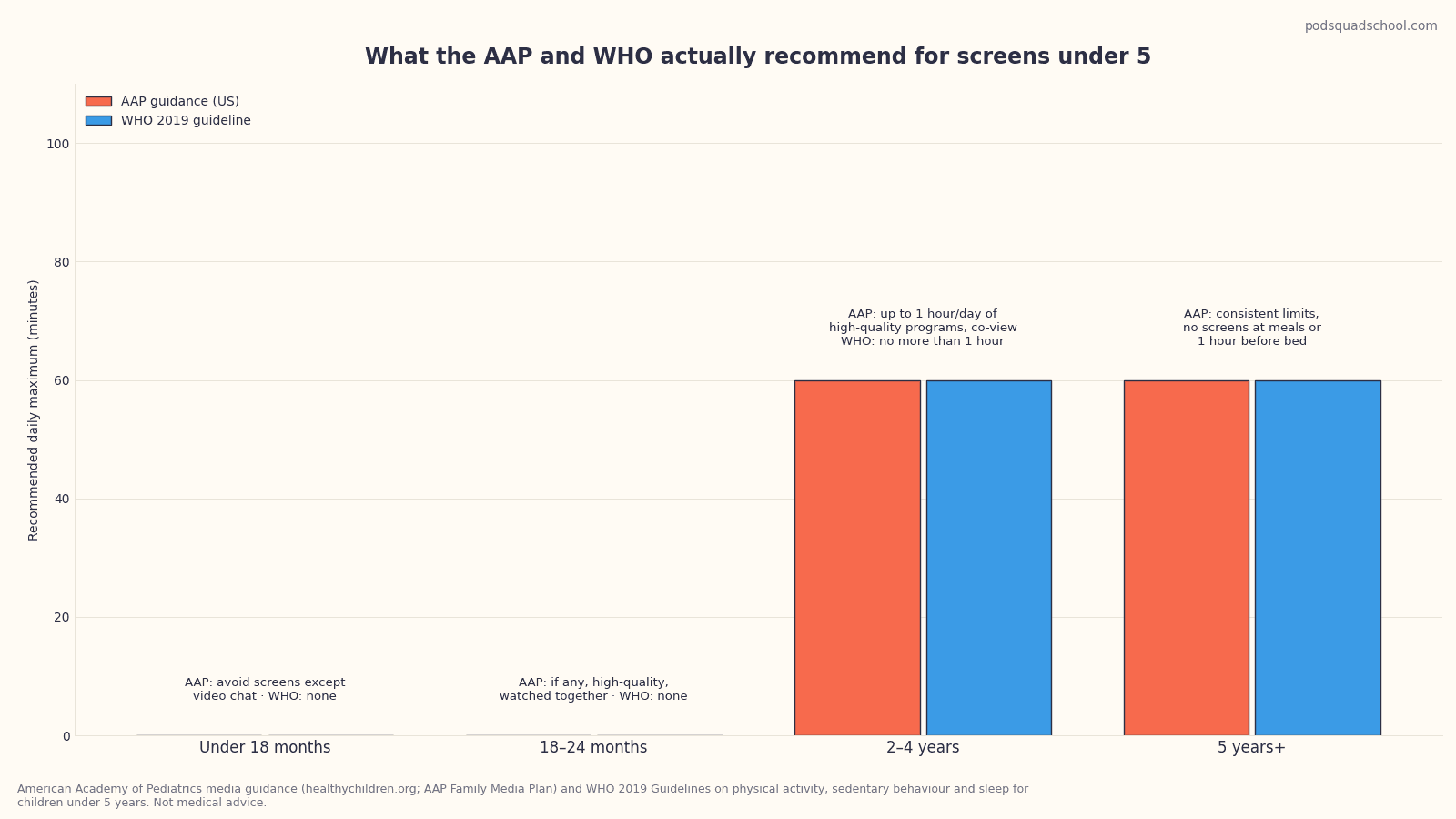
- The AAP guidance is simpler than the internet makes it. Under 18 months: avoid screen media other than video-chatting. 18 to 24 months: if you introduce screens, pick high-quality programming and watch it together. 2 to 5 years: limit screen use to about 1 hour a day of high-quality programs, and co-view. At every age: no screens during meals, none in the hour before bed, and keep bedrooms screen-free (healthychildren.org).
- The WHO is stricter for the youngest kids. Its 2019 guidelines say no sedentary screen time at all for 1-year-olds and no more than 1 hour a day for 2- to 4-year-olds, with less being better.
- The research shows associations, not proof. Heavy screen use in toddlers is correlated with lower language scores, shorter sleep, and more attention and emotional-regulation trouble a few years later. Those studies cannot rule out that busy or stressed households both use more screens and have less talk time. Treat the findings as a reason to be thoughtful, not a reason to panic.
- Screen minutes hide in the same 12 moments for almost every family. Breakfast, the car, the waiting room, dinner prep, the 5 pm melt, restaurants, sick days, early mornings, sibling naps, errands, the potty, and bedtime. Audit those moments and you have a plan; fight the tablet in the abstract and you have a war.
- Every swap needs three things: something set out before the kid needs it, one sentence you say, and a realistic number of minutes. A 2-year-old holds a new activity for about 5 minutes alone; a 3-year-old about 15; a 4-year-old about 30. Plan for those numbers, not for a Pinterest hour.
- A reset week works better than a cold-turkey Monday. Cut the moments in a fixed order (bedtime and meals first, the car last), tell your kid the rule the night before, and expect Tuesday and Wednesday to be the hard days. The asking often slows by day seven.
- The grown-up phone matters more than the kid's tablet. A toddler who watches you scroll learns that screens are what people do when there is a gap. Pod Squad is built so that the app lives on your phone and the kid never touches it; the kid gets the block, the basket, and you.
Somewhere between the first birthday and the second, a tablet or a phone arrives in most toddlers' days. Sometimes it is a video call with grandparents. Sometimes it is one episode while you make dinner. Often it is a quiet twenty minutes in a restaurant that turns into the only way anybody gets to eat out. None of that makes you a bad parent. It makes you a parent of a toddler in 2026.
This post is for you whether your kid is in daycare, home with you, in a part-time preschool, or homeschooled. It is for the family that wants zero screens and the family that wants a sane one hour. It gives you the actual guidance from the American Academy of Pediatrics and the World Health Organization, stated precisely and attributed, so you stop guessing. It tells you what the research does and does not show. Then it does the part the medical sites skip: it finds the exact moments in your day where the screen appears, hands you a swap for each moment sized to your kid's age, and walks you through a seven-day reset that does not turn your kitchen into a battlefield.
One honest note before we start. Pod Squad is a paid membership, and this article will say where it fits. Almost everything below can be done with a basket, a library card, and a kitchen timer. Your pediatrician knows your kid and should have the final word on anything medical, including sleep, speech, or behavior concerns.
What parents are actually searching for (2026)
We pulled search demand for this topic from DataForSEO Labs (Google US) on September 10, 2026. The picture is smaller than you would expect for a subject every parent has an opinion on. That is partly real and partly an artifact: Google Ads hides volume for many keywords about young children, so several of these rows use clickstream estimates (labeled). The adjacent parenting terms are included because they show where this question actually lives in a parent's head.
| Keyword | US searches/mo | Difficulty | What they want |
|---|---|---|---|
| parenting tips | 135,000 | KD 38 | Broad help; screens show up inside almost every answer |
| potty training (adjacent) | 27,100 | n/a | A neighboring toddler problem; screens often get used as the potty bribe |
| gentle parenting | 9,900 | KD 19 | A way to set limits without yelling, including screen limits |
| positive parenting | 1,000 | KD 27 | Same intent, different label |
| screen time recommendations | 320 (down 19% year over year) | KD 31 | The official numbers, by age |
| screen free activities | 260 (up 52% year over year) | KD 8 | Things to do instead, right now |
| quiet time activities | 210 | KD 0 | Something calm the kid can do alone |
| toddler tantrums | about 152 (clickstream) | n/a | Why the meltdown, and how to end it |
| toddler screen time | about 101 (clickstream) | n/a | How much is too much for a 1- to 3-year-old |
| screen time for toddlers | about 50 (clickstream) | n/a | Same question, phrased as a search |
| how much screen time for 2 year old | suppressed | n/a | The most specific version of the question |
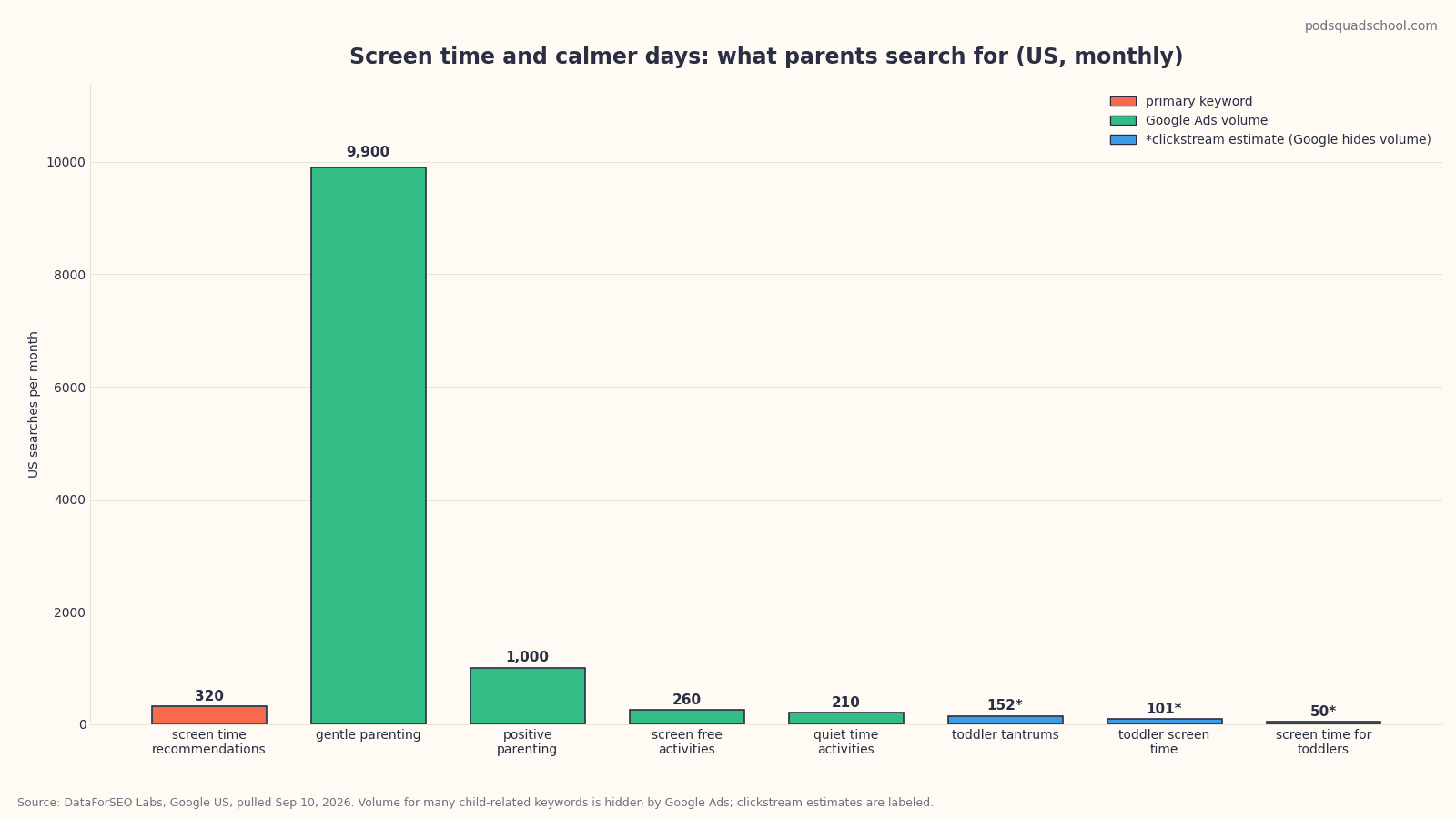
Read the trend arrows and the intent tells you something. Searches for "screen time recommendations" are falling while "screen free activities" is up more than half in a year. Parents are not confused about the numbers anymore; the AAP one-hour figure has been widely repeated since 2016. What they want now is the replacement. "Quiet time activities" has a difficulty score of zero, which means almost nobody has written a genuinely useful page for the parent who needs 25 minutes of calm from a 3-year-old without a screen. That is the gap this post fills.
The second thing the table shows is where the question lives. Nobody searches "screen time for toddlers" at 9 am on a calm Saturday. They search "toddler tantrums" at 5:40 pm after the tablet went away, or "gentle parenting" after they yelled about it. The screen question is really a transition question and a daily rhythm question. So this article is organized around moments in the day, not around a number.
What the AAP and WHO actually say, by age
The American Academy of Pediatrics published its policy statement "Media and Young Minds" in Pediatrics in 2016, and its parent-facing summary lives on healthychildren.org. It has been repeated so many times that the details have gotten blurry. Here is what it says, stated precisely.
Under 18 months
The AAP recommends avoiding screen media other than video-chatting. Video calls are treated differently because they are interactive and social: a grandparent responds to the baby in real time, which is closer to a conversation than to a show. This is the one screen use the AAP is comfortable with for babies.
18 to 24 months
For parents who want to introduce digital media, the AAP says to choose high-quality programming and to watch it with your child. The "with" matters. The guidance is not "one show a day is fine"; it is "if you do this, do it together and talk about what you see." Solo viewing at this age is what the AAP is steering you away from.
2 to 5 years
Limit screen use to 1 hour per day of high-quality programs, and co-view so you can help your child understand what they are seeing and connect it to the real world. High-quality is not defined as a brand; the AAP points to programs built with child-development input (the AAP policy statement names Sesame Workshop and PBS as examples) and away from fast-paced, autoplaying, or violent content.
The rules that apply at every age
- No screens during meals. This one is about conversation and about learning to notice hunger and fullness.
- No screens for 1 hour before bedtime. Light and stimulation both push sleep later.
- Keep bedrooms screen-free, and turn off devices when they are not in use, including background television.
- Do not use media as the only way to calm your child. The AAP's phrasing is that occasional use during a medical procedure or a flight is understandable, but that kids need to learn to calm themselves and that media as the default soothing tool gets in the way.
- Test apps before your child uses them, play them together, and ask what they thought.
The Family Media Plan
The AAP built a free tool, the Family Media Plan, at healthychildren.org (search for the Family Media Plan). You enter each family member, pick screen-free zones (bedroom, dinner table, car) and screen-free times (the hour before bed, meals), and it produces a printable plan. Doing it as a household is the point: the plan applies to the grown-ups too. Ten minutes on a Sunday, and you have a document to point at when your 3-year-old asks for the tablet at dinner.
WHO 2019 guidelines
The World Health Organization's 2019 "Guidelines on physical activity, sedentary behaviour and sleep for children under 5 years of age" come at the same question from a different angle: they are about the whole 24 hours, not the screen itself. For screens specifically:
- Infants under 1 year: screen time is not recommended.
- 1-year-olds: sedentary screen time (watching TV or videos, playing computer games) is not recommended.
- 2- to 4-year-olds: sedentary screen time should be no more than 1 hour a day; less is better.
The same document says kids aged 1 to 4 should get at least 180 minutes of physical activity spread across the day (with at least 60 of those minutes energetic for 3- and 4-year-olds), should not be restrained for more than 1 hour at a time (stroller, high chair, carrier), and need 11 to 14 hours of sleep at ages 1 to 2 and 10 to 13 hours at ages 3 to 4. The practical translation: the screen hour is not the only thing to watch. A 2-year-old who gets 45 minutes of video but also spends two hours strapped into a stroller and a car seat is short on movement, and the WHO cares about both.
Where they differ, and what to do with the difference
The AAP leaves the door open for 18- to 24-month-olds to watch high-quality programming together; the WHO says no sedentary screen time for 1-year-olds at all. Both agree on 1 hour as the ceiling from age 2. Neither is a law and neither is a threat. A reasonable reading for most families: treat 18 to 24 months as a "video calls plus maybe one co-viewed short show" stage, and treat 2 to 4 as "an hour is the ceiling, not the goal, and the hour is watched together when you can."
What the research shows, and what it does not
There are hundreds of studies on young children and screens. Most are observational, meaning researchers measured screen time and later measured something else and looked for a relationship. That design can show a correlation. It cannot prove that the screen caused the outcome. Families who use more screens may also be busier, more stressed, lower on sleep, or have fewer adults at home, and any of those could drive the result. Keep that caveat in front of you while you read this section.
Language
The most consistent finding is around talk. A 2020 meta-analysis in JAMA Pediatrics (Madigan and colleagues) pooled 42 studies and found that more screen time was associated with lower language skills, while co-viewing and higher-quality educational content were associated with stronger language skills, and starting screens later was associated with better outcomes. The likely mechanism is displacement: a toddler watching a video is not in a back-and-forth conversation, and back-and-forth conversation is how vocabulary grows (Harvard's Center on the Developing Child calls this "serve and return"). Background television is part of this; studies going back to the late 2000s found that a TV running in the room cut both the amount and the quality of parent talk during play.
Development screening scores
A 2019 study in JAMA Pediatrics followed about 2,400 Canadian children and found that higher screen time at 24 and 36 months was associated with lower scores on a developmental screening questionnaire at 36 and 60 months. The reverse direction (lower scores leading to more screen use) was not supported in that dataset. This is one of the stronger studies because it followed the same kids over time, but it still measured self-reported screen hours and still cannot rule out unmeasured household factors.
Sleep
Several studies associate evening screen exposure and touchscreen use in infants and toddlers with shorter total sleep and later bedtimes. The plausible mechanisms are light exposure, arousal from stimulating content, and displaced wind-down time. This is why the AAP's "no screens in the hour before bed" rule is the single limit most pediatric sleep clinicians would ask you to keep even if you kept nothing else.
Attention and emotional regulation
An older line of research linked early television exposure to attention problems at school age; some later studies replicated it and some did not, so hold it loosely. A more recent and more specific finding: a 2023 JAMA Pediatrics study (Radesky and colleagues) followed 3- to 5-year-olds and found that frequent use of a mobile device to calm the child was associated with higher emotional reactivity six months later, especially in boys and in kids who were already more reactive by temperament. The direction is not certain (reactive kids might get handed the phone more), but it matches what many parents see: the kid who is always calmed by the screen gets fewer reps at calming down any other way.
The "video deficit"
Toddlers under about 2 and a half learn less from a video than from the same thing shown live. Researchers call this the video deficit. It shrinks when the video is interactive and responsive, which is why live video calls work better than recorded shows for the youngest kids, and it shrinks when a grown-up sits alongside and narrates. This is the science behind "co-view" in the AAP guidance: your voice turns a video into something closer to a conversation.
What the research cannot tell you
It cannot tell you that 61 minutes is harmful and 59 is fine. It cannot tell you that a single sick-day movie will set anything back. It cannot separate the effect of the screen from the effect of what the screen replaced. The honest summary: the amount, the content, the context (alone or together), and what is displaced all matter, and the safest bets are the boring ones. Less rather than more before age 2, together rather than alone, calm content rather than fast, and never at meals or before bed.
Why your toddler melts when the tablet goes away
Parents describe the same scene. The show ends, the tablet gets closed, and a child who was perfectly calm 10 seconds ago is on the floor. Three things are happening, and none of them mean your kid is addicted or broken.
It is a transition, and toddlers are bad at transitions. Leaving the park, ending the bath, and putting away the tablet all trigger the same protest. The difference is that the tablet transition happens at the exact moment your kid's brain has been idling. They were not moving, not talking, not making choices. Going from that to "shoes on, we are leaving" is a bigger jump than going from blocks to shoes.
The content is engineered to hold attention with very little effort. Fast cuts, bright color, autoplay into the next episode, and small rewards on a schedule. People often call this a "dopamine hit." The cautious version is that highly engaging, low-effort activities are simply harder to stop than effortful ones, for grown-ups and toddlers alike, and a 2-year-old has almost no ability yet to override that pull on purpose. That skill (inhibitory control) develops slowly through age 5 and beyond.
The screen often replaced the connection they actually wanted. A lot of tablet time happens when a parent is stretched thin. The kid asked for you, got the tablet, and then loses the tablet too. The meltdown is partly about the show and partly about the fact that they are still waiting for you.
What helps is not a lecture. It is a two-minute warning that names what comes next ("When this song ends, the tablet sleeps and we make toast"), a physical hand-off (you take the device, you do not ask them to hand it over), and a next thing that is already set out where they can see it. That last part is the whole rest of this article.
Where the minutes hide: the screen-moments audit
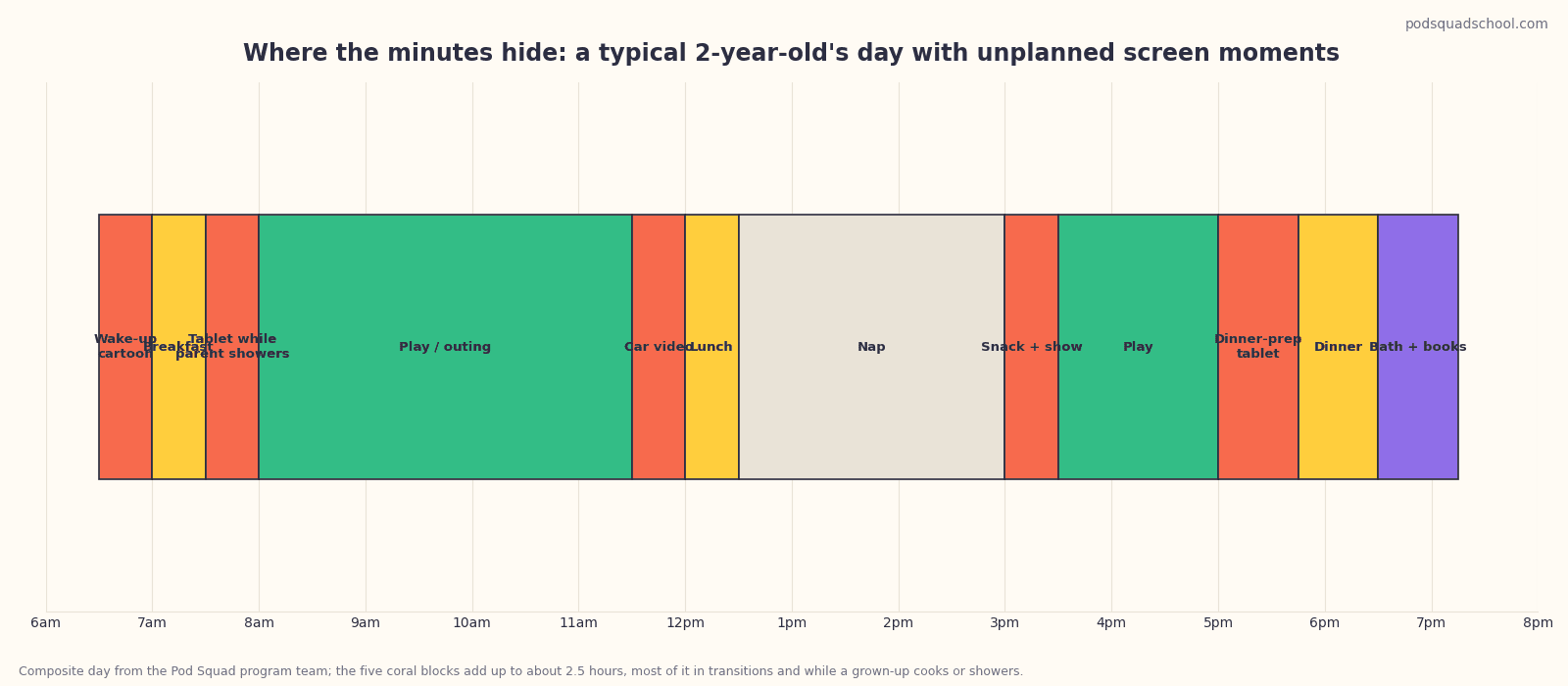
Almost no family decides to give a toddler two hours of screens. It accrues in slices. Twelve minutes at breakfast, twenty in the car, fifteen while dinner cooks, one episode after the bath. The Common Sense Census (Media Use by Kids Zero to Eight) has found average daily screen media use for 2- to 4-year-olds in the neighborhood of two and a half hours, and almost all of it arrives in those slices.
For three days, write down every time a screen turns on for your kid: the time, the reason, and the minutes. Do not change anything yet. Most families find their minutes hide in some subset of these twelve moments.
| # | Moment | Why the screen appears | Swap at 18 to 24 months | Swap at 2 to 3 | Swap at 3 to 4 |
|---|---|---|---|---|---|
| 1 | Breakfast | You need 10 minutes to pack lunches | Muffin-tin breakfast, one food per cup, kid feeds self | A "spread your own" job with a butter knife and cream cheese | Kid makes their own bowl from three set-out containers |
| 2 | The car | Fussing in the seat | A basket of two board books and a soft toy clipped to the seat | Window "I Spy" with three colors | A story-CD or audiobook plus a magnetic drawing board |
| 3 | Waiting rooms | Public meltdown fear | Snack cup and a small board book | A sticker sheet and a paper | "Count the chairs" and a tiny notebook with a crayon |
| 4 | Dinner prep | You need two hands | High-chair pulled to the counter, spinning salad greens | Tearing lettuce, stirring a cold bowl at the table | Peeling a hard-boiled egg, setting the table with a picture map |
| 5 | The 5 pm melt | Everyone is tired | Warm bath early, then books | Water play at the sink with an adult within arm's reach | A "quiet basket" with a puzzle and a flashlight |
| 6 | Restaurants | Sitting still is hard | Sit on a lap, one board book, ask for bread first | Tape a placemat, roll a crayon, play "hide the sugar packet" | A restaurant kit: tiny notebook, three crayons, four animals |
| 7 | Sick days | Nobody has energy | Rotate three baskets you never see otherwise | A nest on the couch, audiobooks, sticker books | A "hospital" for stuffed animals with real bandages |
| 8 | Early morning | You want 20 more minutes | Delay: a bin of books beside your bed | A "morning basket" opened only before breakfast | An audio player with a play button the kid controls |
| 9 | Sibling nap | Older kid needs to be quiet | Not applicable yet | Play-dough at the table, taste-safe recipe | Quiet time in their room, 15 minutes with a timer |
| 10 | Errands | The cart, the line | Hold the list; name items as you pass | "Find the red thing" in each aisle | The kid holds a picture list and checks items off |
| 11 | The potty | Getting them to sit | Not applicable yet | A potty-only board book kept on the tank | A three-song playlist on your phone, phone face-down |
| 12 | Bedtime | Winding down | Books, songs, low light; no screen at all | The same, with a "two books and one song" rule | The same, plus a 10-minute talk about the day |
Two rules for reading the table. First, the swap must be set out before the moment arrives, not after the kid is already asking. The muffin tin is on the table before the kid sits down; the car basket is clipped in before you buckle. Second, the swap only has to hold for the length of the moment. Dinner prep is 20 minutes, not 60. You need a 20-minute swap, and a 2-year-old may need two of them.
50 screen-free swaps that actually hold a toddler's attention
Each swap below tells you what to set out, one sentence to say, how many minutes it realistically holds, and an age note. The minutes are for a kid who has done the activity once or twice before; the first time is always shorter. Safety rules repeat on purpose: anything smaller than a toilet-paper tube stays out of reach of kids who still mouth objects; everything a kid under 3 handles should be taste-safe; an adult stays within arm's length of any water deeper than a puddle.
In the car (8)
- The seat basket. Set out: a shallow basket zip-tied to the back of the front seat with two board books, one soft animal, and one chunky vehicle. Say: "Your car library is open." Holds 5 to 10 minutes. Age note: swap the books weekly; at 18 months a single new book is the whole activity.
- Window colors. Set out: nothing. Say: "I spy something red. Can you find red?" Holds 5 minutes at 2, 10 at 3. Age note: at 3 and up, let the kid be the spy.
- The song bag. Set out: a small bag with five picture cards (a bus, a spider, a star, a monkey, a duck), each standing for a song. Say: "Pick a card and we sing it." Holds 10 to 15 minutes. Age note: at 2 you pick; at 3 they pick and start it.
- Magnetic drawing board. Set out: a board with the pen tied on. Say: "Draw me a road." Holds 10 minutes at 3, 15 at 4. Age note: keep it in the car only so it stays novel.
- Audiobook or story podcast. Set out: a downloaded story on your phone, phone face-down in the cupholder. Say: "Listen for the part where the bear sneezes." Holds 15 to 25 minutes at 3 and 4. Age note: under 3, songs work better than long stories.
- The pipe-cleaner bracelet. Set out: three pipe cleaners with the ends folded over (ages 3 and up only; a supervised choking check every time). Say: "Make a bracelet for Grandma." Holds 10 minutes. Age note: skip under 3.
- Silly counting. Set out: nothing. Say: "How many trucks before the next light?" Holds 5 to 8 minutes. Age note: at 2 you count out loud; at 4 they keep a tally on paper.
- The sticky-note map. Set out: a pad of sticky notes; you stick one on the window for each turn. Say: "Every time we turn, add a note." Holds 10 minutes at 3 and 4. Age note: it teaches sequence; at 4 they can predict the next turn.
Waiting rooms (7)
- The one-sticker-sheet rule. Set out: one sheet of dot stickers and a plain paper. Say: "Cover the whole paper." Holds 10 minutes at 2, 15 at 3. Age note: dot stickers are big enough to be safe at 2; watch for mouthing at 18 months.
- Count the chairs. Set out: nothing. Say: "Let's count every blue chair." Holds 5 minutes. Age note: at 3 add "and how many people are wearing hats."
- The tiny notebook. Set out: a pocket notebook and one crayon kept in your bag only for waiting. Say: "Draw the fish tank." Holds 10 minutes at 3, 15 at 4. Age note: at 2 the crayon is the activity; expect scribbles and enjoy them.
- The zipper pouch. Set out: a pouch with three zippers, a key ring, and a small flashlight. Say: "Find what is hiding inside." Holds 5 to 10 minutes at 2. Age note: nothing inside smaller than a toilet-paper tube.
- Snack with a job. Set out: a snack cup with a lid the kid must open. Say: "You open it." Holds 5 to 8 minutes. Age note: no whole grapes, nuts, or popcorn under 4; cut grapes lengthwise into quarters, per AAP choking guidance.
- The waiting-room walk. Set out: nothing. Say: "Let's walk to the plant and back three times." Holds 5 minutes and burns energy. Age note: at 18 months, hold hands and count steps.
- Peekaboo book. Set out: a lift-the-flap board book kept in the diaper bag only. Say: "Who is under the flap?" Holds 5 to 10 minutes at 18 to 30 months. Age note: rotate it out once they know every flap.
Dinner prep (8)
- The salad spinner. Set out: washed lettuce in a spinner, the kid at a learning tower or a high chair pulled to the counter. Say: "Spin it dry." Holds 5 minutes. Age note: safe at 18 months with you beside them.
- Tearing greens. Set out: a big bowl and a pile of lettuce or herbs. Say: "Tear it small, like this." Holds 5 to 10 minutes. Age note: at 3 add "put the stems in this bowl."
- Cold stirring. Set out: a bowl of yogurt and a spoon, or dry oats and a scoop, at the kid's own table. Say: "Stir until I say stop." Holds 5 minutes at 2, 10 at 3. Age note: taste-safe under 3, so keep raw egg and raw flour out of the kid's bowl.
- The peel job. Set out: a hard-boiled egg or a clementine. Say: "Peel the whole thing." Holds 8 to 12 minutes at 3 and 4. Age note: a real fine-motor workout; cut the egg into quarters before it is eaten by a kid under 4.
- Set the table with a map. Set out: a paper placemat with a plate, cup, fork outline drawn on it. Say: "Match the real ones to the drawing." Holds 5 to 10 minutes. Age note: at 2 do one item; at 4 they set for the whole family.
- Sink water play. Set out: a stool, an inch of water, two cups, a whisk. Say: "Wash these for me." Holds 10 to 15 minutes at 2 and 3. Age note: an adult within arm's length of any water, every time.
- The kitchen drawer. Set out: one low drawer of kid-safe tools (wooden spoons, silicone spatulas, measuring cups, a small pot). Say: "That is your drawer." Holds 10 minutes at 18 to 30 months. Age note: nothing sharp, nothing glass, nothing smaller than a toilet-paper tube.
- Dried-bean scooping. Set out: a tray with a cup of dried chickpeas, a scoop, and two bowls (ages 3 and up, and only with you in the room; beans are a choking risk). Say: "Fill the small bowl." Holds 10 to 15 minutes. Age note: under 3, use large pasta shapes or oats instead. More setups like this are in sensory bin ideas that hold attention.
Sick days (7)
- The nest. Set out: couch cushions on the floor, a blanket, three books, a water bottle. Say: "This is your nest today." Holds 15 to 20 minutes with an audiobook. Age note: at 2, sit in the nest with them for the first 5 minutes.
- Stuffed-animal hospital. Set out: real adhesive bandages, a kitchen towel, a toy thermometer, four stuffed animals. Say: "Bear needs a checkup." Holds 15 minutes at 3, 30 at 4. Age note: bandages are small; supervise under 3.
- The rotation baskets. Set out: three shoebox baskets you keep in a closet and only bring out on sick days (a puzzle, a lacing card, a set of stacking cups). Say: "Sick-day basket number one." Holds 10 minutes each. Age note: at 2 one basket at a time.
- Sticker-book stories. Set out: a reusable sticker book and a flat surface. Say: "Tell me who lives in this house." Holds 10 to 20 minutes at 3 and 4. Age note: under 3, big dot stickers on a paper instead.
- Ice-cube rescue. Set out: a small tray of ice, a spoon, a bowl of warm water, a towel underneath. Say: "Melt the ice and rescue the toy inside." Holds 10 minutes. Age note: freeze a large toy (bigger than a toilet-paper tube) inside; adult within arm's length.
- Audio stories in the dark. Set out: a flashlight, a story on your phone (face-down), the lights off. Say: "Light the ceiling while we listen." Holds 15 minutes at 3 and 4. Age note: at 2 keep it to one song and one book.
- Bath in the afternoon. Set out: a warm bath with two cups and a whisk. Say: "Make the biggest bubbles." Holds 15 to 20 minutes. Age note: never step out of arm's reach, fever or not.
Restaurants (6)
- Order bread first. Set out: nothing; you ask the server for something the kid can eat within two minutes of sitting. Say: "Bread is coming." Holds the first 5 minutes, which are the hardest. Age note: cut everything into strips at 18 months.
- The restaurant kit. Set out: a zip pouch that lives in your bag and only comes out at restaurants: a tiny notebook, three crayons, four small animals (bigger than a toilet-paper tube for under 3). Say: "The zoo is open." Holds 10 to 15 minutes at 2, 20 at 4.
- Sugar-packet hide. Set out: three cups upside down and one sugar packet. Say: "Which cup is it under?" Holds 5 to 10 minutes at 2 and 3. Age note: the packet stays in your hand between rounds for kids who mouth things.
- Straw-wrapper worm. Set out: a paper straw wrapper scrunched up, a drop of water. Say: "Watch the worm grow." Holds 3 to 5 minutes, and it is magic at 3.
- Menu I Spy. Set out: a kids' menu or a paper placemat. Say: "Find something round." Holds 5 to 8 minutes. Age note: at 4, "find the letter your name starts with."
- The walk between courses. Set out: nothing. Say: "Let's go look at the fish tank and come back." Holds 5 minutes and resets everyone. Age note: one grown-up walks, the other stays.
Early mornings (7)
- The bedside book bin. Set out: a bin of six board books beside your bed. Say: "Read in our bed while I wake up." Holds 10 to 15 minutes at 2, longer at 4. Age note: at 18 months, they will read the same book six times; that counts.
- The morning basket. Set out: a basket on a low shelf that is only opened before breakfast: a puzzle, a few animals, a lacing card. Say: "Morning basket is open." Holds 15 minutes at 3, 30 at 4. Age note: change one item every Sunday.
- Kid-controlled audio player. Set out: a screen-free audio player with a big play button (or your phone, face-down, with a playlist ready). Say: "Press the button when you are ready." Holds 15 to 20 minutes at 3 and 4. Age note: at 2, you press it.
- Breakfast prep as play. Set out: a low drawer with the kid's bowl, spoon, and a small pitcher of milk; unsweetened cereal or oats in a container they can open. Say: "Make your breakfast." Holds 10 minutes at 3 and 4. Age note: at 2, they pour the milk with your hand on the pitcher.
- The window seat. Set out: a cushion at a window, a pair of toy binoculars. Say: "Tell me every animal you see." Holds 5 to 10 minutes. Age note: birds and dogs count; so do trucks.
- Coloring at the table. Set out: one page and three crayons, laid out the night before. Say: "Your paper is waiting." Holds 5 minutes at 2, 15 at 4. Age note: at 3 and 4, a simple letter-tracing page works too; see letter tracing worksheets by age.
- The stuffed-animal breakfast. Set out: two animals in chairs at the kid's table with tiny bowls. Say: "Feed your friends." Holds 10 minutes at 2 and 3. Age note: dry oats only; nothing they cannot safely eat themselves.
Siblings (7)
- Big kid, small job. Set out: a spray bottle of water and a cloth for the 4-year-old while the baby nurses. Say: "Wash the chairs." Holds 10 to 15 minutes. Age note: water only, no cleaning products.
- Two trays, same stuff. Set out: two identical trays of play-dough (taste-safe homemade recipe) so nobody fights over the one. Say: "One for each." Holds 15 minutes at 3, 5 to 10 at 2. Age note: play-dough is a choking risk for kids who still mouth; sit at the table with them under 3.
- The reading chain. Set out: a stack of picture books. Say: "Big sister reads to you." Holds 10 minutes at 4 (the reader) and 5 to 10 at 2 (the listener). Age note: "reading" means telling the story from the pictures. That counts.
- Parallel water. Set out: two bins with an inch of water on a towel on the kitchen floor, a cup each. Say: "Pour, but stay on the towel." Holds 10 to 15 minutes. Age note: adult within arm's length of both bins.
- The nap-time quiet basket. Set out: a basket the older kid only gets while the younger one naps: a puzzle, a lacing card, a book with flaps. Say: "Quiet basket until the timer." Holds 15 minutes at 3, 30 at 4. Age note: this is the independent-play training from the next section, in disguise.
- Baby watch. Set out: a blanket on the floor, the baby on it, the toddler beside with a soft rattle. Say: "Show her the rattle." Holds 5 minutes at 2. Age note: nothing small near the baby; you stay right there.
- Build a house for everyone. Set out: a blanket over two chairs and a flashlight. Say: "Make a house where the baby can visit." Holds 15 to 20 minutes at 3 and 4. Age note: the goal is a shared game, not a lecture about sharing.
For a longer list of setups that work on ordinary Tuesday afternoons, see activities for 2-year-olds; the same set-out, say, watch-for structure runs through it.
Independent play and quiet time, trained by age
The single most useful skill for a screen-light household is a toddler who can play alone for a stretch. It is a skill, not a personality trait, and it is trained the same way any skill is: short, frequent, and with a predictable end.
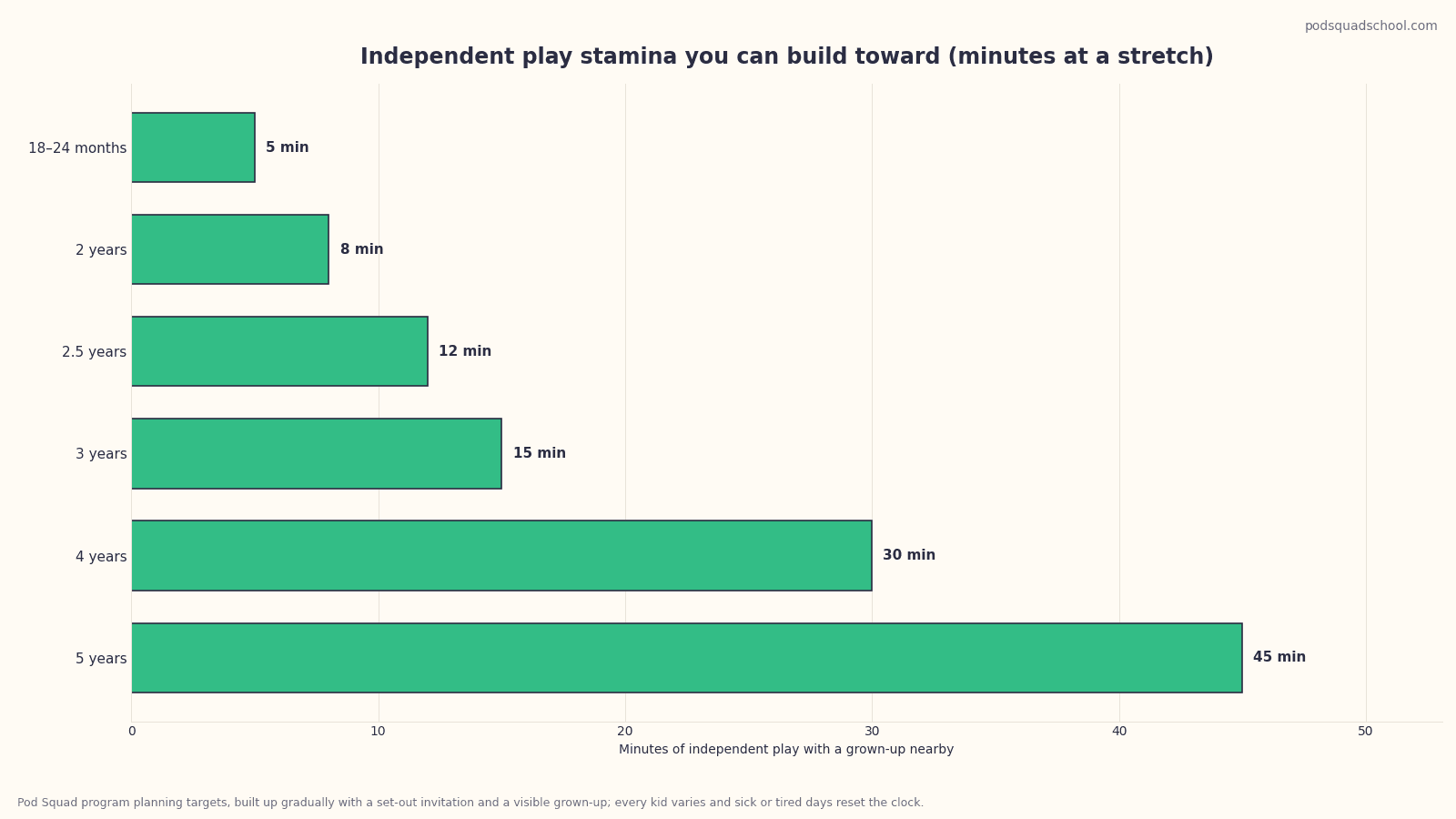
Realistic targets for a kid who has practiced:
| Age | Independent play target | Quiet-time target (in own room, awake) | What makes it work |
|---|---|---|---|
| 18 to 24 months | 2 to 5 minutes in sight of you | Not yet | You in the room, narrating from a distance |
| 2 to 3 years | 5 to 10 minutes | 10 minutes, door open | A set-out invitation and a visible timer |
| 3 to 4 years | 15 to 20 minutes | 15 to 20 minutes | A quiet basket that only appears then |
| 4 to 5 years | 30 minutes or more | 30 to 45 minutes | Books on tape, a project they chose |
How to train it, step by step
- Pick the same time every day. After breakfast and after the afternoon nap are the two easiest slots.
- Set out one invitation, not five. A basket of blocks and a picture of something to build. A puzzle. Three animals and a shoebox.
- Say the same sentence: "This is your play time. I am going to be right there doing my job. The timer will tell us when it is done." Use a visual timer or your kitchen timer.
- Start at the low end of the target: 3 minutes at 2, 10 at 3, 20 at 4. Add 2 minutes every few days if it went fine.
- Stay visible but busy. Fold laundry. Do not watch them; watched play is performance, not play.
- When they come to you, redirect once with a question about the materials ("Which block goes on top?") and go back to your job.
- When the timer rings, go to them before they come to you, and name one thing you saw them do. Not praise; description. "You made the tower as tall as the chair."
- Never extend it past the timer because it is going well. The timer ending on time is what makes the next day work.
Quiet time is the same skill with the door mostly closed, for kids who have dropped the nap. It replaces the nap slot. A 3-year-old gets a basket that lives on a high shelf and only comes down at quiet time; a 4-year-old chooses two items for the basket the night before. The first week is loud. By week three it is often the calmest 30 minutes of your day.
The guided-play structure behind all of this (the grown-up sets out and steps back; the kid keeps the choices) is explained in play-based learning, explained.
Co-viewing well
If your kid is going to watch something, the AAP's word is "co-view." Here is what that looks like in a real living room, not a study.
- Choose the show before the kid asks. Decide on Sunday what this week's one or two shows are. Slow pace, a real story, characters who talk to the viewer, no autoplay. Turn autoplay off in every app you use.
- Sit for at least the first five minutes. You do not have to watch the whole thing. The first five minutes set the tone, and it is where you plant the language.
- Narrate and connect. "That is a fire truck. We saw one at the station on Thursday." "She looks sad. Why do you think she is sad?" At 18 to 24 months, just label. At 3 and 4, ask one question per scene, not five.
- Pause on purpose. Pausing is the co-viewing superpower. "Wait, what do you think happens next?" Kids who have been paused on learn that a screen is something you can control, not something that controls you.
- Close the loop in the real world. If the show was about a garden, dig in dirt that afternoon. If it was about counting, count the stairs. The research on language and screens keeps pointing at the same thing: it is the conversation around the screen that helps, not the screen.
- End before the credits. Turn it off during the last song, not after autoplay starts the next episode. Say the same sentence every time: "Show is over, the tablet sleeps." Then hand them the next set-out thing.
The grown-up phone
This is the part most screen-time articles skip because it is uncomfortable. Toddlers learn what to do with a gap in the day by watching what you do with a gap in the day. If you fill the two minutes in the checkout line by pulling out your phone, they learn that phones are what people do when they are waiting. If your face is lit up by a screen during breakfast, "no screens at meals" is a rule for them and not for us, and a 3-year-old will notice.
Some concrete moves that do not require quitting your phone:
- Face-down is a rule for everyone. At the table, the phone is face-down or in another room. Say it out loud the first few times: "My phone is sleeping too."
- Name what you are doing. Toddlers cannot tell the difference between you texting a friend and you looking up the pediatrician's number. Narrate: "I am checking what time the library opens. Done." Then put it away.
- Give the phone a home. A basket by the door where phones go at 5 pm and stay until bedtime routines are done. It takes about a week to feel normal.
- Use the phone as a tool in front of them, not as an escape. Timer, playlist, grocery list, a photo of the tower they built. These are fine and they teach something true: a phone is a tool you pick up on purpose and put down when the job is done.
Pod Squad is built around this exact line. The app lives on your phone and the kid never touches it. It taps you on the shoulder the night before with what to set out, runs the Block Timer while your kid builds, and lets you log a win with one photo. The kid gets the basket, the block, and you. There is nothing in it for a toddler to look at, on purpose.
Honest exceptions
Rules that never bend break families instead of screens. Here is where a screen is a reasonable call, and how to keep it from becoming the new default.
- Flights and long drives. A tablet on a five-hour flight is a tool, not a failure. Download shows in advance, use headphones sized for kids, and put the tablet away for the first hour and the descent so it is not the only thing that happened. The AAP itself names travel as an understandable exception.
- Illness. A feverish 3-year-old on the couch with a movie is having a normal sick day. What matters is that the default returns when the fever does. Say it on the first day: "Sick-day movies are for sick days."
- A parent who needs 20 minutes. Sometimes you need to make a call, shower, or sit in silence, and there is no other adult. One 20-minute show at a fixed time, chosen in advance, with the tablet going back to its shelf afterward, is a plan. It is the unplanned, open-ended version that becomes two hours.
- Video calls. Grandparents, a deployed parent, a cousin across the country. These are interactive, social, and explicitly approved by the AAP for every age. Sit with your toddler and help them show the camera their block tower.
- A medical procedure. A tablet in the vaccine chair is fine. Nurses hand them out for a reason.
A worked week: the reset week, day by day
Most families who want to cut screens do it on a Monday morning, all at once, with no plan for 5 pm. By Tuesday night everyone is miserable and the tablet is back. A reset week goes in a fixed order, from the easiest moment to cut to the hardest, and it tells the kid the rule the night before each change. Here is a plan for a 2- to 4-year-old with about two hours a day of screens spread across breakfast, the car, dinner prep, and after the bath.
Before Monday (Sunday night, 20 minutes). Fill out the AAP Family Media Plan at healthychildren.org (search for the Family Media Plan) as a household. Build three baskets: a morning basket, a dinner-prep basket (spinner, cold-stir bowl, placemat map), and a quiet basket. Put the tablet in a drawer, charger and all. Pick this week's one show and turn off autoplay. Tell your kid at bedtime: "Tomorrow the tablet sleeps in the drawer at night, and we read three books instead of a show after bath."
Monday: bedtime goes screen-free. This is the easiest cut and the one with the clearest payoff. Bath, then three books on the bed, then one song, lights out. Expect one ask; answer with the same sentence: "The tablet is sleeping. Which book first?" Everything else stays as it was. Minutes saved: about 25. Bonus: most kids fall asleep faster within three nights.
Tuesday: meals go screen-free. Breakfast becomes a muffin-tin breakfast the kid feeds themselves from; dinner is at the table with phones face-down in the basket by the door. At breakfast, set out the tin before they sit. Say: "Breakfast is for eating and talking. Tell me one thing you dream about." Expect protest; it is the first meal in a while without a show. Tuesday is often the hardest day. Keep the car and dinner prep as they were. Minutes saved so far: about 45.
Wednesday: dinner prep gets a job. Pull the learning tower or a chair to the counter. Give the salad-spinner or lettuce-tearing job at 2, the peel job at 3, table-setting with the placemat map at 4. Set a timer for 15 minutes; when it rings, the kid moves to the dinner-prep basket at their own table for the second stretch. Say: "You are my sous-chef. When the timer rings, basket time." Wednesday is the other hard day, because dinner prep is when you are most tired. Hold the line one night and it gets easier. Minutes saved so far: about 65.
Thursday: an adventure, and independent play starts. Get out of the house in the morning: a park, a library story time, a fire station open house. Tired kids fight less at 5 pm. In the afternoon, run the first independent-play session: 3 minutes at 2, 10 at 3, 20 at 4, with a timer, one invitation, and you visible and busy. Tell them at the start how the timer works. Log what happened.
Friday: the car. The last moment to cut, because the car is where you are least able to help. Clip in the seat basket, load one audiobook or the song bag, and say before buckling: "Car library is open. The tablet is at home." Short trips only today if you can arrange it. Minutes saved so far: essentially the whole two hours.
Saturday: reintroduce, on purpose. If your target is zero, skip this and go outside. If your target is one hour a day on some days, this is the day to bring back a single co-viewed show at a fixed time (say, 4 pm), sitting together for the first five minutes, ending during the last song, with the next thing set out. This teaches the kid that the show has a home in the day and that it ends.
Sunday: review and refill. Look at what worked. Swap one item in each basket. Do the Family Media Plan again if the week changed your mind about anything. Tell your kid what next week looks like. The asking often slows by day seven, not because the kid gave up but because the day has other things in it.
If you are homeschooling and running a longer day at home, the same order works; add the quiet-time slot after lunch on Monday so you get your own 20 minutes back early in the week. If your kid is in daycare or preschool, the weekday moments you control are breakfast, the car, dinner prep, and bedtime; that is enough.
Where Pod Squad fits, stated plainly
Pod Squad is a paid membership ($99 a month for the first kid after 7 free days, siblings 50% off), and you can do everything in this article without it. If you want to try the structure first, the free sample includes a Week 1 worksheet and a Wonder Lab card you can print today.
What the membership actually does for a screen-light family is the boring part that is hard to sustain alone: it decides what goes in the basket. Every day in the Toddler Squad program has blocks that say what to set out, what to say, what to watch for, and what to do when it falls apart, with notes for your kid's exact age. Week 3 "Wheels & Roads" gives you a car-themed week of activities, a Squad Job (Pit Stop Crew), a Wonder Lab, a Letter of the Week, and a Thursday adventure at a real place near you. The reminders arrive on your phone the night before and the morning of, so the plan is ready before the tablet usually appears. The Block Timer runs the activity start to finish so the ending is predictable.
The app is for grown-ups only. Your kid never holds it, never taps it, never watches anything on it. That is a design decision, not a limitation, and it is why we are comfortable writing an article like this one. If a screen-free program for your kid sounds right, you can start free in a couple of minutes. Get the app (iPhone and Android), or use any browser.
If your budget is tight, a library card, three shoeboxes, and the 50 swaps above will carry you a long way. That is the honest answer.
Mistakes that cost the most
- Cutting everything on a Monday with no swap ready. The fix: the reset-week order above, one moment per day, baskets built on Sunday night.
- Asking the kid to hand over the tablet. A 2-year-old cannot do this reliably and the "no" becomes the fight. The fix: you take it, with the same two-minute warning and the same sentence, every time.
- Treating the one-hour ceiling as a daily goal. The AAP's hour is a limit for 2- to 5-year-olds, not a prescription. The fix: aim lower on ordinary days and let the hour be for Saturday movie afternoons and sick days.
- Leaving the TV on in the background. The kid is not watching, but the talk in the room drops. The fix: the AAP's "turn off devices when not in use" rule, applied to the news, the game, and your show while the kid is awake.
- Using the screen as the only calm-down tool. This is the finding from the 2023 device-for-calming study, and it is the one most likely to cost you at age 4. The fix: two other tools practiced when nobody is upset (a hug and a count to ten, a walk to the window), so they are available when someone is.
- Making the grown-up phone exempt. The fix: face-down at meals, a phone basket at 5 pm, and narration ("I am checking the weather, done") when you do pick it up.
- Skipping the co-view because you are tired. The five minutes at the start are the part that helps language. The fix: sit for five minutes, plant two connections to real life, then go make dinner.
- Believing a good week means the fight is over. Illness, travel, and a new sibling all bring the screen back. The fix: name the exception out loud when it starts and re-run Monday through Wednesday of the reset week when it ends.
Who this is for, and who it is not for
This is for you if your kid is somewhere between about 1 and 5 and screens have crept into two or more of the twelve moments in the audit. It is for the parent who wants a number to aim at and a plan for 5 pm. It is for daycare families who only control the edges of the day, for stay-at-home parents who need a real quiet-time routine, and for homeschooling families who want the whole day to run without a tablet. It is also for the parent who wants to keep one show a day and do it well.
This is not for you if your pediatrician or a therapist has given you a specific plan for your kid (for example, a speech or occupational therapy program that uses a device on purpose); follow that plan. It is not a substitute for an evaluation if you are worried about language, hearing, sleep, or attention. Your pediatrician knows your kid, and the CDC milestone checklists are a good way to organize what you want to ask. It is not for families of older kids; the school-age screen conversation is a different one about homework, games, and social media. And it is not a zero-screens manifesto. If your family runs happily on one co-viewed show a day at 4 pm, you are inside the guidance.
Frequently asked questions
How much screen time is okay for a 2-year-old?
The American Academy of Pediatrics says children ages 2 to 5 should have no more than about 1 hour a day of high-quality programming, watched with a parent who can help them connect it to the real world. The World Health Organization's 2019 guidelines give the same 1-hour ceiling for ages 2 to 4 and add that less is better. Neither number is a goal; both are limits. Both organizations also say no screens during meals, none in the hour before bed, and no screens in the bedroom. Your pediatrician knows your kid and can adjust for your situation.
Is any screen time okay under 18 months?
The AAP recommends avoiding screen media other than video-chatting before 18 months. Video calls with grandparents or a traveling parent are the exception because they are live and interactive; the adult responds to the baby, which makes it closer to a conversation than to a show. The WHO goes further and does not recommend any sedentary screen time for children under 2. If you have already used some screens before 18 months, that is not a catastrophe; the research is about patterns over years, not single days. Start with the bedtime and meal rules and go from there.
Does screen time cause speech delay?
The evidence shows an association, not proof of cause. A 2020 meta-analysis of 42 studies found that more screen time was linked to lower language scores, while co-viewing and higher-quality content were linked to stronger ones. The likely mechanism is displacement: video time is time not spent in back-and-forth talk. But families who use more screens can differ in many other ways, and the studies cannot fully separate those. If you have any concern about your child's speech, talk to your pediatrician and ask about a hearing check; do not wait to see if cutting screens fixes it.
Why does my toddler melt down when the tablet goes away?
Three reasons, none of them alarming. Stopping a screen is a transition, and toddlers fight transitions of every kind. The content is designed to be very engaging with very little effort, and a 2-year-old has almost no ability yet to stop something pleasant on purpose. And the screen often replaced the connection they actually wanted, so losing it feels like losing twice. What helps: a two-minute warning that names what comes next, you physically taking the device rather than asking for it, and the next activity already set out where they can see it.
What are the best screen-free quiet time activities for a 3-year-old?
A quiet basket that only appears at quiet time is the engine: a puzzle, a lacing card, a lift-the-flap book, a magnetic drawing board, and a set of animals with a shoebox. Add an audiobook or story on a screen-free player. Realistic stamina at 3 is about 15 minutes to start, built up over a few weeks to 20 or 30 with a visual timer. Set out one invitation, say the same sentence every day, stay visible but busy, and end on time even when it is going well. That reliability is what makes tomorrow's quiet time work.
How do I do a screen time reset without a fight?
Go in a fixed order from the easiest moment to cut to the hardest, one per day: bedtime Monday, meals Tuesday, dinner prep Wednesday, an outing plus first independent-play session Thursday, the car Friday. Tell your kid each rule the night before. Have a basket set out for each moment before it arrives. Expect Tuesday and Wednesday to be the hard days. Fill out the AAP Family Media Plan at healthychildren.org (search for the Family Media Plan) as a household on Sunday so the grown-ups are on the same page and the rules apply to your phones too.
Is it okay to use a tablet on a flight or when my kid is sick?
Yes. The AAP names travel and medical procedures as understandable exceptions, and a sick day with a movie is an ordinary part of childhood. What keeps an exception from becoming the new default is naming it out loud when it starts ("Sick-day movies are for sick days") and going back to the usual rhythm when it ends. On a flight, download in advance, use kid-sized headphones, and hold the tablet back for the first hour so it is not the only thing that happened.
Sources & methodology
- American Academy of Pediatrics, Council on Communications and Media. "Media and Young Minds." Pediatrics, 2016;138(5):e20162591. https://doi.org/10.1542/peds.2016-2591
- American Academy of Pediatrics, HealthyChildren.org. "Where We Stand: Screen Time." https://www.healthychildren.org/English/family-life/Media/Pages/default.aspx
- American Academy of Pediatrics, HealthyChildren.org. Family Media Plan. https://www.healthychildren.org/English/fmp/Pages/MediaPlan.aspx
- American Academy of Pediatrics, HealthyChildren.org. "Choking Prevention." https://www.healthychildren.org/English/health-issues/injuries-emergencies/Pages/Choking-Prevention.aspx
- World Health Organization. "Guidelines on physical activity, sedentary behaviour and sleep for children under 5 years of age." 2019. https://www.who.int/publications/i/item/9789241550536
- Madigan S, et al. "Association Between Screen Time and Children's Performance on a Developmental Screening Test." JAMA Pediatrics, 2019. https://doi.org/10.1001/jamapediatrics.2018.5056
- Madigan S, et al. "Associations Between Screen Use and Child Language Skills: A Systematic Review and Meta-analysis." JAMA Pediatrics, 2020. https://doi.org/10.1001/jamapediatrics.2020.0327
- Radesky JS, et al. "Longitudinal Associations Between Use of Mobile Devices for Calming and Emotional Reactivity and Executive Functioning in Children Aged 3 to 5 Years." JAMA Pediatrics, 2023. https://doi.org/10.1001/jamapediatrics.2022.4793
- Harvard University, Center on the Developing Child. "Serve and Return." https://developingchild.harvard.edu/science/key-concepts/serve-and-return/
- Centers for Disease Control and Prevention. "CDC's Developmental Milestones." https://www.cdc.gov/ncbddd/actearly/milestones/index.html
- Common Sense Media. "The Common Sense Census: Media Use by Kids Age Zero to Eight." https://www.commonsensemedia.org/research
- National Association for the Education of Young Children. Position statements and resources on developmentally appropriate practice. https://www.naeyc.org
- Search demand: DataForSEO Labs, Google US, September 10, 2026; volumes for many child-related keywords are suppressed by Google Ads and are shown as clickstream estimates where labeled.
- Method note: the 12-moment audit, the 50 swaps, the stamina targets, and the reset-week order are drawn from the Pod Squad Toddler Squad program and from families running it, not from a controlled study. The minutes are realistic ranges for a kid who has tried the activity once or twice, not norms. Research findings above are described as associations; none of them establishes cause.
Bottom line
The guidance is short. Avoid screens other than video calls under 18 months. If you introduce them between 18 and 24 months, watch together. From 2 to 5, treat 1 hour a day as a ceiling, co-view when you can, and keep meals, the hour before bed, and bedrooms screen-free. The research behind those numbers shows real associations with language, sleep, and self-regulation, and it also has real limits; it is a reason for care, not for guilt.
The work is not in the number. It is in the twelve moments where the tablet shows up and in having a basket, a sentence, and a realistic count of minutes ready for each one. Run the reset week in order, train independent play by age, put your own phone face-down, and expect Tuesday to be hard. You already know your kid; that is the hard part.
If you want the baskets decided for you, sized to your kid's exact age, with reminders that land on your phone at the exact moments the screen used to appear, start free.
Keep exploring
- Activities for 2-year-olds: set out, say, watch for
- Sensory bin ideas that hold attention (and the safety rules for each)
- Play-based learning, explained for parents
- Things to do with kids this weekend, near you
- How Pod Squad works, and how Homie personalizes it to your kid
- Pod Squad pricing, stated plainly
Questions parents ask
How much screen time is okay for a 2-year-old?
The American Academy of Pediatrics says children ages 2 to 5 should have no more than about 1 hour a day of high-quality programming, watched with a parent who can help them connect it to the real world. The World Health Organization's 2019 guidelines give the same 1-hour ceiling for ages 2 to 4 and add that less is better. Neither number is a goal; both are limits. Both organizations also say no screens during meals, none in the hour before bed, and no screens in the bedroom. Your pediatrician knows your kid and can adjust for your situation.
Is any screen time okay under 18 months?
The AAP recommends avoiding screen media other than video-chatting before 18 months. Video calls with grandparents or a traveling parent are the exception because they are live and interactive; the adult responds to the baby, which makes it closer to a conversation than to a show. The WHO goes further and does not recommend any sedentary screen time for children under 2. If you have already used some screens before 18 months, that is not a catastrophe; the research is about patterns over years, not single days. Start with the bedtime and meal rules and go from there.
Does screen time cause speech delay?
The evidence shows an association, not proof of cause. A 2020 meta-analysis of 42 studies found that more screen time was linked to lower language scores, while co-viewing and higher-quality content were linked to stronger ones. The likely mechanism is displacement: video time is time not spent in back-and-forth talk. But families who use more screens can differ in many other ways, and the studies cannot fully separate those. If you have any concern about your child's speech, talk to your pediatrician and ask about a hearing check; do not wait to see if cutting screens fixes it.
Why does my toddler melt down when the tablet goes away?
Three reasons, none of them alarming. Stopping a screen is a transition, and toddlers fight transitions of every kind. The content is designed to be very engaging with very little effort, and a 2-year-old has almost no ability yet to stop something pleasant on purpose. And the screen often replaced the connection they actually wanted, so losing it feels like losing twice. What helps: a two-minute warning that names what comes next, you physically taking the device rather than asking for it, and the next activity already set out where they can see it.
What are the best screen-free quiet time activities for a 3-year-old?
A quiet basket that only appears at quiet time is the engine: a puzzle, a lacing card, a lift-the-flap book, a magnetic drawing board, and a set of animals with a shoebox. Add an audiobook or story on a screen-free player. Realistic stamina at 3 is about 15 minutes to start, built up over a few weeks to 20 or 30 with a visual timer. Set out one invitation, say the same sentence every day, stay visible but busy, and end on time even when it is going well. That reliability is what makes tomorrow's quiet time work.
How do I do a screen time reset without a fight?
Go in a fixed order from the easiest moment to cut to the hardest, one per day: bedtime Monday, meals Tuesday, dinner prep Wednesday, an outing plus first independent-play session Thursday, the car Friday. Tell your kid each rule the night before. Have a basket set out for each moment before it arrives. Expect Tuesday and Wednesday to be the hard days. Fill out the AAP Family Media Plan at healthychildren.org (search for the Family Media Plan) as a household on Sunday so the grown-ups are on the same page and the rules apply to your phones too.
Is it okay to use a tablet on a flight or when my kid is sick?
Yes. The AAP names travel and medical procedures as understandable exceptions, and a sick day with a movie is an ordinary part of childhood. What keeps an exception from becoming the new default is naming it out loud when it starts ("Sick-day movies are for sick days") and going back to the usual rhythm when it ends. On a flight, download in advance, use kid-sized headphones, and hold the tablet back for the first hour so it is not the only thing that happened.
Written by
Pod Squad Program Team
Curriculum & play · Pod Squad. We write the daily plan families run, so every post is built from what actually works with a real kid on a real Tuesday.
Keep reading
Development
Play-Based Learning: What the Research Says, and How to Run It at Home in 20 Minutes a Day
45 min read
Activities
Activities for 2 Year Olds: 62 Ideas by Age, Room, and Moment (From a Program That Plans Them Daily)
43 min read

Out & About
Things to Do With Kids This Weekend: The Parent's Playbook for Parks, Museums, Libraries, and Free Days Out (By Age)
43 min read