
Development
Play-Based Learning: What the Research Says, and How to Run It at Home in 20 Minutes a Day
What researchers mean by play-based learning and guided play, summarized honestly, then turned into a home routine: what to say instead of quizzing, 30 invitations by domain with age notes, Montessori basics worth copying, and CDC milestone anchors for 24 and 36 months.
Pod Squad Program TeamSeptember 10, 2026Updated September 28, 2026 45 min read
Key Takeaways
- Play-based learning is a stance, not a product. You set out a few real materials and an invitation; your kid keeps the choices; you talk with them instead of quizzing them. That is the whole method, and it works with a colander and a $6 bag of dried chickpeas.
- The research points to guided play, not free play alone. Studies led by Kathy Hirsh-Pasek and Roberta Golinkoff found that preschoolers learned more when an adult set up the play and then followed the child's lead than when the adult either lectured or stepped back entirely.
- Serve and return is the engine. Harvard's Center on the Developing Child describes the back-and-forth between a young child and a responsive adult as the interaction that builds brain architecture. Every invitation below is a way to get more of those returns into an ordinary Tuesday.
- The American Academy of Pediatrics literally prescribes play. Its 2018 clinical report, The Power of Play, asked pediatricians to write a prescription for play at well visits during the first two years, because play builds executive function and buffers stress.
- Twenty minutes a day is enough to matter. One set-out block after pickup or before dinner, run four or five days a week, beats a two-hour Saturday marathon your kid abandons at minute nine.
- Milestones are anchors, not tests. The CDC checklists tell you what most kids do by 24 and 36 months; use them to choose invitations, not to grade your kid. Your pediatrician knows your kid.
- Play does not replace reading aloud every day, sleep, or a real conversation at dinner. It sits next to them. Anyone who tells you a play kit is all your kid needs is selling a kit.
Play-based learning has become one of those phrases that means everything and nothing. Preschools print it on banners. Toy companies put it on boxes. Meanwhile you are standing in your kitchen at 4:40 p.m. with a 2-year-old who wants to dump the dog's water bowl and a 4-year-old asking for the tablet, wondering what, specifically, you are supposed to do.
This post is the specific version. It explains what researchers actually mean by play-based learning and guided play, summarizes the evidence honestly (including where it is thin), and then gets practical: what to say and what not to say, 30 invitations sorted by developmental domain with what to set out and what to watch for, the Montessori-at-home basics worth copying and the ones worth skipping, CDC milestone anchors for 24 and 36 months, and a worked week for a family whose kids are in preschool or daycare all day.
It is written for parents of kids roughly 18 months to 5 years, whether your kid goes to preschool, daycare, grandma's house, or stays home with you. Nothing here requires homeschooling. If you do homeschool, the same stance runs your whole morning; if you do not, it runs the 20 minutes between the car seat and dinner. Most of it requires things you already own.
What parents are actually searching for (2026)
The search data tells a clear story: parents are not typing "play based learning" very often. They are typing "montessori," "developmental milestones," and "fine motor activities," and they land on play-based content because that is where the useful answers live. Google Ads hides volume for many keywords about young children, so several of these rows use clickstream estimates (labeled).
| Keyword | US searches/mo | Difficulty | What they want |
|---|---|---|---|
| montessori | 74,000 | 48 | A definition, and whether it is worth the money at home or at school |
| developmental milestones | 12,100 | 38 | A checklist by age, usually with a worried parent behind it |
| fine motor activities | 3,600 | 8 | Things to set out today that build hand strength and control |
| play based learning | 1,900 | 22 | What it means, whether it works, how to do it (trend: +53% over 12 months) |
| outdoor preschool | 1,000 | 0 | Nature-based programs near them, or how to copy the idea at home (trend: +39%) |
| montessori activities | 590 | 0 | Specific trays and practical-life tasks by age |
| montessori homeschool | 590 | 5 | Whether Montessori can be a full home curriculum |
| montessori at home | 480 | 11 | Shelves, materials, and a room setup on a normal budget |
| 3 year old milestones | ≈1,628 (clickstream) | 18 | "Is my 3-year-old on track?" |
| forest school | ≈1,577 (clickstream) | 17 | What it is, and whether there is one nearby |
| 2 year old milestones | ≈1,119 (clickstream) | 24 | "Is my 2-year-old on track?" |
| toddler milestones | ≈254 (clickstream) | n/a | A broad checklist across 12 to 36 months |
| montessori toddler activities | ≈254 (clickstream) | n/a | Practical-life and fine motor trays for 18 to 36 months |
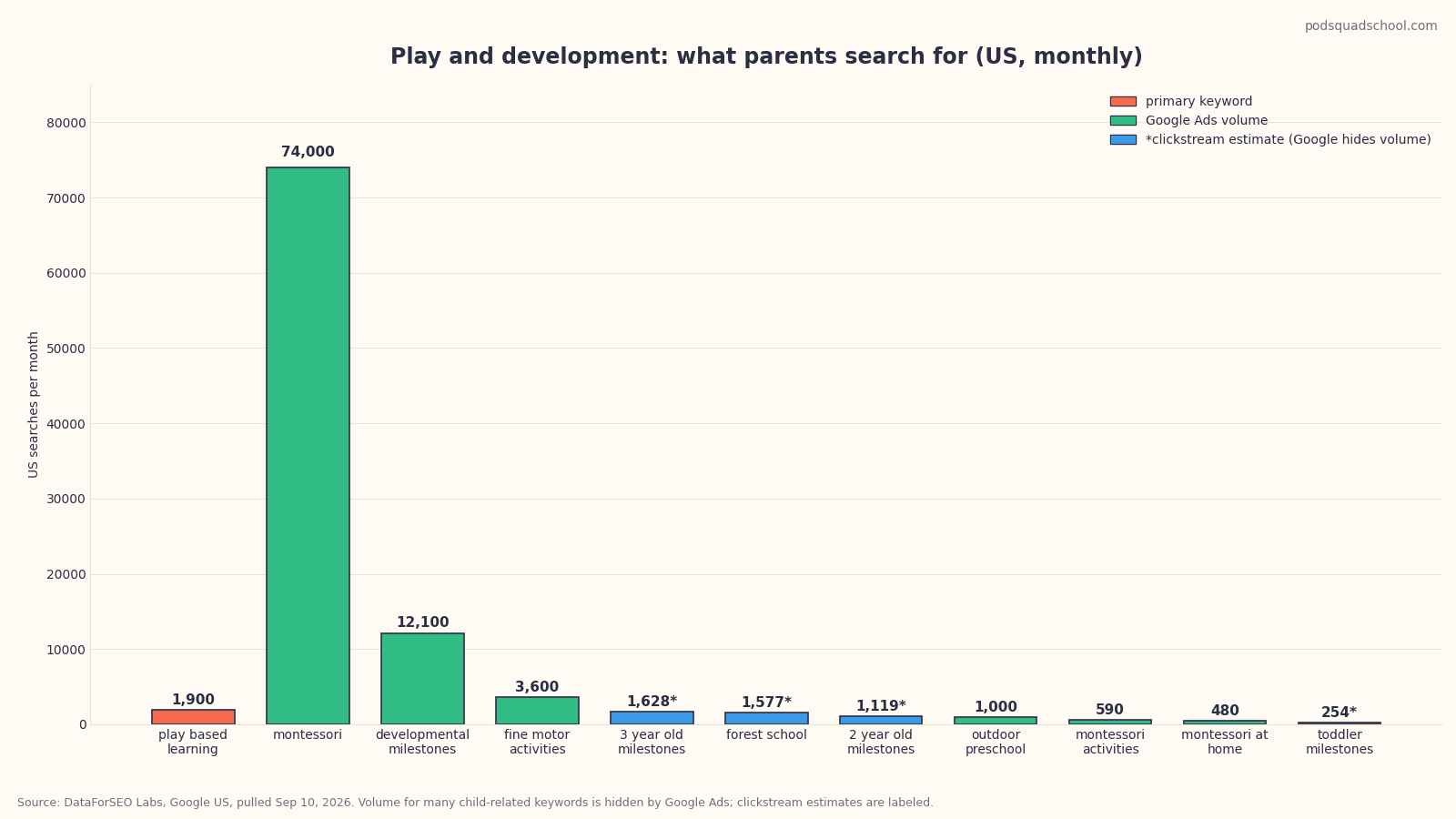
Source: DataForSEO Labs, Google US, pulled September 10, 2026.
Read the intent column and two patterns jump out. First, the biggest numbers are anxious numbers. "Developmental milestones," "2 year old milestones," and "3 year old milestones" together are a parent at 11 p.m. wondering whether a thing they saw at the playground means something. Second, the how-to terms ("fine motor activities," "montessori activities," "montessori at home") have almost no competition (difficulty 0 to 11), which tells you the existing pages are thin: Pinterest roundups with no ages and no explanation of why an activity matters.
The gap is the middle. The research SERP is owned by universities, the Harvard Center on the Developing Child, NAEYC, and the LEGO Foundation, all of whom write for educators. The how-to SERP is owned by Montessori blogs that assume you already bought the shelf. Almost nobody translates the research into a home routine with the guided-play stance, sorted by age, anchored to milestones, and honest about what play does not do. That translation is the rest of this post.
What play-based learning actually means
Four modes on one spectrum
The researchers who study this (a group that includes Jennifer Zosh, Kathy Hirsh-Pasek, Roberta Golinkoff, and David Whitebread, with much of the work published by or with the LEGO Foundation) describe play as a spectrum rather than a single thing. The spectrum is defined by two questions: who starts the activity, and who directs it once it is going.
| Mode | Who initiates | Who directs | What it looks like at home | What it is best for |
|---|---|---|---|---|
| Free play | Child | Child | Your 3-year-old turns the couch cushions into a boat with no help from you | Imagination, self-regulation, working through feelings, long attention stretches |
| Guided play | Adult sets the stage | Child leads; adult narrates, wonders, and extends | You set out a bowl of water, a cork, and a lemon; your kid decides what to drop in; you say "the lemon floated, huh" | Learning a specific idea (shapes, floating, sorting, new words) while the kid stays in charge |
| Games | Adult or the rules | Rules, with the child playing inside them | Simon Says, a matching game, Red Light Green Light | Turn-taking, following rules, impulse control, counting |
| Direct instruction | Adult | Adult | "This is a triangle. Say triangle. How many sides?" | Facts a kid cannot discover on their own, in short doses, after age 4 or so |
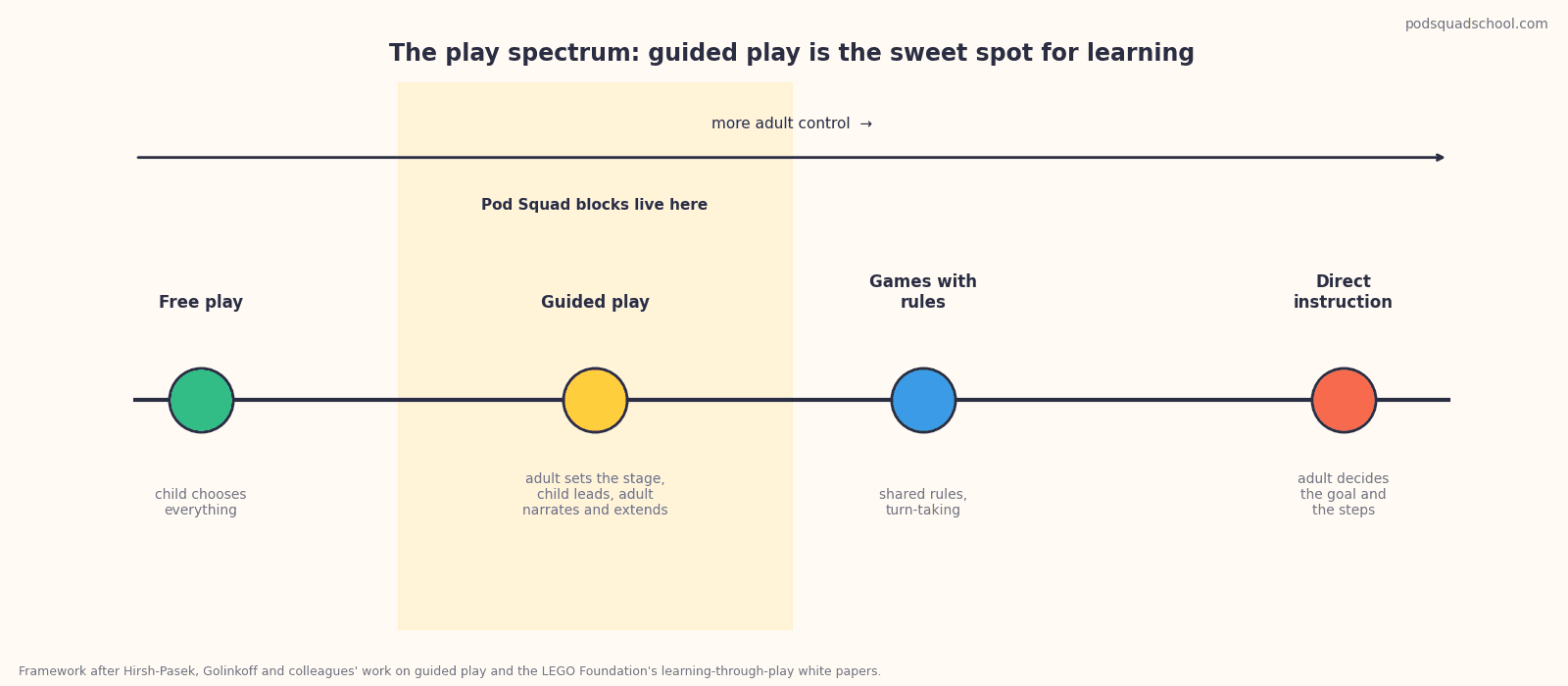
Play-based learning, in the sense this post uses, means most of a young child's learning time lives in the first two lanes, with games mixed in as they get older and direct instruction used sparingly and late. It does not mean the adult disappears. That is the biggest misunderstanding, and the research section below is mostly about why.
The guided-play stance in one sentence
The adult sets the stage, the child leads, and the adult narrates and extends. Set the stage: choose the materials and the invitation ("I put some water and a few things on the tray"). Child leads: they choose what to touch, in what order, for how long. Narrate and extend: describe what you see ("you pushed the cork under and it popped back"), wonder aloud ("I wonder what the rock will do"), and ask one real question you do not already know the answer to ("which one do you think will float?").
Every block in the Pod Squad toddler program is written in that shape: what to set out, what to say, what to watch for, and what to do when it falls apart, with a note for the kid's exact age. If you never use Pod Squad, steal the shape anyway.
What the research says, carefully
This section summarizes the sources most parents will actually run into, and tries to say what each one does and does not show. Where a finding is qualitative here, it is because the effect sizes vary by study and quoting one number would be false precision.
Serve and return (Harvard Center on the Developing Child)
The Center on the Developing Child at Harvard University uses the term serve and return for the back-and-forth between a young child and a responsive adult: the child looks, points, babbles, or hands you something (the serve), and you respond in a way that connects to what they did (the return). The Center's position is that these exchanges are the basic mechanism through which early experience shapes brain architecture, and that their absence over long stretches is a serious stressor.
The Center's five-step guide for parents: notice the serve and share the child's focus; return it with a word, a touch, or a gesture; give it a name; take turns and wait; and practice endings and beginnings. That list is the guided-play stance with different labels. "Give it a name" is narration. "Take turns and wait" is the pause most of us skip. "Practice endings and beginnings" is how you handle the moment your kid walks away from the tray, which is not a failure; it is the end of a serve.
What this research does not say: that you must return every serve, or that you need special materials. It says the returns need to happen, a lot, over years, from someone who cares about the kid.
The AAP's prescription for play (2018)
In 2018 the American Academy of Pediatrics published a clinical report, The Power of Play: A Pediatric Role in Enhancing Development in Young Children (lead author Michael Yogman, in the journal Pediatrics). A clinical report is guidance for pediatricians, and this one recommended that they write a "prescription for play" at well-child visits during the first two years of life.
The argument, summarized: play is not a break from learning; it is how young children build executive function (attention, working memory, flexible thinking, self-control), language, and social skill, and play with a caring adult buffers stress. The authors worried about two trends: the shrinking of recess and free play in favor of academic instruction for very young children, and the displacement of play by screens. They did not claim any particular play curriculum is proven.
If your pediatrician had a prescription pad for this, it would say "20 minutes of unhurried play with a grown-up who follows the kid's lead, daily." The rest of this post is how to fill it.
The LEGO Foundation's five characteristics of learning through play
The LEGO Foundation funded a series of evidence reviews on learning through play, including a 2017 review led by Jennifer Zosh with Hirsh-Pasek, Golinkoff, Whitebread, and others, and a companion review by David Whitebread and colleagues. These summarize a large existing literature rather than reporting one new experiment; the value is the synthesis, and the piece most worth memorizing is that learning through play tends to have five characteristics. It is:
- Joyful. The child enjoys it, including the frustration of a block tower that keeps falling and then the moment it does not.
- Meaningful. It connects to something the child already knows or cares about. Pouring matters to a 2-year-old because grown-ups pour.
- Actively engaging. The child is doing, deciding, and manipulating, not watching or answering.
- Iterative. The child tries, fails, adjusts, and tries again. The ramp gets steeper; the car flies off; the ramp gets flatter.
- Socially interactive. There is another person in it, at least some of the time: a parent, a sibling, a friend in the squad.
Use these five as a diagnostic. When an activity dies in three minutes, one of the five is usually missing. Most often it is "actively engaging" (you were running it) or "meaningful" (it was a worksheet dressed up as play).
Guided play (Hirsh-Pasek, Golinkoff, and Weisberg)
Kathy Hirsh-Pasek (Temple University) and Roberta Golinkoff (University of Delaware), often with Deena Skolnick Weisberg, wrote the papers that gave guided play its name, including a 2013 article in Mind, Brain, and Education and a 2016 review in Current Directions in Psychological Science. Their definition matches the stance above: adults set up an environment with a learning goal in mind, and children direct the play while the adult supports it with comments and questions.
The study parents hear about most is a shapes experiment led by Kelly Fisher with Hirsh-Pasek, Golinkoff, and Nora Newcombe (Child Development, 2013). Four- and five-year-olds learned about geometric shapes with the same materials in one of three conditions: guided play (the adult framed it as discovering each shape's "secrets"), direct instruction (the adult explained the properties), or free play. The guided-play group showed the strongest understanding of what makes a triangle a triangle, including on odd-looking examples that tested whether they had learned the rule rather than memorized pictures, and the advantage held at a later follow-up. Direct instruction came second; free play with no adult framing did least well on that specific goal.
Two cautions. This was one learning goal with preschoolers, not toddlers. And free play losing on a shape test does not make free play worthless; it was never trying to teach shapes. The useful takeaway is narrow: when you want a child to learn a particular idea, setting the stage and then following the child beats lecturing, and it beats leaving the room.
Montessori, stated cautiously
Angeline Lillard (University of Virginia) has spent two decades studying Montessori education. Her book Montessori: The Science Behind the Genius (third edition, 2017) lays out how Montessori's core principles (movement linked to thinking, choice within limits, interest-driven work, learning from peers, order in the environment) line up with later developmental research. In 2017 Lillard and colleagues published a longitudinal study in Frontiers in Psychology following children who won or lost a lottery for seats in public Montessori preschools in Hartford, Connecticut. Over three years, the Montessori children showed higher academic achievement and social understanding on the study's measures, and the gap between lower- and higher-income children narrowed.
The cautions matter. The lottery design is strong, but the study was modest in size and drawn from a few high-fidelity public programs. The Montessori name is not protected, so "Montessori" schools and toys range from rigorous to decorative. A 2023 systematic review from the Campbell Collaboration pooled the available studies and found positive effects on average, while noting that many individual studies were small. And a trained guide in a prepared classroom with a three-hour work period is not a shelf in your living room. The home section below borrows the principles that transfer and leaves the rest.
The honest limits
Three things play does not do. It does not replace reading aloud: the AAP recommends reading with children daily from infancy, and book language (rarer words, longer sentences) is different from the language of play. It does not replace sleep. And the research on play is heaviest for ages 3 to 5 in classrooms; toddler-specific studies are thinner, so what follows for 18 to 36 months leans on the serve-and-return and milestone literature rather than on play trials. When a page says "studies show" a particular toy produces a particular gain in a toddler, be skeptical; those studies mostly do not exist.
What to say, and what not to say
Materials are 20 percent of this. The other 80 percent is your mouth, and the main job of your mouth is to talk with your kid instead of testing them.
Three moves: narrate, wonder, ask one real question
Narrate. Describe what your kid is doing, in a plain sentence, like a sports announcer who likes them. "You put the big one on the bottom." "Both hands. You're squeezing hard." Narration adds vocabulary without demanding a performance, and it tells your kid you are watching.
Wonder aloud. "I wonder what happens if the ramp is steeper." "Hmm, the rock sank." Wondering models curiosity and hands the next move to the kid. You are not asking them to do anything.
Ask one real question. A real question is one you do not know the answer to and actually want to hear. "Which one do you think will float?" "What should the bear eat?" "How did you get it to stay up?" One per block is plenty. Then wait. Count ten seconds in your head before you say anything else; the pause is where the return happens.
The quiz habit, and what to replace it with
| Instead of this (a quiz) | Try this (a return) |
|---|---|
| "What color is this?" | "You picked the blue one again. You like blue today." |
| "How many are there?" | "One, two, three cups. Three." (count for them, no test) |
| "What shape is that?" | "That one has three pointy corners." |
| "Can you say ball?" | "Ball. You threw the ball so far." |
| "Good job." (every 20 seconds) | "You kept trying until the lid came off." |
| "No, not like that." | "That's one way. Here's what I'm going to try." |
| "What sound does a cow make?" | "There's the cow. Moo. What do you think she's doing over there?" |
Nothing terrible happens if you quiz your kid sometimes. But a steady diet of "what color is this" teaches a kid that talking to you is a test, and tests can be failed. Narration teaches them that talking to you is how you figure things out together. By 30 months, a kid who has been narrated to starts narrating themselves ("I doing the big one"), and that self-talk is an early form of the executive function the AAP report describes.
When it falls apart
Every block falls apart eventually. The water gets dumped, the tower is kicked, the 2-year-old starts throwing chickpeas at the dog. Three moves, in order:
- Name it, without a verdict. "You dumped all of it. That was a big splash." You are not approving or disapproving; you are returning the serve.
- Shrink it. Fewer materials, one clear job. Take the bowl away and hand them the towel: "Now we need the floor dry." Cleanup is a real activity, not a punishment.
- End it well. Harvard calls this practicing endings and beginnings. "We're all done with water. Next is the pillow path." A predictable ending phrase, used every time, is worth more than any material you can buy. Kids who know how blocks end are the kids who will start the next one.
30 guided-play invitations by domain
Each invitation lists what to set out, what to say, what to watch for, and an age note. Most take 10 to 20 minutes and cost nothing. Read the safety rules first; they are the same rules every block in the Pod Squad program repeats, because they are the ones that matter.
Safety rules for every invitation below. Anything smaller than a toilet-paper tube stays out of reach of any kid under 3 and any kid who still mouths things; that includes pom-poms, dried beans, small beads, and most "Montessori" bead sets. Sensory materials for under 3 are taste-safe (cooked pasta, oats, cornmeal, homemade dough) or oversized. An adult stays within arm's length of any water deeper than a wet towel, including a mixing bowl. Food used in play is cut the way you would cut it to eat: grapes and cherry tomatoes lengthwise into quarters, no whole nuts, popcorn, or hard candy under 4, per AAP choking guidance.
Language (5)
- The narrated pour. Set out: a small pitcher with an inch of water, two cups, a tray, a towel. Say: "You're tipping it. There it goes." Then wait. Watch for: control of the pour, and whether your kid starts naming what they see ("water," "more," "all gone"). Age: at 18 months, hand over hand with a quarter inch of water; by 3, they fill to a line you draw on the cup with a dry-erase marker.
- Photo talk. Set out: six printed photos of people, pets, and places your kid knows, face down in a stack. Say: "Turn one over. Oh, that's Grandpa. What was he doing?" Watch for: two-word combinations at 24 months ("Papa car"), questions by 36 months ("Where Papa go?"). Age: under 2, you do most of the talking and pause after each photo; 3 and up, they tell the story and you add one detail.
- Sound walk. Set out: nothing. Walk to the mailbox. Say: "Stop. I hear something." Watch for: your kid stopping to listen, then labeling ("truck," "bird") or pointing. Age: 18 to 24 months point and look at you; 3-year-olds start guessing what they cannot see ("that's a airplane").
- Bear's breakfast. Set out: a stuffed animal, a bowl, a spoon, a napkin. Say: "Bear is hungry. What should we tell him?" Watch for: pretend feeding, sequencing (bib, then food, then wipe), and your kid talking to the bear in a different voice. Age: 20 months pretends to feed; 3-year-olds run a whole restaurant with a menu.
- The missing last word. Set out: a book your kid has heard 30 times. Say: read it, and stop right before the last word on each page. Watch for: the fill-in, and later, corrections when you get a word "wrong" on purpose. Age: works from about 20 months with rhyming books; by 4, let them "read" the whole page to you.
Math thinking (5)
- Two-bowl sort. Set out: two bowls and 10 mixed objects: for under 3, big things like socks and wooden blocks; for 3 and up, buttons or pom-poms. Say: "These went in here. Hmm, where does this one go?" Watch for: sorting by color first, then by size or type without prompting. Age: 2-year-olds sort two colors with help; 4-year-olds invent their own rule and can explain it.
- Set the table for three. Set out: napkins, cups, forks in a basket. Say: "One for you, one for me, one for Dad." Watch for: one-to-one correspondence (one napkin per spot) and noticing when something is missing. Age: 2-year-olds carry and place with you counting; 3-year-olds count the chairs first and take the right number.
- Knee-high tower. Set out: cardboard boxes or blocks. Say: "I wonder how many until it's as tall as your knee." Watch for: comparing ("taller," "bigger"), stacking big to small, and the moment the kid measures against their own body. Age: 18-month-olds stack two or three and knock down (that is the game); 3-year-olds build to the knee and then aim for the hip.
- Snack pattern. Set out: banana slices and cheese cubes, cut choking-safe, on a plate in a line: banana, cheese, banana, cheese. Say: "Banana, cheese, banana, cheese. Hmm." Then wait. Watch for: your kid adding the next piece correctly, or making their own pattern. Age: 30 months copies an AB pattern with help; 4-year-olds create ABB or ABC patterns and eat the evidence.
- Tape-shape hop. Set out: painter's tape on the floor in a big triangle, a square, and a circle. Say: "Jump to the one with three sides." Watch for: shape recognition by property, not just by name, and counting corners with a foot. Age: 2-year-olds jump to the one you point at and hear the name; by 4 they can say what makes the triangle a triangle, which is exactly the learning goal in the Fisher study above.
Science (5)
- Sink or float. Set out: a mixing bowl with three inches of water on a towel, a spoon, a cork, a lemon, a rock, a toy car. Say: "I wonder what the lemon will do." Watch for: predictions before dropping, surprise, and repeating a trial on purpose. Age: 18 to 24 months mostly drop and splash (adult within arm's length, always); 3-year-olds predict and start explaining ("it's heavy").
- Ice rescue. Set out: a few toys frozen overnight in a yogurt tub of water, a cup of warm tap water, a spoon, a towel. Say: "The animals are stuck. How could we help?" Watch for: trying tools, noticing melting, patience over 15 minutes. Age: use large toys for under 3; 4-year-olds can add salt from a shaker and compare.
- Ramp and roll. Set out: a cutting board propped on a book, a ball, a toy car, a wooden block. Say: "The block didn't roll. Huh." Watch for: raising or lowering the ramp on purpose, testing the same object twice, sorting rollers from non-rollers. Age: 2-year-olds roll and chase; 3-year-olds adjust the height; 5-year-olds race two cars and argue about fairness.
- Germs run away. Set out: a plate of water, a shake of black pepper on top, a drop of dish soap on your kid's fingertip. Say: "Watch what the pepper does when your finger touches." Watch for: the gasp, then the request to do it again, then a question about soap. This is a Pod Squad Wonder Lab from the Toddler Squad program and it is the best 90 seconds of hand-washing motivation you will find. Age: 2 and up; keep the soap on your finger for kids who still lick their hands.
- Bean in a bag. Set out: a dried bean, a wet paper towel, a zip bag taped to a sunny window. Say: "Nothing yet. Let's check tomorrow." Watch for: your kid checking without being asked, noticing the root before the leaf, and asking what it needs. Age: a 2-year-old checks with you each morning for a week; a 4-year-old draws what they see on a Post-it each day. Dried beans are choking hazards; only the one in the bag is in reach.
Fine motor (5)
- Tongs and bowls. Set out: kitchen tongs, two bowls, and things to transfer: balled-up socks or big blocks for under 3, large pom-poms or cotton balls for 3 and up. Say: "These want to go over there." Watch for: the whole-hand squeeze becoming a finger squeeze, and crossing the midline. Age: 2-year-olds mostly use hands and that is fine; 3-year-olds get one in three; 4-year-olds transfer all 10 and ask for something smaller.
- Sticker peel. Set out: a sheet of dot stickers and a piece of paper with a fat line drawn on it. Say: "I wonder if a sticker can sit on the line." Watch for: pincer grasp, one hand holding the sheet while the other peels (the CDC's 24-month "one hand holds, other hand works" milestone in action). Age: 18 months peels with you starting the corner; 3-year-olds fill the line; 4-year-olds spell their name in dots.
- Colander and pipe cleaners. Set out: a colander upside down, 10 pipe cleaners. Say: "Where could these go?" Watch for: threading, bending, and making a "hairstyle." Age: 2 and up, adult beside them (the ends can poke an eye); 4-year-olds twist two together and thread the thick one.
- Dough, rolling pin, butter knife. Set out: homemade taste-safe dough (flour, salt, water, a little oil), a rolling pin, a dull butter knife, a cup for cutting circles. Say: "Flat. You made it so flat." Watch for: two-hand coordination, pressing hard enough to cut, and sustained attention past 15 minutes. Age: 18 months squishes and tastes (that is why it is taste-safe); 3-year-olds cut and roll; 4-year-olds make "cookies" and count them.
- Clothespin rim. Set out: eight wooden clothespins and an empty oatmeal container. Say: "Pinch and open. Like a crocodile." Watch for: thumb-and-fingers grip, frustration tolerance, and counting the pins on the rim. Age: 2.5 and up; 4-year-olds pin a row of doll clothes on a string between two chairs.
Gross motor (5)
- Pillow river. Set out: couch cushions and pillows across the floor with gaps. Say: "The floor is water. The pillows are rocks." Watch for: balance, planning a route, and pretend ("careful, a shark"). Age: 18-month-olds crawl across; 3-year-olds step; 5-year-olds set their own gap width and time themselves.
- Basket toss. Set out: a laundry basket, six balled-up socks, a tape line on the floor. Say: "Toes on the line. See if you can get it in." Watch for: overhand versus underhand, stepping back on their own, counting made shots. Age: 2-year-olds stand a foot away and drop; 4-year-olds move the line back each round.
- Animal walks. Set out: a hallway. Say: "Be a bear to the door." Then a crab, then a frog, then a snake. Watch for: bearing weight on hands (bear and crab build shoulder and wrist strength that later feeds handwriting), jumping with two feet. Age: 2-year-olds bear-walk and frog-jump (both feet leave the ground around 24 to 30 months); 4-year-olds crab-walk backward.
- Tape beam. Set out: a 10-foot strip of painter's tape on the floor. Say: "Heel, toe, heel, toe." Watch for: arms out, looking ahead instead of down, walking backward. Age: 2-year-olds walk along it any way they like; 3-year-olds stay on it; 4-year-olds walk it backward carrying a cup of water.
- Carry the heavy thing. Set out: a small bag of potatoes, a full watering can, a basket of books. Say: "This needs to get to the counter. It's heavy." Watch for: a wide stance, a grunt, pride. Heavy work calms a wound-up kid better than most things. Age: 18 months carries a half-full watering can to the plant; 4-year-olds carry the grocery bag with the bread.
Social-emotional (5)
- Mirror faces. Set out: a mirror at kid height. Say: "This is my surprised face. What's yours?" Watch for: naming feelings, copying, and later, "I'm mad" instead of a shove. Age: 20 months copies; 3-year-olds name four or five feelings; 4-year-olds tell you what made the face happen.
- Stuffed animal clinic. Set out: adhesive bandages, a toy thermometer or a popsicle stick, a blanket, three stuffed animals. Say: "Bunny says her tummy hurts." Watch for: caring behavior, sequencing (check, bandage, rest), and role talk ("I'm the doctor"). This is a Healer lane favorite in the Pod Squad program. Age: 2-year-olds put bandages everywhere; 4-year-olds run intake.
- The waiting game. Set out: one truly great toy and a kitchen timer set for two minutes. Say: "Your turn until the ding, then my turn until the ding." Watch for: tolerating the wait, watching the timer instead of you, and eventually negotiating ("one more minute?"). Age: 2.5 and up; keep turns under a minute for 2-year-olds.
- Wash-Up Station. Set out: a step stool at the sink, a pump of soap, a small towel on a low hook. Say: "Your station is ready." Then narrate only. Watch for: the whole sequence done without you, and the kid reminding you to wash. This is a Squad Job in Week 1 of the Toddler Squad program, and it works because it is a real chore at kid size. Age: 20 months does it with you; 3-year-olds own it.
- Goodbye rehearsal. Set out: two figures or stuffed animals and a "school" (a shoebox). Say: "Little bear is going to school. Big bear says, 'I always come back.'" Watch for: your kid playing the drop-off, sometimes many times, and the real drop-off getting shorter. Age: 2 to 4, especially the week a new daycare or preschool starts. Calming down within 10 minutes after you leave is a CDC 36-month milestone; this is how you practice it.
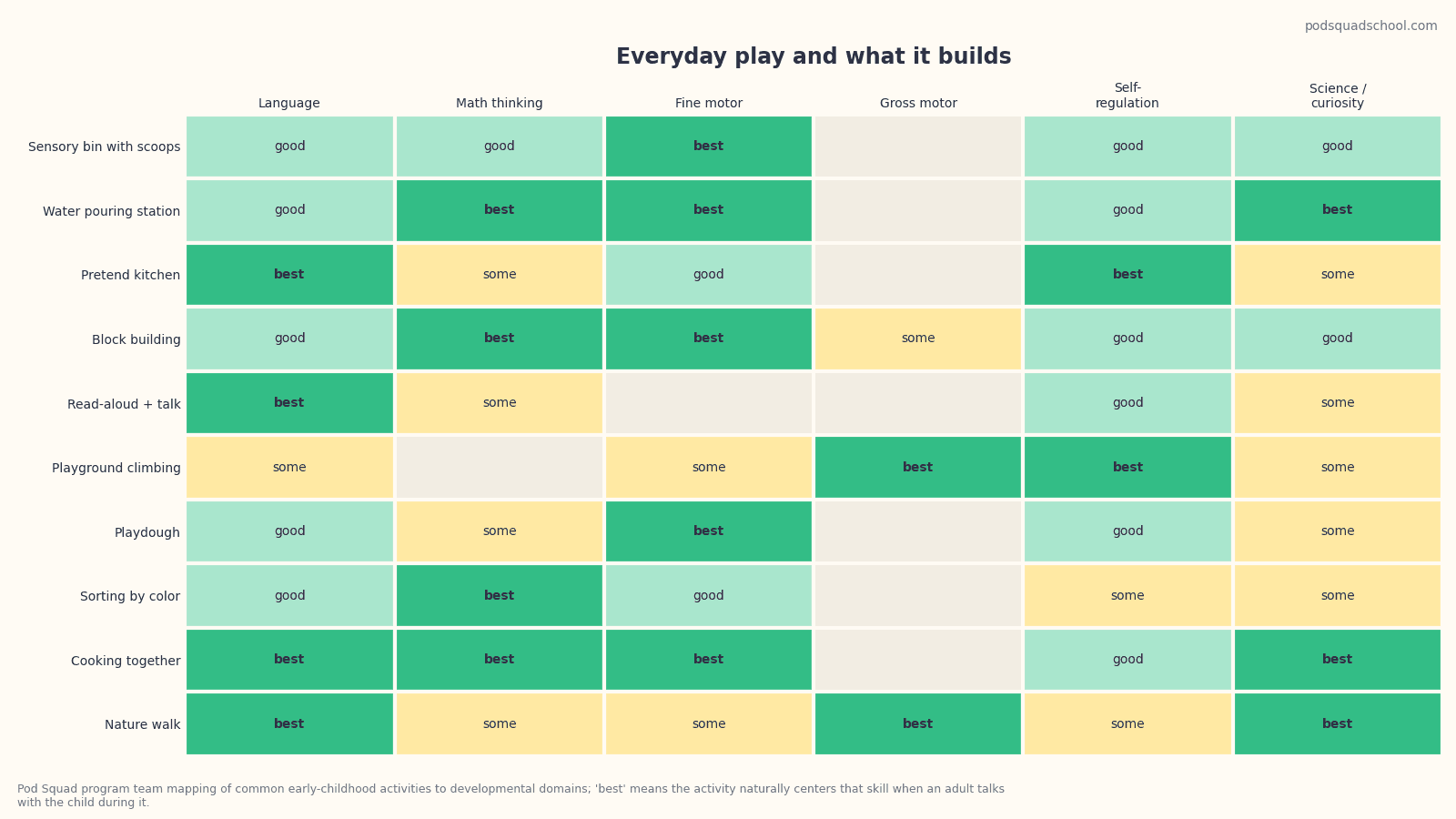
If you want 30 more, sorted by month for 24 to 36 months, the companion post on activities for 2-year-olds does that, and the sensory bin guide goes deep on taste-safe fillers and what to say at the bin.
Montessori at home, the basics that matter
Montessori is the most-searched term in this whole cluster (74,000 US searches a month), and most of the results are either a $3,000 school or a $200 wooden toy. Here is the part you can actually use at home, and the part you can skip.
Copy these
- A child-height shelf with four to six things on it. Not a toy bin. A low bookshelf with each activity on its own tray or basket, spaced out; everything else goes in a closet. Rotate two or three items every week or two, on the same day (Sunday night works). A 2-year-old with six choices plays longer than a 2-year-old with sixty.
- Real tools, sized down. A small glass instead of a sippy cup at the table (one will break; that is the lesson). A small metal pitcher. A child-safe crinkle cutter and a cucumber. A short broom and dustpan. A spray bottle and a rag. Real tools tell a kid the work is real, which is what "meaningful" means in the five characteristics.
- Practical life as the main course. Pouring, spooning, transferring, wiping, sweeping, dressing, watering, washing. For 18 to 36 months, practical life is the curriculum: it builds the hand, the attention span, and the "I can" that every later skill sits on. Pod Squad's Squad Jobs (Wash-Up Station, Laundry Helper, Pit Stop Crew, Water the Plants and Wash the Dishes) are practical life with a kid-size name.
- Order. A place for everything, a picture label on the basket, and a cleanup ritual that is part of the activity. Your kid will not be tidy; the point is an environment predictable enough that they can start something without you.
- Observe before you help. Sit on your hands for 30 seconds when your kid is fighting a lid. If they look at you, that is a serve; return it with a word, not your hands.
Skip these
| Skip | Why | Do instead |
|---|---|---|
| The pink tower, brown stair, and other classroom materials at $100 to $300 | Designed for a trained guide to present in sequence over years; at home they become expensive blocks | Cardboard boxes of graded sizes, or measuring cups that nest |
| Anything labeled "Montessori" at a big-box store | The name is unprotected; the label is marketing | Ask "does my kid choose, and is it real?" |
| The all-wood, all-beige aesthetic | It photographs well and changes nothing about learning | Whatever you own, in fewer pieces, on a low shelf |
| Expecting silent, independent "work" from a 2-year-old | A Montessori 2-year-old classroom is loud and messy too | Expect 5 to 15 minutes, then a transition, then another 5 to 15 |
| Strict fidelity | Home is not a classroom; you are not a guide with a three-hour work cycle | Borrow the principles (choice, real tools, order, observation) and drop the rest |
If you are considering Montessori as a full homeschool approach for a preschooler, the homeschool preschool curriculum post compares it with other options honestly, including cost.
Milestone anchors: 24 and 36 months
Milestone searches are the anxious half of this topic, so a plain word first: the CDC's checklists were revised in 2022 to describe what 75 percent or more of children can do by a given age, which means one in four typically developing kids is not yet doing a listed item on the listed birthday. A missed item is a reason to mention it at the next well visit, not a diagnosis. Your pediatrician knows your kid. If you are concerned, ask; do not let a blog talk you out of asking.
A few anchors from the CDC lists, chosen because they connect directly to invitations above:
| Domain | By 24 months (most kids) | By 36 months (most kids) | Invitations that feed it |
|---|---|---|---|
| Language | Says at least two words together, like "more milk"; points to things in a book when you ask | Talks with you in a back-and-forth of at least two exchanges; asks who, what, where, or why questions | Photo talk (2), missing last word (5), bear's breakfast (4) |
| Social-emotional | Notices when others are hurt or upset; looks at your face to see how to react to something new | Calms down within 10 minutes after you leave; notices other children and joins them to play | Mirror faces (26), stuffed animal clinic (27), goodbye rehearsal (30) |
| Cognitive | Holds something in one hand while using the other, like taking a lid off a container; plays with more than one toy at once, like putting toy food on a toy plate | Draws a circle when you show them how; avoids touching hot things when warned | Sticker peel (17), two-bowl sort (6), dough (19) |
| Movement | Kicks a ball; runs; walks up a few stairs with or without help; eats with a spoon | Strings large beads or macaroni; puts on some clothes, like loose pants or a jacket; uses a fork | Basket toss (22), animal walks (23), clothespin rim (20), tongs (16) |
A note on the 36-month "strings items together like large beads or macaroni" item: large means large. For a kid under 3, use wooden rings on a shoelace with a knot at the end, or cut a pool noodle into inch-thick slices; anything that fits through a toilet-paper tube stays put away.
Milestones point to invitations, not the other way around
Do not run the list as a test. Read it once, notice the one or two items that are next for your kid, and choose invitations that give lots of low-pressure practice. If your 22-month-old is not yet "holding something in one hand while using the other," that is a week of sticker peeling, jar lids, and the narrated pour, not a week of worry. If your 34-month-old is not yet asking "why," that is a week of you wondering aloud until they catch the habit.
Pod Squad's personalization layer, Homie, does this automatically: it reads each kid's birth month and stage and rewrites the "watch for" line in each block for that kid by name, so the pouring block reads differently for a 20-month-old than for a 3-year-old. You can do it by hand with the CDC list and a pencil.
How to tell it is working
You will not see a test score, so here is what you will see, usually within three or four weeks of running one block a day:
- Your kid returns to the same invitation without being asked. Repetition is not boredom; it is practice.
- Stretches get longer. A 2-year-old who lasted four minutes in week one lasts nine in week four.
- They add a twist. The cork goes in the cup, then the cup goes in the bowl, then a spoon becomes a boat. Iteration is one of the five characteristics; when you see it, learning is happening.
- Your words come back. "It sank." "That's heavy." "I wonder." When a kid wonders aloud, you have handed them a tool they will use for life.
- They tell someone later. At dinner, at daycare pickup: "I made the pepper run away."
- Endings get easier. Because you practiced them.
- You feel less like a cruise director. You set out, you narrate, you sit. If you are exhausted after 20 minutes, you are doing too much of it.
Keep a portfolio: one photo and one sentence, a few times a week. It changes how you see your kid, and in six months it is the best answer to "is this working" you will have. The Pod Squad app logs a win with a photo in two taps and files it under the kid; a notes app or a shoebox works too.
The screen note
Screens are the main thing that displaces play in the hours this post is about. The AAP's guidance has been consistent on the young end: avoid screen media for kids under 18 months except video chatting; for 18 to 24 months, choose high-quality programming and watch it with them; and for 2- to 5-year-olds, keep it to about an hour a day of high-quality programming, watched together when you can. The AAP now emphasizes a family media plan over a stopwatch, and that is the right frame: the question is not "how many minutes" but "what did the minutes replace." Twenty minutes of guided play is exactly the block that a tablet at 4:40 p.m. eats. There is a full post on screen time for toddlers with age-by-age specifics and what to do about the car ride.
One structural note: the Pod Squad app is for grown-ups. Kids never use it. The reminders, timer, and printing are for you; the kid gets a tray and your attention.
A worked week
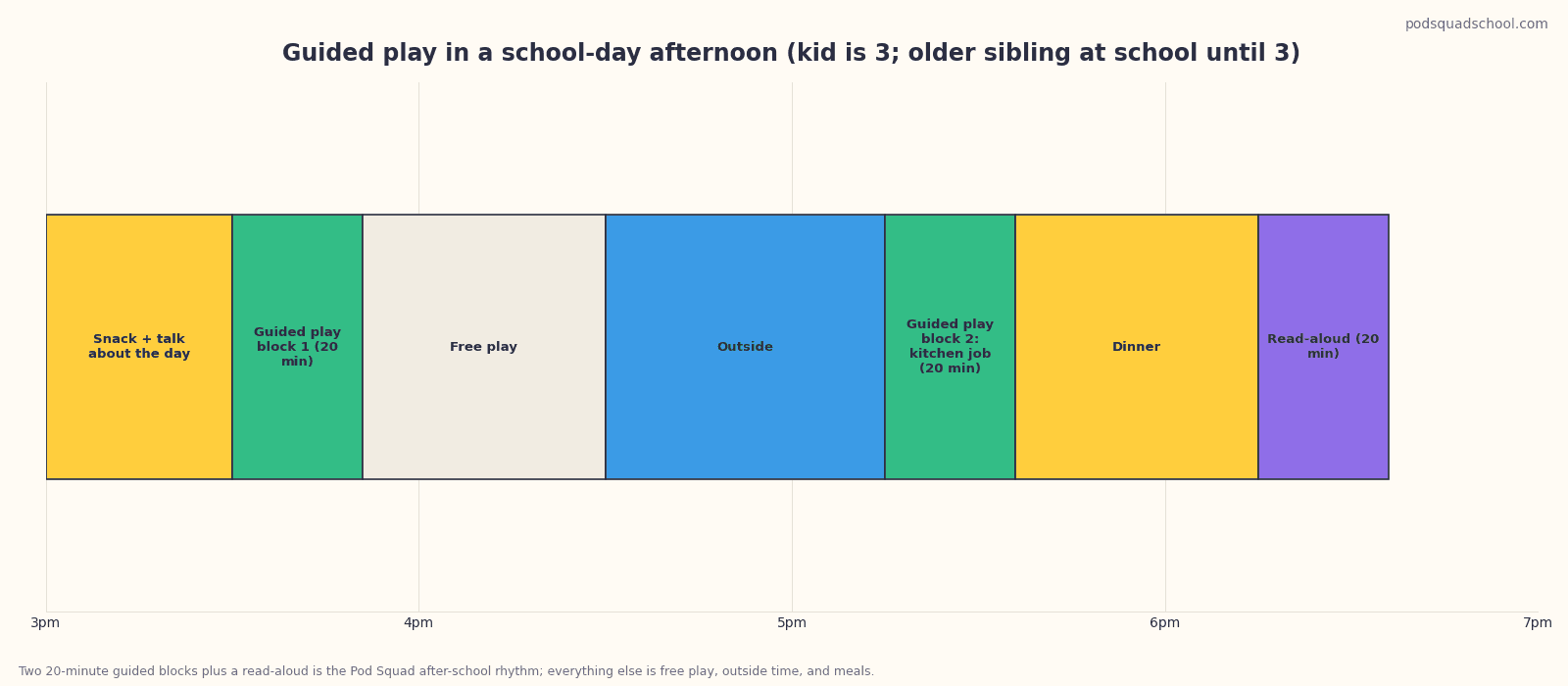
This is a school-day family: a 26-month-old in daycare, a 4-year-old in pre-K, both home by 4:15, dinner at 5:45. The parent has 20 minutes and is tired. Materials are set out the night before (two minutes) so the block starts the moment shoes come off.
| Day | Block (about 20 minutes) | For the 26-month-old | For the 4-year-old | Grown-up's one line |
|---|---|---|---|---|
| Monday | Sink or float (11) at the kitchen table, mixing bowl, towel underneath | Drops, splashes, learns "sank" | Predicts each item first, sorts into two piles | "I wonder what the lemon will do." |
| Tuesday | Dough, rolling pin, butter knife (19) | Squishes, pokes, tastes once | Cuts circles, counts "cookies" | "Flat. You made it so flat." |
| Wednesday | Wash-Up Station (29) then bear's breakfast (4) | Owns the soap pump; feeds bear | Runs a restaurant for bear with a menu they draw | "Bear is hungry. What should we tell him?" |
| Thursday | Ramp and roll (13) in the hallway | Rolls and chases | Adjusts height, races two cars | "The block didn't roll. Huh." |
| Friday | Pillow river (21) then mirror faces (26) | Crawls the rocks | Sets the gap width, names the shark | "This is my surprised face." |
| Saturday (90 min) | An outing near you: a park with a creek, a fire station open house, a farm stand, a hardware store to buy one new pipe cleaner pack | Sound walk (3) on the way in | Sticker map of what they saw | "Stop. I hear something." |
| Sunday (45 min) | Bean in a bag (15) set up, then shelf rotation: swap three trays, kid chooses which stay | Carries the watering can (25) | Picks the trays, labels one with a drawing | "Nothing yet. Let's check tomorrow." |
Total grown-up time for the week: about 100 minutes on weekdays, plus the Saturday adventure and a short Sunday project. Reading aloud happens at bedtime every night on top of this and is not counted here; it is not optional.
If you homeschool, the same seven blocks become the spine of a morning: one block, snack, one block, outside, lunch. Add the letter of the week (the letter tracing worksheets post covers when tracing is developmentally sensible and when it is too early) and a read-aloud, and you have about two hours, which is the toddler Homeschool rhythm in the Pod Squad program.
Where Pod Squad fits, stated plainly
Pod Squad is a paid membership: free for 7 days, then $99 a month for the first kid, with siblings at 50 percent off, so a two-kid family pays $149 a month. That is real money, and you can run everything in this post without it. The CDC list is free. The 30 invitations are free. A low shelf is free if you already own a bookshelf. If your budget is tight, close this tab, pick three invitations, and start tonight. Play-based learning was never supposed to cost anything.
What the membership buys is the planning and the nudging. Every block in the Toddler Squad program is already written in the set out / say / watch for / when it falls apart shape, with a note for your kid's exact age written by Homie, inside a themed week (Week 4 is Water and Weather, which is where sink or float and the Make It Rain Wonder Lab live) with a shopping list, a Squad Job, a Letter of the Week, printables, and a Thursday adventure at a real place sorted by distance from your home. The app taps you on the shoulder the night before ("set out the bowl and the lemon") and the morning of, and the Block Timer runs the 20 minutes so you are not watching the clock. For a family that already knows how to do this and just cannot get it to happen four days a week, that is the value. For a family that finds it easy to improvise, it is not.
The honest comparison: subscription play kits (the Lovevery, KiwiCo, and Pod Squad comparison walks through this) sell you the materials and leave the stance to you. Pod Squad sells you the stance and the schedule and expects you to own the materials, most of which are a pitcher, some tape, and a colander. Neither replaces you.
You can start free and cancel in two taps if it is not for your family, or grab the free sample (a Week 1 worksheet and a Wonder Lab card) to see the block format before you decide anything.
Mistakes that cost the most
- Quizzing. "What color is this? How many? What shape?" turns every block into a test and every kid into a test-taker. The fix: narrate and wonder for a full week without asking a single fact question. Notice how much more your kid says.
- Too much out at once. A room with 60 toys visible produces a kid who touches 60 toys for 30 seconds each. The fix: four to six things on a low shelf, the rest in a closet, rotate on Sunday.
- Buying materials before building the habit. The wooden set arrives, gets used twice, and becomes clutter. The fix: run the free version with a colander for three weeks. If the block is happening four days a week, then consider spending money.
- Fixing it for them. Straightening the tower, opening the lid, finishing the puzzle. Every fix steals a repetition. The fix: sit on your hands for 30 seconds; if they look at you, use a word, not your hands.
- Running it like a lesson. You have a goal, so you start directing: "put the big one there, now the small one." That is direct instruction wearing a play costume, and the Fisher shapes study is the clearest evidence it underperforms guided play with preschoolers. The fix: set the stage, then let the kid choose the first move, always.
- Treating milestones as a scoreboard. A missed item on a list becomes a week of drilling. The fix: read the CDC list once, pick invitations that practice the next thing, and bring any real concern to your pediatrician, not to the tray.
- Skipping the ending. The block just stops when you get bored or dinner is ready, and the next block starts with a fight. The fix: one ending phrase, every time, and cleanup as the last five minutes of the block rather than a separate chore.
- Skipping outside. Forest school and outdoor preschool are trending in the search data for a reason: a stick, a puddle, and a hill cover four domains at once, and there is nothing to set out. The fix: one of your five weekday blocks happens outside, rain or not.
Who this is for, and who it is not for
This is for you if your kid is somewhere between 18 months and 5 years and you have 20 minutes most days that currently disappear into a screen or a whine; if your kid is in preschool or daycare and you want the hour after pickup to count without turning it into homework; if you homeschool a preschooler and want a research-grounded spine for the morning; or if you have been reading Montessori blogs and want the parts that transfer to a normal home on a normal budget.
This is also for you if you are anxious about a milestone. Read the milestone section, pick two invitations, and book the well visit. Both things at once.
This is not for you if you are looking for a program that will get a 3-year-old reading. The research does not support pushing formal instruction down that early, and this post will not pretend otherwise. It is not for you if you want your kid to use an app; there is no kid-facing screen in anything described here, on purpose. And it is not a substitute for an evaluation if your pediatrician or your kid's teacher has raised a concern; play helps every kid, but it is not therapy, and early intervention services exist because they work.
Frequently asked questions
What is play-based learning, in plain words?
Play-based learning means young children learn best through activities they choose and direct, with an adult nearby who sets up interesting materials, describes what is happening, and asks an occasional real question. Researchers call the sweet spot guided play: the grown-up sets the stage and the child leads. It is the opposite of a lesson in which the adult talks and the child answers. In practice it looks like a bowl of water and a lemon on the kitchen table, a parent saying "I wonder what will happen," and a 3-year-old finding out.
Is play-based learning better than an academic preschool?
For children under 5, the evidence favors play-based and guided-play approaches for the outcomes that matter later: language, self-regulation, and problem solving. The AAP's 2018 report specifically warned against replacing play with academic instruction in the early years. That does not mean letters and numbers are banned; it means they show up inside play (a tape triangle to jump on, a snack pattern to extend) rather than on a worksheet at age 3. If a preschool describes itself as academic and the classroom is quiet children at desks, ask more questions.
What is the difference between Montessori and play-based learning?
Montessori is a specific method with trained guides, a set of materials, mixed-age classrooms, and a long uninterrupted work period. Play-based learning is a broader stance that Montessori shares in part: child choice, real materials, an adult who observes more than directs. Montessori is more structured about which materials are presented and when, and it treats "work" and "play" a little differently than most play researchers do. At home, the useful overlap is large: a low shelf, few choices, real tools, practical-life tasks, and an adult who waits.
How much time a day does play-based learning take?
Twenty minutes of one set-out block, four or five days a week, is enough to see changes within a month: longer stretches, more talk, more returning to the same activity. That is on top of the free play your kid already does and the bedtime read-aloud, not instead of them. Homeschooling families run two or three blocks in a morning, about two hours including snack and outside time. Consistency beats length; five 20-minute blocks do more than one two-hour Saturday session that ends in tears at minute nine.
My 2-year-old just dumps everything. Is that play?
Yes. Dumping, filling, and dumping again is the main work of 18 to 30 months; it is how a kid learns about containers, quantity, gravity, and cause and effect. Set up for it instead of against it: a tray with a lip, a towel underneath, materials that are fine to dump (water, cooked pasta, big blocks), and a cleanup that is part of the block. Narrate the dump ("all of it, all at once") and then hand over the towel. Around 30 to 36 months the dumping gives way to sorting and building on its own.
Do I need to buy Montessori materials to do this at home?
No. The classroom materials (pink tower, brown stair, bead chains) were designed for a trained guide to present in sequence over years, and at home they are expensive blocks. What transfers is the setup: a low shelf with four to six activities on trays, real kid-sized tools (a small pitcher, a real glass, a short broom), practical-life tasks, and a habit of observing before helping. All of that costs under $30 if you do not already own it. Skip anything labeled "Montessori" at a big-box store; the name is unprotected and the label is marketing.
Will play-based learning prepare my 4-year-old for kindergarten?
The skills kindergarten teachers most often say they want are the ones guided play builds: sitting with a task, following a two-step direction, taking turns, using words when frustrated, holding a pencil with a functional grip, and being curious. Letter and number recognition matter too, and at 4 they can live inside play: a tape-shape hop, a name spelled in dot stickers, a snack pattern, a Letter of the Week traced on Monday and found on cereal boxes all week. If a 4-year-old shows interest in letters, follow it; if not, keep playing and keep reading aloud, and check in with your pediatrician and their teacher at the start of the year.
What about screens? Can an educational app count as play?
An app can be a game (rules the child plays within), but it is rarely play in the sense researchers mean: the child does not control the materials, cannot iterate freely, and there is usually no live person returning the serve. The AAP's guidance for 2- to 5-year-olds has been about an hour a day of high-quality programming, watched with an adult, and none other than video chat under 18 months. The bigger issue is displacement: the tablet at 4:40 p.m. eats the exact 20 minutes this post is about. Pod Squad's own app is for parents only; kids never touch it.
Sources & methodology
- Harvard University, Center on the Developing Child. "Serve and Return" (key concepts) and "5 Steps for Brain-Building Serve and Return." https://developingchild.harvard.edu
- American Academy of Pediatrics. Yogman M, Garner A, Hutchinson J, Hirsh-Pasek K, Golinkoff RM, et al. "The Power of Play: A Pediatric Role in Enhancing Development in Young Children." Pediatrics, 2018. https://doi.org/10.1542/peds.2018-2058
- American Academy of Pediatrics, HealthyChildren.org. Media use guidance for young children and the Family Media Plan; choking prevention guidance; literacy promotion (reading aloud from infancy). https://www.healthychildren.org
- The LEGO Foundation. Zosh JM, Hopkins EJ, Jensen H, Liu C, Neale D, Hirsh-Pasek K, Solis SL, Whitebread D. "Learning through play: a review of the evidence" (2017), and Whitebread D, et al. "The role of play in children's development: a review of the evidence" (2017). https://learningthroughplay.com
- Zosh JM, Hirsh-Pasek K, Hopkins EJ, Jensen H, Liu C, Neale D, Solis SL, Whitebread D. "Accessing the Inaccessible: Redefining Play as a Spectrum." Frontiers in Psychology, 2018.
- Weisberg DS, Hirsh-Pasek K, Golinkoff RM. "Guided Play: Where Curricular Goals Meet a Playful Pedagogy." Mind, Brain, and Education, 2013. Weisberg DS, Hirsh-Pasek K, Golinkoff RM, Kittredge AK, Klahr D. "Guided Play: Principles and Practices." Current Directions in Psychological Science, 2016.
- Fisher KR, Hirsh-Pasek K, Newcombe N, Golinkoff RM. "Taking Shape: Supporting Preschoolers' Acquisition of Geometric Knowledge Through Guided Play." Child Development, 2013.
- Lillard AS. Montessori: The Science Behind the Genius, 3rd edition. Oxford University Press, 2017. Lillard AS, Heise MJ, Richey EM, Tong X, Hart A, Bray PM. "Montessori Preschool Elevates and Equalizes Child Outcomes: A Longitudinal Study." Frontiers in Psychology, 2017.
- Randolph JJ, et al. "Montessori education's impact on academic and nonacademic outcomes: A systematic review." Campbell Systematic Reviews, 2023.
- Centers for Disease Control and Prevention. "Learn the Signs. Act Early." Developmental milestone checklists (2022 revision), 2 years and 3 years. https://www.cdc.gov/ncbddd/actearly/milestones/index.html
- National Association for the Education of Young Children. "Developmentally Appropriate Practice" position statement (2020). https://www.naeyc.org
- Search demand: DataForSEO Labs, Google US, September 10, 2026; volumes for many child-related keywords are suppressed by Google Ads and are shown as clickstream estimates where labeled. Trend figures are 12-month changes in search volume from the same pull.
- Program details (week themes, Squad Jobs, Wonder Labs, pricing) are from Pod Squad's own program and pricing pages as of September 2026. Pod Squad is a paid membership; this post is published by Pod Squad.
Methodology note: research findings are stated qualitatively on purpose. Effect sizes for play interventions vary by study, age, and outcome, and quoting one number from one study would overstate what is known.
Bottom line
Play-based learning is not a curriculum you buy; it is a way of being in the room. You set out a few real things, your kid decides what to do with them, and you describe what you see, wonder aloud, and ask one real question. The AAP prescribes it, Harvard explains why it works, and the guided-play research says the adult who sets the stage and then steps back does more for a kid than the adult who lectures or the adult who leaves.
Start with 20 minutes, four days this week, using things in your kitchen. Narrate instead of quizzing for seven days and count how much more your kid talks. Read aloud every night on top of it. If the block keeps not happening because life is loud, that is the problem a plan and a nudge can solve, and that is what Pod Squad is for.
You can start free today, run Week 1 with your kid, and decide from there.
Keep exploring
- Activities for 2-year-olds, by month: 30 more invitations for 24 to 36 months with what to set out and say.
- Sensory bin ideas: taste-safe fillers, tools by age, and what to say at the bin.
- Screen time for toddlers: the AAP guidance age by age, and how to get the 4:40 p.m. hour back.
- Homeschool preschool curriculum: how Montessori, Charlotte Mason, and play-based options compare for a home morning.
- The Toddler Squad program: 12-week seasons of guided play blocks, Squad Jobs, Wonder Labs, and Thursday adventures.
- How Homie personalizes each block: age notes, interest lanes, and avoid lists, written for your kid by name.
Questions parents ask
What is play-based learning, in plain words?
Play-based learning means young children learn best through activities they choose and direct, with an adult nearby who sets up interesting materials, describes what is happening, and asks an occasional real question. Researchers call the sweet spot guided play: the grown-up sets the stage and the child leads. It is the opposite of a lesson in which the adult talks and the child answers. In practice it looks like a bowl of water and a lemon on the kitchen table, a parent saying "I wonder what will happen," and a 3-year-old finding out.
Is play-based learning better than an academic preschool?
For children under 5, the evidence favors play-based and guided-play approaches for the outcomes that matter later: language, self-regulation, and problem solving. The AAP's 2018 report specifically warned against replacing play with academic instruction in the early years. That does not mean letters and numbers are banned; it means they show up inside play (a tape triangle to jump on, a snack pattern to extend) rather than on a worksheet at age 3. If a preschool describes itself as academic and the classroom is quiet children at desks, ask more questions.
What is the difference between Montessori and play-based learning?
Montessori is a specific method with trained guides, a set of materials, mixed-age classrooms, and a long uninterrupted work period. Play-based learning is a broader stance that Montessori shares in part: child choice, real materials, an adult who observes more than directs. Montessori is more structured about which materials are presented and when, and it treats "work" and "play" a little differently than most play researchers do. At home, the useful overlap is large: a low shelf, few choices, real tools, practical-life tasks, and an adult who waits.
How much time a day does play-based learning take?
Twenty minutes of one set-out block, four or five days a week, is enough to see changes within a month: longer stretches, more talk, more returning to the same activity. That is on top of the free play your kid already does and the bedtime read-aloud, not instead of them. Homeschooling families run two or three blocks in a morning, about two hours including snack and outside time. Consistency beats length; five 20-minute blocks do more than one two-hour Saturday session that ends in tears at minute nine.
My 2-year-old just dumps everything. Is that play?
Yes. Dumping, filling, and dumping again is the main work of 18 to 30 months; it is how a kid learns about containers, quantity, gravity, and cause and effect. Set up for it instead of against it: a tray with a lip, a towel underneath, materials that are fine to dump (water, cooked pasta, big blocks), and a cleanup that is part of the block. Narrate the dump ("all of it, all at once") and then hand over the towel. Around 30 to 36 months the dumping gives way to sorting and building on its own.
Do I need to buy Montessori materials to do this at home?
No. The classroom materials (pink tower, brown stair, bead chains) were designed for a trained guide to present in sequence over years, and at home they are expensive blocks. What transfers is the setup: a low shelf with four to six activities on trays, real kid-sized tools (a small pitcher, a real glass, a short broom), practical-life tasks, and a habit of observing before helping. All of that costs under $30 if you do not already own it. Skip anything labeled "Montessori" at a big-box store; the name is unprotected and the label is marketing.
Will play-based learning prepare my 4-year-old for kindergarten?
The skills kindergarten teachers most often say they want are the ones guided play builds: sitting with a task, following a two-step direction, taking turns, using words when frustrated, holding a pencil with a functional grip, and being curious. Letter and number recognition matter too, and at 4 they can live inside play: a tape-shape hop, a name spelled in dot stickers, a snack pattern, a Letter of the Week traced on Monday and found on cereal boxes all week. If a 4-year-old shows interest in letters, follow it; if not, keep playing and keep reading aloud, and check in with your pediatrician and their teacher at the start of the year.
What about screens? Can an educational app count as play?
An app can be a game (rules the child plays within), but it is rarely play in the sense researchers mean: the child does not control the materials, cannot iterate freely, and there is usually no live person returning the serve. The AAP's guidance for 2- to 5-year-olds has been about an hour a day of high-quality programming, watched with an adult, and none other than video chat under 18 months. The bigger issue is displacement: the tablet at 4:40 p.m. eats the exact 20 minutes this post is about. Pod Squad's own app is for parents only; kids never touch it.
Written by
Pod Squad Program Team
Curriculum & play · Pod Squad. We write the daily plan families run, so every post is built from what actually works with a real kid on a real Tuesday.
Keep reading
Development
Screen Time for Toddlers: The AAP Guidelines Explained, What Screens Do to a 2-Year-Old's Day, and 50 Screen-Free Swaps That Actually Hold Their Attention
46 min read
Activities
Activities for 2 Year Olds: 62 Ideas by Age, Room, and Moment (From a Program That Plans Them Daily)
43 min read
Activities
Sensory Bin Ideas: 75 Fillers, Tools, and Themes by Age (Taste-Safe Through Age 3)
48 min read