
Activities
Activities for 2 Year Olds: 62 Ideas by Age, Room, and Moment (From a Program That Plans Them Daily)
Sixty-two activities for kids from 18 months to 4 years, each with what to set out, what to say, the minutes, and an age note. Sorted by kind of play and by the moment of your day, with a worked week.
Pod Squad Program TeamSeptember 10, 2026Updated September 28, 2026 43 min read
Key Takeaways
- The best activity for a 2-year-old takes you two minutes to set out and holds them for fifteen. A dish tub of water and three kitchen cups beats a craft with a printable template almost every time.
- Age in months matters more than the word "toddler". An 18-month-old dumps, a 30-month-old scoops and pours, a 42-month-old sorts and narrates. The same bean bin is three different activities, and this post gives the age note for every one.
- Match the activity to the moment, not to a photo. After school wants ten minutes of movement and then a sit-down; the twenty minutes before dinner wants a kitchen job you were doing anyway; a rainy Saturday wants one messy block with cleanup planned in.
- Three supervision rules cover almost everything. Anything that fits through a toilet-paper tube stays out of reach of a kid under 3; everything in a bin is taste-safe under 3; a grown-up is within arm's length of any water, including a dish tub.
- Talk with your kid instead of quizzing them. Between 24 and 36 months the CDC's milestones move from two-word phrases to real back-and-forth conversation, and that growth runs on narration and one honest question at a time, not on "what color is this?"
- Plan for 5 to 15 minutes of focus at 2, 10 to 20 at 3, and 15 to 30 at 4 on an activity the kid chose. Set out short, and when one runs long, let it.
- Pod Squad plans this every day as a paid membership; this post is free and complete on its own. We say plainly below where the free path is all a family needs.
You have a 2-year-old and about forty minutes. Maybe it is 4:45 on a Tuesday and you just got home from daycare pickup. Maybe it is a Saturday and it is raining. Maybe your kid is 19 months and everything on the internet seems to be for a 4-year-old with scissors. This post is for you, whether your kid is in school, in daycare, home with you all day, or some mix of the three. Nothing here assumes you homeschool.
We run Toddler Squad at Pod Squad, a daily play plan for kids from about 20 months to 3 years, so we plan a lot of these blocks and watch a lot of them fall apart. What follows is what holds up: 62 activities sorted by the kind of play, each with what to set out, what to say, how long to expect, what it builds, and how it changes across three age bands (18 to 24 months, 2 to 3 years, 3 to 4 years). Then we sort the same activities by the moment of your day, because that is the sort most lists skip.
One principle sits under all of it. The grown-up sets out the materials and offers an invitation; the kid keeps the choices; the grown-up talks with the kid instead of testing them. Researchers call this guided play, and we cover the evidence in our play-based learning guide. Here we just use it.
What parents are actually searching for (2026)
We pulled the search demand for this cluster because it tells you how other parents frame the problem, and it shows where the internet is thin. Google Ads hides volume for many keywords about young children, so several of these rows use clickstream estimates (labeled).
| Keyword | US searches/mo | Difficulty | What they want |
|---|---|---|---|
| activities for 2 year olds | 5,400 | 0 | A list they can run today, sorted for their kid |
| activities for 3 year olds | 3,600 | 6 | The same list, one year up: more words, simple rules |
| activities for 4 year olds | 2,400 | 6 | Games with rules, crafts that make something |
| activities for 18 month old | 1,600 | 2 | Safe dump-and-fill play, taste-safe materials |
| 18 month old activities | 1,600 | 11 | The same query in a different word order |
| sensory bins | 5,400 | 8 | Fillers, tools, and a bin to buy |
| fine motor activities | 3,600 | 8 | Hand strength before handwriting |
| arts and crafts for kids | 22,200 | 24 | Broad, every age, down 55% in 12 months |
| toddler crafts | ≈610 (clickstream) | n/a | Something to make and hang on the fridge |
| toddler activities | ≈508 (clickstream) | n/a | Browsing on a slow afternoon |
| activities for toddlers | ≈457 (clickstream) | n/a | Same intent, plural |
| sensory activities for toddlers | ≈203 (clickstream) | n/a | Dough, water, bins |
| indoor activities for toddlers | ≈101 (clickstream) | n/a | Rain, sickness, or heat |
| things to do with a 3 year old | ≈101 (clickstream) | 3 | Outings plus ideas for a whole day |
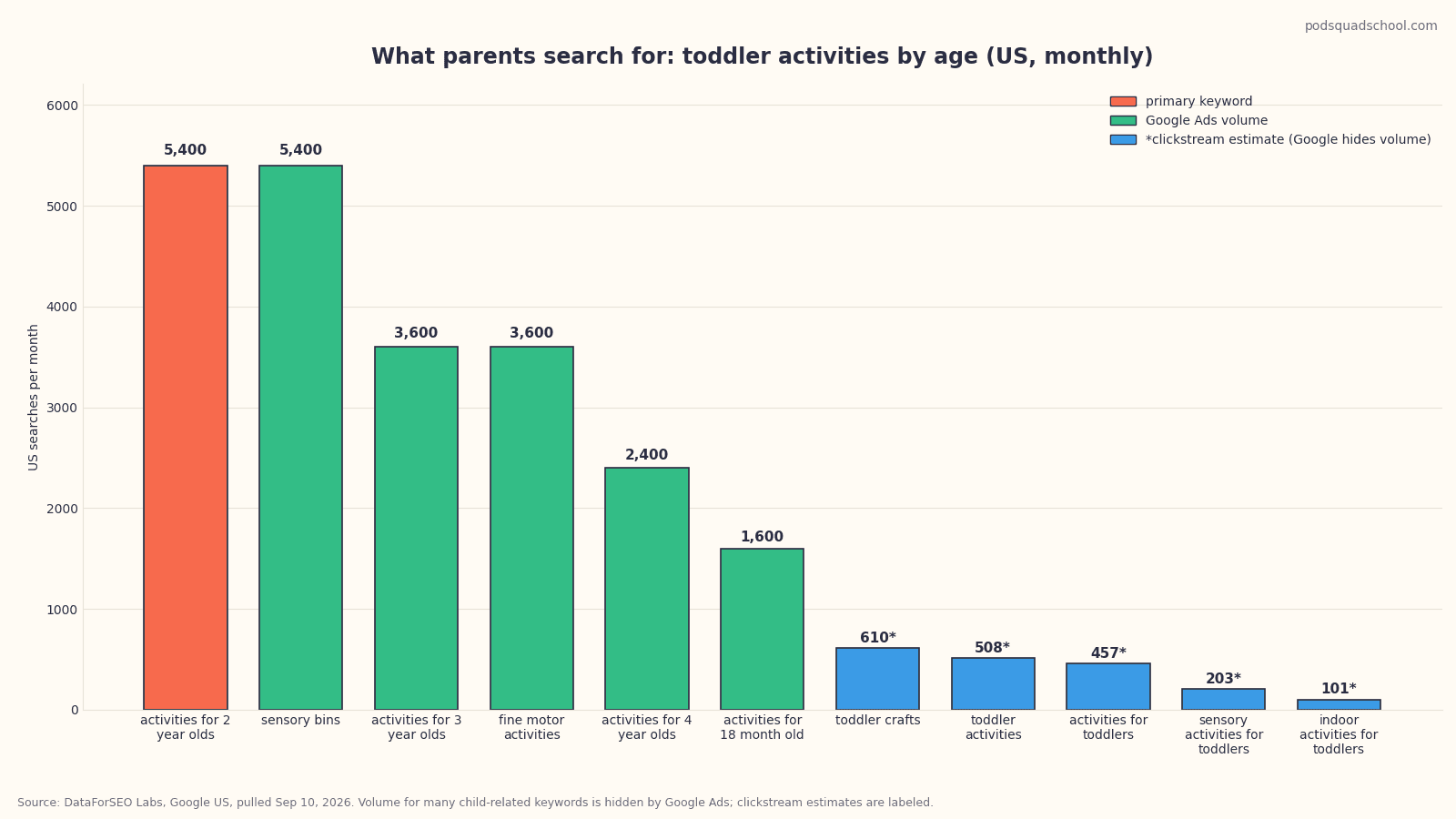
The intent is almost entirely informational and the difficulty scores are near zero, which tells you two things. Parents want a list they can act on in the next ten minutes, and the sites ranking today are mostly individual blog posts about one activity each (oobleck, kinetic sand, bath painting). Busy Toddler, the strongest site in this space, holds roughly 288 first-page-first positions with single-activity pages. Volume across the age-specific terms is down 18 to 47% year over year; our best read is that AI answers on the results page now satisfy the quick "give me five ideas" version of the query, so the searches that remain are from parents who want more than five ideas.
The gap is organization. Nobody sorts activities by the kid's age in months and by the moment of the day at the same time. "Activities for 2 year olds" is a 24-month-old who just learned to jump and a 35-month-old who talks in full sentences; those two kids need different notes on the same bin. And a list of 40 sensory ideas is no help at 5:10 pm when dinner is on the stove and the kid is melting. This post is built around those two axes.
Source: DataForSEO Labs, Google US, pulled September 10, 2026.
What changes from 18 months to 4 years
You already know your kid; that is the hard part. What helps is a map of what typically shifts, so you can read the same activity three ways.
Attention
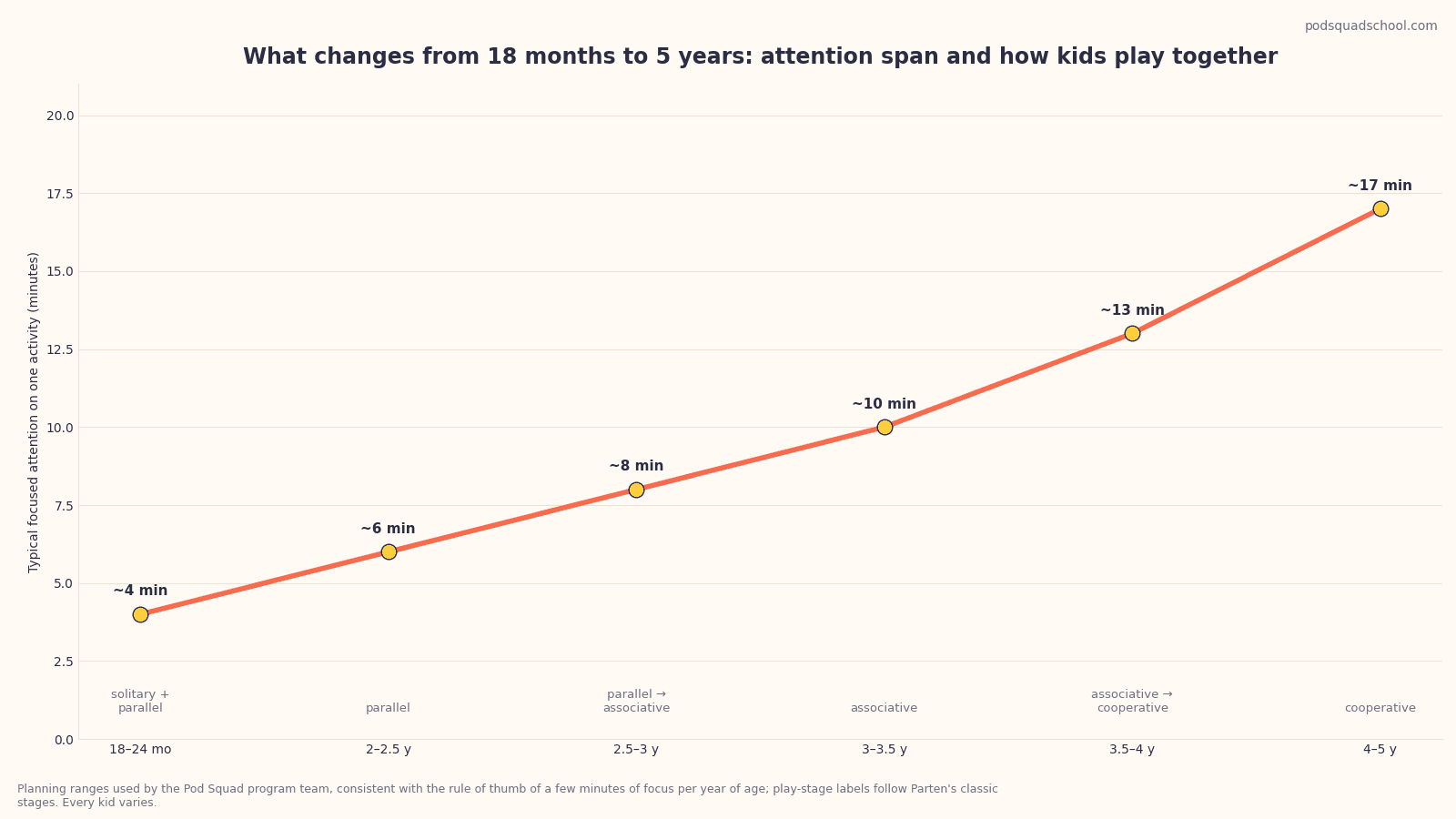
A common rule of thumb among early childhood educators is a few minutes of focus per year of age on an adult-chosen task, so two to six minutes at 2 and three to nine at 3. That number is for tasks the grown-up picked. When the kid picks, the numbers roughly double or triple: a 2-year-old can stay with a water tub for 15 minutes, and a 3.5-year-old can spend half an hour on a pretend restaurant. Plan for the shorter number, set out for the longer one, and treat any activity that runs past its expected minutes as a win, not a schedule problem.
How they play with other kids
Between about 18 and 30 months most kids do parallel play: two kids at one bin, each in their own world, occasionally grabbing the other's scoop. Around 3, associative play shows up: they are doing the same thing, talking about it, still without a shared plan. Cooperative play with roles and rules ("you be the customer, I'm the cook") mostly arrives after 4. This matters for playdates and squads. Set out two of everything for kids under 3, and do not expect sharing to be a skill yet; it is a milestone that is still forming.
Language
The CDC's developmental milestones (updated in 2022) put these anchors at 2 and 3 years. By 24 months, most kids point to things in a book when you ask, say at least two words together like "more milk", point to at least two body parts, and use gestures beyond waving and pointing, like a nod or a blown kiss. By 30 months, they say about 50 words, use an action word ("doggie run"), name things in a book, and use "I", "me", and "we". By 36 months, most kids talk with you in a conversation with at least two back-and-forth exchanges, ask who, what, where, or why questions, say what is happening in a picture, and can be understood by others most of the time.
Read those again as activity instructions. At 2, point-and-name books and "more, gone, again" during pouring. At 2.5, add action words while they play ("the truck is dumping"). At 3, ask what is happening and wait for the answer, then add one more turn.
Hands and bodies
The CDC lists kicking a ball, running, walking up a few stairs, and eating with a spoon at 24 months; twisting lids and doorknobs, jumping with both feet, and turning book pages one at a time at 30 months; drawing a circle after you show them, stringing large beads or macaroni, and using a fork at 36 months. So a threading activity is frustration at 22 months and a favorite at 38. A jump-the-line game is a stretch at 24 months and a party at 30.
If your kid misses several anchors, or loses a skill they had, that is a conversation with your pediatrician. Your pediatrician knows your kid; a blog post does not.
The supervision rules, stated once
Every activity below assumes these three rules, so we state them here and then move on.
- Small parts. Anything that fits through a toilet-paper tube (roughly 1.75 inches across) stays out of reach of a kid under 3, and of any older kid who still mouths things. The American Academy of Pediatrics lists coins, marbles, button batteries, small toy parts, and latex balloons among the most common choking hazards. When a bin has small pieces for a 3-year-old, it goes on a high shelf when the block ends.
- Taste-safe under 3. Anything in a bin or on a brush for a kid under 3 should be safe to lick: oats, cornmeal, cooked pasta, yogurt paint, flour-based dough. Taste-safe is not the same as a snack; it means a mouthful will not hurt them.
- Arm's length from water. The AAP recommends touch supervision, meaning within arm's reach, for toddlers around any water, including a dish tub, a bath, or a bucket; a young child can drown in an inch or two. Empty tubs and buckets the minute the block ends.
For food activities, follow the AAP's choking guidance too: cut grapes and cherry tomatoes lengthwise into quarters, and skip whole nuts, popcorn, hard candy, and hot dog chunks under 4.
How to read each activity
Every entry has the same five parts. Set out is the material list, with the real item and a rough cost when it matters. Say is one sentence to open with, written to narrate or wonder rather than quiz. Minutes is the honest range for a kid who is into it. Ages gives the note for 18 to 24 months, 2 to 3 years, and 3 to 4 years. Builds is what the kid is practicing. The numbering runs straight through so you can point to "number 14" in a group text.
Sensory and messy
Sensory play is where most toddler afternoons should start, because it is the most forgiving: no product, no right answer, and the longest natural focus. For a much deeper list of fillers and themes, see our sensory bin guide.
1. Dry oats bin. Set out a shallow under-bed storage bin with a 42-ounce canister of old-fashioned oats (about $4), a scoop, a cup, and a tray or towel under it. Say: "Scoop, then pour. Listen to the sound it makes." Minutes: 15 to 25. Ages: 18 to 24 months will dump and taste, which is fine; 2 to 3 adds a funnel; 3 to 4 adds a muffin tin and a small pitcher for "one scoop in each". Builds: pouring control, wrist rotation, and the words full, empty, more, gone.
2. Dried bean bin. The same bin with 2 pounds of dried pinto beans and three wooden blocks buried in it. Say: "Something is hiding in here. Dig with your hands first." Minutes: 15 to 30. Ages: 3 to 4 only; beans are a choking hazard and not taste-safe, so under 3 stays with oats. Builds: hand strength, object permanence, sorting.
3. Dish-tub water play. Set out a dish tub with 2 inches of water on a towel on the kitchen floor, plus a ladle, two cups of different sizes, and a small colander. Say: "The colander leaks. Where is the water going?" Minutes: 15 to 30. Ages: 18 to 24 months, one cup and the colander; 2 to 3, add the ladle and a bar of soap; 3 to 4, add a turkey baster and ask them to move all the water to a second tub. Builds: cause and effect, bilateral coordination, "wet, dry, sink, float". You stay within arm's length the whole time.
4. Taste-safe cloud dough. Mix 8 cups of flour (baked at 350 F for 10 minutes and cooled first, so a taste is safe) with 1 cup of olive oil or melted coconut oil in a bin; it packs like damp sand and crumbles apart. Set out a measuring cup and a spoon. Say: "Squeeze it. Now open your hand." Minutes: 20 to 30. Ages: 18 to 24 months, fine with hands only; 2 to 3, add cups and molds; 3 to 4, add toy animals and build a "farm". Builds: hand strength, sensory tolerance, patience with texture.
5. Oobleck. Stir 2 cups of cornstarch into 1 cup of water on a rimmed baking sheet. Say: "Push slow. Now push fast. What changed?" Minutes: 10 to 20. Ages: 18 to 24 months, a small amount on a tray; 2 to 3, whole sheet; 3 to 4, add a spoon and a straw and ask them to make it drip. Builds: early science thinking, vocabulary for hard and soft. Taste-safe; it cleans up dry with a dustpan.
6. Homemade playdough. Mix 2 cups flour, half a cup of salt, 2 tablespoons cream of tartar, 2 tablespoons oil, and 1.5 cups boiling water; knead when cool. Set out a rolling pin and a butter knife. Say: "Roll it long like a snake. Now pinch off a piece." Minutes: 15 to 30. Ages: 18 to 24 months, squish and poke only; 2 to 3, snakes and pancakes; 3 to 4, cut snakes into "cookies" with the butter knife and count them. Builds: hand strength that carries into pencil grip, imagination. Taste-safe in a lick, but very salty, so redirect eating.
7. Ice rescue. Freeze three large toy animals in a loaf pan of water overnight. Set out the block on a tray with a cup of warm water and a small spoon. Say: "They are stuck. How can we get them out?" Minutes: 15 to 25. Ages: 18 to 24 months, warm water only; 2 to 3, add a spoon to chip; 3 to 4, add a pinch of salt and watch what it does. Builds: problem solving, persistence, "melt, cold, warm".
8. Bath or tray painting. For under 3, mix plain yogurt with a drop of food coloring in three cups; for 3 to 4, shaving cream on the tile is fine with hands only. Say: "Paint the wall, then wash it away." Minutes: 10 to 20. Ages: 18 to 24 months, one color, on the high chair tray; 2 to 3, in the bath at bath time; 3 to 4, mix two colors on purpose. Builds: color mixing, big arm movements, mess tolerance for the grown-up.
9. Pouring station. Set out a tray with a small pitcher of water, three cups, and a funnel. Say: "Fill the little cup up to the line, then stop." Minutes: 10 to 20. Ages: 18 to 24 months, one pitcher and one bowl; 2 to 3, three cups; 3 to 4, tinted water in two pitchers to mix colors. Builds: control, focus, and a Montessori-style practical skill they will use at the table.
10. Cornmeal sandbox. Pour a 24-ounce bag of cornmeal into a bin with a toy truck and a small rake (an old fork works). Say: "Make a road for the truck." Minutes: 15 to 30. Ages: 18 to 24 months, truck and hands; 2 to 3, add cups to fill the truck bed; 3 to 4, bury blocks and draw a treasure map. Builds: pretend play, fine motor, and, in our Week 3 "Wheels and Roads" theme, the vocabulary of vehicles.
Movement and gross motor
Two-year-olds need to move before they can sit. If an indoor afternoon keeps falling apart, the fix is usually ten minutes from this list before anything from the fine-motor list.
11. Tape lines. Run painter's tape across the floor in a straight line, a zigzag, and a wave. Say: "Walk the straight one. Now jump the zigzag." Minutes: 10 to 15. Ages: 18 to 24 months, walk and step over; 2 to 3, jump with both feet (a 30-month milestone); 3 to 4, walk heel-to-toe and hop on one foot. Builds: balance, motor planning, following a two-step direction.
12. Cushion mountain. Pull every couch cushion onto the floor into a pile and a path. Say: "Climb the mountain, then slide down the other side." Minutes: 15 to 25. Ages: 18 to 24 months, low pile, you nearby; 2 to 3, add a tunnel under a blanket; 3 to 4, add a "lava" rule and a start and finish. Builds: core strength, risk judgment, big joy.
13. Ball into a laundry basket. Set a laundry basket 3 feet away and give them three soft balls. Say: "Throw it in. Now take one step back." Minutes: 10 to 15. Ages: 18 to 24 months, drop it in from above; 2 to 3, underhand toss; 3 to 4, count the ones that go in. Builds: aim, counting, early turn-taking.
14. Freeze dance. Play a song and pause it every 20 seconds. Say: "When the music stops, you stop." Minutes: 5 to 10. Ages: 18 to 24 months, just dance, no rule; 2 to 3, freeze on the pause; 3 to 4, freeze in a shape you call out. Builds: self-regulation and listening, which is the whole skill behind "wait".
15. Animal walks. Call an animal and move like it: bear on all fours, crab on your back, frog jumps, flamingo on one foot. Say: "Show me a frog. Now show me a slow turtle." Minutes: 5 to 10. Ages: 18 to 24 months, bear and frog; 2 to 3, add crab; 3 to 4, flamingo and a "slow versus fast" version. Builds: strength, body awareness, following a verbal cue.
16. Sock stairs. Put a basket of socks at the bottom of the stairs and an empty basket at the top. Say: "Carry one sock up at a time." Minutes: 10 to 15. Ages: 18 to 24 months, hold your hand or the rail; 2 to 3, walk up on their own (a 24-month milestone) with you behind; 3 to 4, two socks at a time and match the pairs at the top. Builds: leg strength, stamina, one-to-one thinking.
17. Beach ball keep-up. Set out an inflated beach ball. Say: "Tap it up. Don't let it touch the floor." Minutes: 5 to 15. Ages: 18 to 24 months, roll it and chase; 2 to 3, tap it up once; 3 to 4, count taps. Use a beach ball, not a latex balloon, under 4: the AAP names latex balloons among the top choking hazards. Builds: tracking, timing, arm control.
18. Kick to the wall. Set out a soft playground ball against a blank wall. Say: "Kick it to the wall and it comes back to you." Minutes: 10 to 15. Ages: 18 to 24 months, they walk into it; 2 to 3, a real kick (a 24-month milestone); 3 to 4, kick to a taped target. Builds: leg coordination, balance on one foot.
Fine motor and pre-writing
These are the hand skills that come before handwriting. Do not rush pencils; the sequence is dump, scoop, pinch, thread, then draw. Our letter tracing guide covers what comes after, starting around 3.5.
19. Sticker peel. Set out a sheet of 3/4-inch dot stickers and a piece of paper. Say: "Peel one and stick it anywhere." Minutes: 10 to 15. Ages: 18 to 24 months, you lift the corner; 2 to 3, they peel; 3 to 4, stick on a drawn line or match to a colored circle. Builds: pincer grasp, precision, patience.
20. Peas into cups. Set out a bowl of thawed frozen peas and an ice cube tray. Say: "One in each little room." Minutes: 10 to 15. Ages: 18 to 24 months, fingers and eating count; 2 to 3, a spoon; 3 to 4, kid tongs and "only the little ones". Builds: pincer grasp, one-to-one correspondence. Peas are the taste-safe stand-in for pom-poms until 3.
21. Clothespins on a bucket. Clip ten wooden clothespins around the rim of a bucket. Say: "Squeeze to open. Pinch them all off." Minutes: 5 to 15. Ages: 18 to 24 months, pull them off; 2 to 3, put them back on; 3 to 4, match colored pins to colored tape on the rim. Builds: the exact pinch strength a pencil needs.
22. Threading. Set out dry penne and a pipe cleaner with the ends folded over. Say: "Poke it through the hole. Push it down." Minutes: 10 to 20. Ages: 18 to 24 months, skip (pasta is a choking hazard); 2 to 3, penne on a pipe cleaner with you next to them; 3 to 4, large wooden beads on a shoelace, a 36-month CDC milestone. Builds: bilateral coordination, hand-eye control.
23. Vertical drawing. Tape a sheet of paper to the wall at their shoulder height and set out chunky crayons. Say: "Big lines. Up, up, up. Now down." Minutes: 5 to 15. Ages: 18 to 24 months, scribbles; 2 to 3, up-and-down and side-to-side lines; 3 to 4, a circle after you draw one, a 36-month milestone. Builds: wrist extension and shoulder stability, which matter more than the marks.
24. Playdough hide-and-find. Push six large wooden blocks into a lump of the dough from number 6. Say: "Six things are hiding. Dig them out." Minutes: 10 to 20. Ages: 18 to 24 months, one big block; 2 to 3, three; 3 to 4, six, then count. Builds: finger strength, counting, persistence.
25. Tearing and snipping. Set out junk mail and, for older kids, blunt kid scissors and a playdough snake. Say: "Tear a long strip. Now a tiny piece." Minutes: 10 to 15. Ages: 18 to 24 months and 2 to 3, tearing paper only; 3 to 4, snip playdough snakes into pieces, then paper strips. Builds: bilateral hand use, scissor readiness.
26. Lids and containers. Set out five empty yogurt tubs and spice jars with their lids in a separate basket. Say: "Which lid fits this one?" Minutes: 10 to 15. Ages: 18 to 24 months, pull-off lids; 2 to 3, twist-off lids (a 30-month milestone); 3 to 4, all mixed up and matched by size. Builds: wrist rotation, size comparison.
Pretend and language
Pretend play is where language grows fastest, because the kid has a reason to talk. Your job is to be a slightly slow, very interested customer.
27. Doll breakfast. Set out a bowl, a spoon, a cup, and a stuffed animal in a chair. Say: "Bear looks hungry. What is for breakfast?" Minutes: 10 to 20. Ages: 18 to 24 months, feeding the bear a block counts; 2 to 3, they name the food; 3 to 4, bear "does not like it" and they solve it. Builds: symbolic thinking (a 30-month milestone), empathy, food words.
28. Grocery store. Set out empty cereal boxes, a reusable bag, and a shelf. Say: "I need two things for dinner. Can you help me find them?" Minutes: 15 to 25. Ages: 18 to 24 months, fill and empty the bag; 2 to 3, "find the red box"; 3 to 4, write a scribble list and check items off. No coins for anyone under 3. Builds: categories, following directions, the Week 6 "Farm and Food" vocabulary.
29. Car wash. Set out a dish tub with an inch of soapy water, toy cars, an old toothbrush, and a towel. Say: "This one is so muddy. Scrub the wheels." Minutes: 15 to 25. Ages: 18 to 24 months, dunk and splash; 2 to 3, scrub and dry; 3 to 4, a "line" of cars and a price sign. Arm's length from the tub. Builds: sequencing (wash, rinse, dry), pretend roles.
30. Doctor's office. Set out a toy stethoscope or a real one, a box of adhesive bandages, and a patient (you). Say: "My knee hurts. What should we do?" Minutes: 10 to 20. Ages: 18 to 24 months, stick a bandage on you; 2 to 3, "listen" to your heart; 3 to 4, ask you questions and write a "prescription". Builds: caring language, body parts, the Week 7 "Community Helpers" theme.
31. Phone call. Set out an old phone with the battery removed, or a wooden block. Say: "It's for you. It's Grandma." Minutes: 3 to 10. Ages: 18 to 24 months, babble and hand it back; 2 to 3, "hi" and "bye" and one thing they did today; 3 to 4, a whole pretend conversation with turns. Builds: conversational turns, which the CDC anchors at 36 months.
32. Point, name, then what is happening. Set out one picture book with busy pages. Say (under 2.5): "Where is the dog?" Say (over 2.5): "What is the dog doing?" Then wait. Minutes: 5 to 15. Ages: 18 to 24 months, pointing to named things is the milestone; 2 to 3, naming; 3 to 4, describing the action and predicting the next page. Builds: vocabulary, story sense.
33. Sock puppet. Set out a clean sock on your hand and one on theirs. Say: "My sock is hungry. Feed him a word." Minutes: 5 to 15. Ages: 18 to 24 months, they laugh and feed it blocks; 2 to 3, the puppet asks yes-or-no questions; 3 to 4, they voice their own puppet. Builds: perspective-taking, silly language practice.
34. Restaurant. Set out a small table, two plates, a notepad, and a dish towel over your arm. Say: "Welcome. What would you like to order?" Minutes: 15 to 30. Ages: 18 to 24 months, they hand you a plate; 2 to 3, they "cook" and you order; 3 to 4, they take your order, scribble it, and bring the wrong thing on purpose. Builds: role play, sequencing, a long stretch of talk.
Art
Toddler art is process, not product. If the plan needs a finished thing that looks like the photo, it is a craft for you, not an activity for them.
35. Window collage. Tape a sheet of clear contact paper to a low window, sticky side out, and set out a bowl of torn tissue paper. Say: "Stick it on. Look, the light comes through." Minutes: 10 to 20. Ages: 18 to 24 months, big pieces, you tear; 2 to 3, they tear; 3 to 4, make a pattern or a "stained glass" shape. Builds: pincer grasp, color words, the Week 2 "Color Splash" idea.
36. Paint with a car. Squeeze three colors of washable paint onto a paper plate and set out toy cars and a long roll of paper. Say: "Drive through the puddle. Now drive on the road." Minutes: 10 to 20. Ages: 18 to 24 months, one car, one color; 2 to 3, three colors; 3 to 4, notice which tire tracks match which car. Builds: cause and effect, color mixing, tracks as a first "print".
37. Dot painting. Set out a paper with big circles drawn on it and washable paint on a plate. Say: "One dot in each circle." Minutes: 10 to 15. Ages: 18 to 24 months and 2 to 3, fingertips; 3 to 4, a cotton swab or a clothespin holding a folded paper towel. Builds: control, one-to-one, precision.
38. Salad spinner art. Set a paper plate inside a salad spinner, drip three colors on it, close the lid, and let them spin. Say: "Spin it hard. Now open it slowly." Minutes: 10 to 15 for several plates. Ages: 18 to 24 months, you drip, they spin; 2 to 3, they do both; 3 to 4, predict what will happen with more paint. Builds: anticipation, arm strength, wonder.
39. Tape resist. Stick strips of painter's tape across a sheet of card, let them paint over everything, then peel the tape off when dry. Say: "Paint over the tape too. Tomorrow we peel." Minutes: 10 to 15, plus the peel the next day. Ages: 18 to 24 months, you place the tape; 2 to 3, they paint; 3 to 4, they place the tape in a shape or a first letter. Builds: delayed gratification, lines and shapes.
40. Nature brushes. Tape a pine sprig, a leaf, and a dandelion to three sticks. Set out paint and paper on the porch. Say: "Which brush makes the scratchy marks?" Minutes: 10 to 20. Ages: 18 to 24 months, one brush, one color; 2 to 3, three brushes; 3 to 4, guess before testing. Builds: observation, comparison words, the Week 5 "Bugs and Butterflies" outdoor tie-in.
41. Chalk on wet paper. Wet a sheet of dark construction paper with a sponge and set out sidewalk chalk. Say: "Draw on the wet part. What happens to the color?" Minutes: 10 to 15. Ages: 18 to 24 months, scribbles; 2 to 3, they wet the paper too; 3 to 4, draw a rainbow in order. Builds: grip, color intensity, a small experiment.
Kitchen and real jobs
Real jobs at kid size are the most underrated activity on this list. They cost nothing to set up because you were doing them anyway, and a 2-year-old wants to do what you do more than they want any toy. Our program calls these Squad Jobs; every week has one.
42. Wash-Up Station. Set a dish tub of warm soapy water on a towel on the floor with a dish brush and four plastic cups. Say: "These are dirty. You are on wash-up." Minutes: 15 to 25. Ages: 18 to 24 months, splash and dunk; 2 to 3, scrub and put in a drying rack; 3 to 4, wash, rinse in a second tub, dry, and stack. Arm's length from the tub. Builds: sequencing, pride, a real contribution.
43. Tear the lettuce. Set out a head of washed romaine and a big bowl. Say: "Tear it into pieces as big as your hand." Minutes: 5 to 10. Ages: 18 to 24 months, tear and eat; 2 to 3, tear to size; 3 to 4, tear, then add cucumber moons you already cut. Builds: bilateral hands, and kids eat more of a salad they made.
44. Stir and pour pancakes. Set out a bowl, a whisk, and premeasured cups of flour, milk, and a cracked egg. Say: "Pour the flour in. Now stir slow so it stays in the bowl." Minutes: 10 to 15. Ages: 18 to 24 months, pour one cup with your hand on theirs; 2 to 3, pour and stir; 3 to 4, count cups and crack the egg. Builds: measuring, sequence, following a recipe.
45. Sort the silverware. Set out a basket of clean spoons and forks and the open drawer tray. Say: "Spoons here, forks there." Minutes: 5 to 10. Ages: 18 to 24 months, spoons only, into one slot; 2 to 3, spoons and forks; 3 to 4, add big and little spoons. No knives for anyone. Builds: sorting, categories, a real job done.
46. Water the plants. Set out a small watering can filled to a line and one plant. Say: "Pour until the dirt turns dark." Minutes: 5 to 10. Ages: 18 to 24 months, you hold the can with them; 2 to 3, one plant; 3 to 4, three plants and a check of which soil is dry. Builds: care, observation, "wet, dry, thirsty".
47. Wipe the table. Set out a spray bottle with water and a small cloth. Say: "Spray two times, then wipe in circles." Minutes: 5 to 10. Ages: 18 to 24 months, wipe only; 2 to 3, spray with two hands and wipe; 3 to 4, spray, wipe, and check the corners. Builds: hand strength, cause and effect, a job they will ask to do again.
48. Laundry helper. Set out a basket of clean socks and the open washer or dryer door. Say: "Find the sock that matches this one." Minutes: 10 to 15. Ages: 18 to 24 months, throw items in and push the start button; 2 to 3, match pairs by color; 3 to 4, match, fold in half, and deliver to the right room. Builds: matching, sorting, memory.
Outside
Outside solves half the problems inside creates. It also has the loosest rules, so the notes here are mostly about which small things to keep out of little mouths.
49. Dirt dig. Set out a bucket, a sturdy shovel, and a patch of garden or a planter of potting soil. Say: "Dig a hole big enough for the cup." Minutes: 15 to 30. Ages: 18 to 24 months, hands in dirt, you watch for pebbles; 2 to 3, fill and dump the bucket; 3 to 4, plant a bean seed and water it. Builds: strength, sensory tolerance, patience.
50. Chalk roads. Draw a long road with turns on the driveway and set out cars. Say: "Drive to the store. Which way is the turn?" Minutes: 15 to 25. Ages: 18 to 24 months, they scribble beside your road; 2 to 3, they drive it; 3 to 4, they draw the road and add a stop sign. Builds: directional words, pretend, big arm movements.
51. Puddle stomp. Set out rain boots and a change of clothes by the door. Say: "Big splash, then little splash." Minutes: 10 to 20. Ages: 18 to 24 months, hold a hand; 2 to 3, jump in with both feet; 3 to 4, guess which puddle is deepest and test it. Builds: jumping, weather words, the Week 4 "Water and Weather" theme.
52. Nature collection. Set out an egg carton and walk the block. Say: "Find something soft. Now something that crunches." Minutes: 15 to 25. Ages: 18 to 24 months, leaves and big pinecones only (acorns and pebbles fit through the tube); 2 to 3, one thing per cup; 3 to 4, sort by color and count. Builds: categories, observation, describing words.
53. Fence painting. Set out a bucket of water and a wide paintbrush, or a spray bottle. Say: "Paint the whole fence. Watch it disappear." Minutes: 10 to 20. Ages: 18 to 24 months, a brush and a shallow cup of water; 2 to 3, the bucket, you at arm's length; 3 to 4, paint a letter and watch it dry. Builds: shoulder strength, evaporation as a first science idea.
54. Bug hunt. Set out a cheap magnifying glass and a clear cup. Say: "Where would an ant go? Let's follow." Minutes: 10 to 20. Ages: 18 to 24 months, watch and point; 2 to 3, count legs; 3 to 4, catch, look, and let go, then draw it. Builds: patience, observation, gentle hands.
55. Playground with one goal. Pick one thing, like the small ladder, and skip the rest of the plan. Say: "Today you climb the little ladder all by yourself. I am right here." Minutes: 30 to 60. Ages: 18 to 24 months, a low slide and the swing; 2 to 3, ladder and slide; 3 to 4, a taller climber and a game with another kid. Builds: confidence, risk judgment. For finding good parks and free outings near you, see things to do with kids.
Quiet and independent
These are the activities for when you need ten minutes. Independent play is a skill that grows slowly: expect about 5 minutes alone at 2, 10 to 15 at 3, and 20 to 30 at 4, and only after they have had some connected play with you first.
56. Book basket rotation. Set out five books in a low basket and swap two every Sunday. Say: "Your new books are in the basket." Minutes: 5 to 15. Ages: 18 to 24 months, board books; 2 to 3, a mix; 3 to 4, add one nonfiction book with photos. Builds: independence, page turning (a 30-month milestone), a love of the thing.
57. Cookie sheet magnets. Set out a metal cookie sheet and large magnetic tiles or jumbo letter magnets (over 2 inches, with fully enclosed magnets; toss any that crack). Say: "Build me a tall tower on the tray." Minutes: 10 to 20. Ages: 18 to 24 months, stick and pull; 2 to 3, stack; 3 to 4, find the first letter of their name. Builds: spatial reasoning, letter familiarity. Small or loose magnets are dangerous if swallowed; this is a 3-and-up activity if your set has any small pieces.
58. Puzzles. Set out one puzzle at a time on a tray. Say: "Turn it. Try another spot." Minutes: 5 to 15. Ages: 18 to 24 months, a three-piece knob puzzle; 2 to 3, an eight-piece peg puzzle; 3 to 4, a 12- to 24-piece jigsaw with a picture to copy. Builds: shape matching, persistence.
59. Busy box. Fill a shoebox with a whisk, a silicone spatula, a scarf, a large jar lid, and a shower curtain ring. Say: "Your box is on the shelf." Minutes: 5 to 15. Ages: 18 to 24 months, everything larger than the tube; 2 to 3, add a small notebook; 3 to 4, add a padlock with a key on a ribbon. Builds: exploration, independent play stamina.
60. Nesting cups. Set out a set of nesting cups on a mat. Say: "Which one is the biggest?" Minutes: 5 to 15. Ages: 18 to 24 months, stack and knock down; 2 to 3, nest in order with help; 3 to 4, nest in order alone and hide a block under one. Builds: size order, early math words.
61. Audio story and crayons. Play a story or an album on a small speaker (no screen) and set out crayons and paper. Say: "Draw while you listen." Minutes: 10 to 20. Ages: 18 to 24 months, songs, not stories; 2 to 3, a short story with a familiar character; 3 to 4, a chapter of a longer book. Builds: listening stamina, quiet rhythm. This is our favorite screen swap; more in screen time for toddlers.
62. Post the mail. Cut a slot in a shoebox lid and set out a stack of junk mail envelopes. Say: "The mail needs to go in the box." Minutes: 5 to 10. Ages: 18 to 24 months, push envelopes through; 2 to 3, "mail" a drawing to someone; 3 to 4, scribble a name on each and deliver to each room. Builds: hand-eye control, pretend, the idea of writing to someone.
Pick by the moment, not the list
Here is the sort most posts skip. The same 62 activities, chosen by the shape of your day.
Setup minutes versus play minutes
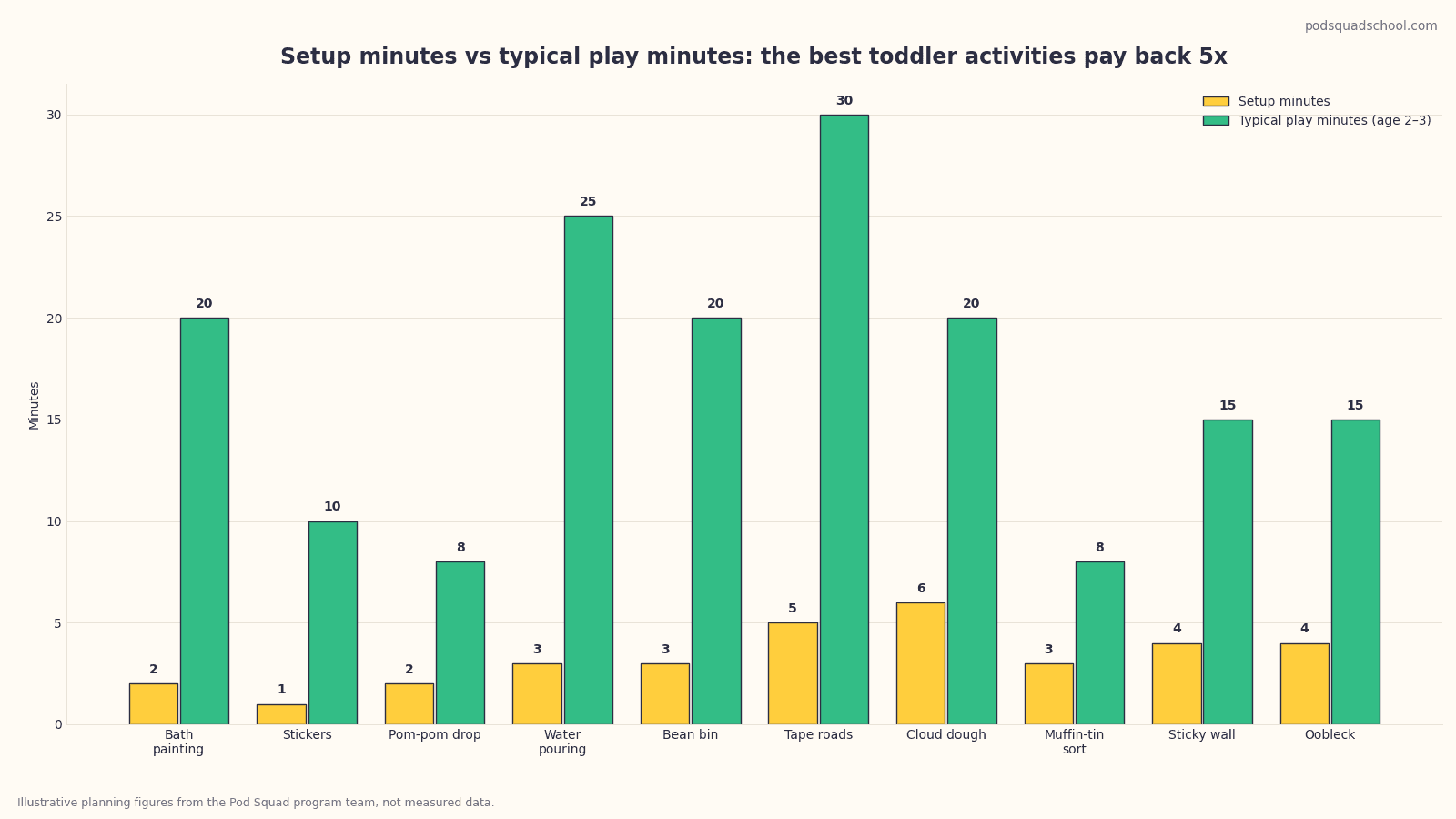
Before you pick, know the ratio. A pouring station takes 90 seconds to set out and holds a 2-year-old for 15 minutes. A themed craft with cut shapes takes 20 minutes to prep and holds them for 6. On a weekday, choose anything with a setup-to-play ratio under one to five.
After school: the 30-minute plan
For a kid coming home from daycare or preschool at 2 or 3, the order matters more than the activity.
- Snack first (5 minutes). Something with protein and fiber, cut safely: cheese cubes and quartered grapes, or hummus and soft pita. See healthy snacks for kids for a week of them.
- Move (10 minutes). Number 11, 13, or 14. They have been holding it together all day; let the body go first.
- One sit-down (15 minutes). Number 1, 9, 20, or 27. Sit with them for the first five, then step back and narrate from the kitchen.
- Clean up together (5 minutes). "Oats in the bin, bin on the shelf." The cleanup is part of the block, not a fight after it.
20 minutes before dinner
Do not start a new bin. Pick a real job that happens where you are: number 43, 44, 45, or 47. The kid is at the counter or the table, within your sight, doing something you needed done. If the kid is melting, number 3 on the kitchen floor with you cooking one step away is the classic save, and it keeps you within arm's length.
Rainy day: the whole-day plan
A rainy day with a 2-year-old is four blocks, two naps or rests worth of quiet, and a lot of snacks.
| Time | Block | Numbers | Minutes |
|---|---|---|---|
| 8:00 | Big movement in the living room | 12, then 14 | 25 |
| 9:00 | Messy block on a towel | 4 or 5, then 3 to wash hands | 30 |
| 10:00 | Books and quiet | 32, 56 | 15 |
| 10:30 | Real job | 44 (make lunch together) | 15 |
| 12:30 | Nap or rest with audio | 61 | 60 to 90 |
| 2:30 | Pretend | 28 or 34 | 25 |
| 3:30 | Fine motor at the table | 19, 21, or 26 | 15 |
| 4:30 | Puddles if it lets up, or 3 in the bath | 51 or 3 | 20 |
Saturday: adventure morning, project afternoon
Saturday works best in two halves. In the morning, go somewhere: number 55 at a new park, a library story time, a farm, or a fire station open house (our Thursday adventures rotate through these; on your own, search your county parks page). Aim to be out by 9 and back by 11:30 for lunch and a nap. In the afternoon, one project block with a bit more setup than a weekday allows: number 6 (make the dough together, then play), number 7 (you froze the pan Friday night), or number 36 with a long roll of paper. Sunday afternoon is a good time to set out Monday's bin.
A worked week
Here is one plan a family could run this week for a 26-month-old who is in daycare Monday through Thursday and home Friday through Sunday. Adjust the numbers, not the shape.
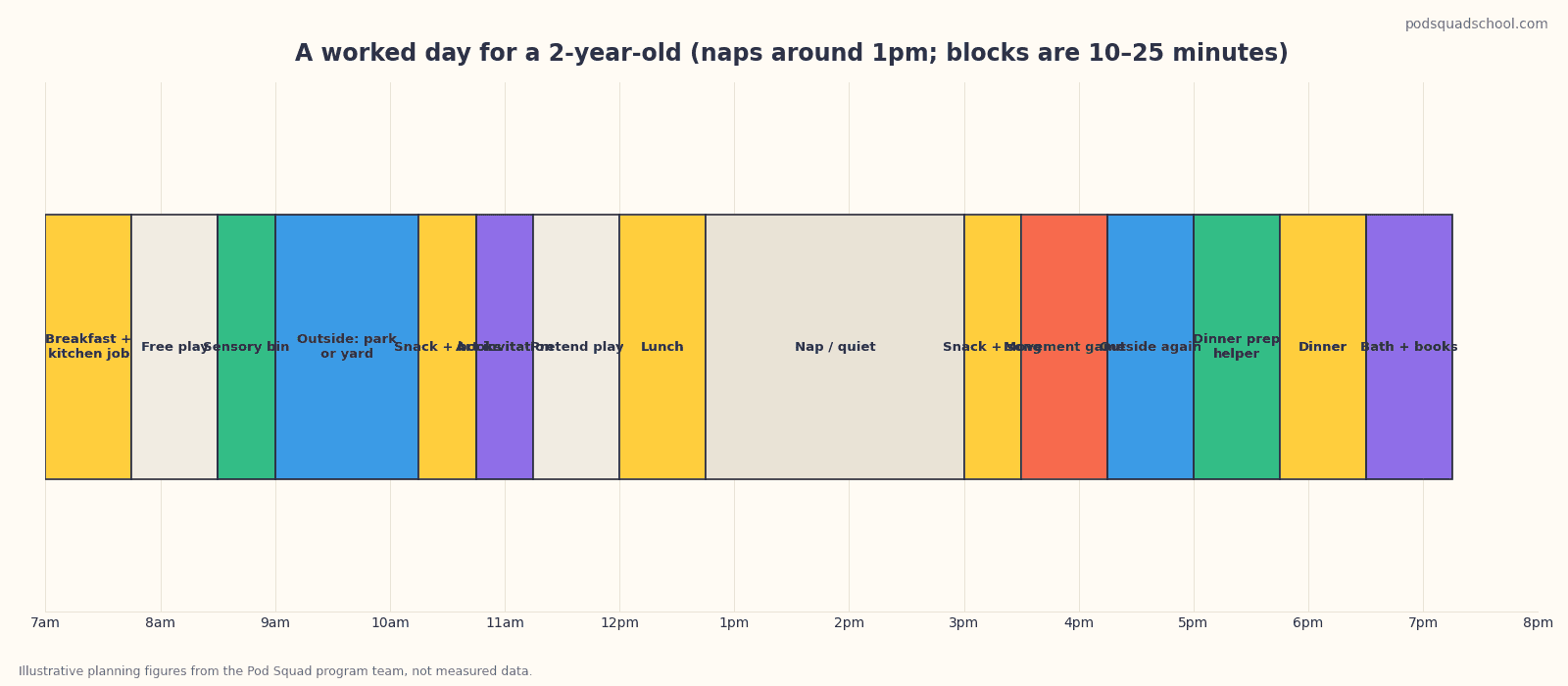
Monday, after school (35 minutes). Snack, then number 11 tape lines (still down from the weekend), then number 1 oats bin at the table while you start dinner. You say: "Scoop, then pour." You watch for two-handed pouring; at 26 months it is often still a dump. Cleanup together.
Tuesday, after school (30 minutes). Snack, number 13 laundry basket toss, then number 27 doll breakfast, with you as the very hungry bear. You listen for two-word phrases ("more milk") and add a third word back ("more warm milk").
Wednesday, before dinner (20 minutes). Number 43 and 45: tear the lettuce, sort the spoons. No setup. Dinner is 10 minutes later than usual and that is fine.
Thursday, after school (30 minutes). Snack, number 14 freeze dance for 5 minutes, then number 3 water tub on the kitchen floor with the colander for 20 while you are within arm's length at the stove. Towel down first.
Friday, home all day. 8:30, number 12 cushion mountain (20 minutes). 9:30, number 5 oobleck on a baking sheet (15 minutes), straight into number 3 to wash off. 10:30, out to the park for number 55, with the one goal of the small ladder (45 minutes). 12:30, nap. 3:00, number 20 peas into the ice cube tray (10 minutes), then number 32 with two books (10 minutes). 4:30, number 47, wipe the table before dinner (5 minutes). Total planned play: about 1 hour 45 minutes, in six pieces.
Saturday. Adventure morning: the library story time at 10, then the playground next door. Afternoon: number 6, make playdough together at 3:00, then play with it until 3:40. Freeze the loaf pan for number 7 before bed.
Sunday. Number 7 ice rescue on the porch at 9:00 (20 minutes). Number 44 pancakes at 10:00. Afternoon: swap two books in the basket (number 56), and set out Monday's bin so it is ready when you walk in the door.
That is about five hours of planned play across the week, no single block over 45 minutes, and a total materials cost under $15 if you already own cups, tape, and a dish tub.
Where Pod Squad fits, stated plainly
Pod Squad is a paid membership: free for 7 days, then $99 a month for the first kid, with siblings at half price. It is an app and website that plans exactly this for your kid's age each day: what to set out, what to say, what to watch for, and what to do when it falls apart, with a note for a 26-month-old that reads differently from the note for a 40-month-old. Toddler Squad runs 12-week seasons with a theme each week (Color Splash, Wheels and Roads, Water and Weather, and so on), a Squad Job, a Wonder Lab science moment, a Letter of the Week, books, songs, a shopping list, printables, and a Thursday adventure at a real place sorted by distance from your home. The app reminds you the night before and the morning of, runs a Block Timer, and prints the worksheet in one tap. The kid never touches the app.
You do not need any of that to run this post. If you have the energy to plan a week on Sunday night, this list and our sensory bin guide will carry you for months, and the free path is the right call for a lot of families. Where a membership earns its price is the planning tax: the 25 minutes a night you spend deciding, shopping, and prepping, and the weeks that quietly go by with no plan at all. Families with a toddler in daycare use it for the hour after pickup, weekends, and the moments they are stuck; families home all day run the whole morning on it, about two hours a day.
If you want to see what a planned week looks like before deciding, the free sample is a Week 1 worksheet and a Wonder Lab card, and you can start the 7-day free trial any time, cancel in two taps, and keep every idea you picked up. The details are at how it works and on the toddler program page.
Mistakes that cost the most
- Sitting down before moving. A 2-year-old asked to do a fine-motor tray at 4:50 pm with a full body of daycare energy will throw the tray. Fix: ten minutes from the movement list first, every time.
- Choosing by the photo. The craft with cut-out felt shapes took you 20 minutes and held them for 6. Fix: choose by the setup-to-play ratio; oats and water win on weekdays, crafts belong to Saturday afternoon.
- Quizzing instead of talking. "What color is this? What shape? How many?" turns play into a test and shuts the talking down. Fix: narrate ("you filled it all the way up"), wonder ("I wonder where the water went"), and ask one real question you do not know the answer to.
- Skipping the age note. Threading at 22 months ends in tears; pouring at 40 months ends in boredom. Fix: read the age line before you set out, and when in doubt, go one band younger; success first, stretch second.
- Treating small parts casually. Beans, pom-poms, beads, coins, and popped balloons are the parts that end up in mouths. Fix: the toilet-paper-tube rule, and every small-parts bin goes to a high shelf the minute the block ends.
- Turning your back on water. A dish tub is water. Fix: arm's length, always, and empty it when the block ends. Do the prep before the kid sits down so you never have to leave.
- Rescuing too fast. The lid does not fit; you fix it in one second. The kid learned that you fix things. Fix: count to ten in your head, then narrate ("that one is too big") rather than solve.
- Buying before trying. Sensory tables, subscription kits, and 40-piece tool sets are fun, but a dish tub and a bag of oats are the actual test. Fix: run two weeks from this post with what you own, then buy whatever the kid kept asking for.
Who this is for, and who it is not for
This is for parents of kids between about 18 months and 4 years who want a real plan for the afternoon, the weekend, or the rainy day, and want it to fit their kid's actual age. It works whether the kid is in daycare five days, preschool three mornings, or home all day with you. It works for grandparents on Wednesdays and for the babysitter, which is why every entry has a one-line "say" to hand over.
It is not for you if your kid is under 15 months (most of this is a step ahead; a baby wants faces, floor time, and things to bang), or if you need a structured academic curriculum for a 4- or 5-year-old (see our homeschool preschool curriculum comparison for that). And it is not a substitute for a pediatrician if you are worried about milestones; the CDC checklists linked below are a starting point for that conversation, not an ending point.
Frequently asked questions
How long should a 2-year-old play with one activity?
Five to fifteen minutes on something they chose is typical at 24 months, and longer stretches happen with water, dough, and pretend play. A rule of thumb from early childhood educators is a few minutes per year of age for a task a grown-up picked, so two to six minutes at 2. Set out for the short end and be pleasantly surprised. If your kid stays with a bin for 25 minutes, do not interrupt to move on to the next thing; the long stretch is the point.
What are good indoor activities for a 2-year-old on a rainy day?
Start with movement: tape lines on the floor, a cushion mountain, freeze dance. Then a messy block on a towel, like cloud dough or a dish tub of water with cups, with you at arm's length. Then books, then a real job like stirring lunch. After nap, pretend play (grocery store, doll breakfast) and a short fine-motor tray (stickers, clothespins). The whole-day table above lays it out hour by hour with activity numbers.
What is the difference between activities for an 18-month-old and a 2-year-old?
An 18-month-old is mostly dumping, filling, mouthing, and walking things from one place to another; every material must be taste-safe and larger than a toilet-paper tube, and most play is next to you. By 24 to 30 months, most kids scoop and pour with some control, twist lids, jump with both feet, put two words together, and pretend (feeding a bear). So the same oats bin gains a funnel and a muffin tin, and the same book goes from "where is the dog" to "what is the dog doing".
Are sensory bins safe for a 2-year-old?
Yes, with two rules. Under 3, every filler should be taste-safe (dry oats, cornmeal, cooked pasta, flour-based dough) and larger than a toilet-paper tube or eaten safely if swallowed; skip beans, rice, beads, and pom-poms until 3 and keep them on a high shelf after. Any bin with water means a grown-up within arm's length, and the tub is emptied when the block ends. Sit with your kid for the first few minutes of any new bin and watch how they use their mouth.
How much screen time should a 2-year-old have?
The American Academy of Pediatrics recommends limiting screen media for kids ages 2 to 5 to about one hour a day of high-quality programming, watched together, and keeping screens out of meals and the hour before bed. The activities in this post are the swap: the quiet list (audio story and crayons, a busy box, a book basket) covers the moments screens usually fill. Our screen time guide has a moment-by-moment audit and a reset week if you want to change the pattern.
What should a 2-year-old be doing developmentally?
The CDC's milestones for 24 months include saying at least two words together, pointing to things in a book, kicking a ball, running, walking up a few stairs, eating with a spoon, and playing with more than one toy at once. By 30 months, jumping with both feet, twisting lids, saying about 50 words, and pretending. Most kids hit most anchors; if yours misses several or loses a skill, talk with your pediatrician. Your pediatrician knows your kid; a checklist does not.
Do I need to buy anything to do these activities?
Almost nothing. A dish tub, painter's tape, a canister of oats, a bag of cornmeal, flour and oil, washable paint, chunky crayons, and dot stickers cover 50 of the 62 activities for well under $30, and most of that you already own. The remaining items are a beach ball, a knob puzzle, nesting cups, and a magnifying glass. Skip sensory tables and subscription kits until your kid has shown you, over two weeks, what they keep coming back to.
Sources & methodology
- Centers for Disease Control and Prevention, "CDC's Developmental Milestones" (Learn the Signs. Act Early.), including the 2-year, 30-month, and 3-year checklists: https://www.cdc.gov/ncbddd/actearly/milestones/index.html
- American Academy of Pediatrics, HealthyChildren.org, "Choking Prevention" (foods and objects to avoid under age 4, small-parts guidance): https://www.healthychildren.org
- American Academy of Pediatrics, HealthyChildren.org, "Drowning Prevention" and water safety guidance for toddlers (touch supervision within arm's reach): https://www.healthychildren.org
- American Academy of Pediatrics, "Media and Young Minds" policy statement (2016) and the Family Media Plan: https://www.healthychildren.org/English/fmp/Pages/MediaPlan.aspx
- American Academy of Pediatrics, clinical report "The Power of Play: A Pediatric Role in Enhancing Development in Young Children" (2018): https://publications.aap.org
- Harvard University Center on the Developing Child, "Serve and Return" and play resources: https://developingchild.harvard.edu
- The LEGO Foundation, "Learning Through Play: a review of the evidence" (Zosh, Hirsh-Pasek, Hopkins, et al.): https://learningthroughplay.com
- National Association for the Education of Young Children (NAEYC), developmentally appropriate practice resources: https://www.naeyc.org
- Play-stage descriptions (solitary, parallel, associative, cooperative) follow Mildred Parten's 1932 classification as summarized in standard child-development references; ages are typical ranges, not cutoffs.
- Attention-span figures are rules of thumb used by early childhood educators, not a clinical norm; the setup-versus-play chart uses Pod Squad Block Timer estimates and is labeled as such.
- Search demand: DataForSEO Labs, Google US, September 10, 2026; volumes for many child-related keywords are suppressed by Google Ads and are shown as clickstream estimates where labeled. Competitor ranking figures (Busy Toddler) are DataForSEO Labs estimates from the same pull.
Bottom line
A 2-year-old does not need a better activity. They need the right one for their age in months, set out in under two minutes, at the right moment of the day, with a grown-up who talks with them instead of testing them. Oats, water, tape, dough, and a real job at the counter cover most afternoons for most kids, and the age note is what turns one bin into three years of play.
Run the worked week above with what you already own. If a bin runs long, let it. If one falls apart, move, then try again tomorrow one age band down. That is the whole method, and it is free.
If you would rather have it planned for your kid's exact age every day, with the reminders and the printing handled, start your free 7 days.
Keep exploring
- Sensory bin ideas: 75 fillers, tools, and themes by age
- Healthy snacks for kids, with portions and safe cuts by age
- Screen time for toddlers: the AAP guidelines and 50 screen-free swaps
- Play-based learning: what the research says
- Toddler Squad: the program, week by week
- Get the app, with reminders and a Block Timer
Questions parents ask
How long should a 2-year-old play with one activity?
Five to fifteen minutes on something they chose is typical at 24 months, and longer stretches happen with water, dough, and pretend play. A rule of thumb from early childhood educators is a few minutes per year of age for a task a grown-up picked, so two to six minutes at 2. Set out for the short end and be pleasantly surprised. If your kid stays with a bin for 25 minutes, do not interrupt to move on to the next thing; the long stretch is the point.
What are good indoor activities for a 2-year-old on a rainy day?
Start with movement: tape lines on the floor, a cushion mountain, freeze dance. Then a messy block on a towel, like cloud dough or a dish tub of water with cups, with you at arm's length. Then books, then a real job like stirring lunch. After nap, pretend play (grocery store, doll breakfast) and a short fine-motor tray (stickers, clothespins). The whole-day table above lays it out hour by hour with activity numbers.
What is the difference between activities for an 18-month-old and a 2-year-old?
An 18-month-old is mostly dumping, filling, mouthing, and walking things from one place to another; every material must be taste-safe and larger than a toilet-paper tube, and most play is next to you. By 24 to 30 months, most kids scoop and pour with some control, twist lids, jump with both feet, put two words together, and pretend (feeding a bear). So the same oats bin gains a funnel and a muffin tin, and the same book goes from "where is the dog" to "what is the dog doing".
Are sensory bins safe for a 2-year-old?
Yes, with two rules. Under 3, every filler should be taste-safe (dry oats, cornmeal, cooked pasta, flour-based dough) and larger than a toilet-paper tube or eaten safely if swallowed; skip beans, rice, beads, and pom-poms until 3 and keep them on a high shelf after. Any bin with water means a grown-up within arm's length, and the tub is emptied when the block ends. Sit with your kid for the first few minutes of any new bin and watch how they use their mouth.
How much screen time should a 2-year-old have?
The American Academy of Pediatrics recommends limiting screen media for kids ages 2 to 5 to about one hour a day of high-quality programming, watched together, and keeping screens out of meals and the hour before bed. The activities in this post are the swap: the quiet list (audio story and crayons, a busy box, a book basket) covers the moments screens usually fill. Our screen time guide has a moment-by-moment audit and a reset week if you want to change the pattern.
What should a 2-year-old be doing developmentally?
The CDC's milestones for 24 months include saying at least two words together, pointing to things in a book, kicking a ball, running, walking up a few stairs, eating with a spoon, and playing with more than one toy at once. By 30 months, jumping with both feet, twisting lids, saying about 50 words, and pretending. Most kids hit most anchors; if yours misses several or loses a skill, talk with your pediatrician. Your pediatrician knows your kid; a checklist does not.
Do I need to buy anything to do these activities?
Almost nothing. A dish tub, painter's tape, a canister of oats, a bag of cornmeal, flour and oil, washable paint, chunky crayons, and dot stickers cover 50 of the 62 activities for well under $30, and most of that you already own. The remaining items are a beach ball, a knob puzzle, nesting cups, and a magnifying glass. Skip sensory tables and subscription kits until your kid has shown you, over two weeks, what they keep coming back to.
Written by
Pod Squad Program Team
Curriculum & play · Pod Squad. We write the daily plan families run, so every post is built from what actually works with a real kid on a real Tuesday.
Keep reading
Activities
Sensory Bin Ideas: 75 Fillers, Tools, and Themes by Age (Taste-Safe Through Age 3)
48 min read
Nourish
Healthy Snacks for Kids: 75 Ideas by Age, With Portions, Prep Times, and the Picky-Eater Playbook
52 min read

Out & About
Things to Do With Kids This Weekend: The Parent's Playbook for Parks, Museums, Libraries, and Free Days Out (By Age)
43 min read