
Nourish
Healthy Snacks for Kids: 75 Ideas by Age, With Portions, Prep Times, and the Picky-Eater Playbook
Seventy-five healthy snacks for kids by age, each with the portion, the choking-safe cut, a protein or fiber pair, and prep minutes. Plus the 2.5 to 3 hour eating window, a lunchbox formula, 45 toddler meal ideas, and a calm picky-eater playbook.
Pod Squad Nourish DeskSeptember 10, 2026Updated September 28, 2026 52 min read
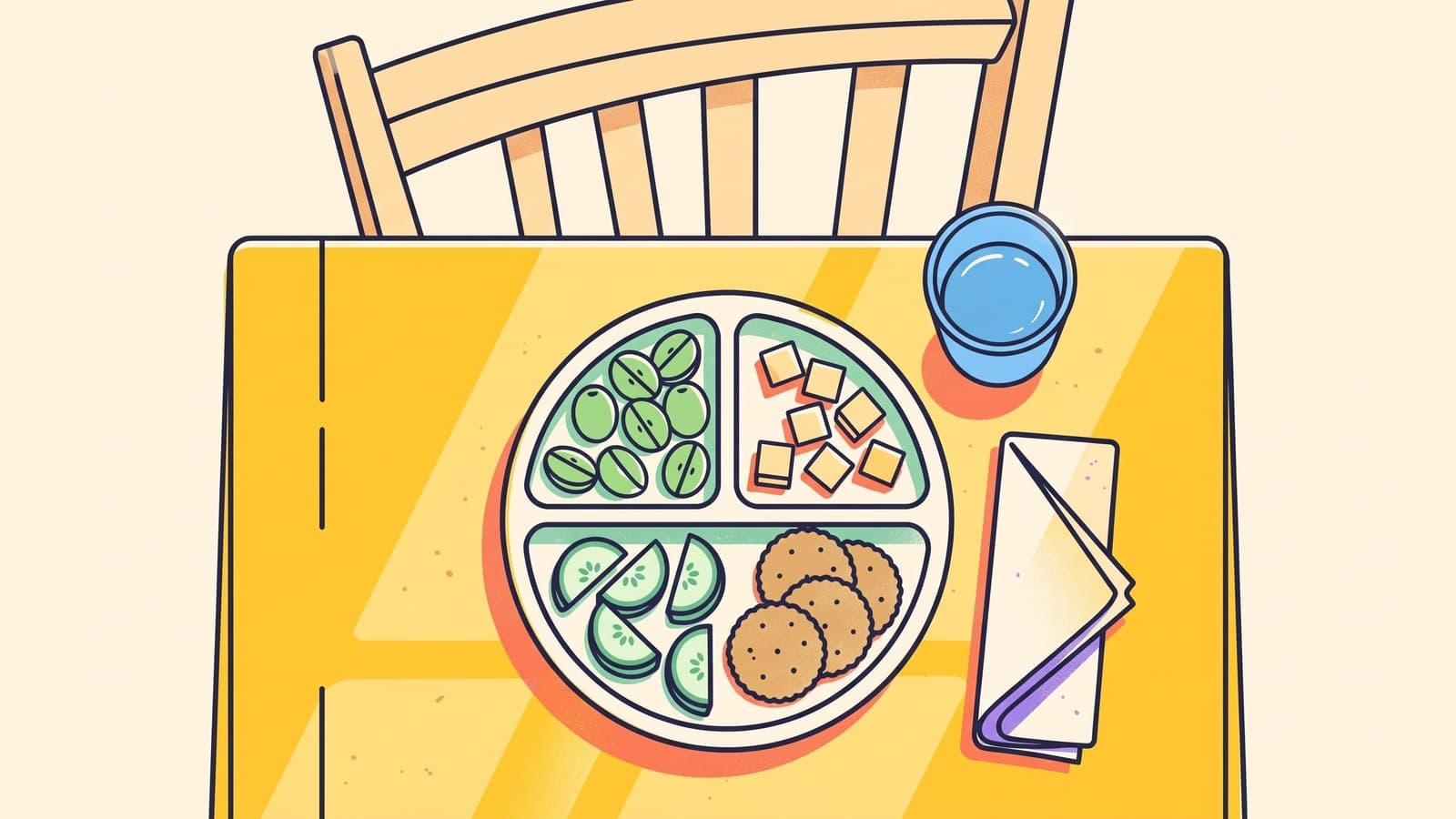
Key Takeaways
- A snack is a small meal, not a treat. The snacks that hold a kid until dinner pair a protein or a fat with a fiber: cheese with apple, hummus with pita, yogurt with berries. A cracker alone buys you 40 minutes; a cracker with cheese buys you two hours.
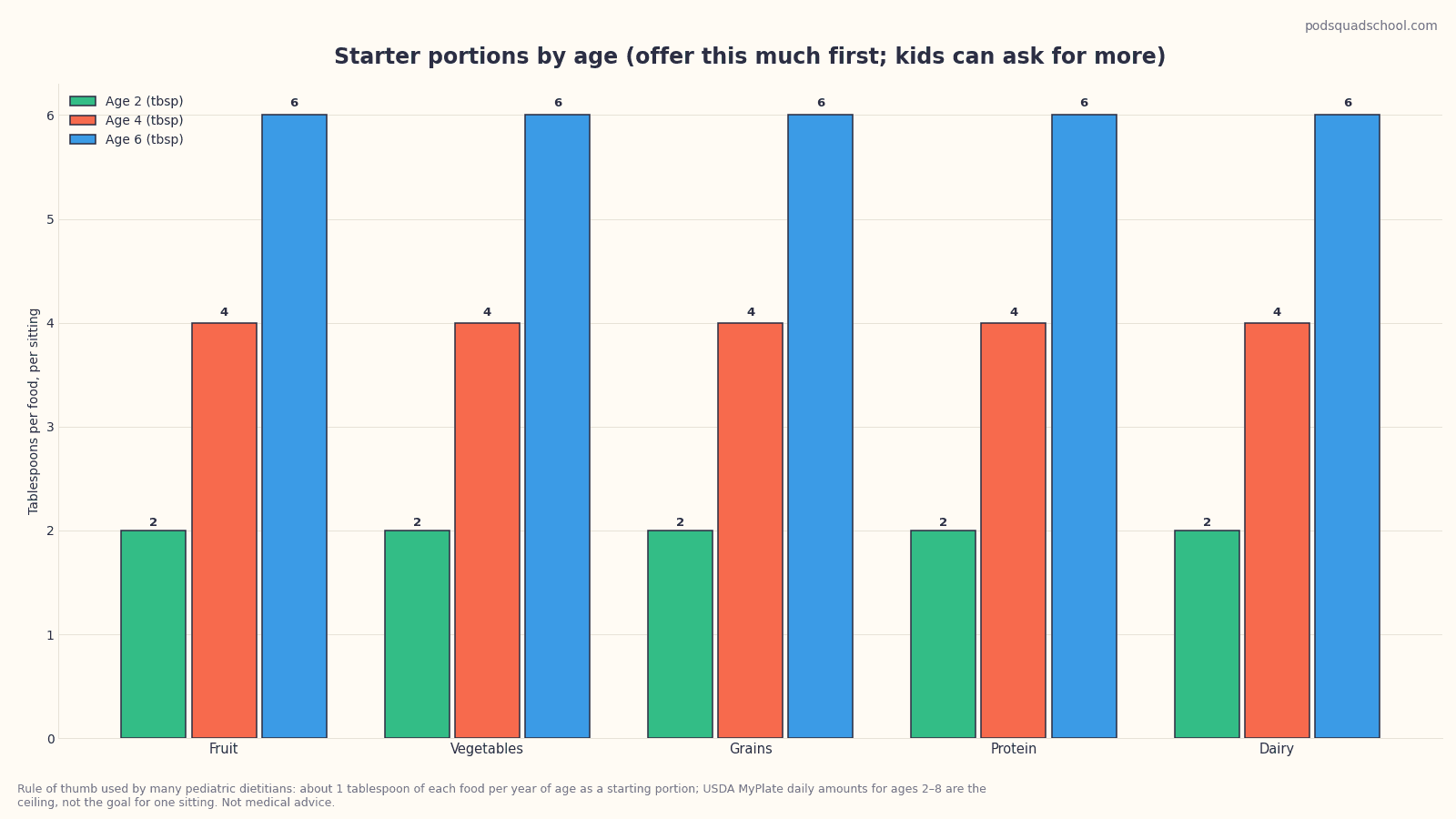
- Start portions small and let the kid ask for more. The AAP's rule of thumb on HealthyChildren.org is about one tablespoon of each food per year of age as a starting portion for toddlers. A 2-year-old's snack can be two tablespoons of cheese cubes and two tablespoons of quartered grapes. That looks like nothing to you; it is a real snack to a 26-pound person.
- Cut for the age, every time. Grapes and cherry tomatoes get quartered lengthwise. No whole nuts, popcorn, hard candy, or hot dog chunks under 4. Nut butter gets spread thin, never served by the spoonful. This is the AAP's choking guidance, and it does not have an off day.
- Run a 2.5 to 3 hour eating window. Toddlers do best with three meals and two or three snacks at predictable times, with water in between. Grazing all afternoon is the single most common reason a 3-year-old "won't eat dinner."
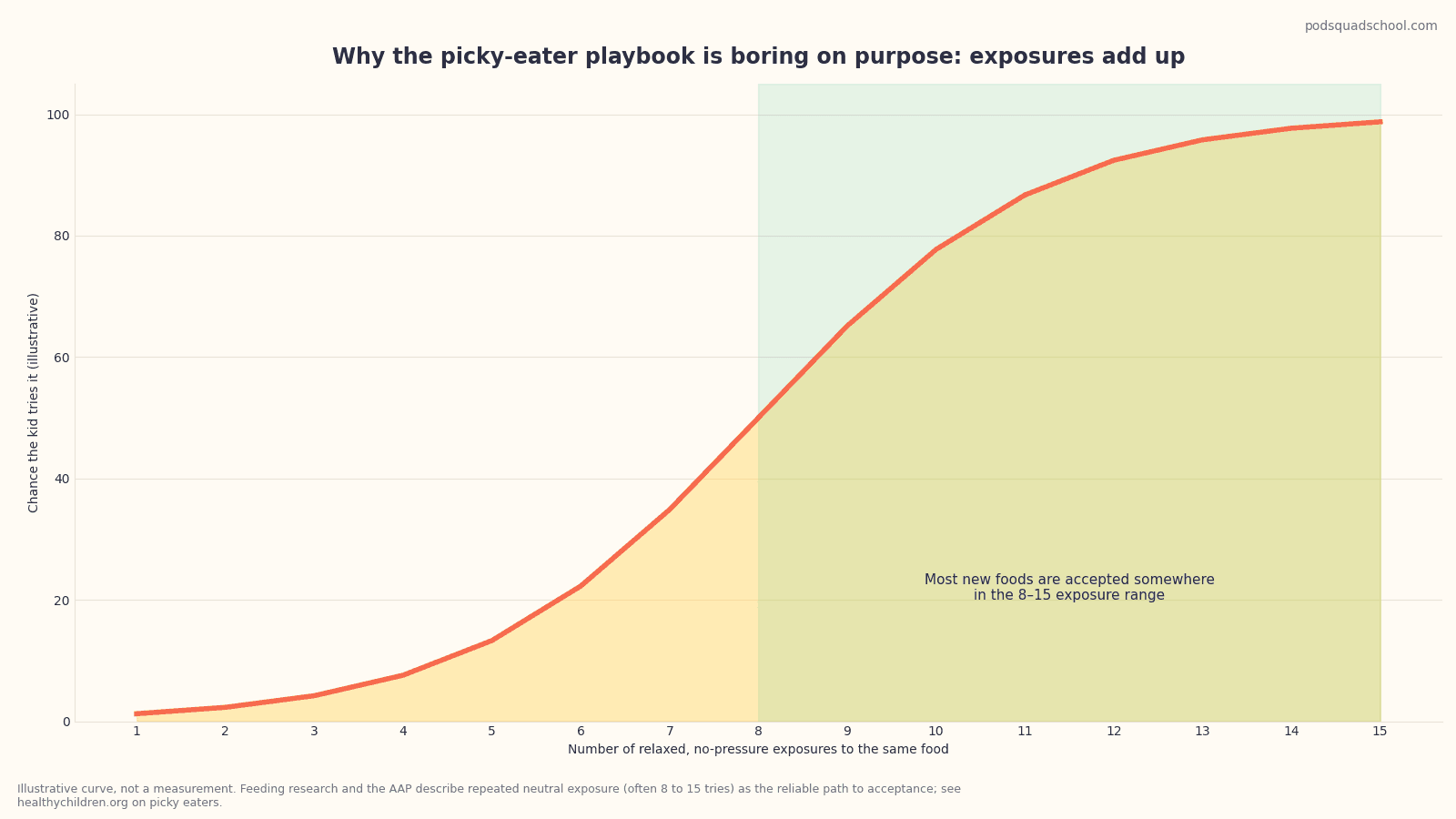
- Picky eating is normal and it responds to repetition, not pressure. Feeding research commonly cites somewhere between 8 and 15 neutral exposures before a new food is accepted. Serve one safe food every time, keep the new food tiny, and stop negotiating. Your job is what, when, and where; the kid's job is whether and how much.
- A weekly system beats daily inspiration. Pick seven snack pairs, prep two of them on Sunday, and rotate. The list below has 75 snacks with the age floor, the cut, the pairing, and the prep minutes so you can build that rotation in ten minutes.
- Pod Squad's Nourish does this planning for you, for a fee. One family menu sized per kid by age, allergy-aware, with choking-safe cuts written into each note. It is a paid membership ($99 a month for the first kid, $50 for each sibling, after 7 free days); the free version of this system is the printable-in-your-head version in this post.
You already know your kid. You know the one who eats a full breakfast and then nothing until 3 pm, the one who lives on cheese and air, the one who asks for a snack eleven minutes after lunch. What most parents do not have is a system: which snacks actually hold a kid, how much to put on the plate at 18 months versus 6 years, how to cut a grape so it is not a hazard, and what to do when your 3-year-old declares that peas are "yucky" for the fortieth time.
This post is that system. It is written for any parent or grown-up who feeds a kid between about 1 and 10 years old, whether the kid is in daycare, in school, or home with you all day. Homeschooling families will find the full-day rhythm useful; school families will mostly use the after-school and lunchbox sections. Nothing here requires a special diet or a special store.
Two rules before we start. Nutrition guidance below is drawn from the American Academy of Pediatrics (HealthyChildren.org) and USDA MyPlate, and we cite them where it matters. None of it is medical advice. If your kid has a diagnosed allergy, a growth concern, reflux, a feeding delay, or anything that worries you, your pediatrician knows your kid, and their word overrides any list on the internet, including this one.
What parents are actually searching for (2026)
We pulled the search demand for this topic before writing a word, because the shape of the demand tells you what parents are actually stuck on. The picture is clear: the big head term is "healthy snacks for kids," lunch ideas are nearly as large, and the fastest-growing term by far is "picky eater." Google Ads hides volume for many keywords about young children, so several of these rows use clickstream estimates (labeled).
| Keyword | US searches/mo | Difficulty | What they want |
|---|---|---|---|
| healthy snacks for kids | 33,100 | 1 | A list they can shop from tonight |
| kids lunch ideas | 22,200 | 1 | A lunchbox formula that survives a school day |
| baby led weaning | 60,500 | 32 | How to start solids without purees; safety cuts |
| picky eater | 8,100 | 31 | Why their kid refuses food and what to do (up 83% in 12 months) |
| toddler lunch ideas | ≈2,086 (clickstream) | n/a | Fast lunches for a 1 to 3 year old |
| toddler snacks | ≈1,628 (clickstream) | n/a | Snacks that are safe and quick |
| toddler dinner ideas | ≈1,475 (clickstream) | n/a | Dinners the toddler will eat that adults can share |
| toddler breakfast ideas | ≈1,017 (clickstream) | n/a | Breakfasts beyond cereal and banana |
| toddler meal ideas | ≈864 (clickstream) | n/a | A whole-day plan |
| healthy toddler snacks | ≈457 (clickstream) | n/a | Same as toddler snacks, with a nutrition filter |
| healthy snacks for toddlers | ≈356 (clickstream) | n/a | Same intent, different word order |
| kid friendly recipes | ≈305 (clickstream) | n/a | Recipes the whole family can eat |
| snack ideas for kids | ≈152 (clickstream) | n/a | Variety for a kid who is bored of the rotation |
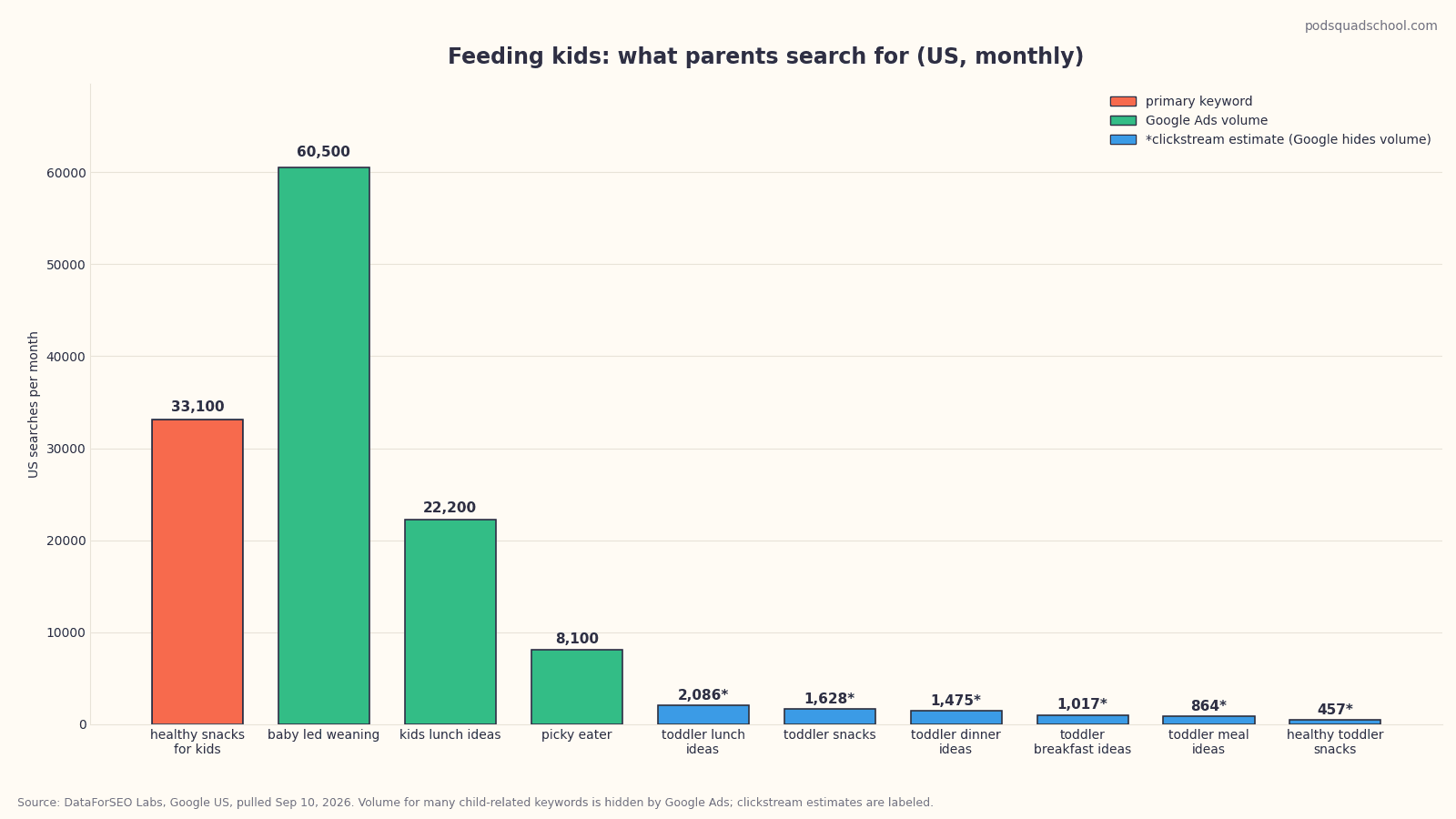
Source: DataForSEO Labs, Google US, pulled September 10, 2026.
Read the intent column and a pattern shows up. Parents are not searching for nutrition theory. They search at 4:45 pm with a kid hanging on their leg, or on Sunday night staring at an empty lunchbox. The head terms have a difficulty score near zero, which means Google is not confident anyone has answered them well; the results are dominated by big food and parenting publishers running 30-item listicles with a photo of a cheese board. Those pages answer "what" and skip "how much," "how to cut it," and "how long it takes." The "picky eater" query is different: it has real difficulty (31) and it grew 83% in a year. That is a parent who has already read the listicles and still has a 3-year-old who eats four foods.
The gap, then, is a page that treats snacks the way a good pediatric dietitian treats them: by age, with a portion, a cut, a pairing, and a prep time, inside a daily rhythm, with a calm plan for refusal. Nobody in the top results organizes snacks by the kid's age in months, and nobody gives a repeatable weekly system. That is what the rest of this post does.
Portions by age: how much is a snack, really
The most common feeding mistake we see is not the wrong food. It is the wrong amount, in both directions: a plate heaped like an adult's for a 2-year-old (who then "never finishes"), or a snack so big at 4 pm that dinner at 6 is dead on arrival.
The AAP starting portion
HealthyChildren.org, the AAP's parent site, gives a starting rule that is easy to hold in your head: about one tablespoon of each food per year of age, and let the kid ask for more. So a 2-year-old's snack plate might hold two tablespoons of cottage cheese and two tablespoons of quartered blueberries. A 4-year-old gets a quarter cup of each. If the kid finishes and asks for more, give more. If the kid eats half, that was the right amount for that day. Toddler appetite varies wildly from meal to meal and day to day, and the AAP is clear that the weekly picture matters more than any one plate.
The other half of the AAP guidance: toddlers eat three meals and two to three snacks a day, spaced out, with water and milk as the drinks. The AAP's juice policy recommends no juice at all before 12 months and, for ages 1 to 3, no more than 4 ounces a day if you serve it at all; whole fruit is always the better choice. For milk, HealthyChildren.org puts toddlers at roughly 16 to 24 ounces a day (about two to three cups). More than that crowds out iron-rich food and is a frequent, invisible cause of a "kid who won't eat."
What MyPlate says a whole day looks like
USDA MyPlate publishes daily food group amounts by age. These are day totals, not snack totals, and they are useful as a sanity check when you feel like your kid "never eats vegetables." The numbers below are rounded from MyPlate's life-stage pages and the 2020 to 2025 Dietary Guidelines patterns.
| Age | Fruit | Vegetables | Grains | Protein foods | Dairy |
|---|---|---|---|---|---|
| 12 to 23 months | ½ to 1 cup | ⅔ to 1 cup | 1¾ to 3 oz | 2 oz | 1⅔ to 2 cups |
| 2 to 3 years | 1 cup | 1 cup | 3 oz | 2 oz | 2 cups |
| 4 to 8 years | 1 to 1½ cups | 1½ cups | 4 to 5 oz | 3 to 4 oz | 2½ cups |
| 9 to 13 years | 1½ cups | 2 to 2½ cups | 5 to 6 oz | 5 oz | 3 cups |
Two translations. A "1 oz equivalent" of grains is one slice of bread, half a cup of cooked oatmeal, or about five whole-grain crackers. A "1 oz equivalent" of protein is one egg, one tablespoon of nut butter, a quarter cup of cooked beans, or one ounce of meat, fish, or cheese. So a 2-year-old's whole day of protein is two eggs' worth. Spread across three meals and two snacks, that is a very small amount per sitting, which is exactly why the tablespoon-per-year rule works.
What that looks like on a plate
| Age | A realistic afternoon snack | Roughly |
|---|---|---|
| 12 to 18 months | 2 tbsp shredded cheese, 2 tbsp soft pear pieces, water in an open cup | 2 tbsp each |
| 18 to 24 months | 2 tbsp hummus, 2 whole-grain crackers, 4 quartered grapes | 2 tbsp each |
| 2 to 3 years | 3 tbsp plain yogurt with 3 tbsp mashed berries, ½ slice toast | 3 tbsp each |
| 3 to 4 years | ¼ cup cottage cheese, ¼ cup cucumber moons, 5 crackers | ¼ cup each |
| 4 to 6 years | 1 hard-boiled egg, ½ apple in thin slices, ¼ cup pretzels | ¼ to ⅓ cup each |
| 6 to 10 years | 1 cheese stick, 1 small apple, ½ cup air-popped popcorn (age 4 and up only) | ½ cup each |
If your kid eats every bite and looks around for more, add more of the same, not a different food. That keeps the snack from turning into a buffet.
Choking-safe cuts: the rules that do not bend
The AAP lists the foods most often involved in choking in young children, and the list is short enough to memorize: hot dogs, whole grapes, nuts and seeds, popcorn, hard candy, chunks of meat or cheese, raw carrots and other hard raw vegetables, spoonfuls of nut butter, marshmallows, and chewing gum. The AAP's guidance is to keep these off the menu, or change their shape, until about age 4, and to have a kid seated and supervised while eating at any age.
Here is how that translates at the counter.
| Food | Under 12 months | 12 to 24 months | 2 to 4 years | 4 years and up |
|---|---|---|---|---|
| Grapes, cherry tomatoes, blueberries | Quartered lengthwise (blueberries halved or smashed) | Quartered lengthwise | Quartered lengthwise | Halved lengthwise until you are confident; whole around 5 |
| Cheese | Shredded or thin strips | Shredded or thin strips | Small cubes no bigger than a pea, or thin sticks | Cubes or sticks |
| Hot dogs and sausages | Avoid | Avoid | Avoid, or quartered lengthwise and then diced | Sliced lengthwise then chopped |
| Raw carrot, celery, apple | Cooked soft or grated | Grated or cooked | Very thin matchsticks or shaved; cooked is safer | Thin sticks or slices |
| Nut butter | Thin smear on toast only | Thin smear only, never by the spoon | Thin smear only | Spread, not spooned, until 5 |
| Whole nuts and seeds | Avoid | Avoid | Avoid | Introduce whole nuts around 4 to 5, seated |
| Popcorn | Avoid | Avoid | Avoid | OK from 4, seated |
| Hard candy, gum, marshmallows | Avoid | Avoid | Avoid | Occasional, seated |
| Meat | Shredded or minced | Shredded or minced | Small, tender pieces cut across the grain | Bite-size pieces |
| Bread | Lightly toasted strips | Toast strips; avoid soft white bread balls | Toast or sandwiches cut small | Normal |
Three habits that matter as much as the cuts. First, kids sit to eat; no snacks in the car seat, on the trampoline, or while walking, because a stumble with a mouthful is how a safe food becomes a hazard. Second, an adult stays within arm's length and looking at the kid, not the phone, for anyone under 4. Third, if you use a squad or a playdate rotation, the host cuts to the youngest kid's rules, not the oldest's; the 4-year-old will not mind quartered grapes and the 20-month-old cannot handle whole ones. (The allergy and snack-table protocol for a shared group is in homeschool co-ops, pods, and squads.)
Allergen introduction, briefly
The AAP's 2019 clinical report on early nutrition and allergy prevention, following the 2017 NIAID guidelines on peanut, found no evidence that delaying common allergens (peanut, egg, dairy, tree nuts, wheat, soy, fish, shellfish, sesame) past about 4 to 6 months prevents allergy, and evidence that early introduction of peanut can reduce peanut allergy risk in some infants. That is a conversation to have with your pediatrician before you start, especially if your baby has severe eczema or an existing egg allergy, which the guidelines flag as higher risk. Once a food is introduced without a reaction, keeping it in regular rotation matters. This post is not that conversation; your pediatrician knows your kid.
One more AAP rule that catches people: no honey in any form before 12 months, because of infant botulism risk. After the first birthday it is fine.
The snack timing rhythm: the 2.5 to 3 hour window
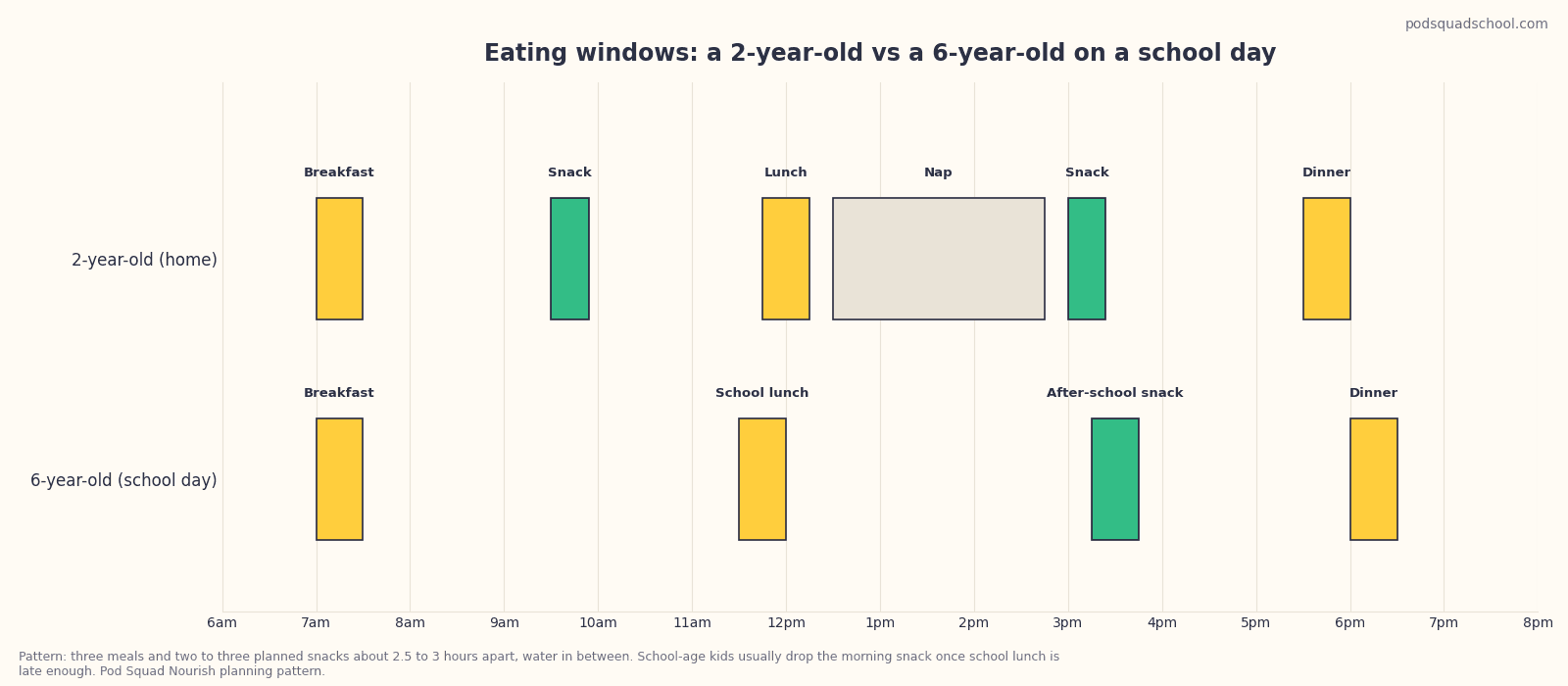
If you change one thing after reading this post, change this. Toddlers and preschoolers eat best when food arrives every 2.5 to 3 hours and nothing but water arrives in between. That is not a diet rule; it is how small stomachs and short attention spans work. A 2-year-old's stomach empties fast, so they are truly hungry every few hours. But a 2-year-old who sips milk and grazes crackers all afternoon is never quite hungry and never quite full, and so dinner becomes a negotiation.
Here is what the window looks like across two ages.
| Time | 2-year-old at home | 6-year-old in school |
|---|---|---|
| 7:00 | Breakfast | Breakfast |
| 9:30 | Snack | (school, no snack or a small class snack) |
| 12:00 | Lunch | Lunch at school (11:30 to 12:15) |
| 2:30 | Snack (post-nap) | Afternoon snack at pickup (3:00) |
| 5:30 | Dinner | Dinner (5:45 to 6:00) |
| 7:00 | Optional small bedtime snack (milk and a banana) | Optional small bedtime snack if dinner was early |
A few practical notes. The post-nap snack is the one that matters most for a toddler's evening; a kid who wakes at 2:15 and eats a real snack at 2:30 will be hungry and reasonable at 5:30. The after-school snack for a school kid is often the hungriest moment of their day, because school lunch was at 11:30 and they ran around all afternoon. Make that one substantial (protein plus fiber) and dinner will still work if it is 2.5 hours later. If dinner is at 5:00 because of a schedule, skip the 3:00 snack or shrink it to a fruit.
Meals themselves go better with the screens off; the AAP recommends no screens during meals at any age, and the swaps for a screen-free dinner are in screen time for toddlers.
The "closed kitchen" between windows is not punitive. Say it plainly and kindly: "Snack is at 2:30. You can have water now." Say it the same way every time. Within about a week most kids stop asking, because the answer is predictable.
Pairing logic: why a cracker alone does not work
The snack that holds a kid is a carbohydrate plus a protein or a fat, or a fruit or vegetable plus a protein or a fat. Carbohydrates alone (crackers, fruit, pretzels, a granola bar) digest fast and leave a kid hungry and cranky within the hour; the protein or fat slows that down and adds the nutrients toddlers most often run short on (iron, zinc, and for the youngest, fat for brain growth). Fiber from fruit, vegetables, whole grains, and beans keeps things moving and supports the kid who is prone to constipation, which is a lot of toddlers.
You do not need to count anything. Just check that each snack has two parts from different columns.
| Carb or fruit/veg (pick one) | Protein or fat (pick one) |
|---|---|
| Whole-grain crackers, pita, toast, rice cakes, tortilla | Cheese (shredded, cubes, string), cottage cheese, yogurt |
| Apple, pear, banana, berries, melon, mango, orange, kiwi | Hummus, white bean dip, refried beans |
| Cucumber, bell pepper, cherry tomato, snap peas, steamed carrot | Nut or seed butter (thin smear), sunflower seed butter |
| Oatmeal, overnight oats, whole-grain toast | Hard-boiled egg, egg muffins |
| Popcorn (4 and up), pretzels, plain tortilla chips | Shredded chicken, turkey slices, meatballs, tuna |
| Sweet potato, corn, peas, edamame | Avocado, guacamole, olive oil on toast |
| Fruit smoothie base | Tofu cubes, milk, plain yogurt in the smoothie |
One honest caveat: this is a heuristic, not a rule. A banana alone at 9:30 is a perfectly fine snack for a 2-year-old who ate a big breakfast. The pairing rule earns its keep at the hungry moments: post-nap, after school, and any snack more than 2.5 hours before the next meal.
75 healthy snacks for kids, by age
Everything below lists the earliest age we would serve it in that form, the cut or prep note, the pair that makes it a full snack, hands-on prep minutes, and whether it can be made ahead. Age floors follow the AAP's choking guidance and are conservative; a kid with a known feeding delay or who is still mastering chewing needs the cut for a younger age. "Make-ahead" means you can prep a batch on Sunday and hold it for the week in the fridge or freezer.
From 12 months
| # | Snack | Age floor | Cut or prep note | Protein or fiber pair | Prep min | Make-ahead? |
|---|---|---|---|---|---|---|
| 1 | Shredded cheddar or mozzarella | 12 mo | Shred fine; small cubes only from 2 | Soft pear pieces | 1 | Yes, shred a block Sunday |
| 2 | Plain whole-milk yogurt with mashed berries | 12 mo | Mash blueberries or raspberries fully | Already a pair (dairy plus fruit) | 2 | Yes, 3 days |
| 3 | Avocado spears or mash | 12 mo | Spears for hand grip; mash for a spoon | Toast strip | 2 | No, browns |
| 4 | Ripe banana, halved lengthwise | 12 mo | Split lengthwise so it is not a round | Thin smear of peanut or sunflower butter | 1 | No |
| 5 | Scrambled egg pieces | 12 mo | Cooked soft, torn into pieces | Steamed sweet potato cube | 5 | Yes, 2 days |
| 6 | Steamed sweet potato cubes | 12 mo | Steam until a fork slides through; cool | Shredded cheese | 12 | Yes, 4 days |
| 7 | Cottage cheese with peach | 12 mo | Dice ripe peach small | Already a pair | 2 | Yes, 2 days |
| 8 | Whole-grain toast strips with thin nut butter | 12 mo | Toast lightly; butter spread thin, never a glob | Already a pair | 3 | No |
| 9 | Soft-cooked pasta shapes with olive oil | 12 mo | Cook past al dente; small shapes | Grated parmesan or white beans | 12 | Yes, 4 days |
| 10 | Mashed white beans on toast | 12 mo | Mash cannellini with a fork and a little olive oil | Already a pair | 4 | Yes, 4 days |
| 11 | Ripe pear or peach slices | 12 mo | Peel and slice thin; ripe enough to smush | Cottage cheese | 2 | No |
| 12 | Steamed broccoli florets | 12 mo | Steam soft; the stem is a handle | Hummus | 8 | Yes, 3 days |
| 13 | Oatmeal fingers | 12 mo | Cook thick oatmeal, chill in a pan, cut into bars | Mashed banana in the batter | 15 | Yes, freezes |
| 14 | Egg muffins | 12 mo | Whisk eggs with spinach and cheese, bake in a muffin tin, cut in quarters | Already a pair | 20 | Yes, freezes |
| 15 | Smashed blueberries | 12 mo | Press each one flat with a thumb | Plain yogurt | 2 | No |
From 18 months
| # | Snack | Age floor | Cut or prep note | Protein or fiber pair | Prep min | Make-ahead? |
|---|---|---|---|---|---|---|
| 16 | Quartered grapes | 18 mo | Always lengthwise into quarters | Cheese cubes (pea-size) | 3 | Yes, 2 days |
| 17 | Hummus with soft pita | 18 mo | Tear pita into small pieces | Already a pair | 2 | Hummus, 5 days |
| 18 | Cucumber moons | 18 mo | Peel, slice thin half-moons, remove seeds if watery | Cream cheese or hummus | 3 | Yes, 2 days |
| 19 | Whole-grain crackers with cheese | 18 mo | Small crackers; thin cheese slices | Already a pair | 2 | Portion Sunday |
| 20 | Applesauce (unsweetened) with cinnamon | 18 mo | Spoon or pouch | Cheese stick or a few crackers | 1 | Yes, homemade 5 days |
| 21 | Steamed carrot coins | 18 mo | Steam until soft; slice thin coins, then halve | White bean dip | 10 | Yes, 4 days |
| 22 | Mini meatballs | 18 mo | Turkey or beef, baked, cut in quarters | Peas | 25 | Yes, freezes |
| 23 | Mango, diced small | 18 mo | Slippery; cut into pea-size dice | Yogurt | 4 | Yes, 2 days |
| 24 | Rice cake with mashed avocado | 18 mo | Break into pieces; watch for sticky mouthfuls | Already a pair | 2 | No |
| 25 | Edamame, shelled and halved | 18 mo | Buy frozen shelled; steam, halve each bean | Already protein and fiber | 5 | Yes, 3 days |
| 26 | Banana oat pancakes | 18 mo | Blend 1 banana, 1 egg, ¼ cup oats; cook small | Already a pair | 12 | Yes, freezes |
| 27 | Kiwi slices | 18 mo | Peel, slice thin, quarter each slice | Cottage cheese | 2 | No |
| 28 | Soft tofu cubes | 18 mo | Press lightly, cube, toss in a little soy or plain | Steamed rice | 4 | Yes, 3 days |
| 29 | Ricotta on toast with mashed strawberry | 18 mo | Mash the berry into the ricotta | Already a pair | 3 | No |
| 30 | Melon, thin slices | 18 mo | Thin slices, then small pieces; no round balls | String cheese | 3 | Yes, 2 days |
From 2 years
| # | Snack | Age floor | Cut or prep note | Protein or fiber pair | Prep min | Make-ahead? |
|---|---|---|---|---|---|---|
| 31 | Cheese cubes | 2 y | No bigger than a pea, or thin sticks | Quartered grapes | 3 | Yes, 4 days |
| 32 | Cherry tomatoes, quartered | 2 y | Always lengthwise quarters | Mozzarella pearls, halved | 3 | Yes, 2 days |
| 33 | Bell pepper strips | 2 y | Very thin strips; red and orange are sweeter | Hummus | 3 | Yes, 3 days |
| 34 | Hard-boiled egg | 2 y | Quarter it; older kids can peel their own | Toast or crackers | 12 | Yes, 5 days in shell |
| 35 | Apple, thinly sliced | 2 y | Peel for the youngest; slices thin enough to bend | Thin nut butter smear or cheese | 3 | Toss in lemon water, 1 day |
| 36 | Snap peas, strings removed | 2 y | Steam 2 minutes to soften at 2; raw from 3 | Ranch made with yogurt | 3 | Yes, 3 days |
| 37 | Pinwheel wraps | 2 y | Whole-grain tortilla, cream cheese, turkey, roll, slice thin | Already a pair | 5 | Yes, 1 day |
| 38 | Smoothie (fruit, spinach, yogurt) | 2 y | Open cup or straw cup; small pour | Already a pair | 4 | Freeze in pops |
| 39 | Roasted chickpeas, slightly soft | 2 y | Roast until golden but not crunchy hard; smash a few for the youngest | Already protein and fiber | 25 | Yes, 3 days |
| 40 | Peas and corn, thawed | 2 y | Straight from frozen, thawed under warm water | Shredded cheese | 2 | No prep needed |
| 41 | Quesadilla triangles | 2 y | Cheese and black beans; cut into small triangles | Already a pair | 8 | Yes, 1 day |
| 42 | Sweet potato toast | 2 y | Slice sweet potato ¼ inch, toast twice; top with nut butter | Already a pair | 8 | Yes, 3 days |
| 43 | Cottage cheese with cucumber | 2 y | Dice cucumber small | Already a pair | 2 | Yes, 1 day |
| 44 | Banana sushi | 2 y | Banana spread thin with nut butter, rolled in hemp hearts or unsweetened coconut, sliced | Already a pair | 4 | No |
| 45 | Veggie muffins | 2 y | Zucchini or carrot muffins, whole-grain flour, halved | Milk or yogurt | 30 | Yes, freezes |
From 3 years
| # | Snack | Age floor | Cut or prep note | Protein or fiber pair | Prep min | Make-ahead? |
|---|---|---|---|---|---|---|
| 46 | Ants on a log | 3 y | Celery cut thin, nut butter spread thin, raisins pressed in; skip raisins under 3 | Already a pair | 4 | No |
| 47 | Yogurt parfait | 3 y | Layer yogurt, soft granola (no whole nuts), berries | Already a pair | 3 | Yes, 1 day |
| 48 | Cheese and whole-grain pretzel sticks | 3 y | Thin pretzel sticks; watch for sharp shards | Already a pair | 1 | Portion Sunday |
| 49 | Guacamole with soft tortilla pieces | 3 y | Mash avocado with lime; tear a warm tortilla | Already a pair | 4 | No |
| 50 | Frozen yogurt bark | 3 y | Spread yogurt on parchment, top with mashed berries, freeze, break into pieces | Already a pair | 5 + freeze | Yes, 2 weeks |
| 51 | Turkey and cheese roll-ups | 3 y | Roll a slice of turkey around a cheese stick, slice into rounds | Already a pair | 3 | Yes, 1 day |
| 52 | Cucumber and cream cheese "sandwiches" | 3 y | Cucumber rounds with a dab of cream cheese between | Already a pair | 4 | Yes, 1 day |
| 53 | Trail mix, no whole nuts | 3 y | Unsweetened puffed rice, raisins, sunflower seeds only if chewing is strong; skip seeds under 4 to be safe | Cheese stick | 2 | Yes, 2 weeks |
| 54 | Baked apple chips | 3 y | Thin slices baked low until leathery, not crisp | Yogurt | 5 + 90 bake | Yes, 1 week |
| 55 | Mini bagel with cream cheese | 3 y | Half a mini bagel, thin cream cheese | Sliced strawberries | 2 | No |
| 56 | Tuna salad on crackers | 3 y | Tuna with yogurt or mashed avocado, mashed fine; small crackers | Already a pair | 5 | Yes, 2 days |
| 57 | Fruit kabobs on a straw | 3 y | Soft fruit on a paper straw, no skewers; grapes still quartered | Cheese cubes | 5 | Yes, 1 day |
| 58 | Homemade granola bars | 3 y | Oats, nut butter, mashed banana, chopped dates; no whole nuts; cut small | Already a pair | 15 + chill | Yes, freezes |
| 59 | Warm oatmeal cup | 3 y | Half a cup, stir in nut butter and mashed fruit | Already a pair | 4 | No |
| 60 | Cottage cheese and pineapple | 3 y | Fresh or canned in juice, diced small | Already a pair | 3 | Yes, 2 days |
From 4 years and up
| # | Snack | Age floor | Cut or prep note | Protein or fiber pair | Prep min | Make-ahead? |
|---|---|---|---|---|---|---|
| 61 | Air-popped popcorn | 4 y | AAP: not before 4; skip unpopped kernels; seated | Cheese stick | 5 | Yes, 2 days |
| 62 | Whole nuts or a small handful of almonds | 4 to 5 y | Introduce seated, a few at a time, once chewing is confident | Apple slices | 1 | Portion weekly |
| 63 | Apple slices with peanut butter dip | 4 y | Thicker slices OK; peanut butter in a dip cup | Already a pair | 3 | No |
| 64 | Caprese skewers | 4 y | Cherry tomato halves, mozzarella, basil on a short paper straw | Already a pair | 6 | Yes, 1 day |
| 65 | Hummus and veggie box | 4 y | Raw carrot sticks, cucumber, pepper, snap peas | Already a pair | 6 | Yes, 3 days |
| 66 | Peanut butter energy bites | 4 y | Oats, peanut butter, mashed dates, hemp hearts; roll small | Already a pair | 10 + chill | Yes, freezes |
| 67 | Edamame in the pod | 4 y | Kid squeezes beans out; fun and slow | Already protein and fiber | 5 | Yes, 3 days |
| 68 | Cheese quesadilla with salsa | 4 y | Cut in wedges; mild salsa for dipping | Already a pair | 8 | No |
| 69 | Hard-boiled egg the kid peels | 4 y | Peeling is the activity; salt shaker if you like | Whole-grain crackers | 12 | Yes, 5 days |
| 70 | Greek yogurt with granola and berries | 4 y | Crunchier granola OK now; plain yogurt, berries do the sweetening | Already a pair | 2 | No |
| 71 | Popcorn trail mix | 4 y | Popcorn, pretzels, raisins, unsweetened coconut flakes | Cheese stick | 5 | Yes, 3 days |
| 72 | Chicken salad in lettuce cups | 4 y | Shredded chicken, yogurt, diced grapes (halved still) | Already a pair | 8 | Yes, 2 days |
| 73 | Whole-grain toast with mashed avocado and egg | 4 y | Cut in strips; kid can mash | Already a pair | 6 | No |
| 74 | Raw carrot and celery sticks | 4 y | Sticks, not coins; kid seated | Nut butter or hummus | 3 | Yes, 4 days |
| 75 | Smoothie bowl the kid tops | 4 y | Thick smoothie; kid adds banana slices, granola, coconut | Already a pair | 6 | No |
A note on packaged snacks: pouches, crackers, and bars are not the enemy. They are convenient carbs, and the rule is the same as for a cracker: pair them. A fruit pouch plus a cheese stick is a real snack; a fruit pouch alone is a fast sugar dip. Read the label for added sugar (the Dietary Guidelines recommend no added sugar at all before age 2, and less than 10% of calories after), and let the pouch be the fruit, not the whole snack.
The lunchbox formula: 1 + 1 + 1 + 1 + 1
Every lunchbox that comes home eaten follows the same shape. One protein, one fruit, one vegetable, one crunchy carb, one fun thing. Five compartments, five decisions, and none of them are hard once you stop trying to make lunch "balanced" and start making it complete.
| Slot | The job | Toddler (18 mo to 3 y) examples | School kid (4 to 10 y) examples |
|---|---|---|---|
| Protein | Holds them until pickup | Cheese cubes, egg muffin, mini meatballs, hummus, shredded chicken | Turkey roll-ups, hard-boiled egg, tuna salad, edamame, leftover chicken |
| Fruit | Sweet, wet, fiber | Quartered grapes, mashed berries, thin pear | Apple slices in lemon water, clementine segments, grapes halved (whole at 5) |
| Vegetable | The exposure slot; it may come back | Steamed carrot coins, cucumber moons, peas | Snap peas, pepper strips, cherry tomatoes quartered, cucumber |
| Crunchy carb | Energy and the thing they eat first | Soft pita, crackers, pasta shapes | Pretzels, whole-grain crackers, tortilla chips, a roll |
| Fun | One thing they are guaranteed to love | A few blueberries, a date-sweetened oat bite | A banana oat cookie, two dates, freeze-dried strawberries |
Three lunchbox rules from families who do this every day. Keep the fun slot small and non-negotiable: it goes in every day and you never take it away as a punishment, because the moment it becomes a bargaining chip, the whole box becomes a negotiation. Put the vegetable in even when it comes back uneaten; that is an exposure, and exposures are the whole game (more below). And pack the same box for the sibling with the cuts changed: the 2-year-old and the 6-year-old can both have turkey, grapes, cucumber, crackers, and a banana oat cookie, with the grapes quartered for one and halved for the other. That is the "one family menu, sized per kid" idea, and it is how Pod Squad's Nourish menu is built.
For a toddler at daycare, check the center's rules first: many have nut-free policies, and some will not serve foods that require refrigeration. An ice pack in an insulated bag keeps yogurt and cheese safe for about four hours, which usually covers a morning drop-off to lunch.
A 7-day snack plan you can repeat all month
Here is a week of afternoon snacks built on the pairing rule, with the Sunday prep that makes it work. Pick the row that matches your kid's age; the plan is the same shape, the cuts change.
Sunday prep, about 30 minutes total: boil 6 eggs; shred a block of cheddar; wash and quarter 2 cups of grapes; steam a tray of carrot coins and broccoli; bake one batch of egg muffins or banana oat pancakes and freeze half; portion crackers into five small containers.
| Day | 18 mo to 3 y | 3 to 6 y | 6 to 10 y |
|---|---|---|---|
| Monday | Hummus with pita pieces, quartered grapes | Hummus with pita, quartered grapes, cucumber moons | Hummus with pita, grapes, pepper strips |
| Tuesday | Hard-boiled egg (quartered), toast strip | Hard-boiled egg, whole-grain crackers, apple slices | Egg the kid peels, crackers, an apple |
| Wednesday | Yogurt with mashed berries, half a banana oat pancake | Yogurt parfait with soft granola and berries | Greek yogurt, granola, berries |
| Thursday | Shredded cheese, steamed carrot coins, crackers | Cheese cubes, steamed carrot coins, pretzel sticks | Cheese stick, raw carrot sticks, pretzels |
| Friday | Egg muffin, thin pear slices | Egg muffin, kiwi slices | Two egg muffins, a clementine |
| Saturday | Smoothie (banana, spinach, yogurt) in an open cup | Smoothie plus a rice cake | Smoothie bowl the kid tops |
| Sunday | Cottage cheese with diced peach | Cottage cheese with pineapple, crackers | Turkey roll-ups, apple slices |
The morning snack, if your kid needs one, is simpler: a fruit plus a little dairy (banana and milk, pear and cheese, berries and yogurt). Keep the morning snack smaller than the afternoon snack so lunch still lands.
Run this exact plan for four weeks. Kids like knowing that Tuesday is egg day. Then swap two rows for two new snacks from the table above, and you have a rotation that is never boring and never a scramble.
The picky-eater playbook
"Picky eater" is the fastest-growing search in this whole cluster, up 83% in a year, and it deserves a section that is more than "keep offering." Here is the science, then the moves.
What the research actually says
Two ideas do most of the work.
Repeated neutral exposure. Feeding research going back to the 1990s (Leann Birch's lab at Penn State, and later studies in preschool settings) finds that young children accept new foods after repeated tastes, not after one, and the number of exposures needed before a new vegetable is accepted is commonly cited in the range of 8 to 15. The exposures have to be neutral: the food is on the plate, nobody comments, nobody pressures, nobody rewards. Pressure ("two more bites") reliably reduces liking in the studies; rewards for eating a food make the food less liked, not more. This is why "keep offering" is right but incomplete: keep offering, tiny, without a word, and expect to do it a dozen times.
Division of responsibility. Dietitian Ellyn Satter's framework, used widely by pediatric dietitians and referenced by the AAP, splits the job cleanly. The grown-up decides what, when, and where. The kid decides whether and how much. You choose the menu, the times, and that meals happen at the table. The kid chooses what to put in their mouth from what you served, and how much. Once you truly hand over the second half, most of the mealtime fights disappear, because there is nothing left to fight about.
Also worth knowing: neophobia (suspicion of new foods) typically peaks between about 2 and 6 years and is a normal developmental stage, not a sign you did something wrong. Toddler appetite drops sharply after the first birthday as growth slows; a 2-year-old genuinely needs less per pound than a 9-month-old did. If growth is tracking on your pediatrician's chart, your kid is eating enough, even if it looks like nothing.
The eight moves
- Serve one safe food at every meal. Something you know the kid will eat (bread, rice, cheese, apple). It is not a reward and it is not "instead of." It is on the plate with everything else, so no meal is a standoff.
- Make the new food tiny. One pea. One green bean cut in half. A quarter teaspoon of the sauce. A huge portion of a scary food is a wall; a tiny portion is a question.
- Say "you don't have to eat it." Out loud, calmly, once. Then talk about something else. This removes the pressure that the research says backfires.
- Serve family style when you can. Bowls in the middle, kids serve themselves (a 2-year-old can spoon from a bowl with help). Kids who choose their own portion eat more variety over time than kids who are handed a made plate.
- Eat the food yourself, in front of them, without commentary. Modeling is the quietest and most effective exposure there is. Your 3-year-old is watching what you put in your mouth far more than they are listening to what you say about it.
- Keep meals to about 20 minutes and then end them. No chasing with a spoon, no "just finish." The plate goes away, warmly, and the next food arrives at the next window. Hunger at the next meal does the work you were trying to do with words.
- Do not make a second dinner. The safe food (move 1) is the backup. If dinner was refused, a small, boring bedtime snack (milk and a banana) is fine; a new hot meal teaches that refusal produces a menu.
- Let the kid touch, smell, and play with food away from the table. A kid who has helped wash the green beans, snapped the ends, and stirred the bowl is far more likely to taste one. This is also where snack prep becomes an activity, which is how Pod Squad's Squad Jobs (Wash-Up Station, Farm & Food week) work; the kitchen jobs in activities for 2 year olds and the taste-safe bins in sensory bin ideas are the same idea with more mess.
What to say and what not to say
| Instead of this | Try this |
|---|---|
| "Two more bites and you can have dessert." | "Dessert is on the table with dinner tonight." (Serve a small portion with the meal; it stops being a prize.) |
| "You loved broccoli last week." | "Broccoli's here if you want it." |
| "You're such a good eater." | "You're figuring out what you like." |
| "Just try it." | "You don't have to eat it. It'll be here another day." |
| "Fine, I'll make you a sandwich." | "There's bread on the table. Kitchen's closed after dinner until bedtime snack." |
Give this playbook six weeks before you judge it. Exposure counts in the dozen range, and the fights often get quieter before the eating gets wider. If your kid gags on textures, eats fewer than about 20 foods, drops whole food groups, or is losing weight, that is beyond picky eating and worth a conversation with your pediatrician and possibly a feeding therapist.
Toddler meal ideas: 15 breakfasts, 15 lunches, 15 dinners
Snacks are the hinge, but meals are where most of the calories and the exposures happen. These lists are written for a 1 to 4 year old and every one of them scales up for an older sibling with a bigger portion and a coarser cut. Cuts follow the choking table above: quarter the grapes and tomatoes, thin the nut butter, shred or mince the meat under 2.
15 toddler breakfast ideas
- Oatmeal with mashed banana and a swirl of peanut butter, thinned with milk (5 minutes).
- Scrambled eggs with shredded cheese and toast strips (6 minutes).
- Banana oat pancakes from the freezer, warmed, with mashed berries (3 minutes).
- Plain whole-milk yogurt with smashed blueberries and a spoon of hemp hearts (2 minutes).
- Egg muffins from Sunday, halved, with pear slices (3 minutes).
- Whole-grain toast with mashed avocado and a soft-boiled egg mashed on top (7 minutes).
- Cottage cheese with diced peach and a toast strip (3 minutes).
- Overnight oats (oats, milk, yogurt, mashed fruit) made the night before (2 minutes in the morning).
- Whole-grain waffle torn into pieces with thin nut butter and sliced strawberries (4 minutes).
- Smoothie (banana, spinach, yogurt, milk) in an open cup plus a slice of toast (4 minutes).
- Cheese quesadilla triangles with a side of mandarin segments (6 minutes).
- Warm rice with a scrambled egg and peas stirred in (8 minutes with leftover rice).
- Ricotta on toast with mashed raspberries (3 minutes).
- Sweet potato toast with cottage cheese on top (8 minutes).
- French toast sticks (egg-dipped whole-grain bread, pan-fried, cut in strips) with a side of applesauce (10 minutes).
15 toddler lunch ideas
- Deconstructed sandwich: turkey pieces, cheese cubes, bread torn, cucumber moons, quartered grapes (5 minutes).
- Pasta shapes with olive oil, peas, and grated parmesan (12 minutes, or 3 with leftover pasta).
- Hummus plate: hummus, soft pita, steamed carrot coins, halved mozzarella pearls (5 minutes).
- Quesadilla with black beans and cheese, mild salsa on the side, mango dice (8 minutes).
- Mini meatballs from the freezer, pasta, steamed broccoli (10 minutes).
- Egg salad (mashed hard-boiled egg with yogurt) on crackers, apple slices (6 minutes).
- Rice bowl: rice, shredded chicken, avocado, corn (5 minutes with leftovers).
- Pinwheel wraps (tortilla, cream cheese, turkey, spinach) sliced thin, with snap peas (6 minutes).
- Tuna salad with soft crackers and cucumber (6 minutes).
- Grilled cheese cut in strips with tomato soup for dipping (10 minutes).
- Chickpea salad (mashed chickpeas, a spoon of plain yogurt, lemon) on toast, quartered cherry tomatoes (7 minutes).
- Leftover dinner, cold or warmed: rice and beans, roast chicken, stir-fry (3 minutes).
- Cottage cheese with pineapple, whole-grain crackers, steamed green beans (5 minutes).
- Bean and cheese burrito, cut in rounds, with avocado (8 minutes).
- Yogurt "dip plate": yogurt in the middle, soft fruit and pita around it (4 minutes).
15 toddler dinner ideas (the whole family eats these)
- Sheet-pan chicken thighs with sweet potato cubes and broccoli; shred the chicken for under 2 (35 minutes, 10 hands-on).
- Turkey meatballs with spaghetti (cut short) and marinara (30 minutes).
- Salmon baked with lemon, rice, peas; flake the salmon and check for bones (25 minutes).
- Black bean tacos: soft tortillas, mashed beans, cheese, avocado, mild salsa (15 minutes).
- Slow-cooker shredded chicken with rice and steamed carrots (10 minutes hands-on).
- Lentil soup with a grilled cheese strip for dipping (35 minutes, or from the freezer).
- Stir-fry: tofu or chicken, soft-cooked vegetables, rice, low-sodium soy (20 minutes).
- Baked pasta with ricotta, spinach, and marinara (40 minutes, 10 hands-on).
- Breakfast for dinner: scrambled eggs, whole-grain pancakes, fruit (15 minutes).
- Chicken and vegetable soup with small noodles (30 minutes, or from the freezer).
- Homemade pizza on pita or naan: sauce, cheese, finely chopped vegetables; cut in small pieces (15 minutes).
- Rice and beans with cheese, avocado, and corn (20 minutes).
- Shepherd's pie with a mashed sweet potato top (45 minutes, 15 hands-on).
- Fish sticks (homemade or a low-sodium frozen brand), peas, roasted potato wedges cut small (25 minutes).
- Burrito bowls: rice, beans, shredded chicken, cheese, corn, avocado; each kid builds their own, which is family style in a bowl (15 minutes with leftover rice).
Every dinner here has at least one safe food in it (rice, pasta, cheese, bread, or tortilla), so no toddler is looking at a plate of only new things. And the "build your own" dinners (tacos, burrito bowls, pizza) are the highest-acceptance meals in most families because the kid controls the plate. That is division of responsibility with a tortilla.
What Nourish in Pod Squad does with all of this
Pod Squad is a paid app and website for parents; its Nourish section is the feeding half. Here is what it does, plainly, so you can decide whether the free version (this post, taped to your fridge) is enough.
One family menu, sized per kid. You enter each kid's birth month, and Nourish builds one menu for the household and writes the portion and the cut for each kid by name: "For Cash (22 months): grapes quartered lengthwise, 2 tablespoons. For Nova (5): grapes halved, ½ cup." The whole family eats the same food; nobody cooks two dinners.
Allergy-aware. Each kid's avoid list is structured data (peanut, tree nut, egg, dairy, wheat, soy, sesame, shellfish, fish, and others), not a note in a text box, so every snack, lunch, and dinner in the week filters against it. If you are in a squad, the host sees the allergies of every kid coming on the hosting board and in the day's reminder.
Choking-safe cuts by age. The cut rules in the table above are written into every menu line, not left to memory. The app does not know your kid better than you do; it just refuses to forget the rules at 5:15 pm.
Snacks tied to the week. In the Toddler Squad program, Week 6 is "Farm & Food" and the Squad Job is a kitchen job (Wash-Up Station, then washing and snapping the week's vegetables), so the snacks that week are the vegetables the kid handled. Exposures, done as play. See the toddler program for how the weeks are built.
Personalized through Homie. Homie is the layer that names the kid by age, stage, and interest lane; a kid in the Chef lane gets more kitchen jobs and a "you made this" note on the plate guidance. Details at how Homie works.
What Nourish does not do: it does not diagnose, it does not replace your pediatrician, and it does not invent recipes on the fly. The menus, cuts, and safety copy are written by people and reviewed against AAP and MyPlate guidance, not generated by a model.
A worked week
Here is a full week for a family with two kids, a 2-year-old at home (or in part-time daycare) and a 6-year-old in first grade, both parents working, dinner at 5:45. It uses the snack plan above, the lunchbox formula, and the dinner list. Times are approximate; the windows are what matter.
Sunday, 3:00 to 3:40 pm (prep, both kids helping): Boil 6 eggs. Shred cheddar. Wash and quarter grapes; the 6-year-old halves, you quarter. Steam carrot coins and broccoli. Bake a double batch of egg muffins; the 2-year-old cracks eggs into a bowl (expect shell; fish it out). Portion crackers into five containers. Pack Monday's lunchbox. Dinner: sheet-pan chicken, sweet potato, broccoli; shred for the toddler.
Monday: Breakfast 7:00, oatmeal with banana and thinned peanut butter for both. Toddler snack 9:30, pear and shredded cheese. Lunch 12:00: toddler at home gets a hummus plate; the 6-year-old's box is turkey roll-ups, halved grapes, cucumber, crackers, a banana oat cookie. Snack 2:30 (toddler, post-nap) and 3:00 (first grader at pickup): hummus with pita, quartered grapes for one, pepper strips for the other. Dinner 5:45: turkey meatballs, short spaghetti, marinara; the safe food is the pasta. Bedtime snack 7:00 for the toddler only: milk and half a banana.
Tuesday: Breakfast: scrambled eggs, toast strips. Toddler morning snack: yogurt with smashed blueberries. Lunches: pasta with peas and parmesan (toddler), and the box: hard-boiled egg, apple slices in lemon water, snap peas, pretzels, a fruit bar. Afternoon snack: hard-boiled egg quartered with a toast strip for the toddler; the first grader peels their own egg, with crackers and an apple. Dinner: black bean tacos, build your own; the toddler gets mashed beans and cheese on a soft tortilla, cut in rounds.
Wednesday: Breakfast: banana oat pancakes from the freezer. Morning snack: kiwi and cottage cheese. Lunches: quesadilla with black beans (toddler); box: pinwheel wraps, clementine, cherry tomatoes quartered, tortilla chips, two dates. Afternoon snack: yogurt with mashed berries and half a pancake (toddler), yogurt parfait (first grader). Dinner: salmon, rice, peas; you flake the salmon and check for bones at the counter.
Thursday: Breakfast: egg muffins, pear. Morning snack: banana halved lengthwise with a thin smear of sunflower butter. Lunches: mini meatballs with pasta and broccoli (toddler); box: egg salad on crackers, grapes, carrot coins, a roll, freeze-dried strawberries. Afternoon snack: shredded cheese, steamed carrot coins, and crackers for the toddler; cheese stick, raw carrot sticks, pretzels for the first grader. Dinner: lentil soup from the freezer with grilled cheese strips.
Friday: Breakfast: plain yogurt with berries and hemp hearts. Morning snack: applesauce and a cheese stick. Lunches: rice bowl with shredded chicken and avocado (toddler); box: tuna salad on crackers, apple slices, cucumber, pretzels, a banana oat cookie. Afternoon snack: egg muffin and thin pear slices (toddler); two egg muffins and a clementine (first grader). Dinner: homemade pita pizzas; each kid tops their own with cheese and finely chopped vegetables.
Saturday: Breakfast: French toast sticks and applesauce. Morning outing (see things to do with kids for the go bag); pack the snack in the bag: smoothie in a lidded cup for the toddler, a rice cake and smoothie for the first grader, water for both, eaten seated on a bench, not walking. Lunch at home: leftover pizza and fruit. Afternoon snack 3:00: guacamole with soft tortilla pieces. Dinner: stir-fry with tofu, soft vegetables, rice.
Sunday: Breakfast: overnight oats made Saturday night. Morning snack: melon slices and string cheese. Lunch: deconstructed sandwich plates. Afternoon: prep again, 30 minutes, and next week is already half done. Dinner: rice and beans with cheese, avocado, corn.
Total hands-on food prep for the week, not counting cooking dinner: about 70 minutes, most of it on Sunday. Number of separate "kid dinners" cooked: zero.
Where Pod Squad fits, stated plainly
Pod Squad is a paid membership: free for 7 days, then $99 a month for the first kid, siblings 50% off, cancel in two taps, with a 30-day money-back guarantee on the first paid month. It is not free, and this post is designed to work without it. If your kid eats well, you have a rotation you like, and the only thing you wanted was the 75-snack table and the cut rules, print this and you are done. Sincerely.
Where Pod Squad earns its fee is the part this post cannot do: the remembering. Nourish builds the week's menu sized for each of your kids, filters it against each kid's allergy list, writes the cut for each age into every line, puts the Sunday prep on your list, and, if you use the app, taps you on the shoulder the night before and the morning of. It also ties food to the rest of the day, so the vegetable your toddler snapped during the Squad Job is the vegetable on the snack plate, and the Farm & Food week ends with a grocery store tour near you. Meals are one part of a full plan for the first years, from the newborn weeks to the first day of kindergarten: the hour after daycare, weekends, and the day at home, which you can see at how it works and pricing.
If you are curious, start free and run Nourish for a week alongside this post; the trial costs $0 today and you can cancel in two taps. If you would rather see the shape of a week before you sign up for anything, the free sample shows how a Toddler Squad week is built, including the shopping list.
Mistakes that cost the most
- Grazing. Crackers in the stroller, a pouch in the car, milk on demand. The kid is never hungry at a meal and "won't eat dinner." Fix: the 2.5 to 3 hour window, water in between, said the same way every time. Give it a week.
- Too much milk or juice. Three cups of milk and a juice box a day is a meal's worth of calories with no iron. Fix: AAP amounts, about two cups of milk a day for toddlers, no juice under 1 and no more than 4 ounces a day for ages 1 to 3, water for thirst.
- Adult portions on a kid plate. The plate looks "unfinished" every time, and the kid learns that eating is a failure. Fix: one tablespoon per year of age to start, then more on request.
- Carb-only snacks. Crackers, pretzels, fruit snacks, a granola bar. Hungry again in 45 minutes, cranky at dinner. Fix: pair every snack with a protein or fat.
- Skipping the cut because the kid "does fine." A 3-year-old who has eaten whole grapes a hundred times is still a 3-year-old with a windpipe the width of a drinking straw. Fix: quarter until 4 or 5, no exceptions, and cut for the youngest kid at any shared table.
- Pressure and bribes. "Two more bites," "eat your vegetables and you can have dessert." The research is consistent: pressure lowers liking, rewards make the rewarded food less liked. Fix: division of responsibility, "you don't have to eat it," dessert served with the meal in a small portion.
- Cooking a second dinner. Once refusal produces a new menu, refusal becomes the strategy. Fix: one safe food on every plate, and a boring bedtime snack as the backstop.
- Giving up on a food after three tries. Three is not close. Fix: aim for a dozen neutral exposures spread over six weeks, tiny portions, no comment.
Who this is for, and who it is not for
This is for you if you feed a kid between about 1 and 10, you are tired of deciding what to put on the plate every single afternoon, and you want a system that is safe, repeatable, and calm. It works for daycare families, school families, and homeschool families; the only thing that changes is where lunch happens. It is especially for the parent of a 2 to 4 year old in the thick of picky eating, who has read every listicle and still has a kid who eats four foods. It is also for grandparents, nannies, and squad hosts who feed other people's kids and need the cut rules and the allergy habits in one place.
This is not for you if your baby is under 12 months; starting solids has its own rules (purees or baby-led weaning, iron-rich first foods, allergen introduction timing), and the AAP's HealthyChildren.org pages on starting solids and your pediatrician are the right sources. It is also not the right resource if your kid has a diagnosed feeding disorder, a metabolic condition, celiac disease, multiple severe allergies, or is on a medically supervised diet; a pediatric dietitian should build that plan, and this post should be read as general background at most. And if your family already has a rotation that works, keep it. Nothing here is more important than a kid who eats dinner with the people who love them.
Frequently asked questions
How many snacks a day should a toddler have?
The AAP's guidance on HealthyChildren.org is three meals and two to three snacks a day for toddlers, spaced roughly every 2.5 to 3 hours, with only water in between. Most 1 to 3 year olds do well with a mid-morning snack and a post-nap snack, plus an optional small bedtime snack (milk and a banana) if dinner was early or refused. A school-age kid usually needs one substantial snack at pickup and nothing else. The number matters less than the spacing: a kid who grazes all afternoon will not be hungry for dinner, and a kid who eats at predictable windows will.
How big should a toddler snack be?
Start with about one tablespoon of each food per year of age, the AAP's rule of thumb for toddler serving sizes, and offer more if the kid asks. A 2-year-old's snack might be two tablespoons of cheese cubes and two tablespoons of quartered grapes; a 4-year-old's, a quarter cup of each. That looks small to an adult, and it is meant to. Toddler appetite swings from meal to meal and day to day; the AAP suggests judging intake over a week rather than a single plate. If your kid is growing along their curve at checkups, they are eating enough.
What snacks are choking hazards for toddlers?
The AAP lists hot dogs, whole grapes, nuts and seeds, popcorn, hard candy, chunks of meat or cheese, raw carrots and other hard raw vegetables, spoonfuls of nut butter, marshmallows, and chewing gum as the most common culprits, and recommends avoiding or reshaping them until about age 4. In practice: quarter grapes and cherry tomatoes lengthwise, shred or thinly slice cheese and meat, cook or grate hard vegetables, spread nut butter thin, and skip whole nuts, popcorn, and hard candy entirely under 4. Have kids sit to eat, with an adult within arm's length who is watching.
What is a good snack for a picky eater?
The most useful snack for a picky eater is a safe food they already accept, paired with a tiny portion of something new, served without comment. For example: crackers and cheese (safe) with two cucumber moons (new) on the same plate, and the words "you don't have to eat it." Feeding research suggests a new food often needs 8 to 15 neutral exposures before acceptance, so the goal of the snack is not to get the cucumber eaten today; it is to make the cucumber ordinary. Keep the safe food generous and the new food small, and let snack prep be an activity the kid helps with.
Should I give my toddler juice?
The AAP's policy is no juice at all before 12 months, and for ages 1 to 3 no more than 4 ounces a day if you serve it, served in a cup with a meal rather than sipped all day. Whole fruit is the better choice because it brings fiber and takes longer to eat. For everyday drinks, the AAP recommends water and milk, with milk for toddlers in the range of about 16 to 24 ounces a day; more than that can crowd out iron-rich foods. If your kid is used to juice, dilute it by half for a week, then by three-quarters, then switch to water with a slice of orange in it.
When can kids have popcorn, whole nuts, and whole grapes?
The AAP recommends avoiding popcorn, whole nuts and seeds, and whole grapes until about age 4, and many pediatric feeding specialists suggest waiting until 5 for whole grapes and whole nuts because chewing skill varies. When you introduce them, do it seated, at a table, a few pieces at a time, with an adult watching. Halve grapes lengthwise as a middle step before going whole. Sunflower and pumpkin seeds fall into the same category as nuts. There is no prize for going early; a 5-year-old who gets whole grapes for the first time will not feel deprived.
How do I pack a healthy lunch a kid will actually eat?
Use the five-slot formula: one protein, one fruit, one vegetable, one crunchy carb, and one small fun thing, every day, in the same shape. Keep the fun slot small and never remove it as a punishment; the moment it becomes a bargaining chip the whole box becomes a negotiation. Put the vegetable in even if it comes home; that counts as an exposure. Pack the same food for siblings with the cuts changed for each age. Use an ice pack for cheese, yogurt, and meat (it keeps food safe about four hours), and check daycare or school rules on nuts before you pack them.
Does Pod Squad plan snacks and meals?
Yes. Nourish, the feeding part of the Pod Squad membership, builds one family menu each week sized per kid by age, with the choking-safe cut written into each line, filtered against each kid's allergy list, and with the Sunday prep on your list. In the Toddler Squad program it also ties snacks to the week's theme and Squad Job, so the vegetable the kid washed is the vegetable on the plate. Pod Squad is a paid membership ($99 a month for the first kid after 7 free days, siblings 50% off). The menus and safety copy are written by people against AAP and USDA MyPlate guidance, not generated by a model; the app never replaces your pediatrician.
Sources & methodology
- American Academy of Pediatrics, HealthyChildren.org, "Serving Sizes for Toddlers" (the one-tablespoon-per-year rule of thumb and appetite variability): https://www.healthychildren.org/English/ages-stages/toddler/nutrition/Pages/Serving-Sizes-for-Toddlers.aspx
- American Academy of Pediatrics, HealthyChildren.org, "Choking Prevention" (the list of high-risk foods and the age-4 guidance): https://www.healthychildren.org/English/health-issues/injuries-emergencies/Pages/Choking-Prevention.aspx
- American Academy of Pediatrics, HealthyChildren.org, "Where We Stand: Fruit Juice for Children" and the 2017 AAP policy statement "Fruit Juice in Infants, Children, and Adolescents: Current Recommendations": https://www.healthychildren.org
- American Academy of Pediatrics, HealthyChildren.org, toddler nutrition and feeding pages (meals and snacks per day, milk amounts, picky eating): https://www.healthychildren.org/English/ages-stages/toddler/nutrition/Pages/default.aspx
- American Academy of Pediatrics, 2019 clinical report, "The Effects of Early Nutritional Interventions on the Development of Atopic Disease in Infants and Children" (Greer, Sicherer, Burks; Pediatrics), and NIAID, 2017 "Addendum Guidelines for the Prevention of Peanut Allergy in the United States": https://www.niaid.nih.gov
- USDA MyPlate, life-stage guidance for toddlers (12 to 23 months), preschoolers, and kids, including daily food group amounts: https://www.myplate.gov
- USDA and HHS, Dietary Guidelines for Americans, 2020 to 2025 (food pattern amounts by age; no added sugar before age 2): https://www.dietaryguidelines.gov
- Ellyn Satter Institute, "The Division of Responsibility in Feeding": https://www.ellynsatterinstitute.org
- Feeding research on repeated exposure and pressure, summarized in general terms: work from Leann Birch's laboratory at Penn State (1990s onward) and subsequent preschool exposure studies; we cite the commonly reported range of 8 to 15 exposures and label our chart illustrative rather than drawn from a single dataset.
- CDC, "Learn the Signs. Act Early." developmental milestones (self-feeding and cup use anchors by age): https://www.cdc.gov/ncbddd/actearly/milestones/index.html
- Search demand: DataForSEO Labs, Google US, September 10, 2026; volumes for many child-related keywords are suppressed by Google Ads and are shown as clickstream estimates where labeled.
- Pod Squad product details (Nourish, pricing, program weeks) are from Pod Squad's own pages as of September 2026.
Bottom line
A healthy snack for a kid is a small meal with two parts, cut for the kid's age, served at a predictable time with water in between. That is the entire system. The 75-snack table gives you the parts, the choking table gives you the cuts, the timing section gives you the windows, and the picky-eater playbook gives you the patience to keep going when the green bean comes back untouched for the ninth time.
You do not need an app to run this. You need a Sunday half hour, a few containers, and the willingness to say "kitchen's closed until 2:30" in the same calm voice every day for a week. If you would rather have the week built for you, sized for each of your kids and tapping you on the shoulder the night before, that is what Pod Squad's Nourish is for, and you can start free and see if it earns its place on your counter.
Keep exploring
- Activities for 2 year olds: 60 ideas by age, room, and mood, including kitchen jobs that double as food exposures.
- Sensory bin ideas, taste-safe through age 3, for the days when the food is the play.
- Screen time for toddlers, including how to run a screen-free dinner without a fight.
- Things to do with kids this weekend, with the seven-item go bag and the seated-snack rule.
- Homeschool co-ops, pods, and squads, including the allergy protocol for a shared snack table.
- Pod Squad's toddler program and how squads share allergies by kid.
Questions parents ask
How many snacks a day should a toddler have?
The AAP's guidance on HealthyChildren.org is three meals and two to three snacks a day for toddlers, spaced roughly every 2.5 to 3 hours, with only water in between. Most 1 to 3 year olds do well with a mid-morning snack and a post-nap snack, plus an optional small bedtime snack (milk and a banana) if dinner was early or refused. A school-age kid usually needs one substantial snack at pickup and nothing else. The number matters less than the spacing: a kid who grazes all afternoon will not be hungry for dinner, and a kid who eats at predictable windows will.
How big should a toddler snack be?
Start with about one tablespoon of each food per year of age, the AAP's rule of thumb for toddler serving sizes, and offer more if the kid asks. A 2-year-old's snack might be two tablespoons of cheese cubes and two tablespoons of quartered grapes; a 4-year-old's, a quarter cup of each. That looks small to an adult, and it is meant to. Toddler appetite swings from meal to meal and day to day; the AAP suggests judging intake over a week rather than a single plate. If your kid is growing along their curve at checkups, they are eating enough.
What snacks are choking hazards for toddlers?
The AAP lists hot dogs, whole grapes, nuts and seeds, popcorn, hard candy, chunks of meat or cheese, raw carrots and other hard raw vegetables, spoonfuls of nut butter, marshmallows, and chewing gum as the most common culprits, and recommends avoiding or reshaping them until about age 4. In practice: quarter grapes and cherry tomatoes lengthwise, shred or thinly slice cheese and meat, cook or grate hard vegetables, spread nut butter thin, and skip whole nuts, popcorn, and hard candy entirely under 4. Have kids sit to eat, with an adult within arm's length who is watching.
What is a good snack for a picky eater?
The most useful snack for a picky eater is a safe food they already accept, paired with a tiny portion of something new, served without comment. For example: crackers and cheese (safe) with two cucumber moons (new) on the same plate, and the words "you don't have to eat it." Feeding research suggests a new food often needs 8 to 15 neutral exposures before acceptance, so the goal of the snack is not to get the cucumber eaten today; it is to make the cucumber ordinary. Keep the safe food generous and the new food small, and let snack prep be an activity the kid helps with.
Should I give my toddler juice?
The AAP's policy is no juice at all before 12 months, and for ages 1 to 3 no more than 4 ounces a day if you serve it, served in a cup with a meal rather than sipped all day. Whole fruit is the better choice because it brings fiber and takes longer to eat. For everyday drinks, the AAP recommends water and milk, with milk for toddlers in the range of about 16 to 24 ounces a day; more than that can crowd out iron-rich foods. If your kid is used to juice, dilute it by half for a week, then by three-quarters, then switch to water with a slice of orange in it.
When can kids have popcorn, whole nuts, and whole grapes?
The AAP recommends avoiding popcorn, whole nuts and seeds, and whole grapes until about age 4, and many pediatric feeding specialists suggest waiting until 5 for whole grapes and whole nuts because chewing skill varies. When you introduce them, do it seated, at a table, a few pieces at a time, with an adult watching. Halve grapes lengthwise as a middle step before going whole. Sunflower and pumpkin seeds fall into the same category as nuts. There is no prize for going early; a 5-year-old who gets whole grapes for the first time will not feel deprived.
How do I pack a healthy lunch a kid will actually eat?
Use the five-slot formula: one protein, one fruit, one vegetable, one crunchy carb, and one small fun thing, every day, in the same shape. Keep the fun slot small and never remove it as a punishment; the moment it becomes a bargaining chip the whole box becomes a negotiation. Put the vegetable in even if it comes home; that counts as an exposure. Pack the same food for siblings with the cuts changed for each age. Use an ice pack for cheese, yogurt, and meat (it keeps food safe about four hours), and check daycare or school rules on nuts before you pack them.
Does Pod Squad plan snacks and meals?
Yes. Nourish, the feeding part of the Pod Squad membership, builds one family menu each week sized per kid by age, with the choking-safe cut written into each line, filtered against each kid's allergy list, and with the Sunday prep on your list. In the Toddler Squad program it also ties snacks to the week's theme and Squad Job, so the vegetable the kid washed is the vegetable on the plate. Pod Squad is a paid membership ($99 a month for the first kid after 7 free days, siblings 50% off). The menus and safety copy are written by people against AAP and USDA MyPlate guidance, not generated by a model; the app never replaces your pediatrician.
Written by
Pod Squad Nourish Desk
Meals, snacks & feeding · Pod Squad. We write the daily plan families run, so every post is built from what actually works with a real kid on a real Tuesday.
Keep reading
Activities
Activities for 2 Year Olds: 62 Ideas by Age, Room, and Moment (From a Program That Plans Them Daily)
43 min read

Out & About
Things to Do With Kids This Weekend: The Parent's Playbook for Parks, Museums, Libraries, and Free Days Out (By Age)
43 min read
Activities
Sensory Bin Ideas: 75 Fillers, Tools, and Themes by Age (Taste-Safe Through Age 3)
48 min read