
Out & About
Things to Do With Kids This Weekend: The Parent's Playbook for Parks, Museums, Libraries, and Free Days Out (By Age)
A repeatable weekend system instead of another 40-item list: 12 outing types rated by age, cost tier, and nap window, with what to bring, what to say, and the follow-up at home. Eight of the twelve are free, and one worked Saturday-and-Sunday plan shows the whole thing running.
Pod Squad Program TeamSeptember 10, 2026Updated September 28, 2026 43 min read

Key Takeaways
- Pick outings by age, nap window, and cost tier, not by what is trending. A 20-month-old and a 6-year-old want different things from the same park; this post rates 12 outing types for toddlers, preschoolers, school-age kids, and mixed-age crews.
- Eight of the twelve are free or nearly free. Playgrounds, splash pads, storytime, trails, fire stations, grocery tours, beaches, and community events cost nothing; museums and indoor playgrounds are the paid tier, and library passes, ASTC Passport, Museums for All, and bank free days cut those bills.
- Timing beats destination. For kids under 4, the safe window is about 9 to 11:30 a.m. Leave before the nap, not after the meltdown. Kids who no longer nap can take a 1 to 4 p.m. block.
- One outing should feed a week of play. The fire station becomes a Sunday cardboard fire truck, a Monday book, and a Tuesday pretend rescue. The follow-up is where the learning sticks, and it is free.
- Pack the same seven items every time (water, snack box, sunscreen, wipes, a change of clothes, a small toy bucket, a library book) so leaving the house takes two minutes instead of twenty.
- Three safety rules do not bend: an adult within arm's reach of any water, sun protection before you leave, and a correctly fitted car seat; the American Academy of Pediatrics guidance for each is linked below.
- Pod Squad plans this for you. Thursday adventures and the Saturday adventure rhythm, sorted by distance from home and sized to your kid's age, are built into the app. It is a paid membership after 7 free days, and the system here works with or without it.
You have a Saturday. The kids are up at 6:40. By 8 you have answered "what are we doing today" four times and you are scrolling a list of 40 "family-friendly" attractions written by someone who has never buckled a toddler into a car seat. Half of them are closed for the season, cost $28 a head, or open at noon, which is nap time.
This is a different kind of list. It is a system for picking one good outing a weekend, sized for your kid's age, priced honestly, timed around sleep, packed in two minutes, and turned into a week of play afterward. It covers 12 outing types: playgrounds, splash pads, libraries, children's museums, science museums, farms, fire stations, grocery stores, nature trails, beaches, indoor playgrounds, and free community events. Each one gets a best age, a cost tier, the best time of day, what to bring, what to say when you get there, and what to do at home the next day.
It is for every family. Families with kids in daycare or school use weekends as the main "out in the world" time; families home with little ones do outings on weekday mornings when the museum is empty. The rules are the same: go before the nap, bring the water, talk more than you direct. You already know your kid; that is the hard part. This is the rest.
What parents are actually searching for (2026)
We pulled US search demand for this topic from DataForSEO Labs on September 10, 2026. The picture is lopsided in a useful way: the biggest numbers are "near me" queries, which Google answers with a map, not an article. Google Ads hides volume for many keywords about young children, so several of these rows use clickstream estimates (labeled).
| Keyword | US searches/mo | Difficulty | What they want |
|---|---|---|---|
| playground near me | 1,000,000 | 0 | A map pin, right now, ideally with shade and a bathroom |
| indoor playground near me | 246,000 | 16 | A rainy-day or too-hot escape, usually paid |
| kids activities near me | 135,000 | 18 | Anything within 20 minutes that holds attention |
| family activities near me | 40,500 | 5 | Something the grown-ups will not hate either |
| things to do with kids | 40,500 | 0 | A list to pick from, often on a Friday night |
| toddler activities near me | 33,100 | 3 | Places that work for a kid who naps and cannot climb the big slide |
| mommy and me classes near me | 8,100 | 0 | A scheduled, social, repeatable thing for the under-3 crowd |
| library storytime | 5,400 | 34 | Days, times, ages, and whether to sign up |
| things to do with kids this weekend | ≈864 (clickstream) | n/a | A plan for the next 48 hours |
| kid friendly activities near me | ≈407 (clickstream) | n/a | Reassurance a place will tolerate a 3-year-old |
| things to do with toddlers near me | ≈407 (clickstream) | n/a | The toddler-specific version |
| toddler classes near me | ≈356 (clickstream) | n/a | Music, gym, swim, and art for ages 1 to 3 |
| free activities for kids near me | ≈152 (clickstream) | n/a | A budget week or the third outing of a long weekend |
| free things to do with kids | ≈101 (clickstream) | n/a | Same intent, national rather than local |
Source: DataForSEO Labs, Google US, pulled September 10, 2026.
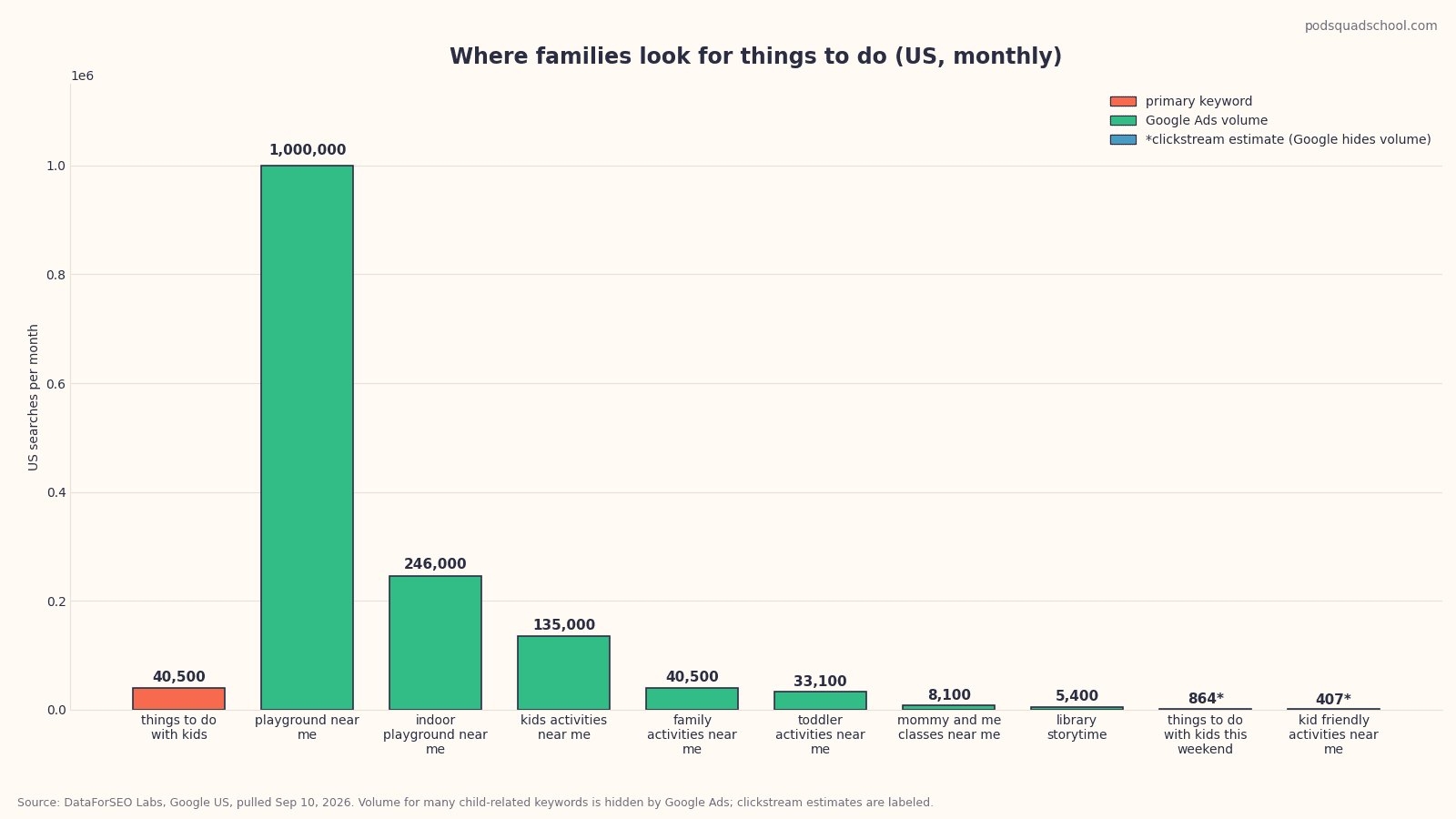
The intent split is clear. A million people a month type "playground near me" and want a pin; Google Maps, Yelp, and county parks pages win those searches and always will. The 40,500 who type "things to do with kids" want a way to decide. They are usually a parent on a Friday night with two days ahead and no plan, and they need a shorter list with the right filters (age, cost, nap, weather), not a longer one. "Indoor playground near me" is up 22% year over year, which tracks with hotter summers and more play cafes opening; "family activities near me" is down 45%, likely because Google now answers it on the results page.
The gap is the system. National listicles give you 50 ideas with no ages, no prices, and no sense of how long a 2-year-old lasts at a science museum (about 50 minutes, if you skip the planetarium). Local sites give you the address and the hours. Nobody tells you that the right time to arrive at the splash pad with a toddler is 9:15, that the fire station will let you in if you call on a Tuesday, or that ASTC Passport turns one science museum membership into free admission at hundreds of others. That is what this post is for.
The weekend system in one page
Here is the decision method, because the method is what you will reuse every week for the next ten years.
- Pick the age band. Toddler (about 18 months to 3 years), preschool (3 to 5), school-age (5 to 10), or mixed. The same museum is a 45-minute stop for a toddler and a 3-hour day for a 7-year-old.
- Pick the cost tier for the week. Free, under $10 total, $10 to $25 per person, or $25 and up. A good default: one paid outing a month, free the rest of the time.
- Fit the nap window. For a napper, the outing starts within 45 minutes of waking and ends 30 minutes before nap. For a kid who no longer naps, the good window moves to after lunch.
- Check the weather rule. Over 90°F or raining: indoor list. Otherwise: outdoor list.
- Grab the go bag (seven items, same every time, packed the night before).
- Decide the follow-up before you leave. One book, one project, or one pretend scene at home the next day. Write it on the fridge.
Cost tiers, honestly
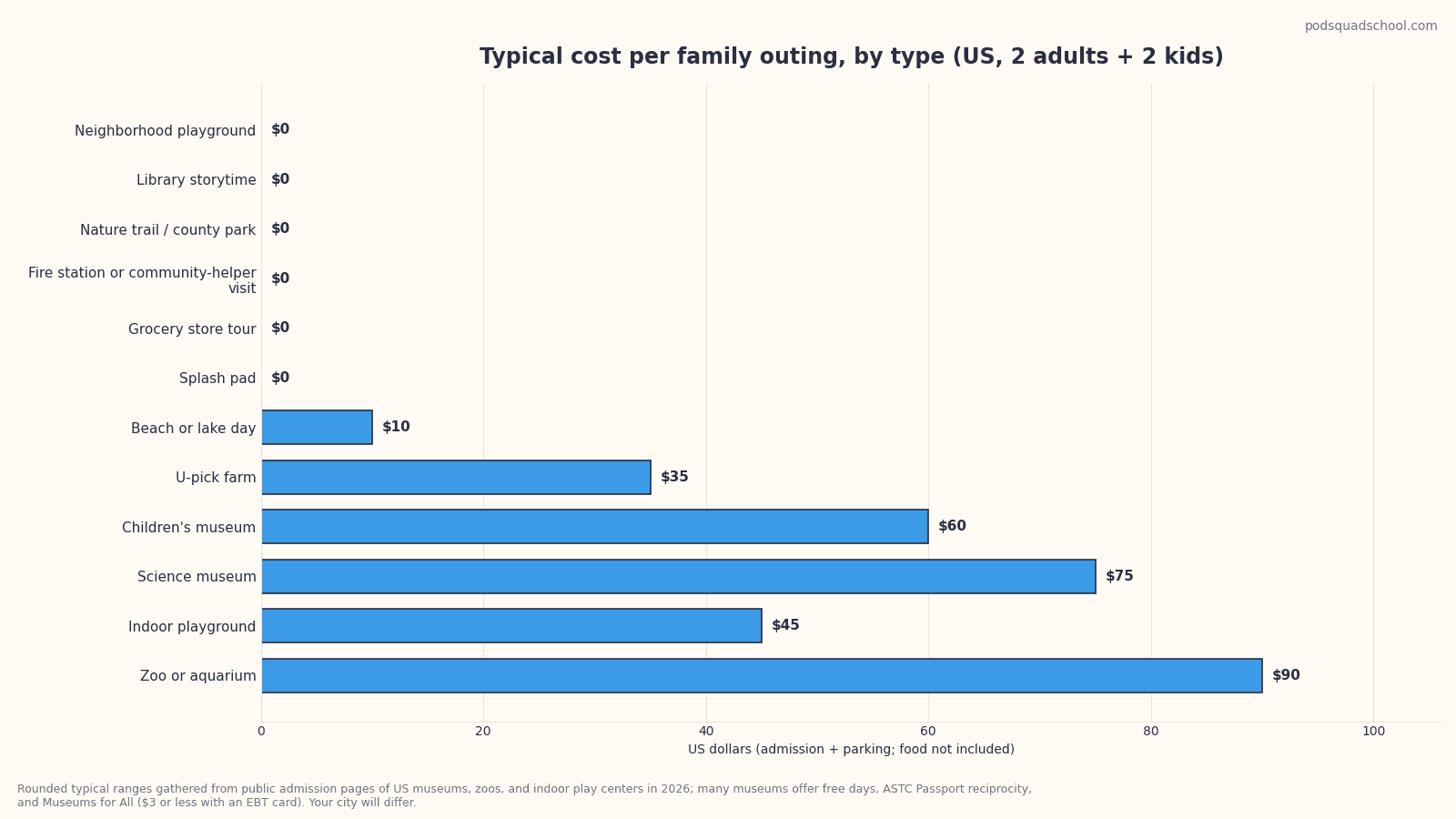
Prices vary by region, so think in tiers. These are typical US ranges as of 2026.
| Tier | Typical outings | Family of four usually spends |
|---|---|---|
| Free | Public playgrounds, storytime, most splash pads, nature trails, beaches with free parking, fire station visits, grocery tours, community events, state parks on fee-free days | $0 to $5 (parking, a snack) |
| Under $10 | State park day-use fees, farm admission without u-pick, county pools, community center open gym, paid beach parking | $5 to $15 total |
| $10 to $25 per person | Children's museums, most science museums, u-pick farms (by the pound), zoos, indoor playgrounds | $40 to $90 |
| $25 and up per person | Aquariums, theme parks, large indoor play centers with adult fees, special exhibits | $100 and up |
Nap-safe windows by age
The American Academy of Pediatrics endorses the American Academy of Sleep Medicine totals: 11 to 14 hours a day including naps at ages 1 to 2, and 10 to 13 hours at 3 to 5. Most 18-month to 3-year-olds take one nap starting between noon and 1 p.m. Plan around it.
| Age | Typical nap | Best outing window | Realistic time on site |
|---|---|---|---|
| 18 to 24 months | 12:00 to 2:00 | 9:00 to 11:15 a.m. | 60 to 90 minutes |
| 2 to 3 years | 12:30 to 2:00 | 9:00 to 11:30 a.m. | 90 minutes |
| 3 to 4 years | 1:00 to 2:00, or dropping | 9:30 to 12:00, or 3:00 to 5:00 | 2 hours |
| 4 to 5 years | Usually none | 9:30 to 12:30 or 1:30 to 4:30 | 2 to 3 hours |
| 5 to 10 years | None | 10:00 to 4:00 | 3 to 4 hours with lunch |
The drive home is the nap trap. A 20-minute drive at 11:45 puts a 2-year-old to sleep and costs you the real nap. Leave by 11:15, or accept the car nap and plan a quiet afternoon.
The 12 outings, by age
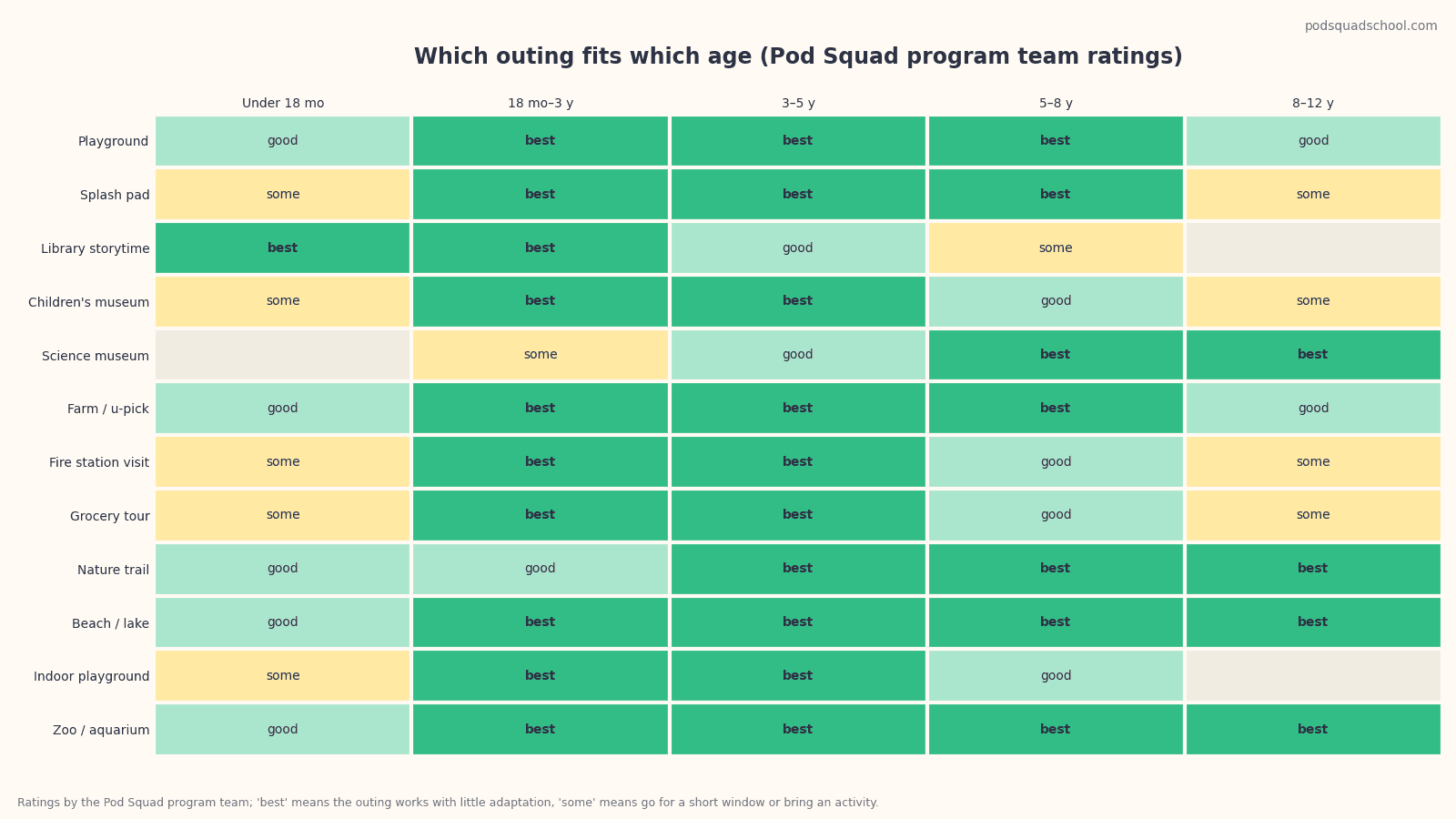
Each entry gives the best age, cost tier, best time, what to bring beyond the go bag, what to say once you are there, and the follow-up at home. The "what to say" lines follow the guided-play stance used across Pod Squad: narrate what you see, wonder out loud, ask one real question, skip the quiz. "What color is that?" gets a shrug; "I wonder where that truck is going" gets a conversation. The research behind that stance is in our play-based learning post.
1. Playgrounds
Best age: every age, but match the equipment. The Consumer Product Safety Commission's playground handbook separates equipment for ages 2 to 5 and 5 to 12, and most parks post which is which. A 2-year-old on a 5-to-12 structure is the most common injury setup you will see. Under 2, look for a bucket swing, a low platform, and a slide under 4 feet.
Cost: free. Best time: 8:30 to 10:30 a.m. in warm months (cool slide, thin crowd); 3:30 to 5:30 in cool months.
Bring: a sun hat, a small ball, a bucket. The ball turns a solo toddler into a game; the bucket collects acorns and pinecones.
What to say: "You climbed three steps by yourself." "That kid is waiting; you go, then she goes." Narrate the body ("both hands on the bar") instead of "be careful," which tells a kid nothing about what to do.
Follow-up: a stuffed-animal playground with a couch cushion slide and a blanket tunnel. For a 3-year-old, draw the playground map together.
2. Splash pads
Best age: 2 to 6. Under 2, the jets are loud and many toddlers cry the first time; let them watch from the edge for ten minutes first. Over 6, kids want a pool.
Cost: free at most city and county parks. Best time: 9 to 10:30 a.m., before the sun is high and the camp groups arrive. Many pads run on a sensor; press the post to start the water.
Bring: water shoes (the surface gets hot), a rash guard, two towels, a dry outfit, a cup for pouring. Swim diapers are required under 3 at most pads.
What to say: "The water goes up, then it comes down." "Where will it spray next?" "Your hair is wet; your shirt is wet." Splash pads are a vocabulary machine: up, down, cold, splash, drip, wait, again.
Safety: the CDC's healthy swimming guidance for splash pads is short: do not sit on the jets, do not swallow the water, bathroom breaks every hour. Stay within arm's reach of kids under 4; a running toddler on a wet surface is a fall waiting to happen.
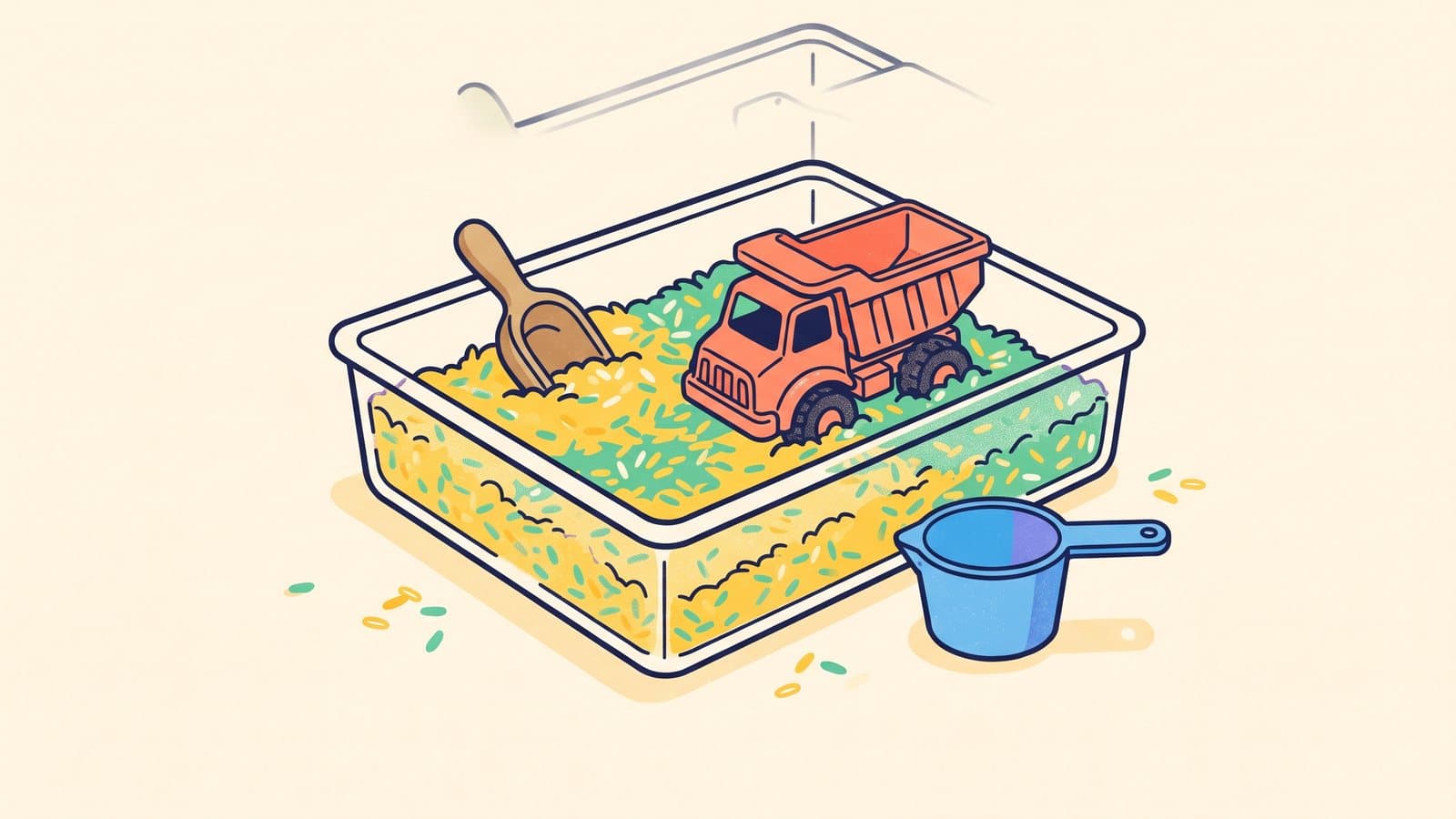
Follow-up: a dishpan on a towel with three cups and a funnel, 20 minutes. For a preschooler, freeze small toys in a bowl overnight and do an ice rescue with warm water and a spoon; more in our sensory bin post.
3. Libraries and storytime
Best age: 12 months to 5 for storytime; every age for the building. Most systems run baby (0 to 18 months), toddler (18 months to 3), and preschool (3 to 5) sessions. The toddler session is 20 to 30 minutes of songs, two or three short books, and a bubble machine.
Cost: free. Best time: whenever your branch schedules it, typically 10 or 10:30 on a weekday, with some Saturday sessions. Arrive 10 minutes early; popular sessions cap attendance.
Bring: a library card in the kid's own name (most systems issue them from birth), a tote, a snack for after.
What to say: during the session, sing and do the motions; your kid watches you, not the librarian, for the first few visits. After: "Which books should we take home?" and let a 2-year-old pick three, even if one is the truck board book you have read 40 times. Repetition is how vocabulary sticks.
What the kid is learning: the American Library Association's Every Child Ready to Read framework names five practices behind early literacy: talking, singing, reading, writing, and playing. A good storytime does all five in 25 minutes, plus a weekly rehearsal of sitting in a group, which is the actual skill preschool needs.
Follow-up: read the three books that night and again Tuesday. Act one out with stuffed animals. For a 4-year-old, set up a home library with a basket, a homemade card, and a stamp.
4. Children's museums
Best age: 2 to 8, peak at 3 to 6. Under 2, you are paying admission for a water table and a padded baby zone; worth it once, not monthly. Over 8, kids are bored unless there is a maker space.
Cost: $10 to $25 per person, with children under 1 or 2 usually free. Family memberships commonly run $100 to $200 and pay off in three or four visits; many include reciprocal admission through the Association of Children's Museums network (check your museum's terms). If your family has an EBT card, look for the Museums for All logo: participating museums admit up to four people for $3 or less each.
Best time: opening bell. Children's museums are the most crowded place on this list at 11 a.m. on a rainy Saturday.
Bring: a change of clothes (there is always a water table), socks for the climbing structure, a snack for the car; most museums ban food on the floor.
What to say: pick two exhibits and stay. Toddlers do not tour; they settle. "You are pouring water into the wheel and the wheel is turning." "What happens if the ball goes in the top?" When your kid is deep in something, say nothing and sit down. You are the base they come back to.
Follow-up: whatever they spent the most time on. A water wheel becomes a Sunday sink session with a colander; a grocery exhibit becomes a Monday pretend shop with three cans and a shoebox register.
5. Science museums
Best age: 4 and up for the main floor; 2 and up if there is an early childhood gallery. Toddlers get about 50 minutes, all of it in that room. A 6-year-old gets three hours.
Cost: $10 to $25 per person, more for IMAX or planetarium add-ons. The money move: most science museum memberships include the ASTC Travel Passport Program, which gives free general admission at participating science centers more than 90 miles from your home museum and your residence. One membership becomes a travel pass; check the participant list at astc.org before you drive.
Best time: opening on a weekend, or a weekday after 1 when school groups leave.
Bring: a notebook and pencil for a school-age kid (one thing they want to find out more about), and layers; exhibit halls run cold.
What to say: "I do not know; how could we find out?" is the best sentence in a science museum. Resist explaining. Ask "what do you notice?" and wait five full seconds. At the ball ramp: "The big ball went slower than the little one. Did you see that?"
Follow-up: one ten-minute kitchen science moment on Sunday, tied to what they saw: a cutting-board ramp with three balls, baking soda and vinegar in a cup, a sink-or-float pile of spoons, corks, and a crayon. For toddlers, everything in that pile stays bigger than a toilet-paper tube.
6. Farms and u-pick
Best age: 2 to 10. Toddlers love animals at a distance and hate them up close; the petting zoo is a 10-minute event at 2, then it is tractor time. Preschoolers and school-age kids can pick for 30 to 45 minutes and genuinely help.
Cost: admission-only farms are often under $10; u-pick is priced by the pound or basket, and a family spends $15 to $40 on fruit they would have bought anyway. Strawberries run early spring in most of the country (winter in Florida and southern California), blueberries early summer, apples and pumpkins in fall.
Best time: 9 a.m. when the fields open. Fruit is cooler, rows are empty, and the animals are being fed, which is the best show on the farm.
Bring: closed-toe shoes, a wagon or carrier for the under-3 (rows are long and dusty), hand sanitizer, and cash; small farms often do not take cards.
What to say: "Red ones are ready. Green ones need more sun." "Is the goat's fur soft or rough?" "This is where the strawberries in your lunchbox come from." A farm is the one place a toddler sees food before it is food, which is why Pod Squad's Farm & Food week ends with a farm or grocery trip.
Safety: wash hands after every animal contact, and no snacks in the animal area; the CDC ties petting zoos to E. coli outbreaks nearly every year, almost always from hand-to-mouth contact. The under-4 stay outside the fence unless you are holding them.
Follow-up: wash and hull the fruit together (a 3-year-old can hull strawberries with a straw). Fruit salad Sunday, farm book Monday. For a 4-year-old, plant three seeds in a cup on the windowsill.
7. Fire stations and community-helper visits
Best age: 2 to 7. This is the sleeper hit on the list. Almost every fire department will host a family or small-group visit if you call the station's non-emergency line and ask; many prefer weekday mornings, and some run open houses during Fire Prevention Week in October (a National Fire Protection Association campaign). Police stations, post offices, and vet clinics are the same idea with a phone call.
Cost: free. Best time: 10 a.m. on a weekday, after the crew's morning checks. Be ready for the visit to end abruptly if a call comes in; that is part of the lesson.
Bring: a thank-you card the kid made (they will hang it up). Leave the snacks in the car.
What to say: before you go, tell your kid the firefighter will put on the big suit and mask and look strange, but it is the same friendly person underneath. During: "The hose is heavy. Two firefighters carry it." "What do you think that button does?" Let the firefighter lead.
Follow-up: a cardboard fire truck (one big box, a paper plate steering wheel, red paint), a Sunday project a 3-year-old can paint and a 5-year-old can design. Stuffed-animal rescue Monday, firefighter book Tuesday. This is Community Helpers week in the toddler program, and it works because of the sequence: see the real thing, build a version, play the story for a week.
8. Grocery store tours
Best age: 2 to 6. Many supermarket chains run free store tours for small groups if you ask the manager a week ahead; the produce manager shows the walk-in cooler, the baker hands out a cookie, the kid rides in the cart with a pretend clipboard. If your store does not do tours, run your own.
Cost: free, plus what you buy. Best time: 9 a.m. on a weekday or 8 a.m. on a Saturday, before the aisles fill.
Bring: a picture shopping list (three items, drawn or cut from a flyer) and a cloth bag the kid carries.
What to say: "Find the yellow fruit." "How many apples do we need? Count them into the bag." "This is cold; this is frozen; feel the difference." For a 4-year-old: "The sign says $2. We have $5. Can we get two bags?" Math and language, hidden inside a chore.
Follow-up: put the groceries away together (a kid-height shelf for what they can reach), then cook one thing from the trip on Sunday. A 2-year-old can wash grapes and tear lettuce; a 4-year-old can spread, stir, and crack an egg with help. The snack you make becomes the week's snack; our healthy snacks post has 75, cut safely by age.
9. Nature trails
Best age: 3 and up for a real walk; 18 months and up for a "trail" that is really a 200-yard shuffle with stops. Rule of thumb: a preschooler walks about half a mile per year of age on flat ground before asking to be carried, less in heat.
Cost: free at city and county preserves; state parks often charge $4 to $8 per car; national parks are free on fee-free days, and every US fourth grader can get a free annual national parks pass through Every Kid Outdoors (everykidoutdoors.gov).
Best time: early morning in summer (shade, animals out), midday in winter.
Bring: a magnifying glass, a paper bag for collecting (leaves and acorns, not living things), bug spray, a carrier for the under-3.
What to say: "Stop. Listen. What do you hear?" "Which way is the water?" "That is a footprint; what made it?" For toddlers, name everything: bark, moss, root, stump, puddle. The Naturalist lane in Pod Squad exists because some kids will spend an hour watching an ant line, and that is a good hour.
Safety: if the trail passes a pond, canal, or creek, a grown-up walks between the kid and the water, within arm's reach, the whole time. Drowning is the leading cause of injury death for US children 1 to 4, and most of those are not in pools.
Follow-up: sort the paper bag on a tray (rough and smooth; big and small). Leaf rubbings with a crayon on Sunday. Keep a nature shelf by the door and change it every outing.
10. Beaches and lakes
Best age: every age, with a different job for the grown-up at each. With a toddler, you are lifeguarding, not lounging. With a 7-year-old who swims, you are still watching from the water's edge.
Cost: free to under $10 (parking). Best time: 8 to 10:30 a.m. or after 4 p.m. The AAP's sun guidance: babies under 6 months stay out of direct sun; seek shade for everyone between 10 and 4; over 6 months, broad-spectrum sunscreen of at least SPF 15 (most pediatricians suggest 30 or higher), applied 15 to 30 minutes before and again every two hours and after swimming.
Bring: a pop-up shade, a bucket and shovel per kid (sharing a shovel at 2 does not work), a gallon of tap water for rinsing feet, a rash guard, twice the snacks you think you need.
What to say: "The wave comes in, the wave goes out." "Dig a hole; will the water fill it?" "Your castle needs wet sand; dry sand falls." For school-age kids: "How could we make the wall hold?" and let them fail three times.
Safety: the AAP recommends touch supervision for toddlers and preschoolers around water: an adult within arm's reach, not reading, not on the phone. Coast Guard-approved life jackets for any kid who cannot swim well, not inflatable arm floats. Learn the flag system. Lakes have no lifeguards and drop off fast.
Follow-up: shells and rocks sorted by size on a tray; an Ocean & Beach bin (dry oats, a few shells bigger than a toilet-paper tube, a cup) on Sunday; a beach book Monday. Watch the toddler with the shells; they go in mouths.
11. Indoor playgrounds
Best age: 1 to 6, and check the size limits. Play cafes with a padded toddler zone are gold for 12 to 30 months. Trampoline parks are for 6 and up, and the AAP advises against recreational trampolines for young children; if you go with an older kid, one jumper per trampoline.
Cost: $10 to $25 per kid, adults often free or a few dollars; grip socks required, $3 at the door if you forget. This is the one outing on the list booming in search (up 22%), because it is the only place on a 95°F afternoon or a rainy Saturday where a 2-year-old can climb for an hour.
Best time: opening, usually 9 or 10 a.m. Weekend afternoons are birthday party territory: loud, crowded, full of cake your kid cannot have.
Bring: grip socks, a water bottle, hand sanitizer.
What to say: "You went through the tunnel and came out the other side." "That kid wants a turn; let's count to three, then it is his turn." Indoor playgrounds are dense social practice: turns, space, "excuse me," and the first time another kid takes your ball.
Follow-up: a couch-cushion obstacle course on Sunday, ten minutes to build, thirty of use. For a 3-year-old, make a paper "ticket" for the home play cafe and let them sell it to you.
12. Free community events
Best age: depends on the event. Outdoor movies and concerts in the park suit 3 and up (late start times). Touch-a-truck events are the best free toddler outing in America and happen in almost every county a few times a year. Farmers markets, holiday parades, library summer reading kickoffs, and hardware-store kids' workshops (several large chains run a free monthly build for roughly ages 5 and up; check your store's schedule) round out the list.
Cost: free. Best time: the first 30 minutes, before the bounce house line.
Bring: a blanket, a wagon, cash for the food truck, ear protection for toddlers at anything with sirens or a stage. Touch-a-truck events usually open with a no-horns quiet hour; go then.
What to say: "There are so many people. Stay where you can see my shoes." "Which truck first?" "The band is loud; we can stand back here." Community events are where kids learn crowds: waiting, watching, choosing.
Follow-up: a photo printed and taped to the fridge, and a drawing of the favorite thing. For school-age kids, a "next time" list.
Free first: the outings that cost nothing
If money is tight this month, or you simply do not want to spend $60 to entertain a 2-year-old, here is the free-only version. For kids under 4, the free list is the better list.
- Playground. Rotate three parks so the equipment feels new. Bring a ball.
- Splash pad. Summer mornings, 9 a.m., dry clothes in the car.
- Library storytime. Once a week, same branch, same day; the repetition is the point.
- Nature trail or preserve. Half a mile, a paper bag, a magnifying glass.
- Beach or lake. Early morning, pop-up shade, touch supervision.
- Fire station. One phone call, one thank-you card.
- Grocery store tour, or your own version. Three-item picture list.
- Community events. Touch-a-truck, farmers market, parades, library kickoffs.
- Pet store or garden center. A pet store is a free 20-minute aquarium and a garden center is a free 20-minute farm, both climate controlled.
- Hardware store walk. Toddlers love the lumber aisle, the fans, and the paint chips. Take home five chips and match them to things in the house on Sunday.
A month of free weekends that stays interesting: Saturday 1 is the splash pad, Saturday 2 is storytime plus the playground next door, Saturday 3 is the fire station, Saturday 4 is the trail. Four outings, four follow-ups, about $8 in parking.
How to find them near you
The "near me" search is where Google earns its keep, but it misses the good stuff. Here is where the good stuff lives.
- The library events calendar. Storytimes, summer reading events, LEGO clubs, and often a museum pass program (many systems lend passes to local museums for a day; ask at the desk).
- County and city parks pages. Splash pad seasons and hours, playground lists with age ratings, nature center programs, the touch-a-truck date.
- Museum free days and reciprocity. Check each museum's site for free or discounted days. Bank of America's Museums on Us gives cardholders free general admission at participating museums on the first full weekend of each month. ASTC Passport for science centers. Museums for All for EBT holders. The Association of Children's Museums network for members of participating children's museums.
- Fire and police non-emergency lines. Ask for a family visit; ask about Fire Prevention Week in October.
- Local parent groups. Facebook groups and neighborhood apps catch the events that never make a website: the church egg hunt, the pop-up petting zoo at the nursery, the free skate day.
- State and national park calendars. Fee-free days, junior ranger programs, guided toddler walks at nature centers.
- U-pick maps. Search "u-pick" plus your county and the fruit; many state agriculture departments keep a map.
- Pod Squad. Members get adventure suggestions sorted by distance from home and by the kid's age, with a Thursday adventure built into each toddler week and a Saturday adventure each weekend. Places in the program are South Florida examples (Patch Reef Park, the Museum of Discovery & Science, a Publix tour), but the categories map to any county.
The 7-item go bag
Pack it Friday night. Leave it by the door. The biggest barrier to a good Saturday is the 25 minutes of hunting for sunscreen while a toddler unravels.
- Water bottle per person, filled. A thirsty kid is a melting kid.
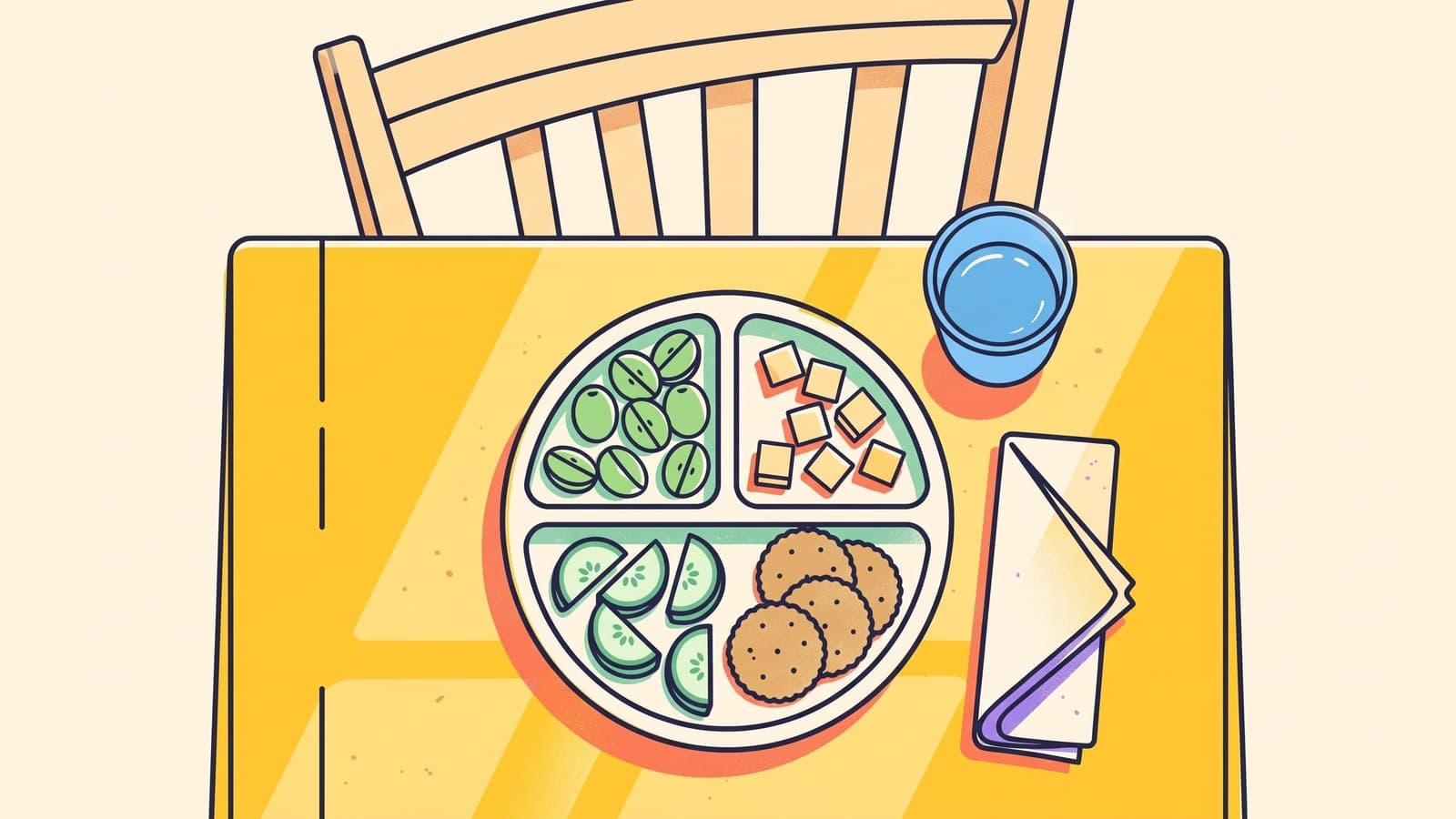
- Snack box with two options, cut safely for the youngest: cheese cubes, grapes quartered lengthwise, whole-grain crackers, banana. Per the AAP's choking guidance, no whole nuts, popcorn, or hard candy under 4, and round firm foods cut lengthwise into quarters. Eat sitting down, not walking.
- Sunscreen (SPF 30, broad spectrum) and a hat. On before you leave, again at the two-hour mark.
- Wipes and a small trash bag, plus the diaper kit if you are still there.
- A full change of clothes per kid under 5, in a zip bag, socks included. Water tables, mud, and splash pads are guaranteed.
- The small toy bucket: a ball, a scoop, two cars bigger than a toilet-paper tube. A bucket turns a bench into a station.
- One library book. For the car, the line, and the moment the older kid needs ten more minutes and the younger one is done.
Add-ons by outing: grip socks (indoor playground), water shoes and rash guard (splash pad, beach), a wagon or carrier (farm, trail, event), cash (farm, food truck), a magnifying glass (trail), a thank-you card (fire station).
Mixed ages: one outing, three kids
A baby, a 3-year-old, and a first grader is the normal family, and most outing lists pretend otherwise. Pick the outing for the middle kid and give the other two a job.
- Pick for the middle. The 3-year-old's stamina sets the plan; the baby rides along and the 6-year-old gets a challenge layer.
- Give the oldest a role. Photographer (your phone, three pictures), map reader, dog counter. At a museum, the 6-year-old picks the first exhibit and the 3-year-old picks the second.
- The baby is never invisible. Narrate for them too: "Nova, that is a goat. Goats say maa." Every block in the toddler program carries a ride-along line for the baby for exactly this reason.
- Two grown-ups, split the last 20 minutes. One takes the toddler to the car at the wall; the other gives the older kid 20 real minutes at their own pace.
- Choose places with a fast exit. Parking next to the playground, a members' entrance, a tractor ride back to the gate.
- Snack together, sitting, all three. The 6-year-old does not need the rule for safety; the family needs it to actually stop.
- Scale the follow-up. Sunday's cardboard fire truck is painted by the 3-year-old and engineered by the 6-year-old (doors that open, a paper-towel-tube ladder). The baby gets the empty box.
You have 90 minutes
Sometimes the weekend is one 90-minute gap between a nap and a birthday party. That is enough if you pick right.
| Age | 90-minute plan | Travel budget |
|---|---|---|
| 18 to 24 months | Playground with a bucket swing (40), snack on the bench (10), walk to the car (10) | Under 15 minutes each way |
| 2 to 3 years | Storytime (25), pick three books (10), playground next door (35) | Under 10 minutes |
| 3 to 4 years | Grocery store with a three-item picture list (40), bakery cookie on a bench (20) | 15 minutes each way |
| 4 to 5 years | Nature trail, half a mile out and back with a paper bag (60) | 15 minutes each way |
| 5 to 10 years | Children's or science museum, two exhibits, if you have a membership (60) | 15 minutes each way; skip without a membership |
| Mixed | Splash pad or playground with a snack blanket (60) | Under 15 minutes |
The rule: for 90 minutes total, travel cannot exceed 30. That excludes anything more than 15 minutes away, which is most of what a listicle will suggest.
The rainy weekend plan
Rain changes the list; it does not cancel the weekend. In order of cost:
- Library (free). Storytime if there is one; otherwise the children's section for an hour with a puzzle and a stack of books. Many branches have a train table or a puppet stage.
- Pet store and garden center loop (free). Twenty minutes each, and a preschooler will talk about the fish all day.
- Hardware store walk (free). Lumber aisle, fans, doorbells you are allowed to press, five paint chips to take home.
- Fire station (free). Rain does not cancel a station visit; call first.
- Indoor playground ($10 to $25 per kid). Go at opening. Leave before the parties.
- Children's or science museum ($10 to $25 per person). Opening bell, two exhibits, membership if you will go four times a year.
- Puddle walk (free, and the best one). Rain boots, a jacket, a cup for measuring the puddle. Ten minutes on your own block, then a warm bath. Toddlers talk about puddle day for a week.
Then Sunday at home: the follow-up project from the last outing, a kitchen job, and a sensory bin on a shower curtain. A full rainy weekend for under $50, or $0 if you skip the paid tier.
Safety rules that do not bend
Most of the rules in this post are preferences. These four are not.
Water: touch supervision. The AAP's guidance for young children around any water (pool, beach, lake, splash pad, canal, bathtub) is an adult within arm's reach, giving full attention. Coast Guard-approved life jackets for non-swimmers, not inflatables. The AAP recommends every parent learn CPR, and says swim lessons from age 1 can lower drowning risk; your pediatrician knows when your kid is ready.
Sun. Under 6 months: shade, hats, lightweight long sleeves, out of direct sun. Over 6 months: broad-spectrum sunscreen SPF 15 or higher (30 is the common recommendation), on 15 to 30 minutes before, reapplied every two hours and after swimming. Shade from 10 to 4 when you can. Heat counts too: a toddler in a car seat at a trailhead on a 90°F day heats up fast.
Car seats. The AAP's guidance: rear-facing as long as possible, until the child reaches the seat's height or weight limit (most convertible seats allow rear-facing to 40 pounds or more); then a forward-facing harness to that seat's limit; then a belt-positioning booster until the adult belt fits, usually at 4 feet 9 inches and between 8 and 12 years; and the back seat for everyone under 13. A loose install or a twisted harness undoes every other safety choice you made that day. Many fire stations check installations free; ask when you visit.
Playgrounds and small parts. Match the equipment to the posted age. Remove drawstrings, bike helmets, and necklaces before climbing (strangulation risks on slides and platforms). Anything smaller than a toilet-paper tube, including acorns and mulch chunks, stays out of a toddler's mouth, which means you are within reach in the mulch pit too.
None of this is medical advice. Your pediatrician knows your kid; ask about sunscreen under 6 months, swim readiness, and car seat transitions.
Turning one outing into a week of play
This is what separates a fun Saturday from a Saturday that changes something. Kids under 6 learn through repetition and through play that revisits real experience. One outing revisited three ways at home does more than three outings in a row.
- Saturday: the adventure. Go. Talk. Take three photos.
- Sunday: the project. Build, cook, or make one thing from the outing. 30 to 60 minutes, kid-led; the grown-up sets out the materials.
- Monday: the book. One library book on the same topic, read at least twice.
- Midweek: the pretend. Three props, and let the story run. A ride-along line for the baby; a role for the older kid.
- Any day: the print. A photo on the fridge, a drawing, a "what we saw" list the kid dictates. In Pod Squad, this is where the win goes into the kid's portfolio.
| Outing | Sunday project | Monday book (any library) | Midweek pretend |
|---|---|---|---|
| Fire station | Cardboard box fire truck, paper plate wheel | Any firefighter picture book | Stuffed-animal rescue with a laundry basket truck |
| Farm | Wash, hull, and mix a fruit salad; plant three seeds | Any farm or where-food-comes-from book | Farm stand with real fruit and a shoebox register |
| Beach | Shell and rock sorting on a tray; oat "sand" bin | Any ocean or beach book | Blanket ocean with paper fish and a colander net |
| Splash pad | Dishpan water play with three cups and a funnel | A water or rain book | Bath time car wash for the toy cars |
| Science museum | Cutting-board ramp with three balls; sink or float | Any how-things-work book | A "lab" with a tray, a spoon, and a bowl of water |
| Grocery store | Cook one thing you bought; kid washes and stirs | Any market or shopping book | Pretend shop with three cans and a cloth bag |
In the toddler program, each week's Thursday adventure matches the theme and seeds the next days' blocks: Wheels & Roads counts truck wheels in a parking lot and then builds a tape road on the floor; Community Helpers visits the fire station; Farm & Food does a farm or grocery tour, then a kitchen job. You can run that logic yourself with the table above.
A worked weekend
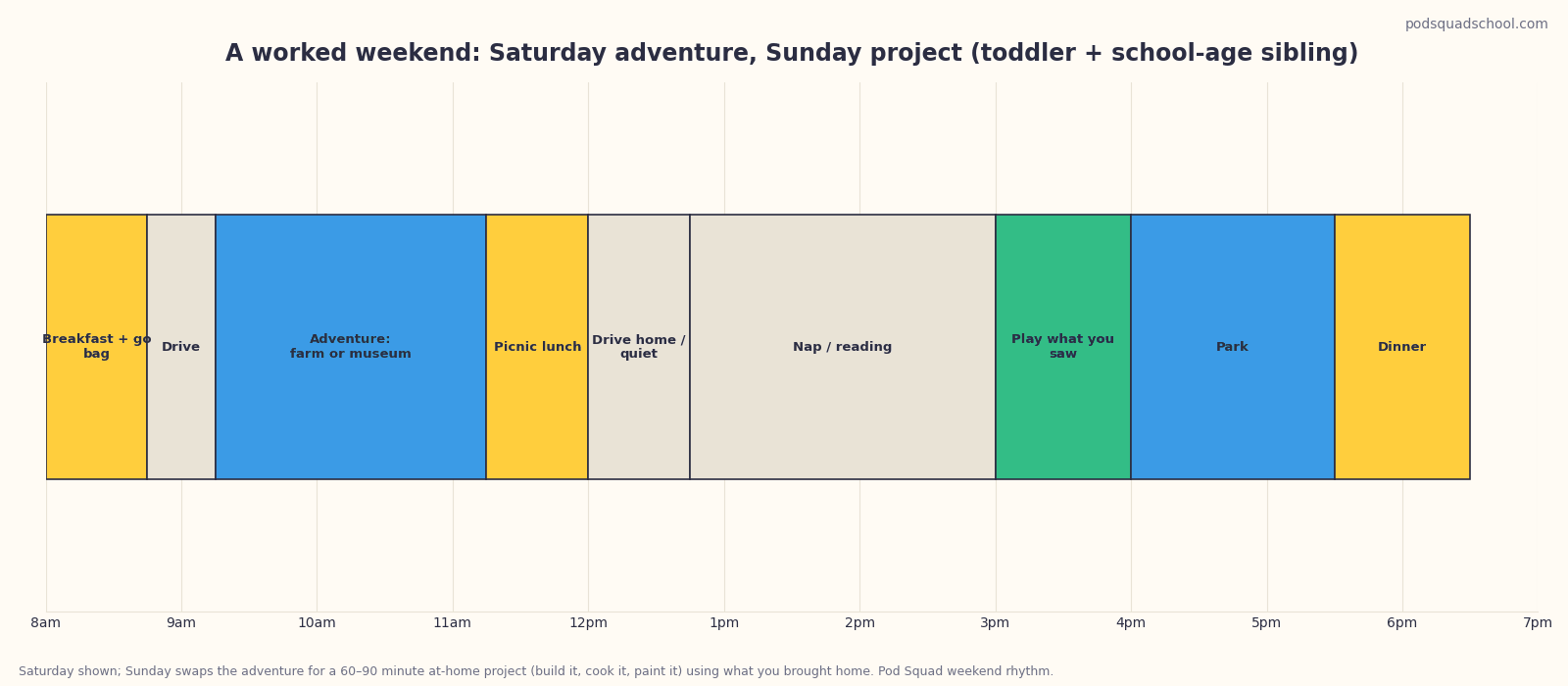
A real Saturday adventure and Sunday project for a family with a 2-year-old (Cash) and a 5-year-old (Chance), in a hot month, on a $20 budget. Change the ages and the weather and the shape holds.
Friday night (10 minutes)
Pack the go bag. Check the farm's hours and whether they take cards (they do not; grab $20 cash). Put the wagon in the trunk. Tell Chance the plan so he can look forward to it: "Tomorrow we are picking strawberries. Your job is to find the reddest one."
Saturday: the adventure
- 7:00 to 8:15. Breakfast, sunscreen on both kids before shoes go on, water bottles filled. Out the door by 8:20.
- 8:45. Arrive at opening. Cash in the wagon, Chance walking. Straight to the rows before the heat.
- 8:50 to 9:30. Picking. Cash lasts 15 minutes with a small basket, then eats strawberries in the wagon, hulled and quartered, one at a time. Chance fills a quart. Narration: "Red ones are ready; the white ones need more sun." "Count to ten and start again." Cost: about $12.
- 9:30 to 9:50. Animals. Cash watches the goats from outside the fence, held. Chance feeds one with a cup of pellets ($2). Hands sanitized after.
- 9:50 to 10:10. Snack on a shaded bench: cheese cubes, crackers, water. Sitting down, both kids.
- 10:10 to 10:30. Tractor ride back to the gate. Three photos.
- 10:35. In the car for a 25-minute drive; Cash is drowsy but home before he falls asleep.
- 11:00 to 11:45. Wash the strawberries together at the sink. Lunch. Chance draws the farm while Cash stacks the empty baskets.
- 12:15. Cash naps. Chance and a grown-up get 45 minutes of reading and a board game.
- Afternoon. Nothing planned. That is the plan.
Total spend: $14. Time out of the house: two hours and fifteen minutes. Meltdowns: one, in the car, over the strawberries running out.
Sunday: the project
- 9:00 to 9:45. Kitchen job (Farm & Food). Fruit salad and a strawberry snack for the week. Cash hulls strawberries with a straw (it works, slowly) and tears lettuce for lunch. Chance slices bananas with a butter knife and stirs. "You are cutting; the pieces are getting smaller." "Where did this fruit grow?" Cash's portion is quartered lengthwise; Chance's is halved.
- 10:00 to 10:30. Plant. Three strawberry seeds (they probably will not sprout; that is fine) and three bean seeds (they will) in a clear cup with a wet paper towel on the windowsill. Cash pours the water; Chance labels the cup.
- 10:30 to 11:15. Pretend farm stand. A laundry basket on its side, the real strawberries, three cans, a cloth bag, and a shoebox register with paper money. Chance runs the stand; Cash is the customer with a wagon; the grown-up buys three things and pays too much. This is the block where the grown-up sits down and says almost nothing.
- Afternoon. A 15-minute library run for a farm book, or the puddle walk if it rains.
- Sunday night, 5 minutes. Print one photo for the fridge. Chance dictates a three-line "what we saw" list. The strawberry snack goes into the week's lunchboxes.
Monday's after-school block: read the farm book, check the bean cup. Tuesday: farm stand again, because a 2-year-old will want it again, and the second time is when the language shows up.
Where Pod Squad fits, stated plainly
Everything above works without an app. If you set up a go bag, a nap-window rule, and a Sunday-project habit, you have the system, and you should not pay anyone for it.
What Pod Squad does is run the system for you every week, sized to your kid's exact age. Each toddler week has a Thursday adventure at a real place (a park, a museum, a farm, a fire station, a grocery tour) that matches the theme, and each weekend gets a Saturday adventure and a Sunday project. Homie, the personalization layer, names your kid by age, stage, and interest lane, so the notes for a 20-month-old and a 4-year-old at the same farm are different notes, and the baby gets a ride-along line on every block. The app taps you on the shoulder Friday night to pack and Saturday morning with the plan; places are sorted by distance from your home. Kids never use the app; it is for the grown-ups, one account for every kid with logins for up to four adults. Families with a little one in daycare use it for the hour after pickup and weekends; families home all day run the whole morning on it. It plans the years from the newborn weeks to the first day of kindergarten, and big brothers and sisters come along free as helpers. You can see how a week is built and try a free sample before deciding anything.
It is a paid membership: free for 7 days, then $99 a month for the first kid, siblings 50% off, a 30-day money-back guarantee on the first paid month, cancel in two taps. If your weekends already run smoothly and the library calendar is doing the job, that money is better spent on a children's museum membership. If Friday night is when the dread sets in, start the free 7 days and run one weekend with it. This Saturday's plan is already in there.
Mistakes that cost the most
- Leaving at 11 with a napper. The car nap replaces the real nap, the afternoon is a mess, and you decide outings are not worth it. Fix: out by 8:45, home by 11:15, until the nap drops.
- Paying museum admission for a kid under 2. A $24 ticket for 45 minutes in the toddler room. Fix: the free list until about 2.5, then a membership if you will go four times a year; check library passes, Museums for All, and reciprocity first.
- Touring instead of settling. Dragging a 3-year-old through eight exhibits. Fix: two exhibits, and sit down when the kid is deep in one.
- Driving 45 minutes for a 90-minute window. Fix: for a short window, travel is capped at 15 minutes each way. Save the far outing for a full morning.
- Quizzing instead of talking. "What color? What animal? How many?" Kids shut down. Fix: narrate, wonder, one real question, wait five seconds.
- Skipping the follow-up. Fun on Saturday, forgotten by Monday. Fix: decide the Sunday project before you leave; write it on the fridge.
- Hunting for sunscreen at 8:30 Saturday. Fix: the go bag, packed Friday, by the door.
- Being on the phone near water. The highest cost of all. Fix: phone in the bag, an adult within arm's reach, trade off every 20 minutes if there are two of you.
Who this is for, and who it is not for
This is for you if you have at least one kid between about 1 and 10, your weekends feel like a scramble or a screen, you want to spend less on outings and get more out of them, or you have a mixed-age crew and every listicle seems written for one age. It is for school families who own the weekend and homeschool families who can take the museum on a Tuesday morning. It is for the parent who wants a repeatable system more than a bigger list.
This is not for you if your kid is under 12 months (a walk, a blanket in the shade, and baby storytime are the outings that matter; the rest can wait), you live somewhere with a long true winter and need an indoor-first system (the rainy plan is a start, but you will lean on libraries, community centers, and indoor pools far more than this post does), or you want a destination guide for your city. For that, your county parks page and library calendar beat anything national.
If you want a paid product to hand you the plan, Pod Squad is one option, and it is not the right one for every family. A children's museum membership and a library card are a better first $100 for a lot of people.
Frequently asked questions
What are the best things to do with kids this weekend for free?
For kids under 5, the free list is the best list: a public playground matched to your kid's age, a splash pad at 9 a.m. in summer, library storytime, a half-mile nature trail with a paper bag, a beach or lake with touch supervision, a fire station visit arranged with one phone call, and a grocery store tour or your own version with a three-item picture list. Add community events (touch-a-truck, farmers markets, parades) from your county calendar. A month of free Saturdays, each with a Sunday follow-up project, costs about $8 in parking and does more for a toddler than four museum tickets.
What time of day should I take a toddler on an outing?
Between about 9 and 11:30 a.m. for most kids 18 months to 3 years. Most toddlers nap starting between noon and 1, and the AAP-endorsed sleep guidance puts total sleep at 11 to 14 hours a day at this age, so the nap matters. Leave the house within 45 minutes of waking, plan 60 to 90 minutes on site, and be in the car by 11:15 so the drive home does not become the nap. Once the nap drops, often around 3 to 4 years, a 3 to 5 p.m. window opens up and afternoons at the park get much easier.
How long will a 2-year-old last at a children's museum?
About 45 to 90 minutes, nearly all of it in one or two exhibits, usually the water table and the toddler room. That is normal; toddlers settle rather than tour. Go at opening, skip the paid add-ons, bring a change of clothes and socks, and leave before the meltdown rather than after. Because the visit is short, a single ticket is rarely worth it under 2.5; use a library pass, Museums for All if you have an EBT card, a reciprocal membership, or wait a year. The free list gets more out of a 2-year-old.
What should I pack for a day out with kids?
Seven things, the same every time, packed the night before: a water bottle per person, a snack box cut safely for the youngest kid (grapes quartered lengthwise, cheese cubes, crackers; no whole nuts or popcorn under 4), SPF 30 sunscreen and a hat, wipes and a trash bag, a full change of clothes per kid under 5 in a zip bag, a small toy bucket (a ball, a scoop, two cars bigger than a toilet-paper tube), and one library book. Add grip socks for indoor playgrounds, water shoes and a rash guard for splash pads and beaches, a carrier or wagon for farms and trails, and cash for farms and food trucks.
How do I find kids' activities near me that are not on Google Maps?
Start with your public library's events calendar (storytimes, clubs, and often a museum pass program), then your county and city parks pages (splash pad hours, playground age ratings, nature center walks, touch-a-truck dates). Call the fire department's non-emergency line for a station visit. Check each museum's site for free days, Bank of America's Museums on Us weekend, ASTC Passport for science centers, and Museums for All for EBT holders. Local parent Facebook groups catch the pop-up events. State agriculture departments often keep u-pick maps. Pod Squad members also get adventures sorted by distance and age in the app.
What is the safest way to do a beach or splash pad day with a toddler?
The AAP's rule is touch supervision: an adult within arm's reach, giving full attention, any time a young child is in or near water, including a splash pad. Coast Guard-approved life jackets for non-swimmers, not inflatable floats. Go early (8 to 10:30) or late (after 4) to dodge the strongest sun; over 6 months, use broad-spectrum sunscreen of SPF 15 or higher, reapplied every two hours and after water. Water shoes protect feet from hot pad surfaces. At splash pads, no sitting on jets and no swallowing water. Your pediatrician knows your kid; ask about swim lessons and sunscreen for babies.
How do I get more out of an outing than one fun morning?
Plan the follow-up before you leave. The pattern that works under 6: Saturday adventure, Sunday project (build or cook one thing from the trip), Monday book on the same topic, a midweek pretend scene with three props, and a photo on the fridge. A fire station becomes a cardboard fire truck and a stuffed-animal rescue; a farm becomes a fruit salad, a bean cup, and a pretend farm stand. Repetition is where the vocabulary and the ideas stick. This is how Pod Squad's toddler weeks are built: the Thursday adventure seeds the rest of the week's blocks.
Sources & methodology
- American Academy of Pediatrics, HealthyChildren.org, "Water Safety and Young Children" (touch supervision, life jackets, swim lessons): https://www.healthychildren.org/English/safety-prevention/at-play/Pages/Water-Safety-And-Young-Children.aspx
- American Academy of Pediatrics, HealthyChildren.org, "Sun Safety: Information for Parents About Sunburn and Sunscreen": https://www.healthychildren.org/English/safety-prevention/at-play/Pages/Sun-Safety.aspx
- American Academy of Pediatrics, HealthyChildren.org, "Car Seats: Information for Families": https://www.healthychildren.org/English/safety-prevention/on-the-go/Pages/Car-Safety-Seats-Information-for-Families.aspx
- American Academy of Pediatrics, HealthyChildren.org, "Choking Prevention" (foods to avoid under 4; cutting round foods): https://www.healthychildren.org/English/health-issues/injuries-emergencies/Pages/Choking-Prevention.aspx
- American Academy of Pediatrics, HealthyChildren.org, "Healthy Sleep Habits: How Many Hours Does Your Child Need?" (AASM totals endorsed by the AAP): https://www.healthychildren.org/English/healthy-living/sleep/Pages/Healthy-Sleep-Habits-How-Many-Hours-Does-Your-Child-Need.aspx
- American Academy of Pediatrics, HealthyChildren.org, "Trampolines: What You Need to Know": https://www.healthychildren.org/English/safety-prevention/at-play/Pages/Trampolines-What-You-Need-to-Know.aspx
- US Consumer Product Safety Commission, "Public Playground Safety Handbook" (age-separated equipment for 2 to 5 and 5 to 12): https://www.cpsc.gov
- Centers for Disease Control and Prevention, "Healthy Swimming" (splash pads, recreational water illness) and "Stay Healthy at Animal Exhibits" (hand washing at petting zoos): https://www.cdc.gov
- Centers for Disease Control and Prevention, "Learn the Signs. Act Early." developmental milestones: https://www.cdc.gov/ncbddd/actearly/milestones/index.html
- American Library Association (ALSC and PLA), "Every Child Ready to Read" (the five practices: talking, singing, reading, writing, playing): https://everychildreadytoread.org
- Association of Science and Technology Centers, "ASTC Travel Passport Program" (reciprocal admission at participating science centers beyond 90 miles): https://www.astc.org
- Institute of Museum and Library Services and the Association of Children's Museums, "Museums for All" (admission of $3 or less per person for EBT cardholders at participating museums): https://museums4all.org
- National Park Service, "Every Kid Outdoors" (free annual pass for US fourth graders) and fee-free days: https://everykidoutdoors.gov and https://www.nps.gov
- National Fire Protection Association, "Fire Prevention Week" (October): https://www.nfpa.org
- Harvard University, Center on the Developing Child, "Serve and Return" (the interaction pattern behind the "what to say" lines): https://developingchild.harvard.edu
- National Association for the Education of Young Children, developmentally appropriate practice resources: https://www.naeyc.org
- Search demand: DataForSEO Labs, Google US, September 10, 2026; volumes for many child-related keywords are suppressed by Google Ads and are shown as clickstream estimates where labeled.
- Cost tiers, nap windows, outing lengths, and the worked weekend reflect Pod Squad program data and typical US ranges as of September 2026; admission prices and program terms (reciprocity, free days) vary by institution and change; check the venue's site before you go.
Bottom line
You do not need a longer list of things to do with kids. You need one good outing a weekend, picked by your kid's age and nap window, priced honestly (free most weeks, paid once a month if you like), packed in two minutes, and turned into a Sunday project, a Monday book, and a midweek pretend scene. The 12 outing types here cover every weekend from 18 months to 10 years, and eight of them cost nothing.
Start this week with the free list and the go bag. Pick the splash pad, the storytime, or the fire station, leave by 8:45, talk more than you direct, and decide the Sunday project before you leave the house. If you want that plan handed to you every Friday night, sized to your kid, start Pod Squad free for 7 days.
Keep exploring
- Activities for 2 year olds: 60 ideas by age, room, and mood
- Sensory bin ideas: fillers, tools, and themes by age
- Healthy snacks for kids, cut safely by age, for the go bag
- Screen time for toddlers: the AAP guidelines and 50 screen-free swaps
- How Pod Squad plans the week, including Thursday and Saturday adventures
- The Toddler Squad program: 12-week seasons with an adventure every week
Questions parents ask
What are the best things to do with kids this weekend for free?
For kids under 5, the free list is the best list: a public playground matched to your kid's age, a splash pad at 9 a.m. in summer, library storytime, a half-mile nature trail with a paper bag, a beach or lake with touch supervision, a fire station visit arranged with one phone call, and a grocery store tour or your own version with a three-item picture list. Add community events (touch-a-truck, farmers markets, parades) from your county calendar. A month of free Saturdays, each with a Sunday follow-up project, costs about $8 in parking and does more for a toddler than four museum tickets.
What time of day should I take a toddler on an outing?
Between about 9 and 11:30 a.m. for most kids 18 months to 3 years. Most toddlers nap starting between noon and 1, and the AAP-endorsed sleep guidance puts total sleep at 11 to 14 hours a day at this age, so the nap matters. Leave the house within 45 minutes of waking, plan 60 to 90 minutes on site, and be in the car by 11:15 so the drive home does not become the nap. Once the nap drops, often around 3 to 4 years, a 3 to 5 p.m. window opens up and afternoons at the park get much easier.
How long will a 2-year-old last at a children's museum?
About 45 to 90 minutes, nearly all of it in one or two exhibits, usually the water table and the toddler room. That is normal; toddlers settle rather than tour. Go at opening, skip the paid add-ons, bring a change of clothes and socks, and leave before the meltdown rather than after. Because the visit is short, a single ticket is rarely worth it under 2.5; use a library pass, Museums for All if you have an EBT card, a reciprocal membership, or wait a year. The free list gets more out of a 2-year-old.
What should I pack for a day out with kids?
Seven things, the same every time, packed the night before: a water bottle per person, a snack box cut safely for the youngest kid (grapes quartered lengthwise, cheese cubes, crackers; no whole nuts or popcorn under 4), SPF 30 sunscreen and a hat, wipes and a trash bag, a full change of clothes per kid under 5 in a zip bag, a small toy bucket (a ball, a scoop, two cars bigger than a toilet-paper tube), and one library book. Add grip socks for indoor playgrounds, water shoes and a rash guard for splash pads and beaches, a carrier or wagon for farms and trails, and cash for farms and food trucks.
How do I find kids' activities near me that are not on Google Maps?
Start with your public library's events calendar (storytimes, clubs, and often a museum pass program), then your county and city parks pages (splash pad hours, playground age ratings, nature center walks, touch-a-truck dates). Call the fire department's non-emergency line for a station visit. Check each museum's site for free days, Bank of America's Museums on Us weekend, ASTC Passport for science centers, and Museums for All for EBT holders. Local parent Facebook groups catch the pop-up events. State agriculture departments often keep u-pick maps. Pod Squad members also get adventures sorted by distance and age in the app.
What is the safest way to do a beach or splash pad day with a toddler?
The AAP's rule is touch supervision: an adult within arm's reach, giving full attention, any time a young child is in or near water, including a splash pad. Coast Guard-approved life jackets for non-swimmers, not inflatable floats. Go early (8 to 10:30) or late (after 4) to dodge the strongest sun; over 6 months, use broad-spectrum sunscreen of SPF 15 or higher, reapplied every two hours and after water. Water shoes protect feet from hot pad surfaces. At splash pads, no sitting on jets and no swallowing water. Your pediatrician knows your kid; ask about swim lessons and sunscreen for babies.
How do I get more out of an outing than one fun morning?
Plan the follow-up before you leave. The pattern that works under 6: Saturday adventure, Sunday project (build or cook one thing from the trip), Monday book on the same topic, a midweek pretend scene with three props, and a photo on the fridge. A fire station becomes a cardboard fire truck and a stuffed-animal rescue; a farm becomes a fruit salad, a bean cup, and a pretend farm stand. Repetition is where the vocabulary and the ideas stick. This is how Pod Squad's toddler weeks are built: the Thursday adventure seeds the rest of the week's blocks.
Written by
Pod Squad Program Team
Curriculum & play · Pod Squad. We write the daily plan families run, so every post is built from what actually works with a real kid on a real Tuesday.
Keep reading

Activities
Activities for 2 Year Olds: 62 Ideas by Age, Room, and Moment (From a Program That Plans Them Daily)
43 min read
Nourish
Healthy Snacks for Kids: 75 Ideas by Age, With Portions, Prep Times, and the Picky-Eater Playbook
52 min read
Activities
Sensory Bin Ideas: 75 Fillers, Tools, and Themes by Age (Taste-Safe Through Age 3)
48 min read