
Activities
Sensory Bin Ideas: 75 Fillers, Tools, and Themes by Age (Taste-Safe Through Age 3)
Seventy-five sensory bin fillers rated by youngest safe age, taste-safety, cost, mess, and reuse, plus tools, 15 themed bins, and five recipes with exact quantities. Built as a decision system so a 20-minute bin takes 30 seconds to plan.
Pod Squad Program TeamSeptember 10, 2026 48 min read
Key Takeaways
- A sensory bin is a decision, not a Pinterest board. Pick a filler, two tools, and one theme, match all three to your kid's age and your tolerance for mess, and you have a 20 to 40 minute activity for under $6.
- Under 3, the filler has to be taste-safe or too big to swallow. Anything that fits through a toilet-paper tube (roughly 1.75 inches across) is a choking hazard for a toddler, which rules out dry rice, beans, pasta, and pom-poms until around the third birthday. Cooked spaghetti, oats, oat sand, and water do the same developmental work with none of the risk.
- Cost per bin is almost always $2 to $8, and most fillers reuse for months. A 2-pound bag of dried chickpeas or a 5-pound bag of flour outlasts a season of Toddler Squad; the expensive items (kinetic sand, water beads, store slime) are also the ones with the shortest engagement or the worst safety record.
- Mess and engagement are not the same axis. Some of the messiest bins (shaving cream, yogurt mud) hold a 2-year-old for 12 minutes; a level-2 bin of dyed pasta with tongs and a muffin tin can run 35. Put a shower curtain under the bin and pick by minutes, not by how it photographs.
- The talk matters as much as the filler. Narrate verbs (scoop, pour, sift, bury, squeeze), name textures (gritty, slippery, cold), and ask one real question. This is where the vocabulary and self-regulation gains come from; the bin is just the excuse.
- Never use peanuts, tree nuts, or birdseed as a filler in a shared bin. In a squad or playgroup, treat fillers like snacks: check every kid's allergy list first, and label the bin.
- Pod Squad plans one sensory block per day inside each toddler theme week, with the filler, the tools, what to say, and the age note already written. It is a paid membership; the free 7 days and the free sample at /sample are enough to run three or four of these bins before you decide anything.
Sensory bins are the most searched toddler activity on the internet, and also the most over-complicated. You do not need a dedicated table, a rainbow of dyed rice, or a supply closet. You need one clear plastic bin, a shower curtain, a scoop, and a plan for what goes in when your kid is 14 months versus 3 and a half.
This guide is that plan. It covers 75 fillers with the youngest safe age for each, whether it is taste-safe, what it costs per bin, how messy it is, and whether you can store it and use it again. It covers the tools, 15 themed bins that follow the same weekly themes as our Toddler Squad program, five recipes with exact quantities, setup and cleanup systems that keep the filler in the bin, and the safety rules that matter most under age 3.
It is written for any family with a kid between about 6 months and 5 years. Most of you send your kids to daycare or preschool and want a 30-minute thing for after pickup or a rainy Saturday. Some of you homeschool and want sensory play to carry real weight in the morning. Both work. Nothing here assumes you homeschool, and nothing here requires you to buy anything from us.
What parents are actually searching for (2026)
Sensory bin searches split into two clear camps: people who want to buy something (sensory table, sensory bins, sensory bin fillers) and people who want ideas and rules (sensory bin ideas, sensory play, taste safe sensory play). The recipes that go into bins (playdough, oobleck, kinetic sand) draw far more searches than the bins themselves. Google Ads hides volume for many keywords about young children, so several of these rows use clickstream estimates (labeled).
| Keyword | US searches/mo | Difficulty | What they want |
|---|---|---|---|
| kinetic sand | 60,500 | n/a | Where to buy it, whether to make it, how to clean it up |
| playdough recipe | 33,100 | 14 | A no-fail cooked recipe with exact quantities |
| oobleck recipe | 22,200 | n/a | The cornstarch-to-water ratio and cleanup tips |
| homemade playdough | 18,100 | 19 | Same as above, often searching for a no-cook version |
| sensory table | 9,900 | 0 | A product to buy, plus what to fill it with |
| sensory bins | 5,400 | 8 | Bins to buy or a list of bin ideas |
| sensory bin ideas | 3,600 | 0 | Themed, age-appropriate bin ideas |
| sensory play | 3,600 | 9 | Why it matters and how to do it at home |
| sensory bin fillers | 2,400 | 0 | A list of fillers, ideally by age and cost |
| taste safe sensory play | 260 | 0 | Fillers a baby or young toddler can mouth safely |
| sensory activities for toddlers | ≈203 (clickstream) | n/a | Activity ideas sized for 1 to 3 year olds |
Source: DataForSEO Labs, Google US, pulled September 10, 2026.
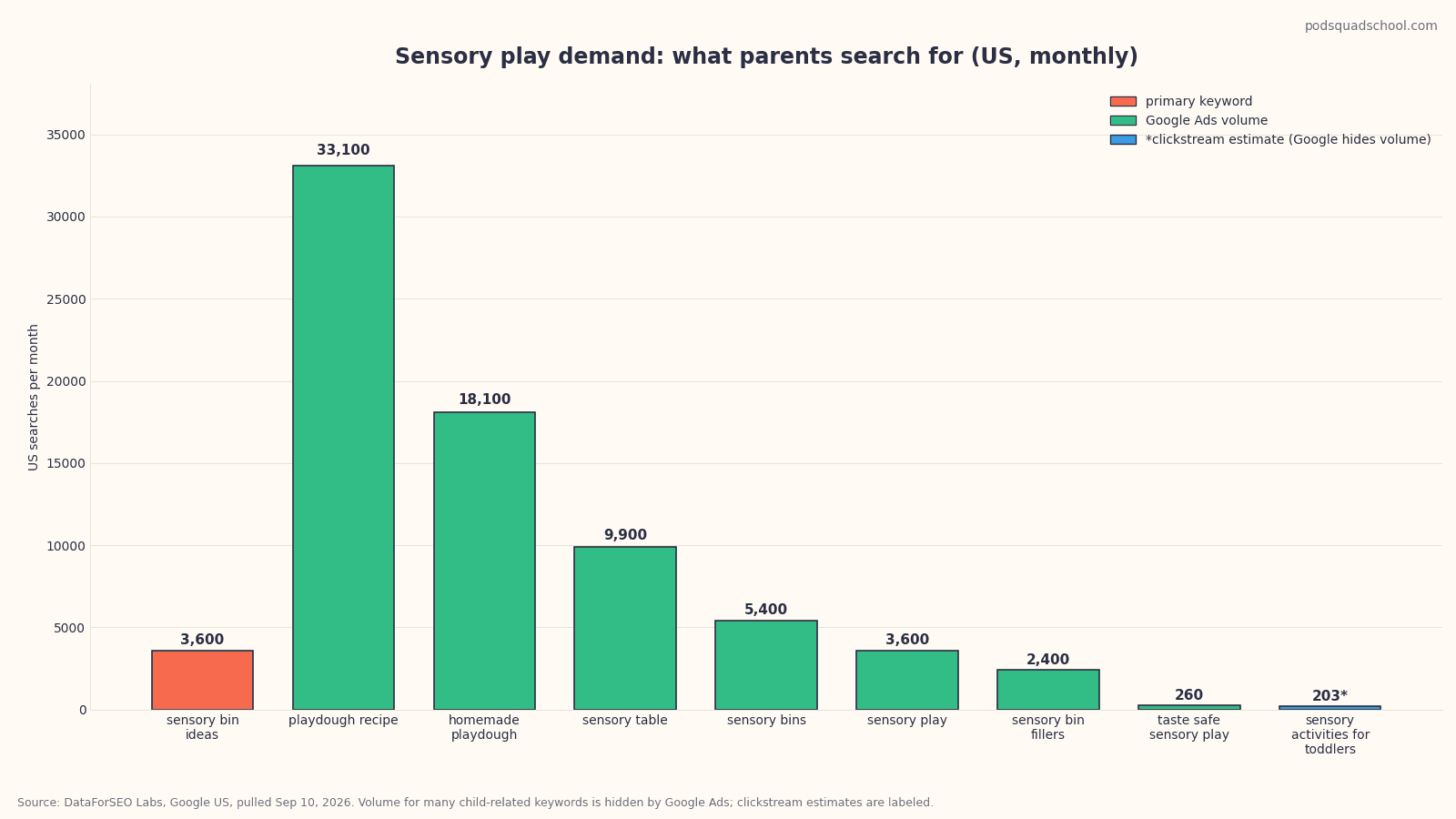
The intent tells us something useful. The single biggest reason parents land on a sensory play page is a recipe: they have decided to make playdough or oobleck tonight and want quantities. The second biggest is a purchase: a table or a pre-filled kit. Only after those two does the general "ideas" search show up, and its difficulty score of 0 says the existing pages are thin, mostly one bin per page with a photo and a paragraph. The year-over-year drop on "sensory bins" and "sensory bin ideas" (both down about 19 percent) alongside a 26 percent rise on "sensory bin fillers" suggests parents already own the bin and are now asking the harder question: what goes in it, and is it safe for my kid.
That is the gap. The big sensory blogs (Little Bins for Little Hands, Busy Toddler, Happy Toddler Playtime, Taming Little Monsters) are excellent and publish hundreds of individual bins. What none of them offer is a system: filler by age, taste-safe or not, cost, mess level, reuse, tools, theme, and the language layer that turns 20 minutes of scooping into a vocabulary lesson. This post is built as that system. Use the tables to decide, then use the themed bins and recipes to run it.
What a sensory bin actually does for a kid
A sensory bin is a container of a loose material (the filler) plus tools and small objects, set out so a child can scoop, pour, dig, sort, and pretend. It is guided play in its cleanest form: the grown-up sets the invitation, the child keeps every choice, and the grown-up narrates instead of quizzing. The American Academy of Pediatrics' 2018 clinical report The Power of Play describes exactly this kind of open-ended, adult-supported play as the mechanism through which young children build executive function, language, and social skills. You do not have to believe anything mystical about "sensory input". Watch a 2-year-old pour dry oats from a measuring cup into a funnel forty times and you are watching wrist rotation, bilateral coordination, cause and effect, and sustained attention being practiced without anyone forcing it.
Fine motor
Scooping trains the wrist to rotate and the hand to hold a tool at the right angle. Pinching small items (once the kid is old enough for small items) builds the pincer grasp that later holds a pencil. Squeezing playdough and tearing wet paper build hand strength. Pouring from one container to another is bilateral coordination: one hand stabilizes, the other acts. Tongs and tweezers isolate the thumb and index finger. This is why the tools you set out matter more than the filler. For the developmental sequence from scoop to pencil, see our guide to letter tracing readiness.
Vocabulary and serve-and-return
Harvard's Center on the Developing Child calls the back-and-forth between a young child and a responsive adult "serve and return", and it is the single most reliable driver of early language. A sensory bin produces serves constantly: the kid holds up a shell, dumps a cup, buries a truck. Your return is a word or a sentence. Verbs are the gold: scoop, pour, dump, sift, bury, dig, squeeze, splash, sprinkle, stir. Textures next: gritty, smooth, slippery, cold, wet, bumpy, soft. Then quantity: full, empty, more, less, heavy, light, all gone. A 20-minute bin with a talking grown-up nearby can expose a toddler to 30 to 50 targeted words in context, which is more than most picture books manage.
Self-regulation
Repetitive scooping and pouring is calming. Occupational therapists use exactly these materials with kids who need help settling, and you will notice the same thing at home: a 3-year-old who is wound up after school will often go quiet within five minutes of hands hitting dry beans. Sensory bins also teach limits in a low-stakes way. "Filler stays in the bin" is one of the first rules a toddler can learn to follow, and following it is a real self-regulation win. We say more about how this fits a school-day afternoon in our post on play-based learning.
Pretend and early math
Add three farm animals to a bin of oats and you have a story. Add a muffin tin and the kid starts sorting, one per cup, which is early one-to-one correspondence. Add two cups of different sizes and you get "which holds more", the root of measurement. None of this needs to be taught. It shows up when the materials are there and a grown-up notices out loud.
Safety rules that do not bend
Read this section even if you skip the rest.
Choking: the toilet-paper-tube rule under 3
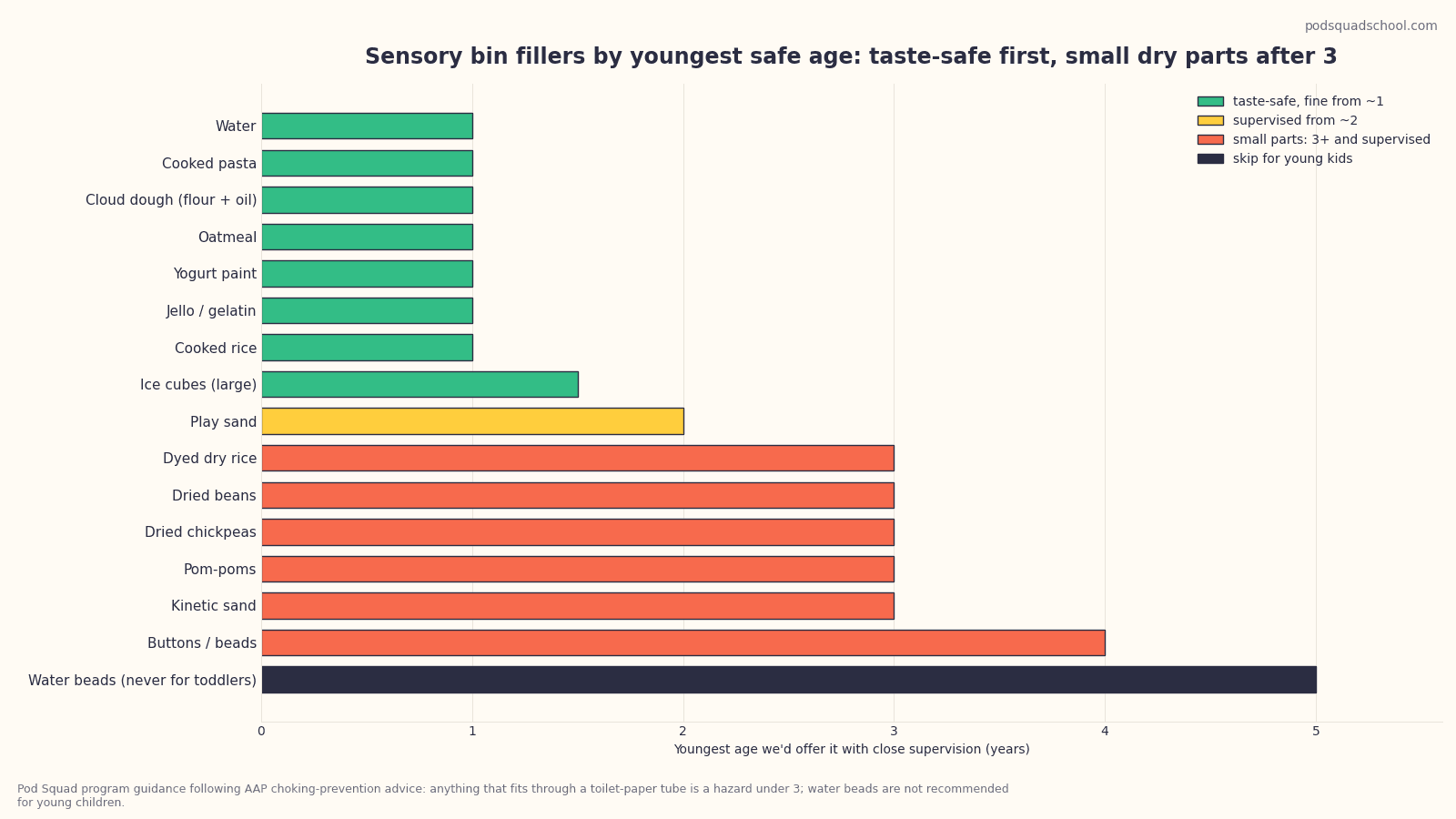
The U.S. Consumer Product Safety Commission's small-parts cylinder is about 1.25 inches across; anything that fits inside it is a choking hazard for children under 3. A cardboard toilet-paper tube is a slightly larger, more forgiving home version (about 1.75 inches across), and it is the rule we use: if it fits through the tube, it does not go in a bin for a kid under 3 unless it is taste-safe and dissolves or squishes. That single rule removes dry rice, dried beans, chickpeas, lentils, dry pasta, popcorn kernels, standard pom-poms, buttons, beads, gems, bottle caps, and acorns from the under-3 list. The AAP's HealthyChildren.org choking prevention guidance lists the same categories of small, hard, round objects as the highest-risk items. Your pediatrician knows your kid; if your 2-and-a-half-year-old has stopped mouthing things entirely, you may decide to loosen this rule under close supervision, and that is your call, not ours.
"Taste-safe" in this post means: if your kid puts a fistful in their mouth, nothing bad happens beyond a face. It does not mean "snack". Oobleck is taste-safe. Salt playdough is taste-safe in the sense that a lick does no harm, but a mouthful of salt is not fine, so it sits at 18 months and up with supervision.
Water: within arm's length, then empty it
The AAP's drowning prevention guidance is blunt: young children can drown in as little as 1 to 2 inches of water, and supervision means a grown-up within arm's reach, not in the same room. Every water bin in this post assumes you are sitting next to it. Empty the bin the moment play ends. Never leave a filled bin on a porch or in a bathroom.
Water beads: skip them
Water beads (the gel balls that swell in water) look like a perfect sensory filler and have a terrible safety record. The CPSC has issued warnings and product recalls after children swallowed them and needed surgery; the beads are hard to see on an X-ray and keep expanding inside the body. We do not use them in any Pod Squad block for any age under 5, and in a house with a toddler we would not have them at all.
Allergens: treat fillers like food
Anything a kid touches ends up in their mouth and on their siblings. Never use peanuts, tree nuts, or nut shells as fillers. Birdseed mixes often contain peanuts or sunflower seeds; check the label or skip it. Wheat flour, oats, and pasta matter for a kid with celiac disease or a wheat allergy (use rice flour or cornstarch bases). Yogurt, whipped heavy cream, and cream cheese are dairy. Aquafaba (whipped chickpea liquid) is a legume. Coconut came off the FDA's tree-nut labeling list in January 2025 and true coconut allergy is rare, but it exists, so ask the group before coconut "snow" goes in a shared bin. In a squad or playgroup, whoever hosts checks every kid's allergy list before choosing a filler, exactly the way they check before setting out snacks. Our guide to starting a squad or co-op covers the allergy protocol in detail.
Raw flour is not a food
Both the CDC and the FDA advise against eating raw flour because of E. coli and Salmonella outbreaks traced to it. A cloud dough made from raw flour is fine for a 3-year-old who does not mouth things; for a 12-month-old, use ground oats or heat-treat the flour first (the recipe below shows how).
The 75 fillers, by age, taste-safety, cost, mess, and reuse
How to read the table. Age floor is the youngest age we set this filler out for a typical kid under supervision, using the toilet-paper-tube rule. Taste-safe means a mouthful does no harm. Cost per bin is an estimate for enough filler to cover the bottom of a standard 15-quart under-bed bin 2 to 3 inches deep, at typical US grocery and craft-store prices in September 2026; your store will vary. Mess runs 1 (wipe with a hand) to 5 (bath afterward). Reuse is whether it goes back in a bag for next time.
Taste-safe, wet (best for 6 to 24 months)
| Filler | Age floor | Taste-safe | Cost per bin | Mess (1-5) | Reuse |
|---|---|---|---|---|---|
| Plain water, 1 inch deep | 6 mo (seated) | Yes | Free | 3 | No |
| Dyed water (food coloring) | 6 mo | Yes | $1 | 3 | No |
| Cooked spaghetti, plain or dyed | 12 mo | Yes | $2 | 4 | 2 days in fridge |
| Cooked rice, dyed | 12 mo | Yes | $2 | 3 | 2 days in fridge |
| Cooked oatmeal, cooled | 12 mo | Yes | $1 | 4 | No |
| Mashed potatoes, cooled | 12 mo | Yes | $2 | 4 | No |
| Applesauce | 12 mo | Yes | $2 | 4 | No |
| Cocoa-yogurt "mud" (plain yogurt + unsweetened cocoa) | 12 mo | Yes (dairy) | $2 | 5 | No |
| Plain yogurt "paint" with berries | 12 mo | Yes (dairy) | $3 | 5 | No |
| Blue chia "ocean" (chia soaked in tinted water) | 12 mo | Yes | $3 | 4 | No |
| Chia seed gel (chia + water) | 12 mo | Yes | $3 | 4 | 3 days in fridge |
| Oobleck (cornstarch + water) | 12 mo | Yes | $2 | 4 | No |
| Aquafaba foam (whipped chickpea liquid) | 12 mo | Yes (legume) | $1 | 3 | No |
| Whipped coconut cream | 12 mo | Yes (coconut) | $3 | 4 | No |
| Real snow | 12 mo | Yes | Free | 3 | No |
| Large ice cubes, 2 inches | 18 mo | Yes | Free | 3 | No |
| Frozen "ice rescue" block | 18 mo | Yes | Free | 3 | No |
| Baking soda + vinegar fizz | 2 y | Yes | $2 | 4 | No |
Taste-safe, dry (12 months and up)
| Filler | Age floor | Taste-safe | Cost per bin | Mess (1-5) | Reuse |
|---|---|---|---|---|---|
| Rolled oats | 12 mo | Yes | $3 | 2 | Weeks, airtight |
| Oat flour (blended oats) | 12 mo | Yes | $3 | 3 | Weeks |
| Taste-safe cloud dough (oat flour + oil) | 12 mo | Yes | $4 | 3 | 2 weeks |
| Oat "sand" (rolled oats blitzed fine) | 12 mo | Yes | $3 | 3 | Weeks |
| Oat-and-cocoa "dirt" (oats blitzed with unsweetened cocoa) | 12 mo | Yes | $3 | 2 | Weeks |
| Thawed frozen peas | 12 mo | Yes | $2 | 2 | No |
| Unsweetened puffed rice | 12 mo | Yes | $3 | 2 | 1 week |
| Cocoa powder + flour "dirt" | 12 mo (heat-treated flour) | Yes | $3 | 4 | 2 weeks |
| Cornmeal | 18 mo | Yes | $3 | 3 | Months |
| Heat-treated flour | 18 mo | Yes | $2 | 4 | Months |
| Classic cloud dough (flour + oil) | 18 mo | Yes (heat-treated) | $4 | 3 | 2 weeks |
| Homemade cooked playdough | 18 mo | Lick-safe, very salty | $2 | 2 | 3 months, airtight |
| Fresh herbs (basil, mint, rosemary) | 12 mo | Yes | $3 | 2 | No |
| Citrus slices in water | 12 mo | Yes | $2 | 3 | No |
| Banana or melon chunks, mashable | 12 mo | Yes | $2 | 4 | No |
| Pumpkin flesh (seeds removed) | 12 mo | Yes | $4 | 4 | No |
| Spaghetti squash strands | 12 mo | Yes | $3 | 3 | No |
| Shredded coconut "snow" | 12 mo | Yes (coconut) | $3 | 3 | Weeks |
Dry pantry fillers (3 years and up: hard and small)
| Filler | Age floor | Taste-safe | Cost per bin | Mess (1-5) | Reuse |
|---|---|---|---|---|---|
| Dry white rice, plain | 3 y | No (hard) | $3 | 3 | Years, airtight |
| Rainbow rice (dyed with vinegar) | 3 y | No | $4 | 3 | Years |
| Dried chickpeas | 3 y | No | $5 | 2 | Years |
| Dried black beans | 3 y | No | $4 | 2 | Years |
| Dried pinto or kidney beans | 3 y | No | $4 | 2 | Years |
| Dried lentils | 3 y | No | $4 | 3 | Years |
| Split peas | 3 y | No | $3 | 3 | Years |
| Dry pasta, large shapes (rigatoni, farfalle) | 3 y | No | $3 | 2 | Years |
| Dyed pasta | 3 y | No | $4 | 2 | Years |
| Popcorn kernels, unpopped | 3 y | No | $3 | 2 | Years |
| Dried feed corn | 3 y | No | $4 | 2 | Years |
| Used, dried coffee grounds | 3 y | No | Free | 4 | Weeks |
| Table salt tray (for tracing) | 3 y | Small amounts | $1 | 2 | Months |
| Epsom salt "snow" | 3 y | No | $3 | 2 | Months |
| Birdseed (nut-free, checked) | 3 y | No | $4 | 3 | Months |
| Sunflower seeds | 4 y | No (choking) | $3 | 2 | Months |
Sand, soil, and store textures
| Filler | Age floor | Taste-safe | Cost per bin | Mess (1-5) | Reuse |
|---|---|---|---|---|---|
| Play sand, washed | 18 mo | No | $3 (from a 50 lb bag) | 4 | Years |
| Kinetic sand, store-bought, 3 lb | 3 y | No | $15 to $20 | 2 | Years |
| Potting soil or garden dirt | 2 y | No | $4 | 5 | Weeks |
| Shaving cream | 3 y | No | $2 | 4 | No |
| Whipped soap foam (tear-free soap + water) | 3 y | No | $1 | 3 | No |
| Cornstarch "snow" (cornstarch + hair conditioner) | 3 y | No | $4 | 3 | 2 weeks |
| Clean mud (toilet paper + grated soap + water) | 3 y | No | $2 | 4 | No |
| Homemade slime (borax or contact solution) | 5 y | No | $5 | 3 | 2 weeks |
| Water beads | Skip (5 y+, we do not use them) | No | n/a | n/a | n/a |
Craft and loose parts
| Filler | Age floor | Taste-safe | Cost per bin | Mess (1-5) | Reuse |
|---|---|---|---|---|---|
| Silk or chiffon scarves | 6 mo | No, but safe | $8 | 1 | Years |
| Fabric and felt scraps, large | 12 mo | No, but safe | $3 | 1 | Years |
| Cardboard tubes and boxes | 18 mo | No, but safe | Free | 1 | Weeks |
| Foam blocks | 18 mo | No | $8 | 1 | Years |
| Jumbo pom-poms, 2 inches and up | 18 mo | No | $6 | 1 | Years |
| Pool noodle slices, 2 inches | 2 y | No | $2 | 1 | Years |
| Cut kitchen sponges | 2 y | No | $2 | 2 (dry), 3 (wet) | Months |
| Bubble wrap | 2 y | No | $2 | 1 | Weeks |
| Shredded paper or crinkle paper | 2 y | No | $2 | 4 | Weeks |
| Wooden craft sticks | 2 y | No | $3 | 1 | Years |
| Plastic Easter eggs, halves | 2 y | No | $3 | 1 | Years |
| Cotton balls | 3 y | No | $3 | 2 | Weeks |
| Standard pom-poms, 1 inch | 3 y | No | $5 | 2 | Years |
| Pipe cleaners | 3 y | No | $4 | 1 | Months |
| Wooden beads, 1 inch | 3 y | No | $8 | 2 | Years |
| Corks | 3 y | No | Free to $5 | 1 | Years |
| Bottle caps and lids | 3 y | No | Free | 1 | Years |
| Craft feathers | 3 y | No | $4 | 3 | Weeks |
| Paper confetti or hole-punch dots | 3 y | No | $1 | 5 | No |
| Buttons | 4 y | No | $5 | 2 | Years |
| Flat glass gems | 4 y | No | $6 | 2 | Years |
Nature fillers
| Filler | Age floor | Taste-safe | Cost per bin | Mess (1-5) | Reuse |
|---|---|---|---|---|---|
| Fresh leaves and grass clippings | 12 mo | Not food, but low risk | Free | 3 | No |
| Flower petals (roses, marigolds, pansies) | 12 mo | Known edible flowers only | Free | 3 | No |
| River rocks, 2 inches and up | 18 mo | No | $6 | 2 | Years |
| Large seashells, 2 inches and up | 2 y | No | Free to $8 | 2 | Years |
| Pinecones | 2 y | No | Free | 2 | Months |
| Sticks, 6 inches and up | 2 y | No | Free | 2 | Months |
| Preserved moss | 3 y | No | $6 | 3 | Months |
| Acorns and small shells | 3 y | No | Free | 2 | Months |
| Pebbles and aquarium gravel | 3 y | No | $5 | 3 | Years |
| Hay or straw | 3 y | No (dust, allergy) | $4 | 4 | Weeks |
That is 92 rows across the six tables, so you have a margin for the ones your kid refuses. If you count only the ones we set out regularly in Toddler Squad, it is a tight 75.
The short list by age
If the big table is too much, here is what we actually reach for.
- 6 to 12 months (seated in your lap or a high chair): water an inch deep, dyed water with a few large floating lids, silk scarves, cooked spaghetti, yogurt paint on the tray. Ten minutes is a long session.
- 12 to 18 months: rolled oats, cooked rice, oobleck, oat sand, chia gel, banana chunks, large ice cubes. Fifteen minutes.
- 18 to 24 months: taste-safe cloud dough, heat-treated flour with a sieve, cornmeal, play sand outside, jumbo pom-poms, foam blocks, cooked playdough. Fifteen to twenty-five minutes.
- 2 to 3 years: everything above plus potting soil, sponges, pool noodle slices, shredded paper, craft sticks, Easter eggs, seashells, pinecones, baking soda and vinegar. Twenty to thirty-five minutes.
- 3 to 4 years: dry rice, beans, chickpeas, pasta, popcorn kernels, kinetic sand, shaving cream, cotton balls, pom-poms, pipe cleaners, beads. Thirty to forty-five minutes, often longer with a good story.
- 4 and up: buttons, gems, hole-punch confetti, sunflower seeds, more complex sorting and measuring tools. The bin becomes a science table.
Tools: what to set out with the filler
Tools decide the engagement minutes more than the filler does. Rotate two or three per bin, never all of them. A crowded bin gets dumped.
| Tool | Youngest age | What it builds | Where to get it |
|---|---|---|---|
| Measuring cups, nesting set | 12 mo | Pouring, size comparison | Kitchen drawer |
| Large slotted spoon | 12 mo | Scooping, wrist rotation | Kitchen drawer |
| Silicone muffin tin | 12 mo | Sorting, one-to-one counting | Kitchen or dollar store |
| Small metal or plastic bowls | 12 mo | Filling, emptying, "full" and "empty" | Kitchen |
| Wide funnel | 18 mo | Pouring accuracy, patience | Dollar store, about $1 |
| Flour sifter or mesh strainer | 18 mo | Bilateral coordination, cause and effect | Kitchen |
| Ice cream scoop with trigger | 2 y | Hand strength, controlled release | Dollar store |
| Squeeze bottle (condiment style) | 2 y | Hand strength, aim | Dollar store |
| Turkey baster | 2 y | Squeeze and release, transferring water | Kitchen |
| Kid-size tongs, 6 inches | 2 y | Pincer precursor, thumb-finger isolation | Kitchen aisle or a craft store |
| Wooden spoons and spatulas | 12 mo | Stirring, pretend cooking | Kitchen |
| Small dump truck or front loader | 18 mo | Pretend, scooping, "load" and "dump" | Toy box |
| Pipettes or medicine droppers | 3 y | Fine pincer, one drop at a time | Pharmacy, free with medicine, or a $4 pack |
| Small watering can | 18 mo | Two-hand pouring, aim | Garden store |
| Paintbrushes, 1-inch chip brush | 18 mo | Sweeping, dusting sand off objects | Hardware store, under $1 |
| Magnifying glass | 3 y | Observation, vocabulary | Dollar store |
| Ladle | 2 y | Two-hand scoop and pour | Kitchen |
| Egg carton | 2 y | Sorting into twelve spots | Recycling bin |
A note on the sensory table itself. IKEA's Flisat children's table with the Trofast bins dropped in is the one you see in every photo, and it is a good product; a low table also saves your back. But a 15-quart clear under-bed storage box on the floor does the same job for a fraction of the cost, and it has a lid, which the table does not. If you have a kid under 2, the floor is also safer: nothing to climb. Buy the table when your kid is 3 and standing at a bin for 40 minutes, not before.
Cost per bin, honestly
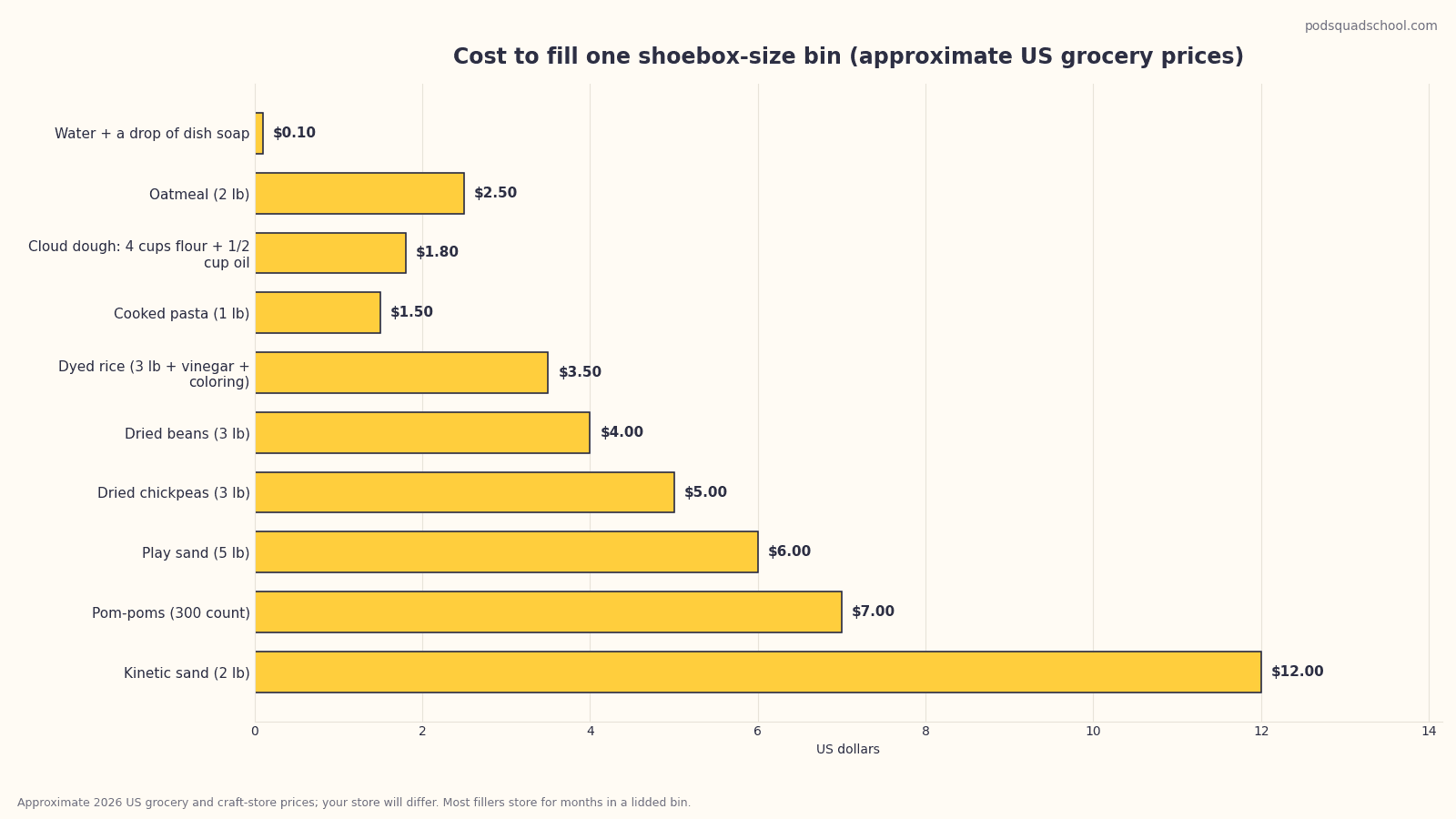
The chart makes the point that the filler tables hint at: cost has almost nothing to do with quality. Water, ice, leaves, and cardboard are free. Oats, flour, cornstarch, rice, beans, and pasta are $2 to $5 and the dry ones store for years. The two most expensive common fillers, kinetic sand and store slime, are also the two with the most limited age range and, in slime's case, the worst safety profile for a house with a toddler. A family that spends $25 once on a bin, a shower curtain, a set of tongs, and a funnel, and then $4 a week on filler, has a full year of sensory play for under $250. That is the honest price, and it is the same whether you use Pod Squad or not.
15 themed bins that follow the toddler weeks
Toddler Squad runs 12-week seasons, and every week has a theme, a Letter of the Week, a Squad Job, books, songs, and a Thursday adventure at a real place near you. These 15 bins follow those themes so the sensory block reinforces the rest of the week, but each one stands alone. For each: the filler, the tools, the add-ins, what to say, the minutes to expect, the age note, and what your kid is practicing.
1. Hello, Squad: the name bin (Week 1)
Filler: rolled oats. Tools: a measuring cup, a silicone muffin tin. Add-ins: large wooden letters or foam letters of your kid's name (2 inches or bigger for under 3). What to say: "I found a C. C is for Cash. Where does the C live in your name?" Minutes: 15 to 20. Age note: under 2, just bury and find the letters; at 3, line them up in order on the muffin tin. Practicing: name recognition, the first letter sound, scooping.
2. Color Splash: the dyed spaghetti bin (Week 2)
Filler: 1 pound of cooked spaghetti split into 3 bowls and tossed with 6 drops of food coloring each (red, yellow, blue), then combined. Tools: tongs, three colored bowls. Add-ins: none needed. What to say: "You picked up a red noodle. Slippery. Does it stretch?" Minutes: 20 at 18 months, 30 at 3 years. Age note: taste-safe from 12 months; the youngest kids will eat some, and that is fine. Practicing: color names, tongs grip, sorting.
3. Color Splash: the color-sort ice bin (Week 2)
Filler: 1 inch of water. Add-ins: 3 trays of ice cubes made with a few drops of food coloring in each tray (one color per tray), 2-inch cubes or larger. Tools: slotted spoon, 3 bowls. What to say: "The blue one is melting. Look, the water is turning blue too." Minutes: 15. Age note: 18 months and up; adult within arm's length the whole time. Practicing: color matching, cause and effect, cold as a word.
4. Wheels & Roads: the construction site (Week 3)
Filler: dried black beans (3 years and up) or oat-and-cocoa "dirt" (12 months and up). Tools: a dump truck, a front loader, a small shovel, a paper plate "parking lot". Add-ins: 3 river rocks as boulders. What to say: "Load it up. Now drive to the lot. Dump." Minutes: 30 to 40; this is one of the longest-holding bins we run. Age note: the oat version is the same activity for the under-3 crowd. Practicing: the verbs load, dump, drive, push; pretend sequencing; hand strength.
5. Wheels & Roads: the car wash (Week 3)
Filler: 1 inch of soapy water (tear-free baby soap). Tools: an old toothbrush, a washcloth, a spray bottle of clean water for rinsing, a towel for drying. Add-ins: 5 toy vehicles. What to say: "The wheels are muddy. Scrub, scrub. Now rinse. Now dry it off." Minutes: 20. Age note: 18 months and up, adult at arm's length; at 3, add a "drying station" towel and a "done" line. Practicing: a real job sequence (wash, rinse, dry), two-hand coordination, and it doubles as the week's Squad Job, Pit Stop Crew.
6. Water & Weather: make it rain (Week 4)
Filler: 2 inches of water. Tools: a turkey baster, a sponge, a clear cup, a small watering can. Add-ins: a handful of cotton balls (3 years and up) or a large sponge "cloud" for younger kids. What to say: "Squeeze the cloud. Rain. When the cloud is full it has to rain." Minutes: 20 to 25. Age note: this is the Wonder Lab for the week, so the science line is simply "clouds hold water until they can't." Practicing: squeeze and release, the words full, drip, pour, and a first weather idea.
7. Bugs & Butterflies: the garden dig (Week 5)
Filler: potting soil (2 years and up) or cocoa-and-flour "dirt" (12 months and up, heat-treated flour). Tools: a garden trowel, a small pot, a chip brush. Add-ins: plastic bugs bigger than a toilet-paper tube, silk flower heads, a magnifying glass at 3. What to say: "You found a beetle under the dirt. How many legs? Let's count together." Minutes: 25 to 35. Age note: soil means a bath after; do it outside or right before the tub. Practicing: counting to six, the words dig, bury, hide, and the beginning of observation.
8. Farm & Food: the muddy pig bin (Week 6)
Filler: cocoa-yogurt "mud" (12 months and up): 2 cups of plain yogurt stirred with 2 tablespoons of unsweetened cocoa, plus a bowl of soapy water on the side. Tools: a spoon, a washcloth. Add-ins: 3 large plastic farm animals. What to say: "The pig loves mud. Now she is dirty. Time for a bath." Minutes: 15 to 20. Age note: dairy; use plain coconut yogurt for a dairy-free kid. Level-5 mess. Practicing: the dirty-clean cycle, animal names and sounds, tolerance for wet and sticky.
9. Farm & Food: the feed store (Week 6)
Filler: rolled oats and dried feed corn in two sections (corn for 3 and up only; use puffed rice for the second section under 3). Tools: a scoop, a funnel, 3 small jars. Add-ins: farm animals, an egg carton. What to say: "The cow eats oats. Scoop some into her bowl. Is it full yet?" Minutes: 25. Age note: the funnel-into-jar move is a big deal at 2 and a half; expect misses, and name them as practice. Practicing: pouring accuracy, full and empty, feeding as care.
10. Community Helpers: the mail sort (Week 7)
Filler: shredded paper (2 years and up). Tools: a shoulder bag, envelopes with a colored dot on each, a muffin tin or egg carton with matching dots. Add-ins: a small toy mail truck. What to say: "This letter has a red dot. Where does red mail go?" Minutes: 20. Age note: at 2, just find the envelopes; at 3 and a half, sort by color and count them. Practicing: matching, sorting, the job of a mail carrier before the Thursday visit.
11. Build It: the cardboard quarry (Week 8)
Filler: cardboard tubes cut to 3 inches and small boxes, plus foam blocks (18 months and up). Tools: a dump truck, painter's tape, a wooden spoon "crane". Add-ins: none. What to say: "Stack it. Taller? Uh oh, it fell. What if the big one goes on the bottom?" Minutes: 25 to 40. Age note: the least messy bin on this list and a good one for a rental or a carpeted room. Practicing: stacking, stability, the word balance, resilience when the tower falls.
12. Ocean & Beach: the tide pool (Week 9)
Filler: 2 inches of water dyed blue, with 2 cups of play sand banked at one end (18 months and up). Tools: a shell scoop, a small net or slotted spoon, a bucket. Add-ins: large seashells, 2 plastic sea animals bigger than a toilet-paper tube. What to say: "The wave covered the shell. Dig it out. Is the sand wet or dry here?" Minutes: 30. Age note: outside if you can; sand plus water is a level-4 mess. Adult at arm's length. Practicing: wet versus dry, sink and float, scooping with a net.
13. Wild Animals: the savanna (Week 10)
Filler: dried yellow split peas and lentils (3 years and up) or cornmeal (18 months and up). Tools: a small shovel, tongs, a bowl "waterhole" with an inch of water. Add-ins: 4 large plastic wild animals, a few 6-inch sticks as trees. What to say: "The elephant is thirsty. Walk her to the waterhole. Stomp, stomp." Minutes: 25 to 35. Age note: the animals carry the play; pick ones your kid already knows. Practicing: animal names, big and small, slow and fast, pretend narratives.
14. Thankful Harvest: the pumpkin scoop (Week 11)
Filler: the inside of a real pumpkin, seeds removed, scooped into the bin (12 months and up; a real, messy, taste-safe filler). Tools: a large spoon, a small bowl, a chip brush. Add-ins: a few gourds, a real apple. What to say: "Slimy. Cold. That is what the inside of a pumpkin feels like. Can you pull a string out?" Minutes: 15 to 20. Age note: the seeds are a choking hazard under 4, so remove them first and let a 4-year-old count them on a separate tray. Practicing: texture words, tolerating slimy, the beginning of gratitude talk as you name the food.
15. Lights, Music & Celebration: the jingle bin (Week 12)
Filler: dyed rice in gold and silver (3 years and up) or rolled oats (under 3). Tools: a scoop, a clear jar with a lid. Add-ins: large jingle bells 1.5 inches and up (under 3, use 2-inch bells only), a few strips of ribbon. What to say: "Fill the jar. Now shake it. Loud or quiet?" Minutes: 20. Age note: check every bell for a loose clapper before it goes in. Practicing: loud and quiet, fill and shake, a homemade instrument for the week's songs.
Five recipes with exact quantities
Each of these takes 10 minutes or less to make. Quantities fill a standard 15-quart bin about 2 inches deep.
Recipe 1: taste-safe cloud dough (12 months and up)
- Blend 4 cups of rolled oats in a blender or food processor until it looks like flour, about 60 seconds. Or use 4 cups of all-purpose flour spread thin on a baking sheet, baked at 350 F for about 10 minutes, stirring halfway, until it reaches 160 F all the way through (check with a food thermometer), then cooled; this heat-treats the flour, which the CDC recommends before any raw flour is handled by a kid who mouths things.
- Add 1/2 cup of olive oil or melted coconut oil.
- Mix with your hands for 2 minutes until it holds a shape when squeezed and crumbles when poked.
- For color, add 2 tablespoons of cocoa powder for "dirt" or 1 teaspoon of ground cinnamon for scent.
Store in an airtight container for up to 2 weeks. Mess level 3. Tools that work: a measuring cup, a silicone muffin tin, a large ice cream scoop.
Recipe 2: oobleck (12 months and up)
- Pour 2 cups of cornstarch into the bin.
- Add 1 cup of water slowly, stirring with a wooden spoon.
- Add more water a tablespoon at a time until it acts solid when you tap it and liquid when you lift it.
- For color, stir 5 drops of food coloring into the water before adding.
Oobleck is taste-safe but not food; a mouthful is unpleasant and harmless. Mess level 4. It does not store; let leftovers dry completely in the bin, then break up the powder and throw it in the trash. Never pour a bowl of oobleck down the drain; it can settle and clog the pipe.
Recipe 3: homemade cooked playdough (18 months and up)
- In a saucepan, whisk 2 cups of all-purpose flour, 1/2 cup of table salt, and 2 tablespoons of cream of tartar.
- Add 1 and 1/2 cups of water, 2 tablespoons of coconut or olive oil, and 10 to 15 drops of food coloring.
- Cook over medium heat, stirring constantly, for 3 to 5 minutes until it pulls away from the sides and forms a ball.
- Turn out onto parchment paper, let it cool for 5 minutes, then knead for 1 minute.
Store in an airtight container or zip bag for up to 3 months at room temperature. Mess level 2. A lick is fine (it is very salty); do not let a kid eat it. For a wheat-free kid, use 1 cup of rice flour and 1 cup of cornstarch in place of the flour, 1 cup of salt, and 4 teaspoons of cream of tartar with 2 cups of water; it comes out slightly stickier and still works.
Recipe 4: frozen ice rescue (18 months and up)
- Fill a loaf pan or a 32-ounce yogurt tub one third full with water and freeze for 2 hours.
- Add 3 or 4 plastic animals or vehicles, each bigger than a toilet-paper tube, and fill to two thirds. Freeze 2 more hours.
- Top off with water and freeze overnight.
- Run warm water over the outside of the pan for 30 seconds to release the block into the bin.
Rescue tools by age: a squeeze bottle of warm (not hot) water and a wooden spoon at 18 months; add a turkey baster at 2; add a salt shaker at 3 (salt melts ice fast, and salt is a small-amounts-only item). Never set out metal picks or skewers. Mess level 3; the bin fills with water as it melts, so an adult stays within arm's length. Minutes: 25 to 40, one of the best ratios of prep to play in this whole post.
Recipe 5: rainbow rice (3 years and up)
- Measure 1 cup of dry white rice into a zip bag.
- Add 1 teaspoon of white vinegar and 8 to 10 drops of food coloring.
- Seal and shake for 1 minute until every grain is coated.
- Spread on parchment paper or a baking sheet and dry for 1 to 2 hours (or 10 minutes in a 200 F oven).
- Repeat for each color; 6 cups (6 colors) fills a bin about 2 inches deep.
Store in an airtight jar for years. Mess level 3, mostly from grains that escape the bin. Rice is not taste-safe and is small enough to inhale, so this one waits until 3. If you are in a humid climate (we are, in South Florida), keep it in the house, not the garage, and drop a silica packet from a shoe box into the jar.
Setup and cleanup systems that keep the filler in the bin
The difference between families who do sensory bins weekly and families who did one and quit is almost never the kid. It is the cleanup system.
The tray under the bin
Put the bin inside something bigger. A 15-quart under-bed box inside a 40-quart box, or a bin on a cookie sheet, or a bin on a $5 fitted crib sheet stretched under a low table with the elastic edges up. Whatever spills lands in the outer layer and pours back in. This one move cuts cleanup time in half.
The shower curtain
A $3 shower curtain liner under everything. When play is over, pick up the corners, walk it to the kitchen, and pour the escaped filler back into the bin (dry fillers) or shake it into the trash and hang it over the shower rod to dry (wet fillers). A fitted sheet works the same way if you have an old one.
The "two hands in the bin" rule
Before the first scoop, say the rule and show it: "Two hands in the bin. The oats stay in the bin." Then use it consistently. When filler comes out on purpose, the first time gets a calm reminder and a demonstration of putting it back. The second time, the bin goes away for the day, with no drama: "The oats came out, so the bin is done for today. We will try again tomorrow." Most 2-year-olds have it within a week. Most 3-year-olds have it in two sessions. This is not a punishment; it is the boundary that makes the activity possible in a house, and it is a real self-regulation lesson.
A dustpan, a hand vacuum, a wet cloth
Keep a small dustpan and brush in the bin's storage spot. Kids love using it. A handheld vacuum handles rice and lentils in the carpet. A wet cloth in a bowl of water next to the bin handles hands mid-play so a kid does not walk cloud dough to the couch.
Wet bins go in the bathroom or outside
Water, oobleck, yogurt mud, ice: run them on the bathroom floor on a towel, in the empty bathtub with the kid sitting in the tub, on a high chair tray, or outside on a patio. The empty-bathtub bin is our favorite winter move for under-2s: the mess is contained by design and the bath is already right there.
Let the kid do the cleanup job
Cleanup is a Squad Job. A 2-year-old can pour a cup of oats from the outer tray back into the bin and carry the bin lid. A 3-year-old can use the dustpan and put the tools in their basket. A 4-year-old can sweep the shower curtain and snap the lid. Name it: "You are the cleanup crew." It doubles the value of the activity and teaches the sequence.
Mess versus minutes
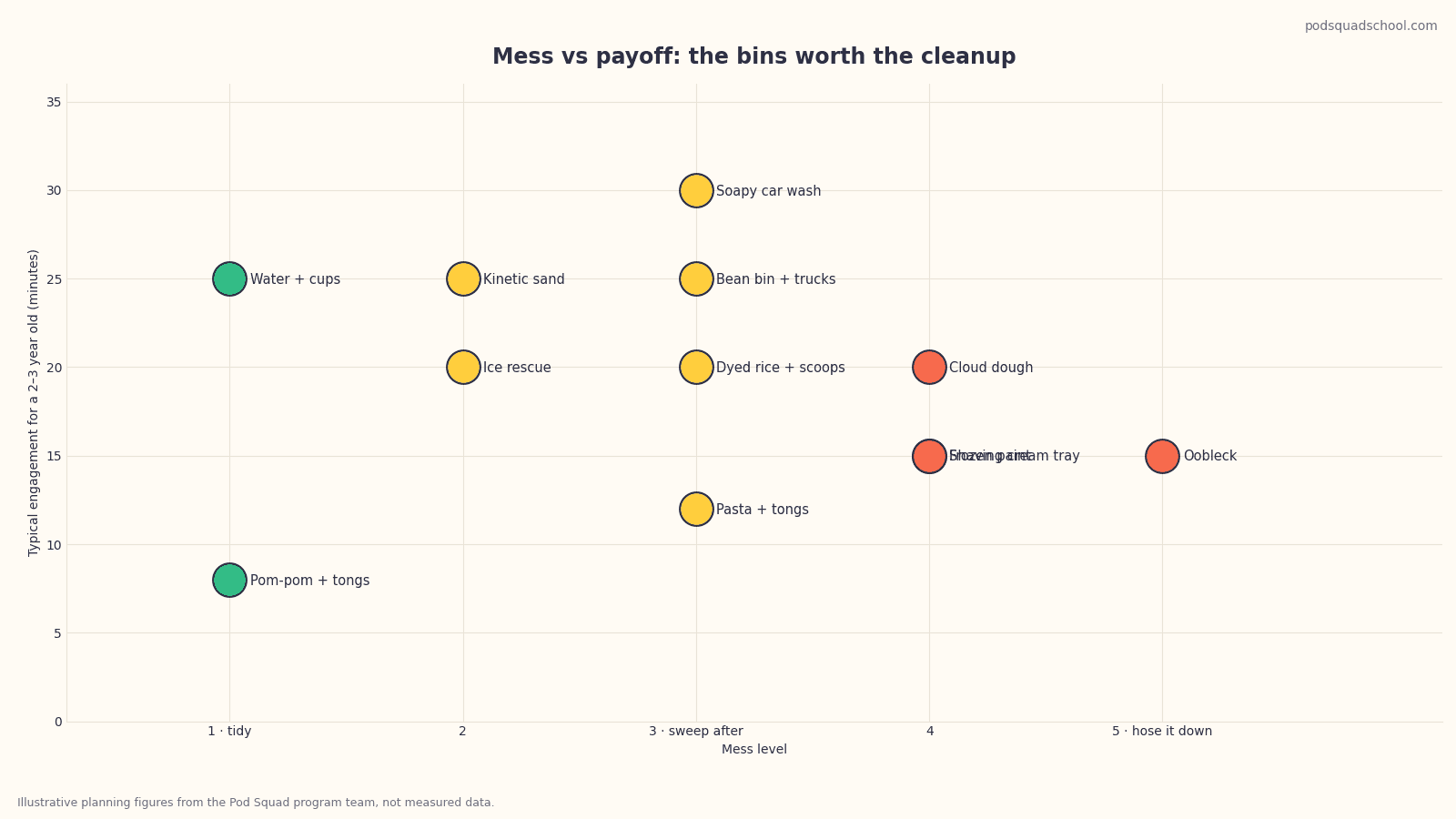
The chart is the argument for planning by minutes. A construction bin of dried beans with a dump truck is a level 2 and routinely runs 35 to 40 minutes. Shaving cream is a level 4 and is often done in 12. Yogurt mud is a level 5 and a 15-minute activity. The frozen ice rescue is a level 3 and can run 40. If you have 20 minutes before dinner, pick a low-mess, high-minute bin; save the level-5 bins for the hour before bath on a weekend.
Storage that survives a season
- Dry pantry fillers (rice, beans, chickpeas, pasta, popcorn kernels, dyed rice): a gallon zip bag inside a gasket-lid container, labeled with the filler and the month. They keep for years. Toss if you see moisture, webbing, or anything moving.
- Oats, cornmeal, and flour-based doughs: two weeks for anything with oil in it, months for plain dry oats and cornmeal. Airtight, in the house, not the garage, especially in humid climates.
- Cooked and wet fillers (spaghetti, rice, yogurt, chia): one to three days in the refrigerator or single-use. Do not store water.
- Playdough: airtight, room temperature, up to 3 months. If it dries, knead in a teaspoon of water.
- Tools and add-ins: one shoebox per theme (farm animals with the farm bowls, sea animals with the shells) so setup is one box plus one filler bag.
- The bin itself: rinse, dry fully, and store with the lid off for a day before you close it, or it smells.
A worked week
A family with a 2-year-old and a 4-year-old, both in daycare or preschool, running sensory bins after pickup and on Saturday. Total filler cost for the week: about $9. Total prep: about 25 minutes, most of it Sunday night.
| Day | Bin | Filler | Minutes | Who does what |
|---|---|---|---|---|
| Sunday night | Prep | Cook 1 lb spaghetti and dye it; freeze the ice rescue block | 15 min prep | Grown-up |
| Monday, 5:00 pm | Color Splash spaghetti | Dyed spaghetti, tongs, 3 bowls | 20 | 2-year-old sorts by color; 4-year-old counts each bowl and sets a "menu" |
| Tuesday, 5:00 pm | Construction site | Oat-and-cocoa "dirt" (for the 2-year-old) with a dump truck; a separate small bin of dried black beans for the 4-year-old, out of the 2-year-old's reach | 30 | Both load and dump; the 4-year-old builds a road with tape |
| Wednesday | Off | Bath night, no bin | 0 | Rest |
| Thursday, 5:15 pm | Ice rescue | Frozen block, squeeze bottle of warm water, turkey baster; salt shaker for the 4-year-old only | 30 | Adult within arm's length; the 4-year-old narrates which animal is "free" |
| Friday, 5:00 pm | Car wash | Soapy water, toothbrush, towel, 5 vehicles | 20 | Wash, rinse, dry; the 2-year-old dries, the 4-year-old runs the "rinse station" |
| Saturday, 9:30 am | Garden dig, outside | Potting soil, trowel, plastic bugs, magnifying glass | 35 | Bath after; the 4-year-old draws the bugs found on paper afterward |
| Saturday, 10:15 am | Cleanup crew | Dustpan, shower curtain shake-out, rinse the bin | 10 | Both kids, named as the job |
Monday and Tuesday are the low-mess bins because weeknights are tight. Thursday is the one that runs longest and needs the closest supervision, so it lands on the night the second grown-up is home. Saturday morning is the messy one, outdoors, right before a planned bath. That is the whole system: match mess and supervision to the day, not the other way round. For more ways to fill an after-school half hour, see our full list of activities for 2-year-olds by moment of the day.
Where Pod Squad fits, stated plainly
Pod Squad is a paid membership: free for 7 days, then $99 a month for the first kid, siblings 50 percent off. Everything in this post is doable without it, and if your family already runs a bin a week and enjoys planning it, you do not need us for sensory play. The public sensory blogs are excellent and free.
What Pod Squad does is remove the planning. In Toddler Squad, every one of the 12 weekly themes has sensory blocks already written: the filler, the two tools, the add-ins, the exact words to say, the minutes to expect, what to watch for, and what to do when your kid dumps it on the floor. The notes name your kid by age: the same Farm & Food week reads differently for a 20-month-old who needs the taste-safe version and a 3-and-a-half-year-old who is ready for dried corn and a funnel. If you have a baby and a toddler on the same account, the baby gets a ride-along line on every block so they are never invisible. The weekly shopping list already includes the filler. The app reminds you the night before to cook the spaghetti and the Block Timer runs the activity start to finish, then lets you log a photo into the kid's portfolio. Kids never touch the app; it is screen-free for them by design.
If you want to try it before paying anything, the free sample includes a Week 1 worksheet and a Wonder Lab card, and the 7-day free trial gives you the whole program for a full week, which is enough time to run three or four of the bins in this post with the plan done for you. Get the app (iPhone and Android), or use any browser. You can read exactly how the personalization layer decides what each kid sees at how it works, and the per-kid pricing at pricing.
Mistakes that cost the most
- Using dry rice or beans with a 1-year-old because a blog photo did. Both fit through a toilet-paper tube and both are inhalation and choking hazards. The fix: cooked rice, oats, or oat sand until 3. Same play, no emergency room.
- Setting out six tools. The kid dumps the bin because the bin is the only thing left to do. The fix: two tools and one add-in set. Rotate next time.
- Skipping the rule. If you never say "filler stays in the bin", the kid has no idea it is a rule, and you end up resenting an activity you set up. The fix: say it before the first scoop, every time, for two weeks.
- Running a level-5 bin at 5:30 on a Tuesday. Yogurt mud before dinner with no bath planned is how families quit. The fix: match mess to the day. Weeknights get level 1 to 3; Saturday before bath gets the level 5.
- Buying kinetic sand as the first filler. It is $15 to $20, not taste-safe, and no more engaging than $3 of beans with a truck. The fix: start free (water, ice, leaves) and cheap (oats, flour, pasta), and buy kinetic sand at 3 if the kid loves sand.
- Water beads, in any house with a child under 5. No fix; skip them.
- Quizzing. "What color is this? What shape is that?" turns play into a test and the kid leaves. The fix: narrate what the kid does and ask one real question in 20 minutes. "You buried the whole cow. Where do you think she went?"
- Leaving a filled water bin for five minutes to answer the door. The fix: the kid comes with you, or the bin gets emptied. There is no third option under 4.
Who this is for, and who it is not for
This is for you if you have a kid between about 6 months and 5 years, you want a 20 to 40 minute activity that costs a few dollars and needs almost no prep, and you would like it to build something (fine motor, language, focus) while it keeps the kid busy. It is for families who send kids to school and want a better after-pickup half hour than a tablet. It is for homeschooling families who want a daily sensory block that connects to a theme, a letter, and a real-world trip. It is for grandparents and babysitters who need a simple, safe list. And it is for anyone hosting a playgroup or squad who needs to think about allergies and age spread before choosing a filler.
This is not for you if your kid is under 6 months (they are not ready to sit and reach; wait), if you need an activity that requires zero supervision (every bin here needs an adult in the room and water bins need one within arm's reach), or if you are looking for a screen-based or app-based activity for the kid (Pod Squad's app is for grown-ups only, and sensory bins are the opposite of a screen). If your kid has sensory processing differences, feeding therapy needs, or a history of pica, talk to your pediatrician or occupational therapist before choosing fillers; they know your kid, and the taste-safe rules here are a floor, not a treatment plan.
Frequently asked questions
What age can a baby start sensory bins?
Around 6 months, once your baby sits with support and reaches for objects, you can start with a shallow inch of water on a high chair tray, a few silk scarves, or a spoonful of yogurt to smear. Keep sessions to 5 or 10 minutes and keep every item either taste-safe or too big to fit through a toilet-paper tube. By 12 months, cooked spaghetti, rolled oats, oobleck, and oat sand open up. Dry rice, beans, and pasta wait until about 3. Your pediatrician knows your kid, so ask if you are unsure about readiness.
What is the best filler for a sensory bin?
For under 3, rolled oats: they are taste-safe, cheap (about $3 a bin), level-2 mess, and store for weeks. For 3 and up, dried black beans or chickpeas: about $4 to $5, level 2, they last for years, and they pair with almost every theme. Water is the best free filler at any age with an adult at arm's length. The best filler is really the one that fits your kid's age, the day's mess budget, and the time you have; the tables above are built to make that a 30-second decision.
Is dry rice safe for toddlers?
Not before about 3 years. A grain of rice is far smaller than the CPSC small-parts cylinder, it can be inhaled, and it is not taste-safe because it is hard. Many blogs show 18-month-olds in rice bins; we do not recommend it. Cooked rice, dyed with a few drops of food coloring, gives a 1-year-old the same scooping, pouring, and texture experience and is safe to eat. Once your kid is 3 and has stopped mouthing things, dry rice and rainbow rice become one of the best long-term fillers you can own.
How do I keep the mess under control?
Three systems. First, put the bin inside a larger tray or box so spills land in the outer layer and pour straight back. Second, put a $3 shower curtain liner under everything and shake it out after. Third, teach the rule "two hands in the bin, filler stays in the bin" before the first scoop, and end the session calmly the second time filler leaves on purpose. Run wet bins in the empty bathtub, on the bathroom floor, or outside. Let the kid do the cleanup as a real job with a dustpan.
How long should a sensory bin last?
Expect about 10 minutes at 12 months, 15 to 20 at 18 months, 20 to 30 at 2, and 30 to 45 at 3 and older. Engagement depends more on the tools and the pretend story than on the filler. A construction bin with a dump truck and beans routinely runs 40 minutes for a 3-year-old; shaving cream is often done in 12. If your kid walks away after 5 minutes, add one tool or one animal and narrate what it could do, then step back. If they walk away twice, the bin is done for today, and that is fine.
Can I do sensory bins with two kids of different ages?
Yes, and it is the normal case. Use one taste-safe filler both kids can share (oats, cloud dough, cooked spaghetti, water) and give each kid their own tools and add-ins. If the older kid wants beans or rice, run a second small bin for them on a table out of the younger kid's reach, or wait until the younger one naps. Give the older kid a "job" (menu writer, rinse station, counter) so they stay in the play. Pod Squad writes the age note for each kid on the same block for exactly this reason.
What sensory fillers should I avoid in a playgroup or squad?
No peanuts, tree nuts, or nut shells, ever. No birdseed unless you have read the label and confirmed it is nut-free. Coconut came off the FDA's tree-nut labeling list in January 2025, but coconut allergy exists, so ask before it goes in a shared bin. Check for wheat, dairy, and legume allergies before using flour, yogurt, or aquafaba. Confirm every kid's list before choosing, label the bin, and keep an ingredient list nearby. In a squad on Pod Squad, allergies by kid live on the hosting board so the snack host and the bin host see the same list.
Are sensory bins actually educational or just busy work?
Both, and that is the point. The AAP's 2018 clinical report The Power of Play describes open-ended, adult-supported play as the mechanism for building executive function and language in early childhood. A bin gives a kid scooping and pouring (fine motor), a talking adult (vocabulary through serve-and-return), sorting and measuring (early math), sink and float and melt (early science), and a rule to follow (self-regulation). The busy-work part is real too: 30 minutes of a focused toddler is not nothing at 5 pm.
Sources & methodology
- American Academy of Pediatrics, HealthyChildren.org, "Choking Prevention" and related safety guidance: https://www.healthychildren.org
- American Academy of Pediatrics, HealthyChildren.org, "Drowning Prevention" guidance, including supervision within arm's reach for young children: https://www.healthychildren.org
- American Academy of Pediatrics, Clinical Report, "The Power of Play: A Pediatric Role in Enhancing Development in Young Children," Pediatrics, 2018 (Yogman et al.): https://publications.aap.org/pediatrics
- U.S. Consumer Product Safety Commission, small parts regulation for children under 3 (16 CFR Part 1501) and water bead safety warnings and recalls: https://www.cpsc.gov
- Centers for Disease Control and Prevention, "Say No to Raw Dough" guidance on raw flour and E. coli and Salmonella risk: https://www.cdc.gov
- Centers for Disease Control and Prevention, developmental milestones (Learn the Signs. Act Early.): https://www.cdc.gov/ncbddd/actearly/milestones/index.html
- Harvard University, Center on the Developing Child, "Serve and Return" and executive function resources: https://developingchild.harvard.edu
- National Association for the Education of Young Children, position statement on developmentally appropriate practice: https://www.naeyc.org
- U.S. Food and Drug Administration, food allergen labeling guidance (coconut classified as a tree nut for labeling purposes): https://www.fda.gov
- Search demand: DataForSEO Labs, Google US, September 10, 2026; volumes for many child-related keywords are suppressed by Google Ads and are shown as clickstream estimates where labeled.
- Cost per bin figures are Pod Squad estimates at typical US grocery, dollar-store, and craft-store prices in September 2026 for enough filler to cover a 15-quart bin 2 to 3 inches deep. Mess levels and engagement minutes come from Pod Squad Toddler Squad block notes and family logs, 2025 to 2026, and are illustrative, not a study.
- Competitor references: littlebinsforlittlehands.com, busytoddler.com, happytoddlerplaytime.com, taminglittlemonsters.com, viewed September 2026. No competitor prices are quoted in this post.
Bottom line
A sensory bin is one bin, one filler, two tools, one theme, matched to your kid's age and the mess you can handle today. Under 3, the filler is taste-safe or too big to swallow; after 3, the pantry opens up. Most bins cost under $6 and most dry fillers last for years. The talk you do beside the bin is where the language and self-regulation come from, so narrate the verbs and skip the quiz.
You already know your kid; that is the hard part. The tables above make the rest a 30-second decision, and the recipes and themed bins give you a season of Tuesdays. If you would rather have someone hand you the plan, the filler already on the shopping list, and the words to say for your kid's exact age, that is what Pod Squad does.
Start free for 7 days at /start and run the first three bins this week.
Keep exploring
- Activities for 2-Year-Olds: 60 Ideas by Age, Room, and Mood
- Play-Based Learning: What the Research Says and How to Run It at Home
- Healthy Snacks for Kids: 75 Ideas by Age, With Choking-Safe Cuts
- Screen Time for Toddlers: The AAP Guidelines and 50 Screen-Free Swaps
- Toddler Squad: the 12-week program these bins come from
- Get the free sample
Questions parents ask
What age can a baby start sensory bins?
Around 6 months, once your baby sits with support and reaches for objects, you can start with a shallow inch of water on a high chair tray, a few silk scarves, or a spoonful of yogurt to smear. Keep sessions to 5 or 10 minutes and keep every item either taste-safe or too big to fit through a toilet-paper tube. By 12 months, cooked spaghetti, rolled oats, oobleck, and oat sand open up. Dry rice, beans, and pasta wait until about 3. Your pediatrician knows your kid, so ask if you are unsure about readiness.
What is the best filler for a sensory bin?
For under 3, rolled oats: they are taste-safe, cheap (about $3 a bin), level-2 mess, and store for weeks. For 3 and up, dried black beans or chickpeas: about $4 to $5, level 2, they last for years, and they pair with almost every theme. Water is the best free filler at any age with an adult at arm's length. The best filler is really the one that fits your kid's age, the day's mess budget, and the time you have; the tables above are built to make that a 30-second decision.
Is dry rice safe for toddlers?
Not before about 3 years. A grain of rice is far smaller than the CPSC small-parts cylinder, it can be inhaled, and it is not taste-safe because it is hard. Many blogs show 18-month-olds in rice bins; we do not recommend it. Cooked rice, dyed with a few drops of food coloring, gives a 1-year-old the same scooping, pouring, and texture experience and is safe to eat. Once your kid is 3 and has stopped mouthing things, dry rice and rainbow rice become one of the best long-term fillers you can own.
How do I keep the mess under control?
Three systems. First, put the bin inside a larger tray or box so spills land in the outer layer and pour straight back. Second, put a $3 shower curtain liner under everything and shake it out after. Third, teach the rule "two hands in the bin, filler stays in the bin" before the first scoop, and end the session calmly the second time filler leaves on purpose. Run wet bins in the empty bathtub, on the bathroom floor, or outside. Let the kid do the cleanup as a real job with a dustpan.
How long should a sensory bin last?
Expect about 10 minutes at 12 months, 15 to 20 at 18 months, 20 to 30 at 2, and 30 to 45 at 3 and older. Engagement depends more on the tools and the pretend story than on the filler. A construction bin with a dump truck and beans routinely runs 40 minutes for a 3-year-old; shaving cream is often done in 12. If your kid walks away after 5 minutes, add one tool or one animal and narrate what it could do, then step back. If they walk away twice, the bin is done for today, and that is fine.
Can I do sensory bins with two kids of different ages?
Yes, and it is the normal case. Use one taste-safe filler both kids can share (oats, cloud dough, cooked spaghetti, water) and give each kid their own tools and add-ins. If the older kid wants beans or rice, run a second small bin for them on a table out of the younger kid's reach, or wait until the younger one naps. Give the older kid a "job" (menu writer, rinse station, counter) so they stay in the play. Pod Squad writes the age note for each kid on the same block for exactly this reason.
What sensory fillers should I avoid in a playgroup or squad?
No peanuts, tree nuts, or nut shells, ever. No birdseed unless you have read the label and confirmed it is nut-free. Coconut came off the FDA's tree-nut labeling list in January 2025, but coconut allergy exists, so ask before it goes in a shared bin. Check for wheat, dairy, and legume allergies before using flour, yogurt, or aquafaba. Confirm every kid's list before choosing, label the bin, and keep an ingredient list nearby. In a squad on Pod Squad, allergies by kid live on the hosting board so the snack host and the bin host see the same list.
Are sensory bins actually educational or just busy work?
Both, and that is the point. The AAP's 2018 clinical report The Power of Play describes open-ended, adult-supported play as the mechanism for building executive function and language in early childhood. A bin gives a kid scooping and pouring (fine motor), a talking adult (vocabulary through serve-and-return), sorting and measuring (early math), sink and float and melt (early science), and a rule to follow (self-regulation). The busy-work part is real too: 30 minutes of a focused toddler is not nothing at 5 pm.
Written by
Pod Squad Program Team
Curriculum & play · Pod Squad. We write the daily plan families run, so every post is built from what actually works with a real kid on a real Tuesday.
Keep reading
Activities
Activities for 2 Year Olds: 62 Ideas by Age, Room, and Moment (From a Program That Plans Them Daily)
43 min read
Nourish
Healthy Snacks for Kids: 75 Ideas by Age, With Portions, Prep Times, and the Picky-Eater Playbook
52 min read
Printables
Letter Tracing Worksheets: When Kids Are Ready, Which Letters First, and a Letter-of-the-Week System That Works
44 min read