
Printables
Letter Tracing Worksheets: When Kids Are Ready, Which Letters First, and a Letter-of-the-Week System That Works
Most kids are not ready to trace letters until the pre-writing strokes are in place, and most worksheets are designed wrong. Here is the stroke ladder by age, the letter order that follows it, and a five-minute letter-of-the-week rhythm.
Pod Squad Program TeamSeptember 10, 2026Updated September 28, 2026 44 min read
Key Takeaways
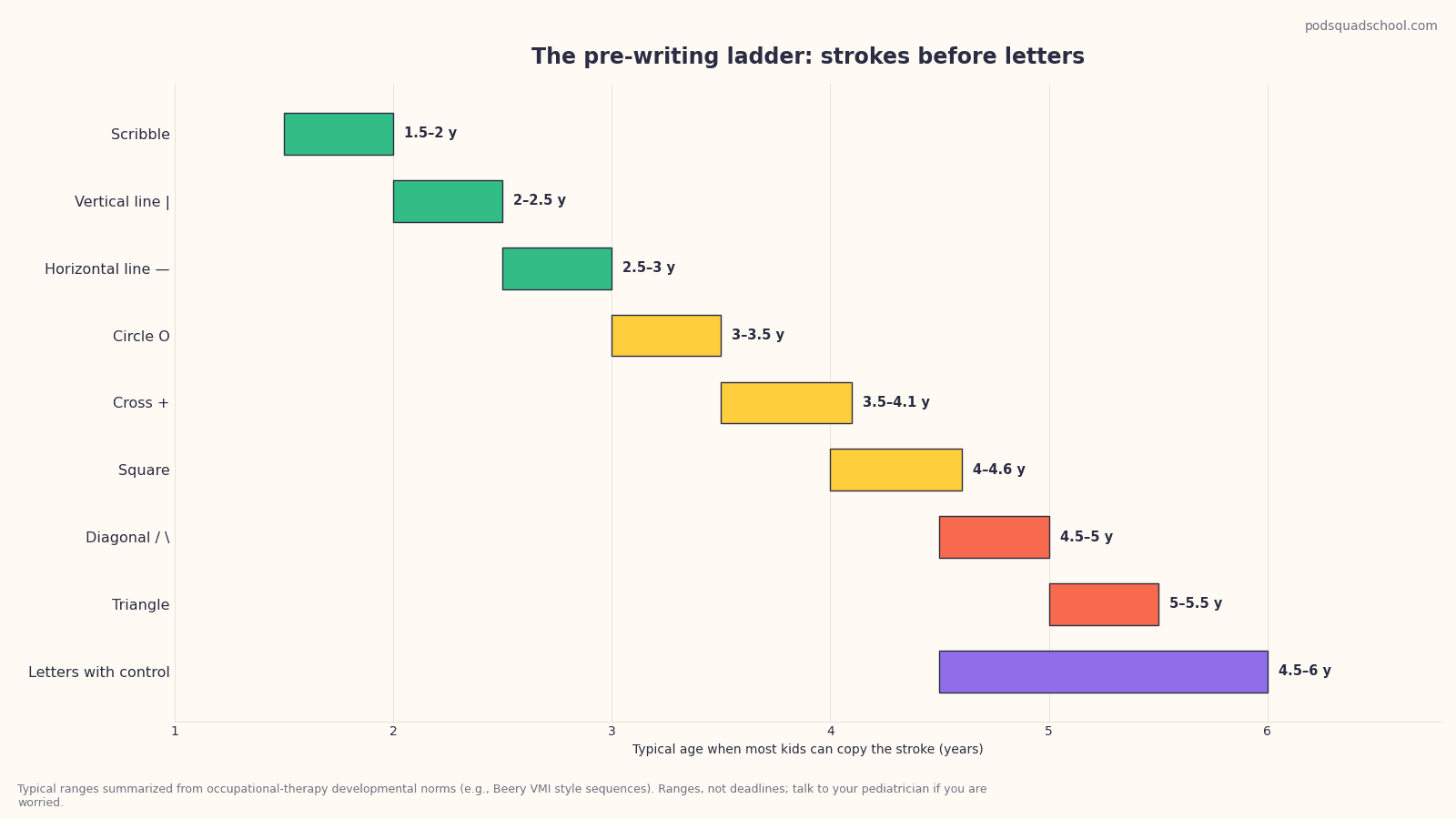
- Tracing helps after the strokes are in place. Most kids can copy a vertical line around 2, a horizontal line around 2.5, a circle around 3, a cross around 3.5 to 4, a square around 4, and diagonal lines and a triangle around 4.5 to 5. Letters are built from those strokes, so a worksheet handed over before the strokes show up mostly teaches frustration.
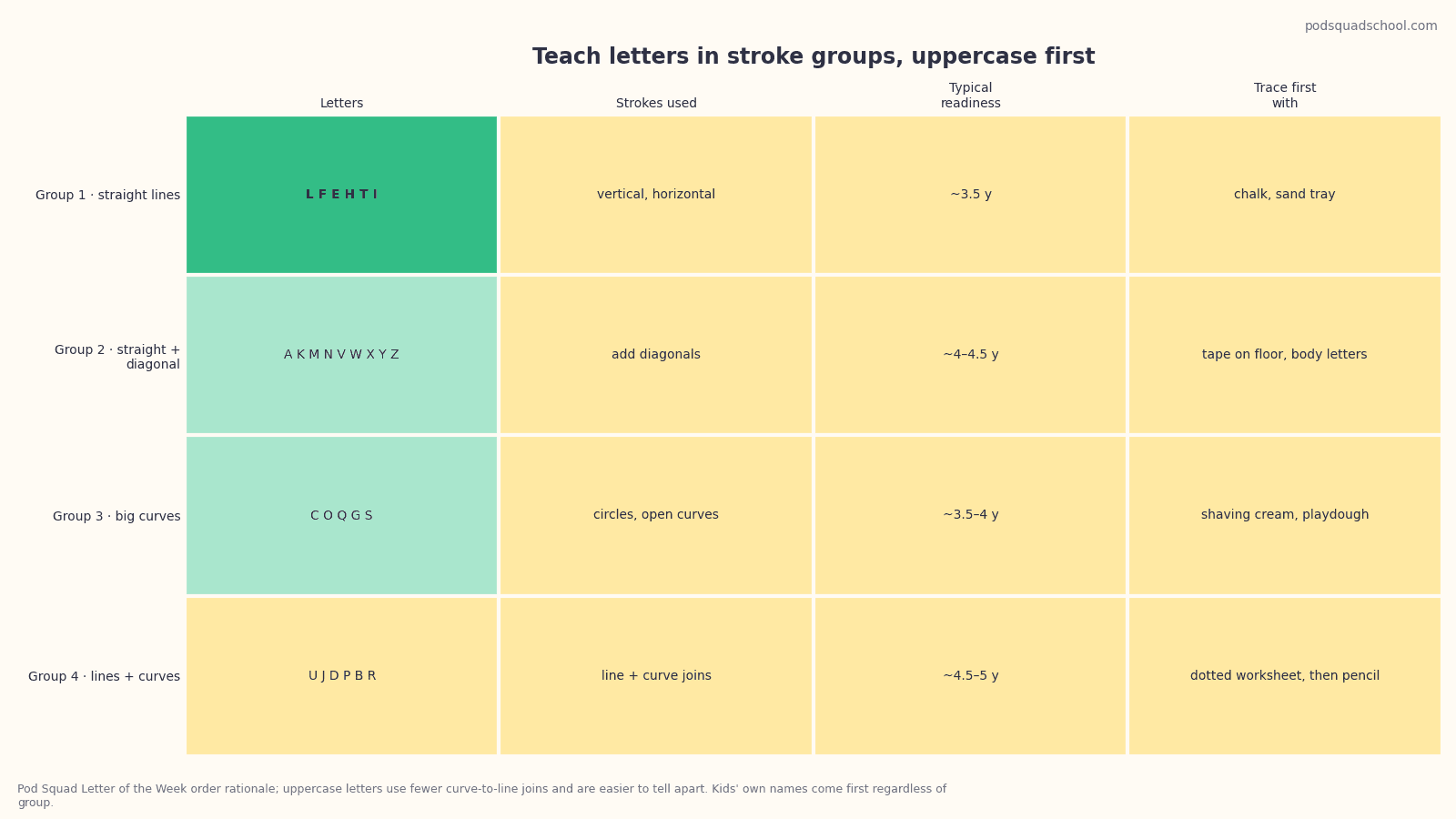
- Uppercase first, grouped by stroke. Capitals are mostly straight lines and look more different from one another than lowercase letters do. Teach L, F, E, H, T, I first; then A, K, M, N, V, W, X, Y, Z; then C, O, Q, G, S; then U, J, D, P, B, R. The kid's own name is the one exception that jumps the line.
- Five minutes is the whole session. A 3-year-old gets about three minutes of pencil work, a 4-year-old five to seven, a 5-year-old ten. Stop while it is still going well, and never add a second page because the first one went fine.
- Finger before pencil. A salt tray, shaving cream on the table, sidewalk chalk, a playdough snake bent into a letter, and letters made with the whole body build the motor memory. The pencil version is the last step in the sequence, not the first.
- A good worksheet is boring on purpose. One big letter per page, a dot where the stroke starts, numbered arrows, wide dotted lines, a plain border, and nothing else competing for attention.
- The worksheet is five minutes inside a week of play. Monday trace, Tuesday sound hunt, Wednesday review, Thursday adventure tie-in, Friday song. The letter shows up thirty times in a week and only once on paper.
- The search demand is real and the results are thin on the "when." "Letter tracing worksheets" pulls about 14,800 US searches a month at a difficulty of 0; nearly every page that ranks is a download, and almost none of them answer whether a 3-year-old should be doing this at all.
Somewhere around a kid's third birthday, a printer becomes a parenting tool. You search "letter tracing worksheets," you get four hundred PDFs, you print the alphabet, and your kid scribbles across the A, folds the B into a boat, and asks for a snack. That is not a failure. It is information: the worksheet came before the hand was ready for it, or the letter came before the kid cared about it, or both.
This post is the guide we wished existed the first time we printed a stack. It covers the pre-writing strokes kids develop before letters make sense, how the pencil grip changes from 18 months to 6 years, which letters to teach first and why, the five-minute rule, the multi-sensory tracing that should happen before pencil ever touches paper, what a good worksheet looks like, and a letter-of-the-week template you can run on a Monday-through-Friday rhythm with one printed page a week. There are 26 letter activities, one per letter, each with what to set out and what to say.
It is written for both kinds of families. If your kid is in preschool or daycare and you want ten good minutes after pickup, this works. If you homeschool and the letter of the week is the spine of your morning, this works too. Nothing here requires you to teach reading, buy a curriculum, or turn your kitchen into a classroom. It requires a pencil, a tray, some salt, and a rule about stopping.
One note on ages. Every age in this post is a typical range, not a deadline. Kids land in these ranges months apart, and the range is wide on purpose. Your pediatrician knows your kid; if handwriting worries you, that is the person to ask, and an occupational therapist is the person they might send you to.
What parents are actually searching for (2026)
We pulled the search demand for this cluster from DataForSEO Labs (Google US) on September 10, 2026. Google Ads hides volume for many keywords about young children, so several of these rows use clickstream estimates (labeled). The pattern is clear: the demand is for the printable, and the difficulty is near zero because almost every page competing for it is a download link with a two-sentence intro.
| Keyword | US searches/mo | Difficulty | What they want |
|---|---|---|---|
| letter tracing worksheets | 14,800 | 0 | A printable alphabet, ideally free, ideally today |
| preschool worksheets | 14,800 | 25 | A general stack for a 3-to-5-year-old; often a parent who feels behind |
| name tracing | 14,800 | 0 | A generator that prints the kid's own name in dotted letters |
| tracing worksheets | 9,900 | 0 | Lines, shapes, and letters to trace; pre-writing practice |
| alphabet worksheets | 4,400 | 0 | Letter recognition and matching, not just tracing |
| shapes worksheets | 2,900 | 0 | Circles, squares, and triangles for a 3-year-old |
| number worksheets | 2,400 | 0 | Tracing 1 to 10, counting objects |
| letter recognition activities | 1,300 | 2 | Games, not paper; a parent who knows worksheets are not landing |
| letter of the week | 590 | 0 | A weekly system, usually a homeschool or preschool teacher |
| free printables for kids | ≈814 (clickstream) | n/a | Anything printable, any age, free |
| toddler worksheets | ≈457 (clickstream) | n/a | Paper for a 2-year-old; usually too early |
| printable activities for kids | ≈305 (clickstream) | n/a | Printables that are activities, not drills |
| coloring pages | 550,000 | 38 | The biggest printable of all; a crayon on paper |
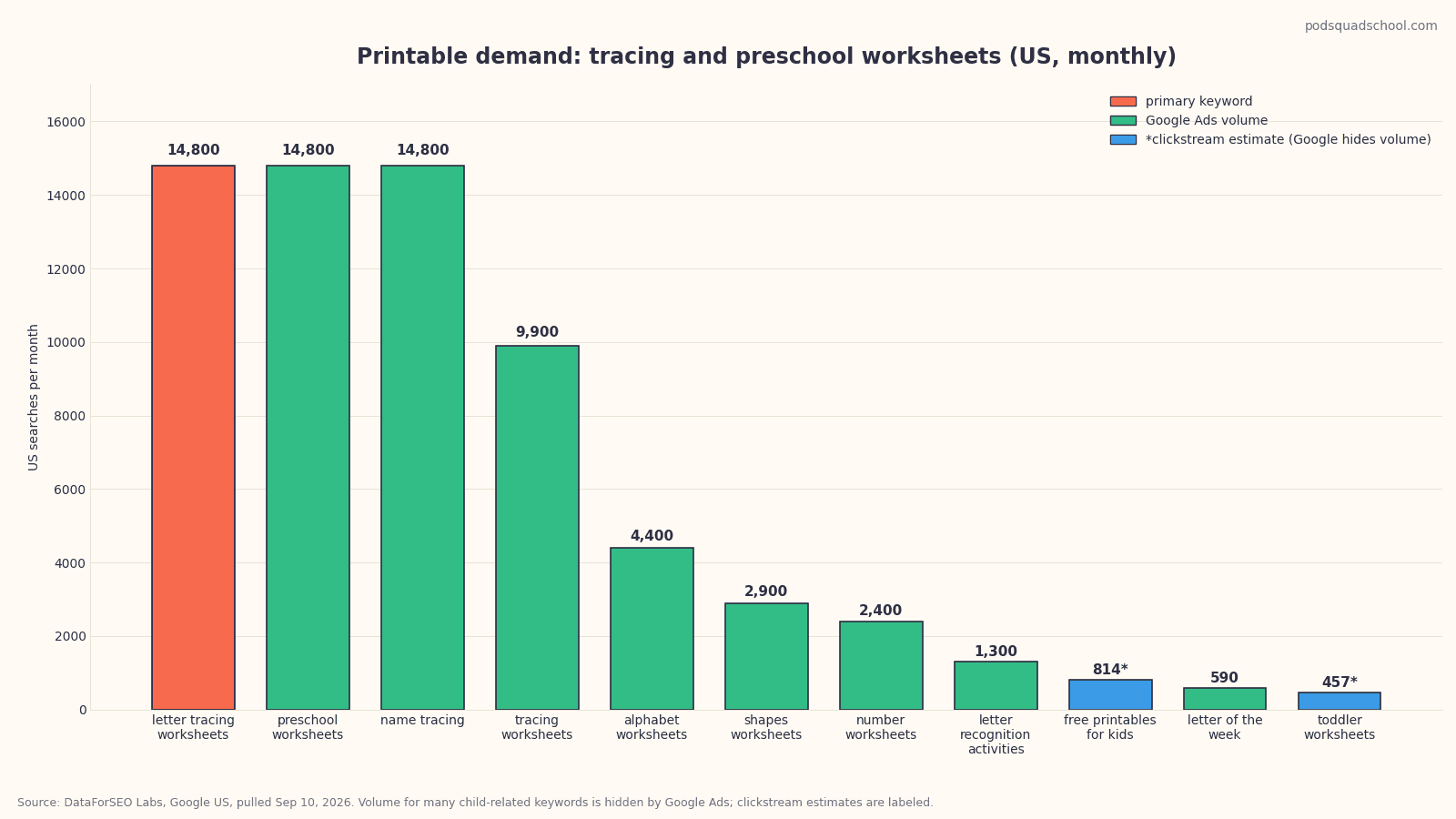
Read the intent and a story shows up. Three keywords tie at 14,800: the tracing sheet, the general preschool stack, and the name generator. Those are the same parent at three moments: "my kid is three, we should be doing something," "start with letters," and "start with the letters that matter most, the ones in her name." The trend lines are flat or slightly down, which fits the general softening of parenting search as more of it moves into AI assistants and app stores. Meanwhile "letter recognition activities" is down 33% and "toddler worksheets" is a clickstream-only term, both signs that the parents who dig deeper are looking past paper and toward games.
The gaps are the interesting part. Teachers Pay Teachers ranks for 1.19 million US keywords, and Twinkl and Education.com are close behind; they win by volume, one letter per page, thousands of pages. Blogs like Pre-K Printable Fun and Pocket of Preschool win single-letter pages with a craft attached. What nobody ranks for is the readiness question. Search "is my 3 year old ready for tracing" and the results are forum threads. The developmental sequence of pre-writing strokes, which letters come first and why, and how to make the worksheet a five-minute piece of a play-based week: that is what this post is for. If you want the general case for play over drills, the companion post on play-based learning makes it.
Is your kid ready to trace? The pre-writing stroke ladder
Letters are not the first thing a hand learns to draw. They are assemblies of a small set of strokes, and the strokes arrive in a fairly predictable order. Occupational therapists have documented this sequence for decades, and the order shows up in standardized visual-motor tools like the Beery VMI, where imitating and copying simple forms is the early part of the test. The ages below are typical ranges drawn from that general body of occupational-therapy guidance; they are not cutoffs, and kids move through them months apart.
The sequence, stroke by stroke
| Stroke | Typical age to imitate or copy | Letters that need it | What it looks like at home |
|---|---|---|---|
| Scribble | 12 to 18 months | None yet | Crayon fisted, whole arm moving, marks everywhere including the table |
| Vertical line | around 2 | I, L, T, H, E, F | Draws a line down when you draw one first; a "rain" picture |
| Horizontal line | around 2.5 | L, T, H, E, F, A | Draws across when shown; often after you say "like a road" |
| Circle | around 3 | O, C, Q, G, and the round parts of D, P, B | Closes the loop most of the time; earlier circles are spirals that never meet |
| Cross (plus sign) | 3.5 to 4 | T, E, F, H, and crossing lines in A | Two lines that meet on purpose; this is the first time two strokes coordinate |
| Square | around 4 | The corners in E, F, L, and the frame the kid uses to size letters | Four sides with stops at the corners; earlier attempts have rounded corners |
| Diagonal line | 4.5 to 5 | A, K, M, N, V, W, X, Y, Z | Draws a slanted line without rotating the paper to make it vertical |
| X and triangle | 4.5 to 5 | X, and the point in A | Crossing diagonals and a closed three-sided shape |
Notice what this table says about the alphabet. A 3-year-old who cannot yet draw a plus sign is not ready for T, E, F, or H on a worksheet, because each of them is a plus sign in a costume. A 4-year-old who has not yet found diagonals is not ready for A, K, M, N, V, W, X, Y, or Z, which is nine letters and a third of the alphabet. The first stroke groups you want are vertical and horizontal, which is exactly why L, I, and T are good starter letters and why the letter A, everyone's default first letter, is actually one of the later ones to write well.
The CDC milestones line up with this ladder. At 3 years the CDC lists drawing a circle when shown how; at 4 years, holding a crayon or pencil between fingers and thumb rather than in a fist, and drawing a person with three or more body parts; and at 5 years, writing some letters in their name. That last one is the tell. The public-health milestone for writing letters is 5, not 3.
How to check without a test
You do not need an evaluation. You need a crayon, a blank page, and two minutes.
- Sit beside the kid, not across. Draw a vertical line and say, "Watch me. Now you." Do not hold their hand.
- Draw a horizontal line the same way. Then a circle. Then a plus sign. Then a square. Then a slanted line, and an X.
- Stop at the first shape that does not come back recognizably. That is where they are on the ladder. Everything at or below that line is fair game for letters. Everything above it is next month's project, not today's.
- Repeat monthly. Do not repeat weekly; the ladder moves slowly and weekly checks turn into drills.
If the plus sign comes back as two lines that do not touch, the kid is at "circle." Give them O, C, and lots of lines. If the diagonal comes back vertical, they are at "square." Give them L, T, I, E, F, H and the round letters, and leave A alone for a few months. This one check will save you most of the frustration parents describe when they say "he just scribbles on the worksheet."
In short: at 2, finger tracing and a chunky crayon on blank paper; at 3, the salt tray and one big line-or-circle letter with a fat crayon; at 4, a dotted-line worksheet with one letter per page and a golf pencil; at 5, the whole uppercase alphabet and the name, which is when most kindergartens expect it.
How the grip develops (and why you should not fix it)
The other half of readiness is the hand. A pencil grip is not a habit a kid picks up; it is a stage the hand grows through, and each stage is right for its age. Occupational therapists generally describe four:
| Grip | Typical age | What it looks like | Best tool |
|---|---|---|---|
| Fisted (palmar supinate) | 12 to 18 months | Whole fist around the crayon, arm moving from the shoulder | Chunky egg-shaped or rock crayons; big paper taped to the table |
| Digital pronate | 2 to 3 | Fingers point down the crayon toward the paper, palm faces down, movement from the elbow | Chunky crayons and thick chalk; drawing on a vertical surface |
| Static tripod | 3.5 to 4 | Thumb and two fingers hold the pencil, but the wrist and arm still move the pencil, not the fingers | Short crayons, half-length pencils, golf pencils |
| Dynamic tripod | 4.5 to 6 | Thumb and two fingers hold and move the pencil; the wrist rests on the table | A regular pencil; a triangular pencil if it helps |
Two practical points come out of this. First, a 3-year-old with a fist or a digital pronate grip is not "holding it wrong." Correcting the grip at that age usually makes the kid tense and slow, and the hand will move to a tripod on its own when the small muscles are ready. Second, you can help the hand get ready without ever mentioning the pencil: peeling stickers, tearing paper, squeezing a spray bottle, picking up cereal one piece at a time, tongs, tweezers, clothespins, playdough, threading beads (with the toilet-paper-tube rule for anything under 3), and drawing on a vertical surface like an easel, a taped-up sheet on the fridge, or the shower wall with bath crayons. Vertical surfaces put the wrist into extension, which is the position it needs for writing.
The single most useful trick for the grip: break the crayons. A one-inch stub cannot be held in a fist. It forces the fingertips forward without a word from you. Golf pencils do the same thing for a 4-year-old. Chunky triangular crayons are fine, but a broken regular crayon is free.
If a 5- or 6-year-old still holds a pencil with a fist, presses so hard the paper tears, or switches hands constantly and avoids drawing, that is worth a conversation with the pediatrician, who may refer to an occupational therapist. That is not a judgment on you or the kid; it is the right person for a hand that needs help.
Which letters first, and why uppercase
Alphabetical order is a list, not a teaching sequence. A is one of the harder letters to write (two diagonals and a crossbar), B has two bumps, and C is easy but has nothing to do with the two before it. If you teach letters by the strokes they use, you can start with letters the kid can actually make and stack on the next group as the ladder moves.
Why uppercase first
- Capitals are mostly straight lines and big curves. The first group below uses only vertical and horizontal lines, strokes most kids have by 2.5 or 3. Lowercase letters lean on small curves, tails, and precise sizing that arrive later.
- Capitals are more distinct from one another. Lowercase b, d, p, and q are the same shape rotated, which is why reversals are so common at 5 and 6. Uppercase B, D, P, and Q look different enough that a 4-year-old can tell them apart.
- Capitals all start at the top and sit on the same line. Lowercase letters have ascenders, descenders, and a middle line. Uppercase removes that variable while the hand learns to start at the top and pull down.
- Capitals are what kids see first. Store signs, cereal boxes, the STOP sign, the first letter of their name on their cubby.
This is the same logic behind several well-known handwriting programs (Learning Without Tears is the best known), and it is why most occupational therapists working with preschoolers start with capitals. Lowercase comes in kindergarten, after the capitals are automatic.
The four groups
| Group | Letters | Strokes needed | Typical readiness |
|---|---|---|---|
| 1: Lines | L, F, E, H, T, I | Vertical and horizontal only | around 3 to 3.5 for tracing with a crayon; 4 for pencil |
| 2: Diagonals | A, K, M, N, V, W, X, Y, Z | Diagonals, sometimes with a vertical or crossbar | 4.5 to 5 |
| 3: Curves | C, O, Q, G, S | A single curve; S is the hardest of the group | around 3 for C and O; 4 for Q, G, S |
| 4: Line plus curve | U, J, D, P, B, R | A vertical line with a curve attached | 4 to 4.5 |
You can run groups 1 and 3 together, since a 3.5-year-old usually has both lines and circles. Save group 2 for last even though it contains A and everyone's favorite M. Group 4 slots in between; D is a good bridge letter because it is a line and a big C.
The name jumps the line
The exception to all of this is the kid's own name. A name is the most motivating word a 3-year-old will ever see, so you teach its first letter no matter which group it is in, and you teach it the moment the kid starts asking "which one is mine." If your kid is named Ava, she is going to want to write A at 3, diagonals or not, and she should. Let her trace it big in the salt tray, build it with two crayons and a stick, and see it on her cup. Do not require it to be neat.
For the whole name, start with capitals: AVA rather than Ava. Around 4.5 to 5, when the kid is heading to a kindergarten that will expect a capital and lowercase letters, switch to the form the school uses. Name-tracing generators (that 14,800-a-month search) are fine for this stage; pick one that gives you a big dotted version with a start dot on each letter and print one copy a week, not a stack. And keep the name's letters in the letter-of-the-week rotation twice as often as the others.
The five-minute rule
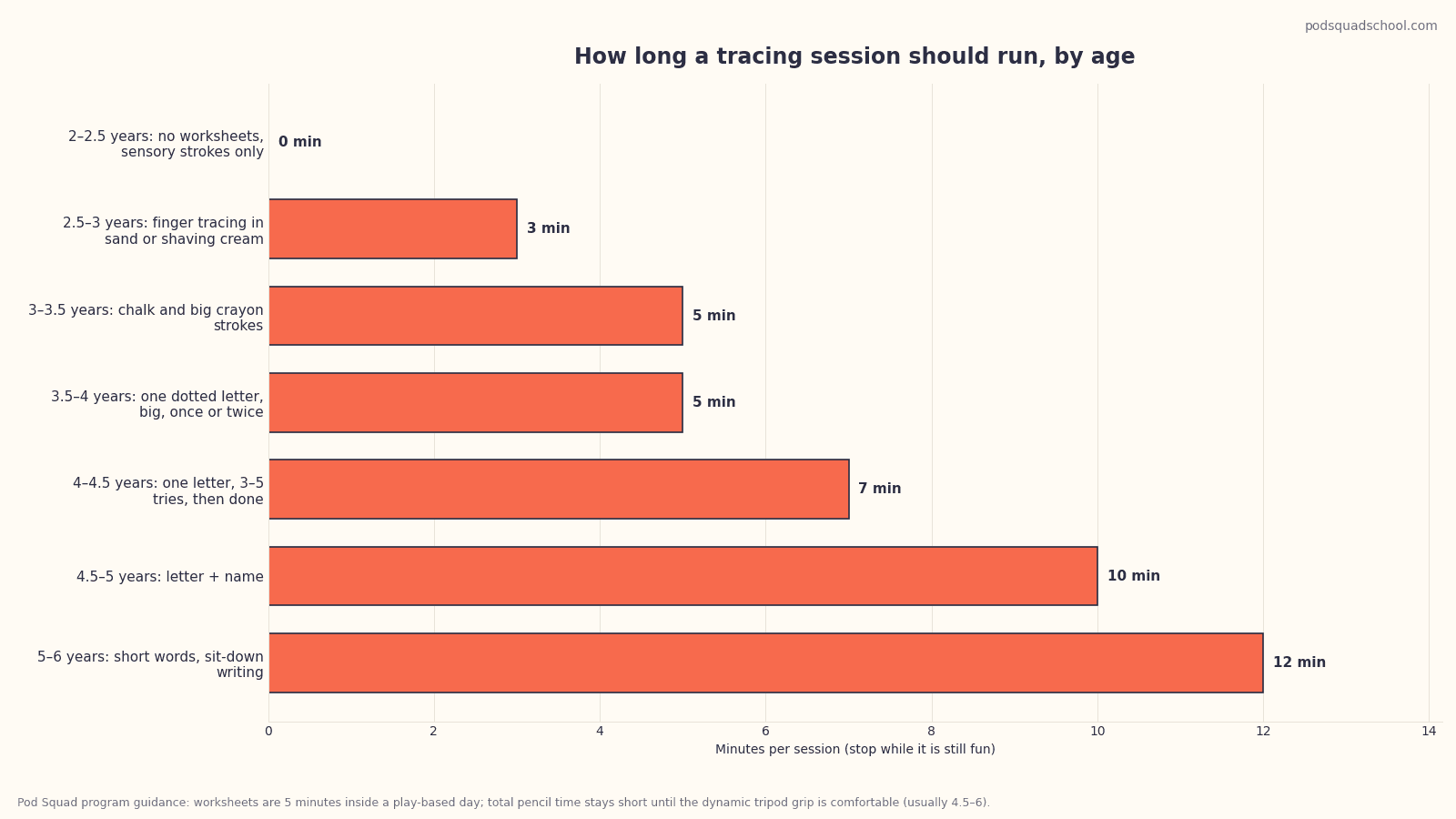
The right length for pencil practice is short enough to feel like a game and stop before it feels like work. Our rule of thumb, which lines up with what most preschool teachers and occupational therapists suggest for table time at these ages: about a minute per year of age, capped at ten, and never a second page.
| Age | Session | What the session is | Times per week |
|---|---|---|---|
| 2 to 2.5 | 2 to 3 minutes | Finger tracing on a big letter; chunky crayon on blank paper | Whenever they pull out crayons; no schedule |
| 2.5 to 3 | 3 minutes | Salt tray, shaving cream, one big letter with a fat crayon | 2 or 3 |
| 3 to 3.5 | 3 to 5 minutes | One letter, big, traced with a crayon or a finger; sticker dots along the strokes | 3 |
| 3.5 to 4 | 5 minutes | One dotted-line letter with a golf pencil, then the same letter in a tray | 3 |
| 4 to 5 | 5 to 7 minutes | One worksheet page (one letter), then the letter in a word | 3 or 4 |
| 5 to 6 | 8 to 10 minutes | One page; the name; the first lowercase letters | 4 or 5 |
Why so short? Because the goal is a correct motor pattern repeated a few times, not a page filled. A kid who traces T correctly four times and stops has learned more than one who traces it twenty times, with the last twelve done fast, backward, and from the bottom because the arm was tired. Fatigue is when bad habits get practiced. Stopping early means every repetition is a good one.
What this looks like in practice: set a visible timer (the Block Timer in the Pod Squad app does this, but any kitchen timer works), announce it as the game ("we have five minutes, then it is snack"), and when it rings, stop even if the kid wants more. Wanting more is exactly the state you want them in for next time.
Trace it before you pencil it: multi-sensory tracing
The pencil is the last, smallest, most precise version of a movement. Before it, kids need the big version: the whole arm drawing an L in the air, a finger dragging through salt, a hand pushing a playdough snake into a curve. Every one of these builds the same motor pattern the pencil will use later, at a size the hand can manage now. Here are the seven we return to most, with what to set out, what to say, and the safety rule.
Salt or sand tray
- Set out: a shallow tray or a baking sheet with a lip, a cup of table salt or fine play sand poured to about a quarter inch, and a big letter card propped behind it.
- Say: "Start at the top. Pull down. Now across. Shake it, and again." Say the stroke names every time; the words become the plan the kid uses later on paper.
- Minutes: 3 to 5.
- Builds: stroke order, top-to-bottom habit, the feel of the letter without pencil pressure.
- Age note: from about 2.5. For under 3, use cornmeal or rice flour instead of salt or sand, because a mouthful of salt is a real problem and sand does not belong in a mouth. Adult within arm's reach for anything a kid can eat by the fistful.
Shaving cream on the table
- Set out: a squirt of plain shaving cream spread flat on a washable table or a tray, a damp cloth, and the letter card.
- Say: "Make a big O. Big as your whole hand. Now wipe and make it small."
- Minutes: 5 to 10 (this one usually turns into free play, which is fine).
- Builds: big-arm movement, size control, tolerance for mess.
- Age note: not taste-safe, so under 3 use whipped cream or plain yogurt on the tray instead. Keep hands out of eyes; a wet cloth beside the tray.
Sidewalk chalk
- Set out: fat chalk and a driveway, patio, or fence board. Draw a letter three feet tall.
- Say: "Walk it. Start at the top, walk down, turn, walk across. Now drive the car on it." A toy car pushed along the strokes is the best chalk tracing there is.
- Minutes: 10 to 15 outside.
- Builds: gross-motor version of the stroke; the kid feels the letter with their legs.
- Age note: from 2. Chalk pieces that break small go in the bin, not the mouth.
Playdough letters
- Set out: a ball of playdough, a laminated letter card or a letter drawn with marker on a plate, and a small rolling pin.
- Say: "Roll a snake. Lay it on the line. Where does the line bend? Bend your snake there."
- Minutes: 5 to 8.
- Builds: hand strength, the shape of the letter as an object, curves.
- Age note: from 2. Under 3, use homemade playdough (flour, salt, water, oil) so a taste is unpleasant but harmless; the recipe is in our sensory bin ideas post.
Wax sticks (Wikki Stix or a similar bendable wax yarn)
- Set out: four or five wax sticks and a printed big letter.
- Say: "Lay the stick down the line. Press. Where does the next one go?"
- Minutes: 5.
- Builds: the letter as a set of parts; especially good for group 1 letters (L is one bent stick; T is two).
- Age note: from 3, and keep them out of mouths; they are wax on yarn, not food. Under 3, skip and use the playdough version.
Body letters
- Set out: nothing. A rug and a mirror help.
- Say: "Make a T with your body. Arms out, legs together. Now an X. Now lie down and be an I." For two people, "You be the line, I'll be the bump; we're a D."
- Minutes: 3 to 5, usually during the letter song.
- Builds: body awareness, the letter's shape as posture; it also burns off the energy that makes table time hard.
- Age note: from 2 with you doing most of the shapes; from 3 the kid leads.
Sticker-dot tracing
- Set out: a big printed letter and a sheet of quarter-inch or half-inch dot stickers.
- Say: "Put a dot on the top. Now the next one below. Follow the road down."
- Minutes: 5.
- Builds: the pincer grip (peeling stickers is fine-motor gold), start-at-the-top, the letter's path.
- Age note: from 2.5 with half-inch dots. Quarter-inch dots for 3 and up; small stickers fit through a toilet-paper tube, so they stay in your hand between placements for a kid under 3.
Run any two of these in a week and the pencil version on the third day will go noticeably better. If you want more of this kind of play sorted by month of age, the activities for 2 year olds post has a full fine-motor section.
What makes a good letter tracing worksheet
Most free tracing worksheets are designed to look busy on a Pinterest thumbnail, not to teach a 4-year-old a stroke. Here is what to look for, what to avoid, and what to skip entirely.
The checklist
- One letter per page. A page of the whole alphabet is a poster, not a worksheet. The kid's job is one motor pattern today.
- Big first. The first row of letters should be at least two inches tall. Smaller letters come later on the same page or on a later page, never first.
- A dot at the start point. A green dot or a big black dot where the first stroke begins. The most common tracing error is starting at the bottom, and the dot fixes it without a word from you.
- Numbered arrows. Small numbers showing stroke order (1 down, 2 across). You can point at them instead of talking.
- Wide dotted lines. Dashes with gaps, not a solid gray letter. A dashed line invites the pencil to connect them; a solid gray letter invites coloring inside it.
- Plain border and a lot of white. No cartoon frame, no ten clip-art apples around the A. Every extra picture is a place for a 4-year-old's eyes to go instead of the letter.
- One picture, top corner. A single, clear image of a word that starts with the letter and its sound (A is for apple, not A is for aisle) so the sound is in the room. Beside the letter, not around it.
- Fade across the page. Three fully dotted letters, then two with only the start dot, then a blank space to write it alone. The kid graduates across a single page.
- A line to sit on. Uppercase letters need a baseline. A thick line under the row, not a three-line handwriting staff at this age.
- Room for the name. A short dotted version of the kid's name at the bottom, if the generator allows it. This is the part they will want to do first.
Good versus bad, side by side
| Feature | Good worksheet | Bad worksheet |
|---|---|---|
| Letters per page | 1 | 26, or the whole "letter family" |
| First letter height | 2 inches or more | Half an inch |
| Start cue | A dot and numbered arrows | Nothing, or a tiny gray arrow |
| Line style | Dashed, with gaps | Solid light gray outline |
| Decoration | One picture, top corner | A themed border, a maze, a coloring section |
| Case | Uppercase, or upper and lower in separate rows | Upper and lower alternating in one row |
| Fade | Full dots to start-dot to blank | Every letter fully dotted |
| Paper | Plain white; print at 100% | A worksheet shrunk to fit a page with three others |
What to skip
- Cursive for preschoolers. Cursive needs a dynamic tripod grip and consistent diagonals; that is a 6-to-7-year-old skill. A 4-year-old given cursive practices wobbles.
- Timed drills. Anything with a clock on it teaches speed before accuracy, and accuracy is the whole point at this age.
- Lowercase before uppercase is solid. Except in the kid's name, once they are 4.5 or so.
- Full-alphabet pages, "trace and color" combo sheets, and letter mazes. They are fine as coloring pages; they are not tracing practice.
- Tablet tracing apps as the main method. A finger on glass is not a pencil on paper; the resistance, the pressure, and the grip are all different. If an app is in your house, treat it as one of the multi-sensory versions and keep it inside the AAP's screen-time guidance (none as a solo activity under 18 to 24 months; about an hour a day of high-quality content from 2 to 5, watched with you). More on that in our screen time for toddlers post.
A letter-of-the-week template
Here is the rhythm we use inside Pod Squad's Toddler Squad and the one we would suggest to any family, homeschooling or not. The letter shows up every day. The worksheet shows up once. Total table time for the week is about fifteen minutes.
| Day | Block | Minutes | What happens |
|---|---|---|---|
| Monday | Trace | 5 | Introduce the letter with the card and the sound. Trace it in the salt tray, then one worksheet page (or crayon-on-big-letter for under 3.5). Hang the letter on the fridge. |
| Tuesday | Sound hunt | 10, spread through the day | Hunt for things that start with the sound: in the kitchen, in the car, at the store. Say "Ball. B. B-b-ball." Add three words to a Words of the Week list on the fridge. |
| Wednesday | Review | 5 | The tray again, then a different multi-sensory version (playdough, stickers, body letters). No new paper. |
| Thursday | Adventure tie-in | Built into the outing | Find the letter in the world: on a sign, a truck, a menu, a museum label. Take one photo of the letter for the portfolio. |
| Friday | Song and one word | 5 | Sing the letter's song, build one word that starts with the letter out of magnet letters, and read one book where the letter's sound is loud. Put the worksheet in the folder. |
A few rules that make it hold together:
- The fridge is the classroom. One letter card at kid height, the Words of the Week list beside it, the week's worksheet after Monday. When the week ends, the card moves to a "letters we know" strip along the bottom of a cabinet.
- Review beats new. Wednesday is the most skipped day and the most important. The second exposure two days later is where the motor pattern sticks.
- Every fourth week is a review week with no new letter. Pull the four cards, do a tray letter of each, play a matching game, and let the kid pick a favorite to trace.
- The name's letters come around twice. Whenever the letter of the week is in the kid's name, make Tuesday's sound hunt about their name and do the name-tracing page on Friday.
26 letter activities, A to Z
One activity per letter, each five to ten minutes, each with what to set out and what to say. Most pair naturally with a letter-of-the-week theme; several match the themes of Pod Squad's toddler weeks, which move from A in Week 1 onward with a weekly theme. Ages are noted where the activity has a floor.
A: Apple stamps. Set out: an apple cut in half crosswise so the star shows, a plate of red and green paint, paper with a big dotted A. Say: "Stamp along the line, top to the bottom, then the other side. Where does the crossbar go?" Under 3, the apple halves stay in your hand between stamps.
B: Bubble-wrap B. Set out: a strip of bubble wrap taped to the table, a marker-drawn big B on paper beneath, a chunky crayon. Say: "Push your crayon down the line and over the bumps. Feel the bumps? B has two bumps too."
C: Car track C. Set out: painter's tape on the floor in a giant C, two toy cars. Say: "Start at the top of the C and drive it around. Cars start with C. C-c-car." Fits Wheels & Roads week.
D: Dot marker D. Set out: a big dotted D and one dot marker (bingo dauber). Say: "Line down first. Then the big bump from the top. Dot, dot, dot." From 2.5; dot markers are the easiest tracing tool there is.
E: Egg carton E. Set out: an empty egg carton, three pipe cleaners cut to fit, a big E on paper. Say: "One long stick down. Three short sticks across. Which one is the middle?" Pipe cleaner ends get folded under before the kid touches them.
F: Feather F. Set out: craft feathers, a glue stick, a big F. Say: "Line down. Two lines across, top and middle. F has no bottom line; that is what makes it not an E."
G: Green G in the garden. Set out: a tray of potting soil, a stick, a G card. Say: "G is a C with a little shelf. Draw the C in the dirt. Now the shelf." Soil is not taste-safe; under 3 do this in cornmeal instead.
H: Hopscotch H. Set out: chalk, a driveway, an H drawn three feet tall. Say: "Hop down one line, hop down the other, walk across the bridge." From 2.
I: Ice I. Set out: an ice cube, a dark tray. Say: "Push the ice down the line. I is just a line down. Cold." Adult within arm's reach; a whole ice cube fits through a toilet-paper tube, so under 3 the cube stays in your hand and the kid pushes your hand.
J: Jumping J. Set out: a J taped on the floor. Say: "Walk down the line, and at the bottom, jump around the hook." Then trace it in the tray.
K: Kick-the-ball K. Set out: a big K on paper, a marble-sized pom-pom (from 3; smaller than a toilet-paper tube, so hand-to-hand for younger siblings). Say: "Line down. Now two kicks from the middle: one up, one down. K is a kicking letter."
L: Lego L. Set out: a baseplate and eight long bricks. Say: "Build the line down. Now build the foot. L is the easiest letter to build; it is two sticks." Bricks under 3 stay in the big duplo size.
M: Mountain M. Set out: a big M, small pebbles or dried beans, glue. Say: "Down, up the mountain, down the mountain, down. Two mountains." Beans and pebbles are choking hazards: from 3 with you beside them, and never in a shared bin with a baby in the room.
N: Noodle N. Set out: three cooked spaghetti noodles, a plate with an N drawn in marker. Say: "Lay one down. Lay one slanting. Lay one down. N has one mountain." Taste-safe, so this one works from 2.
O: Orange O. Set out: an orange, a plate of paint, paper. Say: "Start at the top and go all the way around. Where did you start? End there." Then eat a different orange.
P: Pom-pom P. Set out: a big P, pom-poms, tweezers or tongs. Say: "Pick one up with the tongs. Line down. Bump at the top. P's bump is at the top; that is what makes it not a b." From 3 for small pom-poms.
Q: Q-tip Q. Set out: cotton swabs, paint, a big Q. Say: "Draw a big O with your Q-tip. Now give it a tail. Q is an O with a tail." From 3.
R: Ribbon R. Set out: a length of ribbon, a big R. Say: "Lay the ribbon down the line. Now the bump. Now the leg. R is a P that decided to stand up." Ribbon under 3 stays short, shorter than the kid's arm.
S: Snake S. Set out: a playdough snake, an S card. Say: "S is the snake letter. Start at the top, curve like the snake is going home, curve back." S is the hardest curve; do it in the tray many times before paper.
T: Tape T. Set out: painter's tape and the wall. Say: "One long tape down. One short tape across the top. You built a T." From 2.
U: Cup U. Set out: a big U, a small cup of water, a paintbrush. Say: "Paint down, around the bottom, back up. U holds water like a cup." Adult within arm's length of any water.
V: Vegetable V. Set out: a celery stick cut lengthwise into two thin sticks. Say: "Lay them so they touch at the bottom. V. Vegetables start with V." Taste-safe. Celery for under 3 gets cut into thin matchsticks, not chunks.
W: Wash the W. Set out: sidewalk chalk W, a spray bottle of water. Say: "Spray along the line: down, up, down, up. W is two V's holding hands." Spray bottles are also a grip workout.
X: X marks the spot. Set out: two craft sticks, tape, a small "treasure" (a sticker). Say: "One stick slants this way, one slants that way. Now go find the X I hid in the room." Hide a taped X on a cabinet; the sticker treasure is under it.
Y: Yarn Y. Set out: three short pieces of yarn, glue, a big Y. Say: "One stick down. Two arms up like you're cheering. Y." Yarn pieces shorter than the kid's forearm for under 3.
Z: Zigzag Z. Set out: a toy car and a Z made of tape on the floor. Say: "Across the top, zoom down the slide, across the bottom. Z is a zigzag." Fits the last stroke on the ladder, so most kids do not get Z on paper until 4.5 or 5, and that is fine.
Number and shape worksheets: readiness
The same ladder applies to the other two printables in the top ten: "shapes worksheets" (2,900 a month) and "number worksheets" (2,400).
Shapes come first, and they are the ladder itself. Tracing a circle is the circle stroke; tracing a square is the square stroke; tracing a triangle is diagonals. A shapes worksheet at 3 (circles and big squares with rounded corners) is actually a good pre-writing tool. Triangles and diamonds belong at 4.5 and up. One shape per page, same design rules as letters.
Numbers are letters with fewer friends. Digits use the same strokes: 1 is a vertical line (around 2.5 on the ladder), 4 and 7 are lines with a diagonal (4.5 to 5), 0 and 6 and 9 are curves (3.5 to 4), 2 and 3 and 5 combine curves and lines (4 to 4.5), and 8 is the hardest. There is no reason to start numbers before letters; there is also no reason to wait. Fold one digit into every fourth week and start with 1, 0, 7 (a good early diagonal because it is short), and 4.
Counting is not writing digits. A 3-year-old who can count five crackers is doing math; the digit is a label they learn later. Do not hold up counting practice waiting for the pencil, and do not judge number knowledge by a traced 3.
A worked week
Here is a real week for a family running Group 3 (curves) with the letter C. It maps to Pod Squad's Week 3, Wheels & Roads, where C is the letter of the week; you can run it with or without the program. The family has a 3-year-4-month-old (call him Cash) and a 20-month-old (Nova). Cash does the tracing; Nova rides along with a chunky crayon and no expectations.
Monday, 4:15 to 4:25 (after pickup). Set out the C card on the fridge, the salt tray with cornmeal (Nova is in the room), and one worksheet page with a big dotted C. Say: "This is C. C says c-c-c, like car. Start at the top, curve around like a smile on its side, stop before you close it." Cash traces in the tray four times, then one row of C with a broken red crayon. Nova scribbles on a blank sheet beside him with the same crayon color. Timer at 5 minutes; stop at the bell even though Cash wants "one more." Total: 8 minutes including setup.
Tuesday, all day, about 10 minutes total. Sound hunt in the car and at the grocery store: car, cart, corn, carrot, cup, cookie. Cash picks three; you write them on the Words of the Week list on the fridge and draw a tiny picture next to each. Nova gets "cup" repeated at dinner.
Wednesday, 4:15 to 4:22. Review. The salt tray first (two C's), then car-track C: painter's tape in a giant C on the kitchen floor, two toy cars, both kids driving the curve. "Start at the top of the road." Seven minutes, zero paper. Nova is fully in this one, which is the point of the floor version.
Thursday, the outing. The family's Thursday adventure is somewhere with wheels: a car wash, a bus stop, a fire station on an open-house day, or a parking garage where you can watch cars spiral down (Pod Squad sorts places like these by distance from your home; use your county parks or library calendar if you are running this yourself). Task: find a C on a sign. Cash spots one on a "CAUTION" cone. One photo, into the portfolio.
Friday, 4:15 to 4:25. Sing the C song (any letter song works; the point is the sound). Build CAR out of magnet letters on the fridge, Cash finding the C and you finding the A and R. Read a book where C is loud (a book about cars, a book about a cat). Move the C worksheet into the folder, the C card to the "letters we know" strip. Nova gets a magnet C to hold.
Saturday and Sunday. No letter work. Saturday adventure, Sunday project; if Sunday's project involves a paintbrush or playdough, the hand is still working. The letter comes back Monday as D, which is a line plus a big C, so Cash will start next week already knowing half of it.
Total table time for the week: 15 minutes for Cash, zero for Nova, and the letter C appeared roughly forty times.
Where Pod Squad fits, stated plainly
Pod Squad is a paid membership, $99 a month for the first kid after 7 free days (siblings are 50% off, so two kids are $149; details on the pricing page). What you are paying for in the tracing department is the system above, already built and already sized for your kid's exact age: a Letter of the Week from A in Week 1 through Z across the Toddler Squad seasons, a Monday trace block and a Wednesday review block with what to set out and what to say, a Words of the Week poster for the fridge, the week's worksheet designed the way this post describes (one letter, big, start dot, numbered arrows, wide dashes), I Spy cards for the Tuesday hunt, and a Thursday adventure that points at a real place near you where the letter can be found. Homie, the personalization layer, writes the notes by age: a 2-year-old's Monday is finger tracing with sticker dots; a 3-and-a-half-year-old's is one worksheet row with a broken crayon; a 4-year-old's adds the golf pencil. If you have a baby in the house, the baby gets a ride-along line on every block, so nobody is invisible. You can read how that works on the how it works page.
You do not need Pod Squad to do any of this. Salt, a baking sheet, and a free name-tracing generator will get a motivated family through the alphabet in six months, and if you have the time to plan the week yourself, you should keep your $99. Pod Squad is for the family that keeps meaning to do the letter of the week and gets to Thursday without having done Monday. The app reminds you the night before, sets the Block Timer at five minutes, prints the sheet in one tap, and logs the photo of the C on the caution cone into the kid's portfolio.
If you want to see what a Pod Squad worksheet actually looks like before deciding, the free sample includes a Week 1 worksheet (the letter A, built for a 2- to 4-year-old with the design rules above) and a Wonder Lab card. If you want the full program, you can start free for 7 days, $0 today, cancel in two taps. Families with a kid in daycare or preschool run the letter blocks after pickup and on weekends; families doing preschool at home run them as the morning's spine. Both work, and the toddler program page walks through the weeks.
Mistakes that cost the most
-
Starting with a worksheet at 2. The fix: no paper tracing before about 3, and no pencil before about 3.5. Give a 2-year-old a chunky crayon, a big blank page, chalk, and playdough. Everything they need for handwriting at that age happens in their hands, not on a line.
-
Teaching in alphabetical order. A is a diagonal letter, and diagonals are last on the ladder. The fix: group 1 (L, F, E, H, T, I) and group 3 (C, O) first. Put A on hold unless it is the first letter of the kid's name.
-
Correcting the grip at 3. The fix: break the crayons, use a vertical surface, do the fine-motor play (stickers, tongs, spray bottles), and leave the fingers alone. The tripod arrives on its own between 3.5 and 4.5 for most kids.
-
Printing the stack. A ream of worksheets on the counter becomes homework for you and a chore for them. The fix: one page a week, on Monday, and a folder for the finished ones.
-
Going past the timer. "She was doing so well, so we did three pages." The last two pages are where the bottom-up strokes and the backward letters get practiced. The fix: the minute-per-year rule, and stopping while they want more.
-
Skipping Wednesday. One exposure a week does not stick. The fix: the review day is non-negotiable, and it is not paper; it is the tray or the floor version.
-
Letting the worksheet be the whole letter. A kid who has traced T but never heard "t-t-truck" or found a T on a stop sign has a motor pattern and no letter. The fix: the sound hunt and the adventure tie-in are what make the tracing mean something.
-
Treating a slow start as a problem. Most kids are not writing letters until 5, and the CDC puts writing some letters of the name at the 5-year milestone. The fix: check the ladder monthly, keep the tray out, and if you are worried at 5 or later, ask the pediatrician, who knows your kid and may send you to an occupational therapist.
Who this is for, and who it is not for
This is for you if:
- Your kid is between about 2.5 and 5.5 and you want handwriting to arrive without tears.
- Your kid is in preschool or daycare and you have ten minutes after pickup and a fridge.
- You homeschool and want the letter of the week to be a spine, not a binder.
- You have two kids at different ages and want one letter to work for both of them at their own level.
- You have already printed the stack and watched it get folded into boats, and you want to understand why.
This is not for you if:
- Your kid is under 2. Read the activities for 2 year olds post instead; everything there builds the hand for later.
- Your kid is 6 or older and struggling with handwriting. The ladder still applies, but you want an occupational therapist's eyes, not a blog post. Ask the pediatrician.
- You are looking for a reading program. Letter tracing supports letter knowledge, which supports reading, but the phonics work is a separate thread, and this post does not cover it.
- You want cursive. Not before 6 or 7, and not from a preschool worksheet.
Frequently asked questions
When should a child start tracing letters?
Most kids are ready for finger tracing (in a salt tray, with a big letter) around 2.5 to 3, ready for crayon tracing of big single letters around 3 to 3.5, and ready for a pencil on a dotted-line worksheet around 3.5 to 4. The signal is not age but strokes: when a kid can copy a vertical line, a horizontal line, and a circle, the first groups of letters make sense. Diagonal letters (A, K, M, N, V, W, X, Y, Z) usually wait until 4.5 to 5. The CDC lists writing some letters of the name as a 5-year milestone, so a 3-year-old who is not tracing is right on schedule.
Should I teach uppercase or lowercase letters first?
Uppercase, for most preschoolers. Capitals use straighter lines and bigger curves, they all start at the top and sit on one line, and they look more different from one another than lowercase letters do (think of b, d, p, and q). That means fewer reversals and less frustration at 3 and 4. Lowercase comes in around kindergarten, once the capitals are automatic. The one exception is the kid's name: teach it in capitals first, then switch to a capital plus lowercase around 4.5 to 5, matching whatever form the kindergarten your kid will attend uses.
How long should a tracing session be?
About a minute per year of age, capped at ten minutes, and never a second page. A 3-year-old gets three minutes, a 4-year-old five to seven, a 5-year-old up to ten. Short sessions keep every repetition a good one; fatigue is when kids start strokes at the bottom and rush, and those are the habits that stick. Use a visible timer, name it as the game, and stop at the bell even when the kid wants more. Three short sessions in a week beat one long one every time.
Which letters should I teach first?
Group them by stroke, not alphabet. Start with straight-line letters: L, F, E, H, T, I. Add the easy curves C and O early too. Then the line-plus-curve letters U, J, D, P, B, R around 4 to 4.5. Then Q, G, and S. Save the diagonal letters (A, K, M, N, V, W, X, Y, Z) for 4.5 to 5, when diagonals arrive on the pre-writing ladder. The kid's own first initial jumps the line regardless of its group, because motivation matters more than stroke order for that one letter.
Are letter tracing worksheets bad for preschoolers?
Not by themselves. They are bad when they are the only method, when they arrive before the pre-writing strokes are in place, when they run longer than five or ten minutes, and when they are designed badly (whole alphabets on one page, tiny letters, cluttered borders). A good worksheet is one big letter per page with a start dot and numbered arrows, used for five minutes on Monday inside a week that also includes a salt tray, a sound hunt, a chalk letter outside, and a song. In that context, the worksheet is useful; it is the pencil rehearsal of a movement the kid already knows.
My 3-year-old holds the crayon in a fist. Should I fix it?
Usually not yet. A fisted or "fingers pointing down" grip is normal at 2 to 3; the three-finger tripod grip typically shows up between 3.5 and 4.5 as the small hand muscles strengthen. Correcting it early tends to make kids tense. What helps: break crayons into one-inch stubs (a fist cannot hold them), draw on vertical surfaces like an easel or a sheet taped to the fridge, and do lots of fine-motor play such as peeling stickers, using tongs, and squeezing spray bottles. If a 5- or 6-year-old still uses a fist or avoids drawing entirely, ask your pediatrician about an occupational-therapy evaluation.
What is a letter of the week, and does it work?
It is a weekly rhythm where one letter shows up every day in different forms: a trace on Monday, a sound hunt on Tuesday, a review on Wednesday, a real-world sighting on Thursday, a song and a word on Friday. It works when the letter is everywhere and the paper is rare; it fails when it becomes a worksheet packet. Total table time is about fifteen minutes a week. Pod Squad's Toddler Squad runs this rhythm from A in Week 1 through Z across its seasons, with the worksheet, the Words of the Week poster, and the adventure tie-in included, but any family can run the template with a salt tray and a fridge.
Are tracing apps as good as paper?
No, and they are not meant to be the main method. A finger on glass has no pencil pressure, no grip, and no resistance, so it builds the shape memory but not the hand. Treat an app as one more multi-sensory version, like shaving cream, and keep it inside the AAP's screen-time guidance: no solo screens under 18 to 24 months, and about an hour a day of high-quality content watched with you from 2 to 5. Paper, tray, chalk, and playdough do the real work for the hand.
Sources & methodology
- American Academy of Pediatrics, HealthyChildren.org, Developmental Milestones: 3 to 4 Year Olds and related ages-and-stages pages. https://www.healthychildren.org
- American Academy of Pediatrics, HealthyChildren.org, Choking Prevention (the source for the "anything that fits through a toilet-paper tube" rule and the under-4 food list). https://www.healthychildren.org/English/health-issues/injuries-emergencies/Pages/Choking-Prevention.aspx
- American Academy of Pediatrics, HealthyChildren.org, media and screen-time guidance for children under 5. https://www.healthychildren.org
- Centers for Disease Control and Prevention, Learn the Signs. Act Early. Developmental Milestones (3 years: draws a circle when shown; 4 years: holds a crayon or pencil between fingers and thumb, draws a person with three or more body parts; 5 years: writes some letters in their name). https://www.cdc.gov/ncbddd/actearly/milestones/index.html
- Pearson Assessments, Beery-Buktenica Developmental Test of Visual-Motor Integration (Beery VMI); the pre-writing stroke ages in this post are stated as general ranges consistent with visual-motor development norms of this kind and with common occupational-therapy guidance, not as figures from the test manual. https://www.pearsonassessments.com
- American Occupational Therapy Association, resources on children and youth, fine motor and handwriting development. https://www.aota.org
- Learning Without Tears (formerly Handwriting Without Tears), the developmental case for teaching capitals first and grouping letters by stroke. https://www.lwtears.com
- National Association for the Education of Young Children, Developmentally Appropriate Practice position statement. https://www.naeyc.org
- Harvard University Center on the Developing Child, resources on executive function and self-regulation in early childhood (the basis for short, predictable sessions). https://developingchild.harvard.edu
- ZERO TO THREE, early development resources for birth to 3. https://www.zerotothree.org
- The LEGO Foundation, Learning Through Play research. https://learningthroughplay.com
- Search demand: DataForSEO Labs, Google US, September 10, 2026; volumes for many child-related keywords are suppressed by Google Ads and are shown as clickstream estimates where labeled. Competitor ranked-keyword counts are from the same source and date.
- Pod Squad program details, pricing, and week themes are from podsquadschool.com as of September 2026.
Bottom line
Letter tracing works when it comes in the right order: strokes before letters, finger before pencil, capitals before lowercase, the kid's name before everything, and five minutes before you wanted to stop. A 3-year-old who cannot yet draw a plus sign is not behind; T is a plus sign, and it will come. A 4-year-old whose A leans like a tent in the wind is right on time; diagonals are the last stroke on the ladder.
Print one page a week, not a stack. Keep the salt tray on the counter. Hunt for the letter at the grocery store and on the caution cone, and sing about it on Friday. Do that for 26 weeks, with a review every fourth one, and you will have walked the whole alphabet with your kid, at their pace, without a single fight over the grip.
If you would rather have the week planned, sized to your kid's age, and tapped onto your shoulder Monday at 4, start free and run the first letter this week.
Keep exploring
- Activities for 2 Year Olds: 60 Ideas by Age, Room, and Mood
- Sensory Bin Ideas: 75 Fillers, Tools, and Themes by Age
- Play-Based Learning: What It Is and Why It Works
- Homeschool Preschool Curriculum: How to Choose in 2026
- The free sample: a Week 1 worksheet and a Wonder Lab card
- The Toddler Squad program, week by week
Questions parents ask
When should a child start tracing letters?
Most kids are ready for finger tracing (in a salt tray, with a big letter) around 2.5 to 3, ready for crayon tracing of big single letters around 3 to 3.5, and ready for a pencil on a dotted-line worksheet around 3.5 to 4. The signal is not age but strokes: when a kid can copy a vertical line, a horizontal line, and a circle, the first groups of letters make sense. Diagonal letters (A, K, M, N, V, W, X, Y, Z) usually wait until 4.5 to 5. The CDC lists writing some letters of the name as a 5-year milestone, so a 3-year-old who is not tracing is right on schedule.
Should I teach uppercase or lowercase letters first?
Uppercase, for most preschoolers. Capitals use straighter lines and bigger curves, they all start at the top and sit on one line, and they look more different from one another than lowercase letters do (think of b, d, p, and q). That means fewer reversals and less frustration at 3 and 4. Lowercase comes in around kindergarten, once the capitals are automatic. The one exception is the kid's name: teach it in capitals first, then switch to a capital plus lowercase around 4.5 to 5, matching whatever form the kindergarten your kid will attend uses.
How long should a tracing session be?
About a minute per year of age, capped at ten minutes, and never a second page. A 3-year-old gets three minutes, a 4-year-old five to seven, a 5-year-old up to ten. Short sessions keep every repetition a good one; fatigue is when kids start strokes at the bottom and rush, and those are the habits that stick. Use a visible timer, name it as the game, and stop at the bell even when the kid wants more. Three short sessions in a week beat one long one every time.
Which letters should I teach first?
Group them by stroke, not alphabet. Start with straight-line letters: L, F, E, H, T, I. Add the easy curves C and O early too. Then the line-plus-curve letters U, J, D, P, B, R around 4 to 4.5. Then Q, G, and S. Save the diagonal letters (A, K, M, N, V, W, X, Y, Z) for 4.5 to 5, when diagonals arrive on the pre-writing ladder. The kid's own first initial jumps the line regardless of its group, because motivation matters more than stroke order for that one letter.
Are letter tracing worksheets bad for preschoolers?
Not by themselves. They are bad when they are the only method, when they arrive before the pre-writing strokes are in place, when they run longer than five or ten minutes, and when they are designed badly (whole alphabets on one page, tiny letters, cluttered borders). A good worksheet is one big letter per page with a start dot and numbered arrows, used for five minutes on Monday inside a week that also includes a salt tray, a sound hunt, a chalk letter outside, and a song. In that context, the worksheet is useful; it is the pencil rehearsal of a movement the kid already knows.
My 3-year-old holds the crayon in a fist. Should I fix it?
Usually not yet. A fisted or fingers-pointing-down grip is normal at 2 to 3; the three-finger tripod grip typically shows up between 3.5 and 4.5 as the small hand muscles strengthen. Correcting it early tends to make kids tense. What helps: break crayons into one-inch stubs (a fist cannot hold them), draw on vertical surfaces like an easel or a sheet taped to the fridge, and do lots of fine-motor play such as peeling stickers, using tongs, and squeezing spray bottles. If a 5- or 6-year-old still uses a fist or avoids drawing entirely, ask your pediatrician about an occupational-therapy evaluation.
What is a letter of the week, and does it work?
It is a weekly rhythm where one letter shows up every day in different forms: a trace on Monday, a sound hunt on Tuesday, a review on Wednesday, a real-world sighting on Thursday, a song and a word on Friday. It works when the letter is everywhere and the paper is rare; it fails when it becomes a worksheet packet. Total table time is about fifteen minutes a week. Pod Squad's Toddler Squad runs this rhythm from A in Week 1 through Z across its seasons, with the worksheet, the Words of the Week poster, and the adventure tie-in included, but any family can run the template with a salt tray and a fridge.
Are tracing apps as good as paper?
No, and they are not meant to be the main method. A finger on glass has no pencil pressure, no grip, and no resistance, so it builds the shape memory but not the hand. Treat an app as one more multi-sensory version, like shaving cream, and keep it inside the AAP's screen-time guidance: no solo screens under 18 to 24 months, and about an hour a day of high-quality content watched with you from 2 to 5. Paper, tray, chalk, and playdough do the real work for the hand.
Written by
Pod Squad Program Team
Curriculum & play · Pod Squad. We write the daily plan families run, so every post is built from what actually works with a real kid on a real Tuesday.
Keep reading
Activities
Activities for 2 Year Olds: 62 Ideas by Age, Room, and Moment (From a Program That Plans Them Daily)
43 min read
Activities
Sensory Bin Ideas: 75 Fillers, Tools, and Themes by Age (Taste-Safe Through Age 3)
48 min read

Homeschool
Homeschool Preschool Curriculum: How to Choose in 2026 (Playing Preschool vs The Good and the Beautiful vs Blossom & Root vs Pod Squad)
46 min read