
Squads
Homeschool Co-ops, Pods, and Microschools Near You: How They Work, What They Cost, and How to Start One With Four Families
Co-ops, learning pods, microschools, hybrid schools, and playgroups are five different things with very different price tags in dollars and Saturdays. Here is how each works, what to ask before you join, and a 30-day plan for starting one with families you already know.
Christopher McGinnisSeptember 10, 2026Updated September 28, 2026 40 min read
Key Takeaways
- "Co-op," "pod," "microschool," and "hybrid school" are four different things, and the word people use near you often does not match what the group does. Ask about hours, who teaches, and who gets paid before you ask anything else.
- Most of the cost is time, not money. Many parent-run co-ops charge $50 to $300 a semester in fees; a learning pod splits a hired teacher's pay, often $3,000 to $11,000 a family a year; microschool tuition commonly runs $5,000 to $15,000 a year. A friends' playgroup runs on a bowl of fruit and a park.
- Group size decides whether the group survives. Four to six families for kids under 4; eight to twelve kids for elementary. Bigger than that and you need a real calendar, a written allergy list, and one person whose job is running it.
- The legal picture is simple until money changes hands. Parents trading time in each other's homes is a playdate in every state. Hiring a teacher, collecting tuition, or supervising unrelated kids on a schedule can put you in child-care or private-school territory; check your state first.
- Ask seven questions before you join: faith stance, how families are screened, discipline norms, allergy policy, background checks, insurance, and who is liable when a kid gets hurt at someone's house.
- You can start one in 30 days with people you already know. Two texts, one shared calendar, a hosting rotation, an allergy list, and a standing day beat a 4,000-member Facebook group every time.
- Squads on Pod Squad are the friends-first version. One shared calendar, a hosting board, allergies by kid, polls, a photo feed, and a Thursday adventure planned for each kid's exact age. It is a paid membership ($99 a month for the first kid, $50 for each sibling, after 7 free days) and the lead can earn a free one. Everything in this post works without it.
If you typed "homeschool co op near me" into Google this week, you were not looking for a legal treatise. You wanted other kids for your kid, other grown-ups for you, and a reason to put on real pants on a Tuesday. This post is for you whether you homeschool full time, send your kid to school and want a weekend group, or have a 2-year-old and are tired of the same three parks alone.
Here is the problem with the results you got. Directories list groups that dissolved in 2023. Microschool networks have polished pages and quiet tuition. Local Facebook groups have 4,000 members and six who show up. None of them explain what you actually need: what each model is, what it costs in dollars and Saturdays, how big it should be, what happens when a kid gets hurt at someone's house, and how to start one with four families you already trust.
That is what follows. We run a squad program at Pod Squad, so we have opinions about the friends-first version, and we say plainly where our paid membership fits and where it does not. Most of this is useful if you never touch our app. You already know your kid and you already know three parents you like; that is the hard part, and it is done.
What parents are actually searching for (2026)
We pulled demand for this cluster from DataForSEO Labs (Google US, September 10, 2026). The pattern: parents search with "near me" attached, volumes are meaningful, and almost nobody has written anything worth ranking. Google Ads hides volume for many keywords about young children, so several of these rows use clickstream estimates (labeled).
| Keyword | US searches/mo | Difficulty | What they want |
|---|---|---|---|
| homeschool co op near me | 8,100 | 0 | Real groups within driving distance, with a way to contact them |
| mommy and me classes near me | 8,100 | 0 | A weekly class where the parent stays; trend down 33% |
| homeschool co op | 6,600 | 0 | A definition, how they work, what they cost |
| mommy and me classes | 6,600 | 0 | Same, without location; trend down 70% |
| microschool | 4,400 | 11 | What it is, how it differs from private school, cost |
| homeschool groups near me | 2,900 | 0 | Park days, field trips, social groups; trend down 34% |
| mom groups near me | 1,900 | 6 | Adult friendship first, kids second |
| microschools near me | 1,300 | 0 | A directory with tuition |
| playgroups near me | 590 | 0 | Casual, cheap, for kids under 4; trend up 22% |
| homeschool pods | 390 | 0 | How pods work, how to split a teacher; CPC $15.08 |
| learning pods | 390 | 0 | Same, often from a parent who heard the term in 2020 |
| homeschool pod near me | 390 | 9 | A pod with an open seat |
| homeschool community | 390 | 0 | Belonging, not logistics |
| how to make mom friends | 210 | 0 | Scripts, courage, a place to go; trend up 24% |
| forest school | ≈1,577 (clickstream) | n/a | Outdoor, play-based programs for young kids |
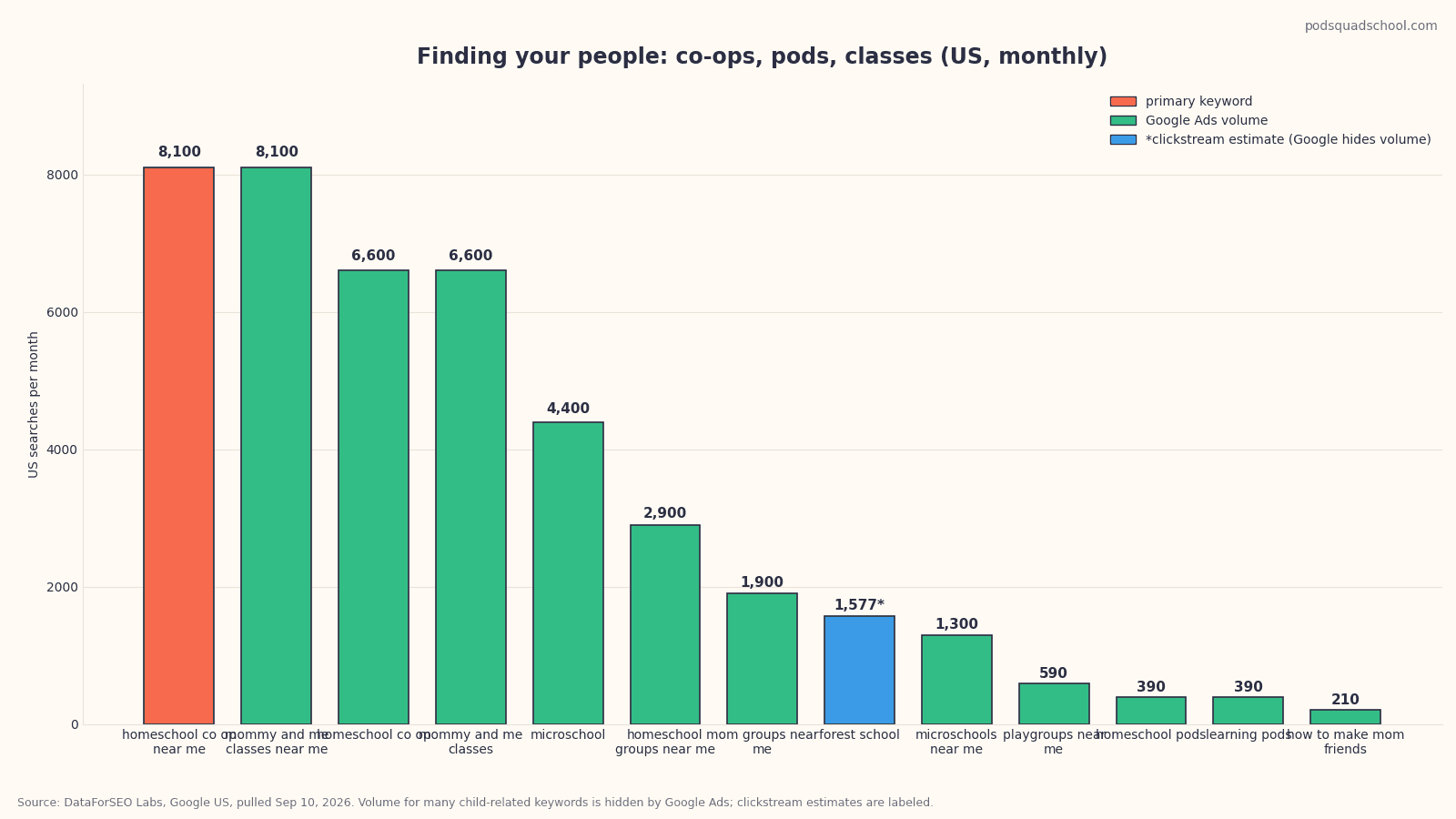
Source: DataForSEO Labs, Google US, pulled September 10, 2026.
Two things stand out. Roughly 23,000 of these monthly searches carry "near me," and difficulty on almost every row is zero: people want a local answer and nobody credible gives one, because the local answer changes every semester. The real question is not "what is a co-op" but "is there one within 20 minutes that takes a 3-year-old and does not meet during nap." The trend lines also split by formality. Class-based searches ("mommy and me classes," down 70%) are falling while informal ones ("playgroups near me," up 22%; "how to make mom friends," up 24%) are rising. Parents of young kids are moving away from paying $25 a session for a room and a rhyme and toward finding three families to meet at the park.
The gaps are the expensive part. Nobody compares the models on cost, hours, and liability; nobody says how many families a toddler group can hold before it collapses; nobody gives you the text to send your friend. And "homeschool pods" carries a $15 cost per click, which tells you companies selling seats will fill the gap with a sales page. The rest of this post is the version a friend would write.
The six models, defined plainly
The words get used interchangeably at the park. They should not be.
Homeschool co-op
Homeschooling families who pool their teaching. Parents take turns leading classes (one mom teaches art, a dad runs science, a grandmother reads aloud), usually one half or full day a week in a church building or library room. Fees cover supplies and space, commonly $50 to $300 a semester; the real cost is your commitment to teach or assist several weeks a term. Most serve elementary and up, with a parent-staffed preschool room for siblings. Some require a statement of faith; many are secular or "inclusive." Ask.
Learning pod (homeschool pod)
Three to eight families who hire a teacher or tutor and split the cost, meeting several days a week in one home or a rotating set. The most school-like option that is still legally homeschooling in most states: each kid is a homeschooler under the parent's name, and the teacher is a contractor the parents pay.
Microschool
A very small school, typically 5 to 15 mixed-age students with one or two educators, independent or under a network brand (Prenda, KaiPod Learning, Acton Academy, and Primer are the ones you will see most in a US search). Unlike a pod, the microschool is the legal entity: it enrolls students, charges tuition, and in many states registers as a private school or operates under a state microschool law. Tuition commonly runs $5,000 to $15,000 a year and varies by city and days per week.
Hybrid or university-model school
A private school where kids attend two or three days a week and do assigned work at home the other days under a parent. The school sets the curriculum and issues grades; the parent is the "co-teacher." Often a few thousand dollars to around ten thousand a year depending on days and grade, frequently faith-based, common for K through 12 and rare for toddlers.
Playgroup
A handful of families with babies or toddlers who meet at a set time and place. No curriculum, no teacher; the cost is snacks and the occasional admission. "Mommy and me" classes are the paid version: a room, an instructor, a song circle, usually $15 to $35 a session, and the search data says parents are drifting away from them.
A squad on Pod Squad
Families who already know each other running the same age-planned program together. Each family has its own account with each kid's age, stage, allergies, and interests; the squad shares one calendar, a hosting board, allergies by kid so the snack host sees them, polls for the Thursday adventure, and a photo feed. Pod Squad does not match strangers, and the lead who brings the families can earn a free membership. It is a paid membership, $99 a month for the first kid and $50 for each sibling after 7 free days, and it plans the years before kindergarten: a few good things a day and a weekend adventure, or a whole preschool morning at home. Details at /how-it-works#pods.
The comparison table
| Model | Typical cost to a family | Hours per week | Who teaches | Legal status (typical, varies by state) | Size | Best ages |
|---|---|---|---|---|---|---|
| Homeschool co-op | $50 to $300 a semester, plus your teaching time | 3 to 7 | Parents, rotating | Homeschool under each parent; group is an informal association or small nonprofit | 10 to 60 families | 5 to 14 |
| Learning pod | Share of a hired teacher's pay, often $3,000 to $11,000 a year | 9 to 25 | Hired teacher or tutor | Homeschool under each parent; teacher is a contractor | 3 to 8 families | 5 to 12 |
| Microschool | Tuition commonly $5,000 to $15,000 a year | 15 to 35 | Employed educators | Private school or state microschool law; the school enrolls the kid | 5 to 15 students | 5 to 14 |
| Hybrid / university-model | Often a few thousand to around $10,000 a year | 10 to 20 on campus, plus home days | School staff on campus, parent at home | Private school; the school issues grades | 30 to 300 students | 5 to 18 |
| Playgroup | $0 to $20 a month | 1.5 to 3 | Nobody; parents stay and play | A playdate | 3 to 8 families | 0 to 4 |
| A squad on Pod Squad | $99 a month for the first kid, $50 for each sibling (lead can earn free), plus split snacks and admissions | 2 to 10 | Parents run the blocks; the program plans them | A playdate or a homeschool, depending on the family | 4 to 8 families | Newborn to kindergarten, deepest at 20 months to 3 years |
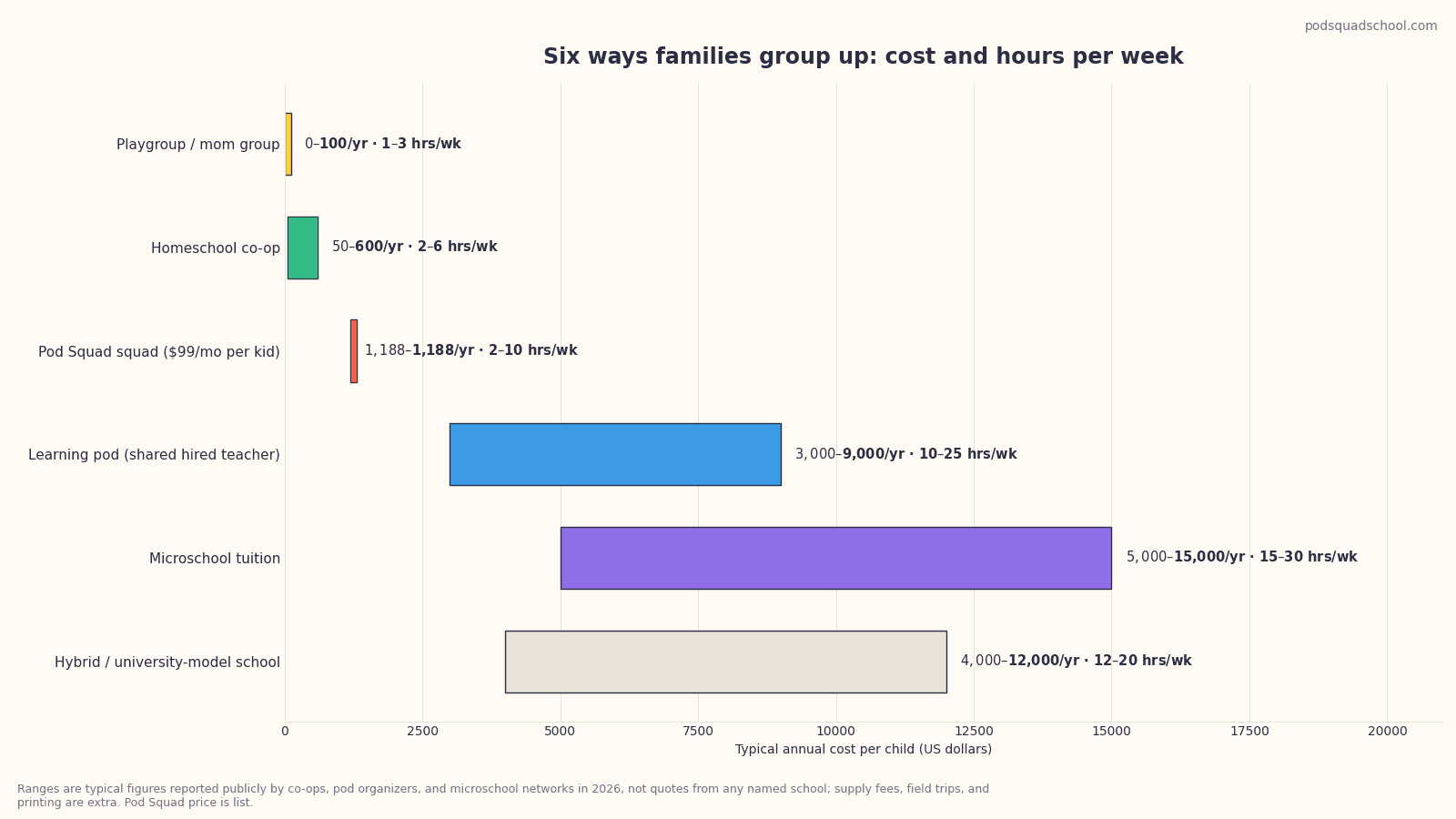
The table hides the most useful sentence, so here it is alone: the further right you go on "who teaches," the more you pay in dollars and the less you pay in Saturdays. A co-op costs almost nothing and eats your calendar. A microschool costs a car payment and hands you your week back. Everything else is a point between.
What each model costs, and where the money comes from
Local prices are set by a volunteer treasurer in a spreadsheet, so these are ranges to plan against, not quotes.
Co-op fees
Most co-ops charge a registration fee per family and a supply fee per class, commonly $50 to $300 a semester in total; the high end usually means a rented church building and real lab supplies. Some take a deposit you forfeit if you skip teaching turns. The hidden cost is time: a co-op meeting 30 weeks a year that asks each parent to lead a third of the sessions is asking for roughly 10 half-days of teaching plus prep.
Pod math
A pod's price is arithmetic. Decide what you are hiring and divide.
- A full-time teacher at $45,000 to $65,000 a year split among six families: $7,500 to about $10,800 a family, before curriculum, space, and payroll taxes if you set it up as employment.
- A part-time tutor at $35 to $60 an hour, three hours a day, three days a week, 36 weeks, split among five families: $11,340 to $19,440 total, or about $2,270 to $3,890 a family.
- A college student or retired teacher at $25 an hour, two mornings a week (6 hours), 32 weeks, split among four families: $4,800 total, $1,200 a family.
Add curriculum (often $200 to $800 a kid a year), a supply kitty ($20 to $40 a month), and a plan for who pays when a family drops out mid-year. That last one kills pods. Put it in writing before the first check: usually the remaining families absorb the share for the rest of the term, or each family posts a one-month deposit.
Microschool tuition
Commonly $5,000 to $15,000 a year, with three-day programs at the low end and five-day programs in expensive metros at the top. Networks generally publish a range or a "starting at" figure and set the actual number per location, so ask the specific school what is included (lunch, materials, before-care, field trips). We do not quote tuition for any named school because it varies by campus and changes yearly; the school's own page is the only figure worth trusting.
Scholarships and ESAs
In a growing number of states, public education dollars can follow a kid to a microschool, a hybrid school, or a homeschool. Florida is the clearest example. The Family Empowerment Scholarship for Educational Options (FES-EO) pays private school tuition, and its Personalized Education Program (PEP) option lets families not enrolled in a school direct funds toward curriculum, tutoring, and approved programs. Both are administered through scholarship funding organizations, most prominently Step Up For Students; eligibility, award amounts, and application windows change yearly, so use the official page at stepupforstudents.org rather than a Facebook comment. Arizona, Arkansas, Iowa, Utah, West Virginia, and others run education savings accounts with their own rules. If you live in one of those states, spend an hour on the official site before you rule a microschool out.
Playgroups and squads
A playgroup costs snacks: rotate hosting among five families at $12 a host and you are in for $12 a month, maybe $30 with an outing. A squad on Pod Squad adds the membership: $99 a month for the first kid, $50 for each sibling (two kids are $149), 10% off your bill for every friend you bring, two months free on annual plans, and a 30-day money-back guarantee on the first paid month. Whether that is worth it depends on whether you would otherwise plan the week yourself; more below.
The legal and insurance basics
None of this is legal advice, and rules differ by state. But the shape is the same almost everywhere.
Are you a school or a playdate?
Parents meeting with their own kids, watching them together, and taking turns leading an activity is a playdate. It has no legal status and needs none. That covers a co-op where parents teach as volunteers, and it covers a squad. Three things move you across the line in many states:
- Paying someone to teach or supervise unrelated kids on a regular schedule. Child-care licensing can apply, especially under school age. Many states exempt small groups, short hours, or arrangements where a parent stays on site; many do not. Your state's child care licensing office publishes the exemptions.
- Enrolling kids and charging tuition. That is a private school in most states: registering with the department of education, keeping attendance, sometimes meeting building and fire codes. Several states now have specific microschool or learning-pod laws that lighten this.
- Renting commercial space. The landlord's insurance and occupancy rules apply. In a home, you are guests.
Homeschool compliance stays with the parent
In a co-op, pod, or squad, each kid is still a homeschooler under the parent's name (if the family homeschools at all). The parent files the notice of intent, keeps the portfolio, and arranges the annual evaluation where the state requires one. Florida's home education law (section 1002.41, Florida Statutes) is typical: a letter of intent to the district, a portfolio, an annual evaluation. The Home School Legal Defense Association keeps a plain-language summary for every state at hslda.org/legal. Read yours once; it takes ten minutes.
Insurance and who is liable
When a 3-year-old falls off a step stool in your kitchen during squad snack, who pays for urgent care is not theoretical. Three layers:
- The host's homeowners or renters policy. Most include personal liability for guests injured on the property. Call your agent, say "I host five families with toddlers every other week, no money changes hands," and ask what is covered. The call is free and most parents never make it.
- A group liability policy. Larger co-ops, especially those renting space, often buy general liability coverage, commonly a few hundred dollars a year for a modest group. A friends' playgroup or squad almost never needs this.
- A signed participation agreement. One page: each parent stays responsible for their own kid, emergency contacts, allergies, and the activities involved (water play, climbing, outings). Not a magic shield, but it sets expectations. Many co-ops add a medical release so another parent can authorize care if you step out.
Background checks
Any adult who will be alone with kids who are not theirs should have one, and good co-ops require it for every teaching parent. A standard state check runs $20 to $50; churches that host co-ops often require their own. In a group where every parent stays with their own kid, checks are less common, but if you ever move to drop-off, do them first.
The group-size math
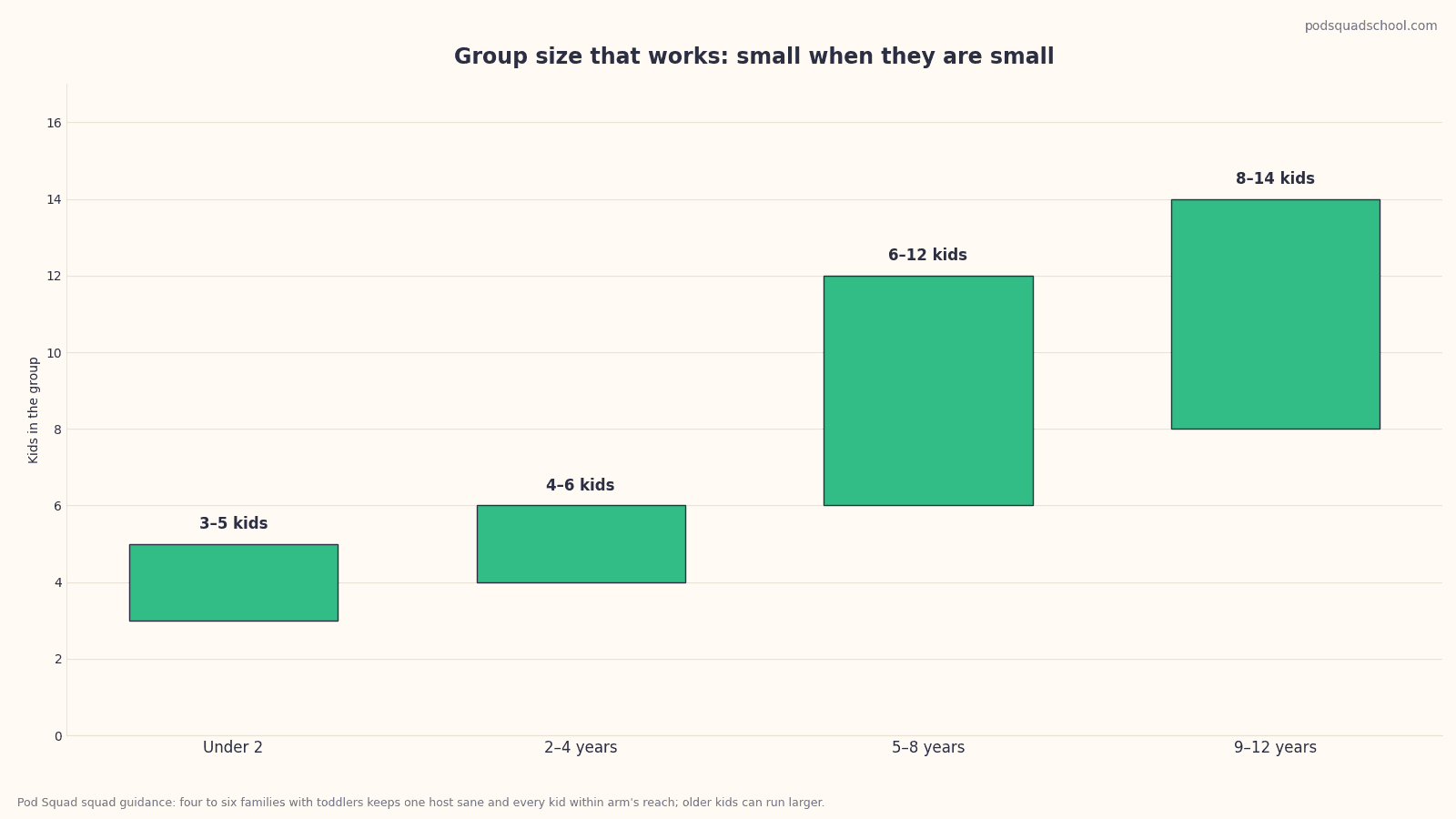
The best predictor of whether a group is still meeting in six months is how many families are in it. Too few and one sick kid cancels the day. Too many and nobody feels responsible for anything.
Under 4: four to six families
Count families, not kids, because every grown-up stays and is doing a job. Four is the floor: one sick and one at work still leaves two, a playdate rather than a cancellation. Six is the ceiling for a house; past that you are in a park or a rented room, snack turns into catering, and a 2-year-old cannot find the one kid she actually likes. Licensed child care in most states runs about one adult per four toddlers; in a home with stairs and a dog, stay tighter, which happens naturally when parents stay.
Preschool (3 to 5): five to eight kids
Preschoolers start to want the same faces every week. Five to eight is where circle time works, where a Community Helpers week can include someone's firefighter uncle without a mob, and where one parent leads while two handle water and snack. Parents still stay.
Elementary (5 to 11): eight to twelve kids
Where co-ops and pods live: enough for a real discussion, enough to split by reading level, enough to survive two absences. It is also where you need a shared calendar, a written cancellation rule, and a named person who runs the day, because "we'll figure it out on the thread" stops working at about nine families.
Mixed ages
A 20-month-old and a 7-year-old in one group is how most families live. Plan for the youngest and give the oldest a job. In our toddler program every kid gets a role: toddlers run the blocks, babies under 16 months ride along with one line per activity, kids 4 and up get their own plan for the same theme, and big brothers and sisters 6 and up get a real helper's job. A co-op that hands a kindergartner a worksheet and tells the toddler to wait does not last.
How to find one near you
Real groups live in real places, and most are not on the first page of Google. Work this list in order; you will usually find something by step five.
- Your public library. Ask the children's librarian, not the front desk. Check the bulletin board by the children's room and the event calendar for "homeschool hour." Librarians know which groups actually show up.
- Your county homeschool group. Almost every county has one, often named "[County] Homeschoolers." They run park days and field trips and know every co-op in the area. Your state homeschool association lists them.
- HSLDA's group finder at hslda.org/groups. Some listings are stale; email three and see who answers.
- TheHomeSchoolMom's state pages at thehomeschoolmom.com/local-support: local groups plus the law summary.
- Facebook. Search "[your city] homeschool" and "[your city] moms." Join two. Then, instead of reading, post: "Looking for a small co-op or playgroup for a 3-year-old, weekday mornings, west side. Anyone?" You will get replies within a day. The big groups are directories, not communities; use them as directories.
- Church and park district calendars. Most co-ops meet in church buildings whether or not they are faith-based. Park districts run "parent and tot" hours and sometimes homeschool gym days.
- Meetup. Search "homeschool," "toddler playgroup," and "moms" within 15 miles on meetup.com. Fewer groups than Facebook, but the ones there tend to have a standing schedule.
- Apps for meeting parents. Peanut is the best known for meeting other mothers nearby, and Meetup lists parent-and-toddler groups in most metro areas. These are for making friends first; the playgroup follows once you have two.
- The park at 9:30 on a weekday. Not a joke. Homeschool families and at-home parents of toddlers are at the good park on weekday mornings. Go three Tuesdays in a row, talk to the same person twice, and you have the start of a group. Our Thursday adventure exists partly for this reason: same kind of place, same time, a reason to be there.
If you find nothing, that is common for kids under 4 and in suburbs where families spread out. It is your signal to start one. The 30-day plan below assumes you know three other parents, even loosely: a neighbor, a coworker's spouse, the family you keep seeing at swim.
Questions to ask before you join
Ask on the phone or over coffee, not in a group post. The answers matter less than whether the leader has answers.
- What is the faith stance? Many co-ops are explicitly Christian and require a statement of faith from teaching parents; many are secular; some are "inclusive," meaning both attend and the curriculum avoids religion. None is wrong. Mismatch is what hurts.
- How are families screened? Application, interview, trial visit? A group that lets anyone in has no way to handle the family that does not fit.
- What are the discipline norms? How does the group handle a 3-year-old who hits, a 7-year-old who will not participate, a parent who yells? You want a calm description of what usually happens. You do not want "that has never happened."
- What is the allergy policy? Is there a list of every kid's allergies that the snack host actually sees? Nut-free rules? Who carries the epinephrine and who knows where it is?
- Are background checks required, and for whom? For any co-op with drop-off or adults teaching other people's kids, the answer should be yes, for every teaching adult, renewed on a schedule.
- Is there insurance, and whose? A friends' playgroup can honestly answer "no, we are a playdate." A 40-family co-op renting a church cannot.
- Who is liable if a kid is hurt? The leader should say without hesitation that parents are responsible for their own kids, that a signed agreement says so, and that there is a first-aid kit and an emergency plan. Then ask where the kit is.
Three more people forget: what happens when a family misses a teaching turn (co-ops die on this); what the schedule is around naps (a toddler group meeting 12:30 to 2:30 loses every 2-year-old by October); and how the group handles a family who does not pay or contribute (the answer tells you whether an adult is in charge).
How to start one in 30 days
You do not need a name, a logo, or a Facebook group. You need four families, one standing day, one shared calendar, and one allergy list. Skip a day when nothing happens; the order matters more than the dates.
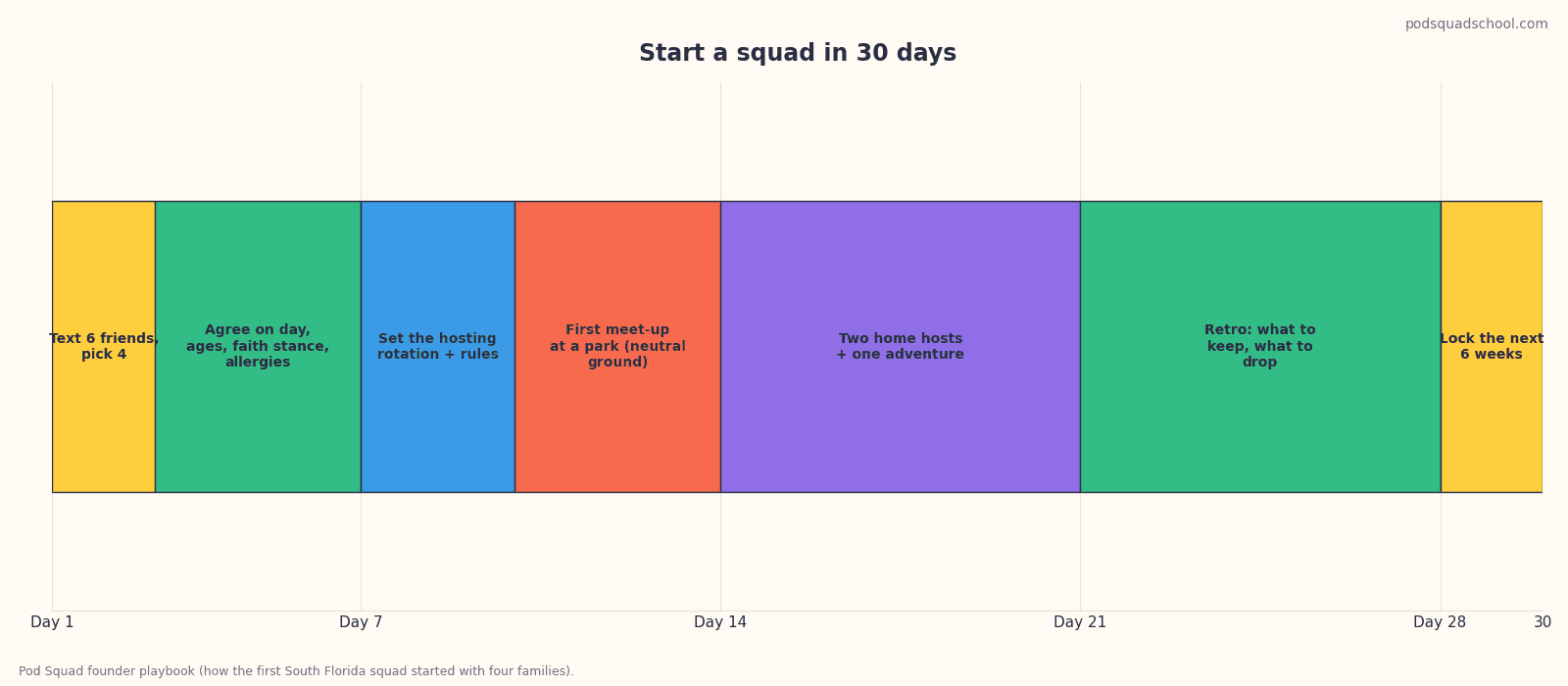
Week one: the ask
Day 1. Write down every parent you know with a kid within two years of yours: neighbors, the family from swim, the coworker whose kid is 3. Aim for eight names. You need three yeses.
Day 2. Pick the day and time before you ask anyone; groups that ask "what works for everyone?" never meet. Toddlers: a weekday 9:30 to 11:30, done before nap. School-age homeschool co-op: a weekday 9 to 1. Kids in school: Saturday 9:30 to noon.
Day 3. Send the text, individually, not a group blast:
"Hey. I'm putting together a small group for [age] kids, four or five families, Thursday mornings at 9:30, rotating houses and parks. Nothing fancy: snack, an activity, the kids run around. I'd love for you and [kid] to be in it. Would that work most Thursdays?"
For the friend you are less sure about:
"Random question. Would you be up for a standing Thursday morning thing with a few other toddler families? I'm trying to get out of the house on purpose instead of by accident. No pressure if the timing is wrong."
Days 4 to 6. Follow up once with anyone silent. Take the first three or four yeses. Say no, kindly, to a fifth for now: "we're starting with four so it stays small; I'll tell you the second there's room." Write down every kid's name, birth month, and allergies as people say yes.
Day 7. Send the group its first message: the day, the start date (two weeks out), the first two hosts. Ask each family to reply with allergies and an emergency contact, even if the answer is "none."
Week two: the boring parts that make it last
Day 8. Make the shared calendar: Google Calendar, a pinned group-text message, or a squad calendar in an app. What matters is that there is exactly one. Put the next eight meetings on it with host and location.
Day 9. Build the hosting rotation. Four families, each hosts once a month. The host provides the place (home, or a park they reach first with a blanket), the snack, and the activity setup; everyone else brings their own kid's water bottle and a change of clothes. Write two months down.
Day 10. Write the allergy list and the snack rule (the full protocol is in the next section). If any kid has a nut allergy, the group is nut-free. Put the toddler cut rules on the same page and link the AAP's choking page.
Day 11. Write the cancellation rule. Host cancels by 7:30 a.m. if anyone in their house is sick; the next host offers their place or a park. Fever, vomiting, or a new rash in the last 24 hours stays home, no explanation, no guilt. "Runny nose, no fever" is the group's call; decide it now.
Day 12. Write the money rule. Hosts pay for their own snack. Admissions and shared supplies split evenly, settled on Venmo or Zelle within the week, tracked by one person. Nobody profits; nobody fronts more than $40 without asking.
Day 13. Pick the first two activities. Toddlers: a water table on a towel with cups and a funnel (adult within arm's reach), and a paper-plate color sort with pom-poms too big to swallow (nothing smaller than a toilet-paper tube within reach of anyone under 3). Preschoolers: a Community Helpers dress-up bin and a "wash the toy trucks" tub. Elementary: one parent teaches 40 minutes on something they love, then outside. Our free sample at /sample has a Week 1 worksheet and a Wonder Lab card if you want a ready-made first activity; our sensory bin ideas post has a dozen more with age notes.
Day 14. Send the pre-launch message: date, host, address, what to bring, the allergy list, the sick rule, and "we end at 11:30 no matter what so nobody misses nap."
Week three: the first two meetups
Day 15 (meetup one). The host sets out the activity before anyone arrives and puts snack out at 10:30. Arrive and free play (30 minutes), the activity (20, and expect toddlers to abandon it after eight), snack (15), outside (40), a two-minute clean-up song, out by 11:30. Take one photo.
Day 16. Send two lines: "That was great. Next Thursday is at [host]'s, [address]. Same time." That message is the whole difference between a group and a one-off.
Days 17 to 21. Confirm the second host has the allergy list. Poll one outing for week four: a fire station open house, a farm, a children's museum, the aquarium, a grocery store tour (our Thursday adventures rotate through exactly these places). Buy tickets and split them the same day.
Day 22 (meetup two). Same structure, new house. Change one thing that fell apart last time; usually it is snack timing or too many toys out.
Week four: review and lock it in
Days 23 to 26. Ask each family privately: "Is Thursday at 9:30 working, and is there anything you'd change?" You will learn one kid naps at 11, one family cannot host because of a dog, one wants more outside time. Adjust once.
Day 27. Put the next three months on the calendar with hosts. Add a fifth family only if two of the four have asked for one.
Day 28 (meetup three: the outing). Meet at the place. That week's host brings snack in a cooler and the allergy list in their pocket. Aim for 90 minutes; toddlers are done after that anywhere.
Days 29 to 30. Write the one-page "how we work" note: day, time, rotation, sick rule, money rule, allergy list, emergency contacts. Pin it. You are now a group that will still be meeting in June, which is rarer than it sounds.
Running it: the hosting board, allergies, cancellations, and money
The 30-day plan starts you. These four systems keep you going.
The hosting board
A grid: date, host, location, snack, activity, notes. The host's job is the place and the snack; the activity can rotate separately so the parent who loves crafts does crafts every time and the parent who hates them never has to. In Pod Squad the hosting board is a screen in the squad tab, and the snack host sees every kid's allergies next to the snack line, on the day page, and in their reminder the night before. On a group text, the equivalent is a pinned message updated every Sunday. Three rules that prevent resentment: hosting is a place and a bowl of fruit, nothing more; the host does not chase RSVPs (families reply to the Sunday pin, silence means out); swaps are between the two families swapping, not a group vote.
The allergy protocol
- One list, every kid, allergy and severity ("peanut, carries epinephrine" versus "mild dairy intolerance"). Update it the day a family joins.
- The snack host reads the list before shopping, every time. If any kid has a life-threatening allergy, the whole group avoids that food; a 2-year-old cannot be trusted to stay in his lane at the snack table and neither can a 5-year-old.
- The parent carrying epinephrine says where it is when they walk in. If they step out, it stays with the kid and one named adult knows.
- Toddler cuts, every snack: grapes, cherry tomatoes, and blueberries for the under-2s quartered lengthwise or smashed; hot dogs split lengthwise then chopped; no whole nuts, popcorn, hard candy, or gummies under 4; hard raw carrot and apple grated or steamed soft under about 3. Kids eat sitting, an adult within arm's reach. That is the AAP's choking guidance in one paragraph; the page is in the sources.
- Our Nourish program does this per kid: one family menu, sized and cut for each kid's age, with each kid's avoid list built in. Our healthy snacks for kids post has a snack-host shopping list by age.
Cancellations
Write one rule and follow it without discussion. Fever, vomiting, diarrhea, or an unexplained rash in the last 24 hours: stay home, no explanation needed. Host household sick: host cancels by 7:30 a.m., next host offers, or the group meets at the standing park. Weather: the host decides by 8 a.m. Two families out: still meet. No cancellation is ever a judgment; say that aloud once and live it.
Money
Hosts cover their own snack, about $10 to $15 for six kids. Shared costs split evenly, settled within a week on Venmo, Zelle, or cash, tracked by one person who is not always the host. Nobody profits; if the group collects more than it spends, it has become a business and the legal section applies. Do not collect dues "just in case"; a kitty with $300 and no plan becomes a fight by spring. If you use a paid program together, each family pays for their own membership; do not pool it.
Why squads die
The groups that stop share four causes, and none is "the parents did not like each other."
One overloaded host. One parent does the planning, hosting, reminding, and snack, and by month three she quietly stops sending the Sunday message. Fix: the rotation is written before meetup one, and the lead's only standing job is the calendar.
No calendar. Each week gets planned on the thread. Someone misses the message, someone shows up at the wrong house, two weeks get skipped, the habit is gone. Fix: one shared calendar with eight meetings on it at all times.
Mismatched ages. A 14-month-old and two 4-year-olds looks fine on paper and works for three weeks, until the toddler's parent realizes every activity is for the big kids and every snack is a choking hazard. Fix: keep the spread to about two years under 5, or give every kid a written role for the day.
Unclear expectations. Nobody said whether parents stay, whether snack is provided, whether a runny nose comes, whether you can bring a cousin. Each becomes a small hurt feeling and the group frays. Fix: the one-page note, pinned forever.
A fifth: growth without structure. Five families that add three because "the more the merrier" now need the systems of a twelve-family co-op and do not have them. Grow one family at a time, only when the current families ask.
How squads on Pod Squad work
Plainly: Pod Squad is a paid membership. One account per family, every kid on it from the newborn weeks to the first day of kindergarten (brothers and sisters 6 and up come along free as big helpers), up to four grown-ups with their own logins. It tells you what to do with your kid today, what to feed them, what to print, and where to go this weekend, planned for each kid's exact age. Families use it for 30 to 45 minutes after daycare, on weekends, and when they are stuck; families doing preschool at home run about two hours a day on it. Kids never use the app.
A squad sits on top. You start one with families you already know (we do not match strangers, on purpose), and the squad gets one shared calendar with the week's meetups and the Thursday adventure sorted by distance from your homes; a hosting board with reminders the night before you host; allergies by kid, visible to the snack host on the board, the day page, and their reminder (notes about what is hard at home stay inside each family); polls for choosing the adventure; and a photo feed where a logged win goes into the kid's portfolio.
The whole squad runs the same week, sized to each kid. In a toddler squad with a 22-month-old, two 3-year-olds, a 10-month-old, and a 5-year-old, the week has one theme (say, Water and Weather), a Squad Job at kid size, a Wonder Lab moment, a Letter of the Week, and a Thursday adventure. The toddlers run the blocks with notes for the youngest and oldest by name; the baby rides along with one line per block; the 5-year-old gets his own plan for the same theme. Nobody waits.
The lead who brings the families can earn a free membership; the others pay $99 a month for the first kid, $50 for each sibling, 10% off for each friend they bring. Seven days free, cancel in two taps; pricing at /pricing. What it is not: not a co-op (no parent-taught classes), not a pod (no hired teacher), not a school. It is the friends-first playgroup or homeschool day with the planning done, and the logistics that usually kill a group handled by software instead of one tired parent.
A worked first month
A toddler squad's first four Thursdays, as it runs. Four families: Cash (22 months), Nova (3 years, 2 months), Chance (3 years, 8 months, peanut allergy), and Ellie (10 months, Nova's sister). Thursdays 9:30 to 11:30, rotating homes, theme Water and Weather.
| Day | Host | Where | Minutes | What happens |
|---|---|---|---|---|
| Thursday 1 | Cash's family | Their backyard | 120 | 9:30 free play. 10:00 water table on a towel with cups, a funnel, a turkey baster; an adult within arm's length the whole time. 10:25 snack, nut-free: banana coins, cheese sticks, grapes quartered for Cash. 10:45 Wonder Lab, Make It Rain: shaving cream on a jar of water, blue food coloring dripped on top, watch it rain. Ellie rides along in a high chair squeezing a wet washcloth. 11:15 clean-up song, out by 11:30. |
| Thursday 2 | Nova and Ellie's family | Living room and driveway | 120 | 9:30 free play. 10:00 Squad Job, Water the Plants and Wash the Dishes: a dish tub with two inches of warm water, plastic cups, a sponge; Cash gets one cup and a sponge, Chance gets the drying-towel job. 10:30 snack. 10:50 Letter of the Week trace on a printed sheet for Nova and Chance; Cash scribbles on his; Ellie chews a board book. 11:10 outside with a spray bottle each. |
| Thursday 3 | Chance's family | Splash pad, then their patio | 90 | Meet at the splash pad at 9:30 with towels, every parent in arm's reach of their own kid. 10:20 snack on the patio; Chance's mom hosts so it is nut-free by default, and the epinephrine is in her bag, which she says aloud when everyone sits. 10:45 I Spy cards from the week's printables in the shade. 11:00 done; splash days end early. |
| Thursday 4 | Whole squad | A children's museum with a water room near you | 100 | The Thursday adventure. Meet at the door at 9:45 when it opens. Water room first while it is empty, then the toddler area, snack at the museum tables at 10:45 (host brings it in a cooler, allergy list in her pocket), out by 11:30. One photo per kid logged as a win. |
Between Thursdays each family runs the rest of the week however they like: the daily block after work, the Saturday adventure and Sunday project, or two hours of homeschool a day. The squad is the Thursday; the program is the week.
The cost of that month to each family, not counting membership: about $12 for the snack they hosted plus a quarter share of museum admission, often $12 to $20 an adult with the youngest toddlers free. Call it $45 a family. Run the identical month with no app and it costs the same $45 plus the three evenings the lead spends planning. That is the honest trade.
Where Pod Squad fits, stated plainly
If you already have three families, a park, and a parent who enjoys planning, you do not need us. Start the group with the 30-day plan, use a shared calendar and a pinned note, and print our free sample at /sample for a ready-made first activity. Plenty of good groups run exactly that way for years.
Pod Squad earns its price when the planning is the thing that keeps not happening. The membership plans every kid's day for their exact age, sizes one menu per kid with allergies built in, prints the week's sheets in one tap, and runs the squad logistics (calendar, hosting board, allergies to the snack host, polls, reminders) so no single parent carries them. For a lead who has watched two groups die of exhaustion, that is the difference. For a family whose little ones are in daycare, it is the after-pickup block and weekend adventures plus a Saturday squad. It costs $99 a month for the first kid, $50 for each sibling, and the first 7 days are free at /start. If you want the reminders on your phone, get the app (iPhone and Android), or use any browser.
If you are choosing among a co-op, a pod, and a microschool for a school-age kid, we are not the answer to that question; those are decisions about who teaches your kid math, and Pod Squad plans the years before kindergarten. We answer "what do we do together Thursday, who is bringing the snack, and is it safe for Chance." Squads are optional inside the membership, and the program works without one.
Mistakes that cost the most
Joining the biggest group you can find. A 40-family co-op feels like the most options. It is also where your 3-year-old knows nobody and you teach eleven kids you have never met. Fix: the smallest group that survives two absences; four to six families under 4, eight to twelve kids for elementary.
Asking "what day works for everyone?" Nobody answers, or everyone answers differently, and the group never meets. Fix: pick the day and time, then ask who can make it.
Hosting as entertaining. The host deep-cleans, bakes, and plans a 14-step craft. By her third turn she dreads it. Fix: hosting is a place and a bowl of fruit. Enforce it on yourself first.
An allergy list that lives in someone's memory. The regular snack host knows Chance has a peanut allergy; the substitute does not. Fix: one written list, read before every shopping trip, epinephrine location said aloud at every meetup.
Meeting during nap. A toddler group running 12:30 to 2:30 loses every 2-year-old by October and blames the weather. Fix: 9:30 to 11:30 under 4, and end on time no matter how well it is going.
Hiring a pod teacher without a dropout clause. A family leaves in November and the other five owe $1,800 more each. Fix: a written agreement with a one-month deposit and a notice period before the first payment.
Treating a paid program as the group. Buying a curriculum or a membership and expecting it to produce friends. Software plans the week; it does not send the first text. Fix: find your three families first, then decide what, if anything, to pay for.
Growing because you feel bad saying no. A friend of a friend asks, then her cousin, and the group doubles in a month. Fix: "we're keeping it at five so it stays small, and I'll tell you the second there's room."
Who this is for, and who it is not for
This is for you if you have a kid under 8 and want a standing group of other kids and parents; you homeschool and the co-ops near you do not fit (wrong faith stance, wrong ages, wrong day); your toddler has aged out of "mommy and me" and you want the free version with real friends; you keep meaning to start something with three families you like and have not found the first step; you are the organizer in your friend group and are tired of being the only one who plans; or you are weighing a microschool against a hybrid school and want the cost and legal picture before you tour.
This is not for you if you need full-day care five days a week so you can work (a co-op, pod, or squad is not child care; a microschool that runs school hours is closer); you want a group to handle your kid's academics end to end without your involvement (that is a school, and there are good ones); you want to be matched with strangers by an app (Pod Squad does not do that, and groups formed that way tend not to last); or your kid is school-age and needs someone to teach one subject, where a tutorial-style co-op or a hired teacher is the right tool (Pod Squad plans the years before kindergarten).
Frequently asked questions
What is the difference between a homeschool co-op and a learning pod?
A co-op is parent-taught: families pool their time, each parent leads or assists classes, and fees are small (often $50 to $300 a semester) because nobody is paid. A learning pod hires a teacher or tutor and splits the cost among a few families, so it costs real money (often $3,000 to $11,000 a family a year depending on the teacher's hours) and asks less of parents' time. Both keep each kid legally a homeschooler under the parent's name. Co-ops usually run one day a week; pods often run three to five.
How much does a microschool cost?
Microschool tuition commonly runs $5,000 to $15,000 a year in the US, with three-day programs at the low end and five-day programs in expensive cities at the top. Networks such as Prenda, KaiPod Learning, Acton Academy, and Primer set tuition per location and publish ranges or "starting at" figures, so ask the specific campus and note the date. In states with education savings accounts or scholarships (Florida's FES-EO and PEP through Step Up For Students, Arizona's ESA, and others), families often apply public funds toward tuition, which changes the math completely.
How many families should a toddler playgroup have?
Four to six. Four is the floor, because with two families out you still have a playdate rather than a cancellation. Six is the ceiling for a home; beyond that you are renting space, snack becomes catering, and a 2-year-old cannot find the one kid she likes. Count families rather than kids under 4, because every grown-up stays and is working. For preschoolers, five to eight kids; for elementary, eight to twelve kids with a written calendar and a named organizer.
Do I need insurance or background checks for a playgroup at my house?
For a group where every parent stays with their own child and no money changes hands, most families rely on the host's homeowners or renters liability coverage plus a one-page participation agreement listing allergies and emergency contacts. Call your insurance agent and describe the group; the call is free. Background checks matter the moment any adult is alone with children who are not theirs, which is why most co-ops require them for teaching parents. If you ever move to drop-off, do the checks first.
Is a homeschool co-op legal in my state?
Parents volunteering to teach each other's children is legal everywhere; each child remains a homeschooler under their own parent's compliance (notice of intent, portfolio, evaluation, whatever your state requires). The rules change when a group hires staff, charges tuition, or supervises unrelated children on a set schedule; that can trigger child-care licensing or private-school registration depending on the state and the children's ages. HSLDA publishes a state-by-state legal summary at hslda.org/legal, and your state's child-care licensing office lists exemptions.
How do I find a homeschool co-op near me if Google shows nothing?
Ask your library's children's librarian, join your county homeschool group, search HSLDA's group finder and TheHomeSchoolMom's state page, post (do not just read) in two local Facebook groups with your kid's age and your preferred day, check church and park district calendars, and go to the best park at 9:30 on a weekday three times. If nothing turns up, that is normal for kids under 4, and it is your signal to start one with three families you already know using the 30-day plan above.
What should the allergy protocol be for a snack rotation?
One written list of every kid's allergies and their severity, updated the day a family joins and read by the snack host before every shopping trip. If any child has a life-threatening allergy, the whole group avoids that food. The parent carrying epinephrine says where it is on arrival. Every toddler snack follows the AAP's choking guidance: grapes and cherry tomatoes quartered lengthwise, no whole nuts, popcorn, or hard candy under 4, kids seated with an adult within arm's reach. Your pediatrician knows your kid; the list is the group's job.
Can I use Pod Squad without a squad, or with a squad that does not homeschool?
Yes to both. Squads are optional, and the program works for one family on its own. A squad can be four families with kids in daycare who meet Saturday mornings, four families doing preschool at home who run the Thursday adventure together, or a mix. Pod Squad plans the years before kindergarten, so it fits a squad of babies, toddlers, and preschoolers, and older brothers and sisters come along free as big helpers. Pod Squad does not match you with strangers; you start a squad with people you already know, and the lead can earn a free membership. The first 7 days are free and you can cancel in two taps.
Sources & methodology
- Search demand: DataForSEO Labs, Google US, September 10, 2026; volumes for many child-related keywords are suppressed by Google Ads and are shown as clickstream estimates where labeled.
- American Academy of Pediatrics, HealthyChildren.org, "Choking Prevention": https://www.healthychildren.org/English/health-issues/injuries-emergencies/Pages/Choking-Prevention.aspx
- Centers for Disease Control and Prevention, "CDC's Developmental Milestones": https://www.cdc.gov/ncbddd/actearly/milestones/index.html
- Harvard University Center on the Developing Child, "Serve and Return" and the science of early relationships: https://developingchild.harvard.edu
- National Association for the Education of Young Children (NAEYC), Developmentally Appropriate Practice and early learning program standards, including group size and ratio guidance: https://www.naeyc.org
- USDA MyPlate, feeding guidance by age: https://www.myplate.gov
- Home School Legal Defense Association (HSLDA), state law summaries: https://hslda.org/legal; homeschool group finder: https://hslda.org/groups
- TheHomeSchoolMom, "Homeschooling in Your State" pages: https://www.thehomeschoolmom.com/local-support/
- Step Up For Students, Florida Family Empowerment Scholarship and Personalized Education Program (PEP): https://www.stepupforstudents.org
- Florida Statutes, section 1002.41 (Home Education Programs), via Online Sunshine: http://www.leg.state.fl.us/statutes/
- Microschool network official pages (Prenda, KaiPod Learning, Acton Academy, Primer) for program models and days per week; tuition ranges here are general US ranges and are not attributed to any single school. Last checked September 2026.
- Co-op fee ranges compiled from published fee schedules of parent-run co-ops across several US states; pod cost math is arithmetic from the stated teacher-pay assumptions and is illustrative.
- Pod Squad pricing and squad features: https://podsquadschool.com/pricing and https://podsquadschool.com/how-it-works, current as of September 2026.
Bottom line
"Homeschool co op near me" is three searches wearing one coat: a group for my kid, friends for me, and a way to make the week feel planned instead of improvised. Co-ops, pods, microschools, and hybrid schools each answer a different version at very different prices in dollars and Saturdays, and the right one depends on your kid's age, your state's rules, and whether you want to teach or pay someone to.
For a kid under 4, the answer is almost always the small one: four to six families you already know, one standing morning, a hosting rotation, an allergy list, and a calendar. It costs a bowl of fruit and one text you have been meaning to send. Send it this week, and if you want the planning and the squad logistics handled so nobody burns out, start free at /start.
Keep exploring
- How squads on Pod Squad work: the calendar, hosting board, allergies by kid, and Thursday adventures.
- Homeschool preschool curriculum: what a two-hour homeschool day looks like for a 3- or 4-year-old.
- Things to do with kids near you: picking a Thursday adventure that works for toddlers and big kids at once.
- Healthy snacks for kids: the snack-host shopping list by age, with choking-safe cuts.
- Play-based learning, explained: why the group activity should be an invitation, not a lesson.
- Pricing: $99 a month for the first kid, siblings half off, 7 days free, and how a pod lead earns a free membership.
Questions parents ask
What is the difference between a homeschool co-op and a learning pod?
A co-op is parent-taught: families pool their time, each parent leads or assists classes, and fees are small (often $50 to $300 a semester) because nobody is paid. A learning pod hires a teacher or tutor and splits the cost among a few families, so it costs real money (often $3,000 to $11,000 a family a year depending on the teacher's hours) and asks less of parents' time. Both keep each kid legally a homeschooler under the parent's name. Co-ops usually run one day a week; pods often run three to five.
How much does a microschool cost?
Microschool tuition commonly runs $5,000 to $15,000 a year in the US, with three-day programs at the low end and five-day programs in expensive cities at the top. Networks such as Prenda, KaiPod Learning, Acton Academy, and Primer set tuition per location and publish ranges or "starting at" figures, so ask the specific campus and note the date. In states with education savings accounts or scholarships (Florida's FES-EO and PEP through Step Up For Students, Arizona's ESA, and others), families often apply public funds toward tuition, which changes the math completely.
How many families should a toddler playgroup have?
Four to six. Four is the floor, because with two families out you still have a playdate rather than a cancellation. Six is the ceiling for a home; beyond that you are renting space, snack becomes catering, and a 2-year-old cannot find the one kid she likes. Count families rather than kids under 4, because every grown-up stays and is working. For preschoolers, five to eight kids; for elementary, eight to twelve kids with a written calendar and a named organizer.
Do I need insurance or background checks for a playgroup at my house?
For a group where every parent stays with their own child and no money changes hands, most families rely on the host's homeowners or renters liability coverage plus a one-page participation agreement listing allergies and emergency contacts. Call your insurance agent and describe the group; the call is free. Background checks matter the moment any adult is alone with children who are not theirs, which is why most co-ops require them for teaching parents. If you ever move to drop-off, do the checks first.
Is a homeschool co-op legal in my state?
Parents volunteering to teach each other's children is legal everywhere; each child remains a homeschooler under their own parent's compliance (notice of intent, portfolio, evaluation, whatever your state requires). The rules change when a group hires staff, charges tuition, or supervises unrelated children on a set schedule; that can trigger child-care licensing or private-school registration depending on the state and the children's ages. HSLDA publishes a state-by-state legal summary at hslda.org/legal, and your state's child-care licensing office lists exemptions.
How do I find a homeschool co-op near me if Google shows nothing?
Ask your library's children's librarian, join your county homeschool group, search HSLDA's group finder and TheHomeSchoolMom's state page, post (do not just read) in two local Facebook groups with your kid's age and your preferred day, check church and park district calendars, and go to the best park at 9:30 on a weekday three times. If nothing turns up, that is normal for kids under 4, and it is your signal to start one with three families you already know using the 30-day plan above.
What should the allergy protocol be for a snack rotation?
One written list of every kid's allergies and their severity, updated the day a family joins and read by the snack host before every shopping trip. If any child has a life-threatening allergy, the whole group avoids that food. The parent carrying epinephrine says where it is on arrival. Every toddler snack follows the AAP's choking guidance: grapes and cherry tomatoes quartered lengthwise, no whole nuts, popcorn, or hard candy under 4, kids seated with an adult within arm's reach. Your pediatrician knows your kid; the list is the group's job.
Can I use Pod Squad without a squad, or with a squad that does not homeschool?
Yes to both. Squads are optional, and the program works for one family on its own. A squad can be four families with kids in daycare who meet Saturday mornings, four families doing preschool at home who run the Thursday adventure together, or a mix. Pod Squad plans the years before kindergarten, so it fits a squad of babies, toddlers, and preschoolers, and older brothers and sisters come along free as big helpers. Pod Squad does not match you with strangers; you start a squad with people you already know, and the lead can earn a free membership. The first 7 days are free and you can cancel in two taps.
Written by
Christopher McGinnis
Founder, Pod Squad. We write the daily plan families run, so every post is built from what actually works with a real kid on a real Tuesday.
Keep reading
Nourish
Healthy Snacks for Kids: 75 Ideas by Age, With Portions, Prep Times, and the Picky-Eater Playbook
52 min read

Out & About
Things to Do With Kids This Weekend: The Parent's Playbook for Parks, Museums, Libraries, and Free Days Out (By Age)
43 min read
Activities
Sensory Bin Ideas: 75 Fillers, Tools, and Themes by Age (Taste-Safe Through Age 3)
48 min read