Reviews
Lovevery vs KiwiCo vs Pod Squad (2026): Play Kits, Crates, or a Daily Plan? An Honest Comparison
Lovevery ships toys, KiwiCo ships projects, and Pod Squad ships nothing but a plan. We compare what each actually is, the official September 2026 prices, cost from ages 1 to 5, and who each is best for.
Christopher McGinnisSeptember 10, 2026Updated September 28, 2026 32 min read
Key Takeaways
- These are three different products, not three versions of one thing. Lovevery ships toys on a developmental schedule, KiwiCo ships project crates, and Pod Squad is a daily plan and an app with nothing in the mail. Comparing them on price alone misses what you are buying.
- On sticker price, KiwiCo is the cheapest and Pod Squad is the most expensive. KiwiCo's Panda Crate works out to about $252 a year, Lovevery's Play Kits to about $480 a year, and Pod Squad to $1,188 a year for one kid ($1,788 for two kids), at the official prices listed at the time of check in September 2026.
- Per dollar, you get different things. Lovevery buys toys you keep. KiwiCo buys one to three projects a month. Pod Squad buys roughly 25 to 40 hours of planned play a month plus meals, printables, reminders, and a weekend adventure, for every kid on the account.
- Age coverage is the quiet deciding factor. Lovevery's Play Kits stop at age 5. KiwiCo is strongest from 5 to 9 and continues into the teen years. Pod Squad covers the years before school, from the newborn weeks to the first day of kindergarten, on one account, with older siblings along free as big helpers.
- You can combine them, and the do-it-yourself path is real. A Lovevery toy works well inside a Pod Squad block; a KiwiCo crate makes a good Sunday project; a $30 bin of supplies and a library card beat all three if you have three to five hours a week to plan.
- Pod Squad wrote this comparison. We linked the official pricing pages so you can check us, and we say plainly when a competitor or a free option is the better call for your family.
Let's get the obvious thing out of the way first. Pod Squad wrote this article. We make one of the three products in the title, we charge money for it, and we would like you to try it. A comparison written by one of the contestants is worth exactly as much as its honesty, so here is our deal with you: every competitor price in this post comes from that company's official page, is phrased as "listed at" with the month we checked, and is linked so you can verify it. Where Lovevery or KiwiCo is the better fit for your family, we say so, by name. Where a $30 bin of rice and a library card beats all three of us, we say that too.
This post is for parents of kids from birth through the early school years deciding whether to spend money on a play subscription, and if so, which kind. Families use Pod Squad at home with a baby, in the 30 to 45 minutes after daycare pickup, for Saturday adventures and Sunday projects, for snacks, and for printables. Some do preschool at home and run their whole morning on it. You do not have to homeschool to find this useful, and nothing below assumes you will.
What parents are actually searching for (2026)
Parents search the brand names directly, in large numbers; they rarely search for a category name, because "an app that tells me what to do with my toddler today" barely exists as a category yet. Google Ads hides volume for many keywords about young children, so several rows in our wider research use clickstream estimates (labeled where we do); in this set, one keyword is suppressed entirely with no estimate available, and we show it that way rather than guess.
| Keyword | US searches/mo | Difficulty | What they want |
|---|---|---|---|
| outschool | 110,000 | 37 | Live online classes for school-age kids; mostly brand navigation |
| lovevery | 90,500 | 50 | Is it worth it, which kit comes next, honest reviews |
| kiwico | 74,000 | 15 | Which line fits my kid, discount codes, reviews |
| lovevery play kits | 18,100 | 19 | Ready to buy; comparing kits and subscription terms |
| homemade playdough | 18,100 | 19 | The make-it-yourself instinct: a recipe, tonight |
| sensory bins | 5,400 | 8 | DIY play ideas, fillers, and setups |
| little passports | 4,400 | 0 | Geography and culture subscription boxes |
| parenting apps | 880 | 41 | A shortlist of apps that help day to day |
| kinedu | 720 | 17 | A milestone-based baby and toddler activity app |
| babysparks | 480 | 24 | A milestone-based baby activity app |
| best parenting apps | 390 | 24 | A ranked list, mostly aimed at the baby year |
| toddler activity app | suppressed | n/a | An app that tells you what to do with a toddler today |
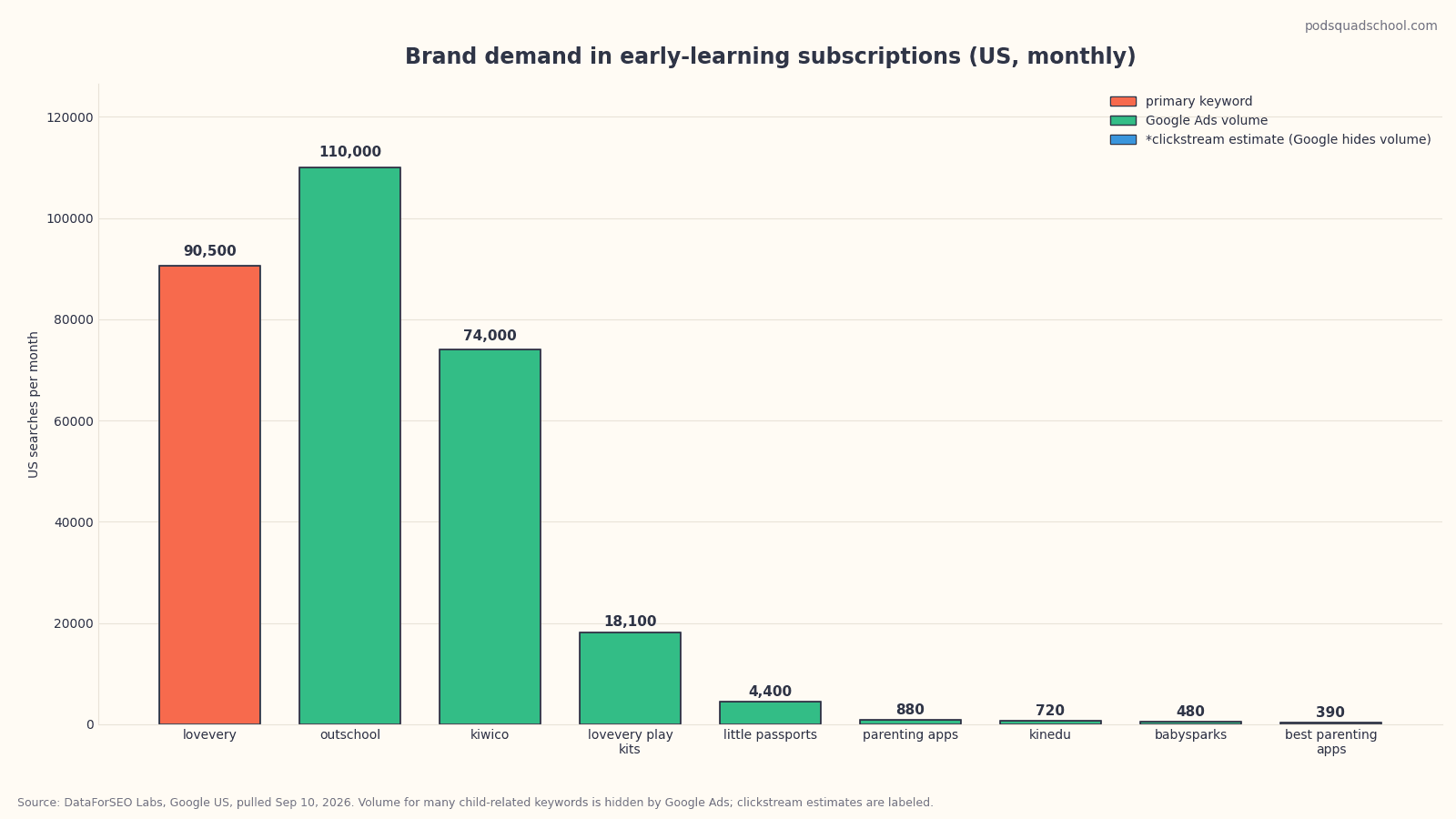
Source: DataForSEO Labs, Google US, pulled September 10, 2026.
Two things stand out. First, the brand searches are evaluative, not just navigational. People searching "lovevery" are largely asking whether $120 a kit is justified, and the 18,100 monthly searches for "lovevery play kits" are people close to buying who want the lineup and the terms in one place. "Kiwico" has a low difficulty score (15), which tells you the results are mostly coupon sites and quick reviews rather than useful comparisons. Both brand terms are down about 18% over 12 months, and the milestone apps are down harder (Kinedu −33%, BabySparks −56%), which suggests the baby-app category peaked and parents are drifting back toward physical products or toward doing it themselves.
Second, look at the DIY signals in the middle of the table. "Homemade playdough" draws as many searches as "lovevery play kits", and "sensory bins" draws more than "little passports". Many parents comparing subscriptions would happily make a bin of dyed rice if someone told them how and when. That is the gap none of the three products fully owns: not the toy, not the crate, but the daily decision of what to do, when, with what you already have. It is why we wrote separate guides on sensory bin ideas and activities for 2 year olds.
What each product actually is
Lovevery: toys shipped on a developmental schedule
Lovevery's core product is the Play Kit subscription. Every kit is named for a stage (The Looker, The Charmer, The Babbler, The Realist, and so on) and is built around what a child at that stage is working on: tracking with the eyes, grasping, dropping things on purpose, posting objects into slots, sorting, buttoning, early pretend. Kits arrive every two months during the first year and every three months from about 13 months through age 5. Each contains a set of playthings, mostly wood and organic cotton, a printed Play Guide explaining what the child is developing and how to use each item, and access to the Lovevery App. The playthings are the product; the guide and app help you use them.
KiwiCo: project crates by age line
KiwiCo sells subscription crates, each one a boxed project, across several age lines. Panda Crate covers 0 to 36 months and arrives every two months with a small set of developmentally themed items and a parent guide. Koala Crate (listed for ages 3 to 4, with some pages saying 3 to 6) and Kiwi Crate (5 to 8, with some pages saying 6 to 9) arrive monthly, and older lines continue into the tween and teen years. A typical Koala or Kiwi crate holds the materials for one to three hands-on projects, pre-cut and sorted, an illustrated step-by-step booklet, and a small magazine. A child builds a thing and keeps it.
Pod Squad: a daily plan and an app, nothing in the mail
Pod Squad ships nothing. It is an app (iPhone and Android, with the same account in any browser) and a website that tells you what to do with your kid today, what to feed them, what to print, and where to go this weekend, planned for the kid's exact age. Every kid in the family, from the newborn weeks to the first day of kindergarten, is on one account (brothers and sisters 6 and up come along free as big helpers), and up to four grown-ups have their own logins. Kids never use the app; it is for the adults, and it keeps the kids screen-free.
The deepest program is Toddler Squad, for roughly 20 months to 3 years. It runs in 12-week seasons, back to back. Each week has a theme (Week 2 "Color Splash", Week 3 "Wheels & Roads", Week 6 "Farm & Food", Week 9 "Ocean & Beach"), a Squad Job (a real chore at kid size, like a Wash-Up Station or Laundry Helper), a Wonder Lab (a two-minute science moment such as "Germs Run Away" with pepper, water, and dish soap), a Letter of the Week with a Monday tracing page and a Wednesday review, books, songs, a shopping list, printables, a Spanish Play Day on Friday, and a Thursday adventure at a real place near you. Every block says what to set out, what to say, what to watch for, and what to do when it falls apart, with a note for your kid's exact age. Nourish adds one family menu sized per kid with choking-safe cuts for toddlers. Homie, the personalization layer, names your kid in every note by age, stage, and interest lane. Squads are optional; start one with friends you already have. Pod Squad does not match strangers.
The others: Little Passports, Kinedu, BabySparks
Little Passports is a subscription box built around geography and world cultures: a themed package about a country or region with activities, souvenirs, and reading, best for kids roughly 6 and up. It is a box, not a plan. Kinedu and BabySparks are milestone-based activity apps for babies and young toddlers: you enter your child's age and the app suggests short activities tied to milestones, often with a video. They are closest to Pod Squad in format (an app for the parent, nothing shipped) but narrower: no meals, no printables, no adventures, no siblings on one plan, and most of their depth is in the first two years. We describe formats only; we did not verify current pricing for these three and will not guess.
What a typical kit, crate, and week actually contain
Lovevery's example is a toddler-stage kit; KiwiCo's is a Koala Crate for a 3- or 4-year-old; Pod Squad's is one week of Toddler Squad.
| Lovevery Play Kit (toddler stage) | KiwiCo Koala Crate | Pod Squad Toddler Squad week | |
|---|---|---|---|
| Arrives | Every 3 months, in a box | Monthly, in a box | Every Sunday night, in the app |
| Physical items | Roughly 5 to 8 playthings, mostly wood and cotton | Materials for 1 to 3 projects, pre-cut and sorted | None; a shopping list of household items (about $5 to $15 a week) |
| Guide | Printed Play Guide plus the Lovevery App | Step-by-step booklet plus a small magazine | Every block: what to set out, what to say, what to watch for, what to do when it falls apart |
| Planned time | Open-ended | One session per project, typically 30 to 60 minutes | 5 weekday blocks, Thursday adventure, Saturday adventure, Sunday project; 30 to 45 minutes a day after daycare or about 2 hours for a day at home |
| Food | None | None | One family menu, portioned per kid, allergy-aware, choking-safe cuts |
| Printables | None | Occasional, in the magazine | Letter tracing page, Words of the Week poster, I Spy cards, sorting mat, Little Wins tracker |
| Outing | None | None | One Thursday adventure at a real place, sorted by distance from home |
| Personalization | By stage (age band) | By age line | By exact age in months, stage, and interest lane, with the kid's name in the note |
| Reminders | App notifications for new content | Email when a crate ships | The night before and the morning of; a Block Timer runs each activity |
| What you keep | The toys | The finished project | A portfolio of logged wins with photos |
Cost over time, with the official prices
All prices below are as listed on each company's official pages at the time of check, September 2026. Pricing changes and sales happen, so click through before you decide.
Lovevery pricing
Lovevery lists its Play Kits on its Play Kits page and explains cadence and cancellation in its help center.
| Plan | Listed price | Cadence | Works out to |
|---|---|---|---|
| Play Kits, 0 to 12 months | $80 per kit | Every 2 months | About $40 a month; $480 a year |
| Play Kits, about 13 months through age 5 | $120 per kit | Every 3 months | About $40 a month; $480 a year |
| Prepaid subscription | 5% off the above | About $456 a year | |
| Single kit, no subscription | $96 (baby stage) or $144 (toddler and up) | One-time |
Last verified: September 2026.
KiwiCo pricing
KiwiCo lists all lines on kiwico.com, with free US shipping.
| Line | Listed ages | Listed price | Cadence | Works out to |
|---|---|---|---|---|
| Panda Crate | 0 to 36 months | $42 per crate | Every 2 months | $252 a year |
| Koala Crate | 3 to 4 (some pages say 3 to 6) | From $24 a month month-to-month; about $18.50 a month on an annual plan | Monthly | $288 a year month-to-month; about $222 a year annual |
| Kiwi Crate | 5 to 8 (some pages say 6 to 9) | Same as Koala | Monthly | Same as Koala |
Last verified: September 2026.
Pod Squad pricing
Pod Squad's pricing page has the current terms.
| Plan | Price | Notes |
|---|---|---|
| Free trial | $0 for 7 days | Cancel anytime in two taps; nothing charged today |
| One kid | $99 a month | $1,188 a year |
| Two kids | $149 a month | Siblings 50% off; $1,788 a year |
| Big helpers | $0 | Brothers and sisters 6 and up come along free, with a job in each block and no plan of their own |
| Annual plan | 2 months free | $990 a year for one kid, $1,490 for two |
| Referrals | 10% off your bill per friend who joins | |
| Pod leads | Can earn a free membership | See how squads work |
| Guarantee | 30-day money-back on the first paid month |
Last verified: September 2026.
One year and ages 1 to 5, side by side
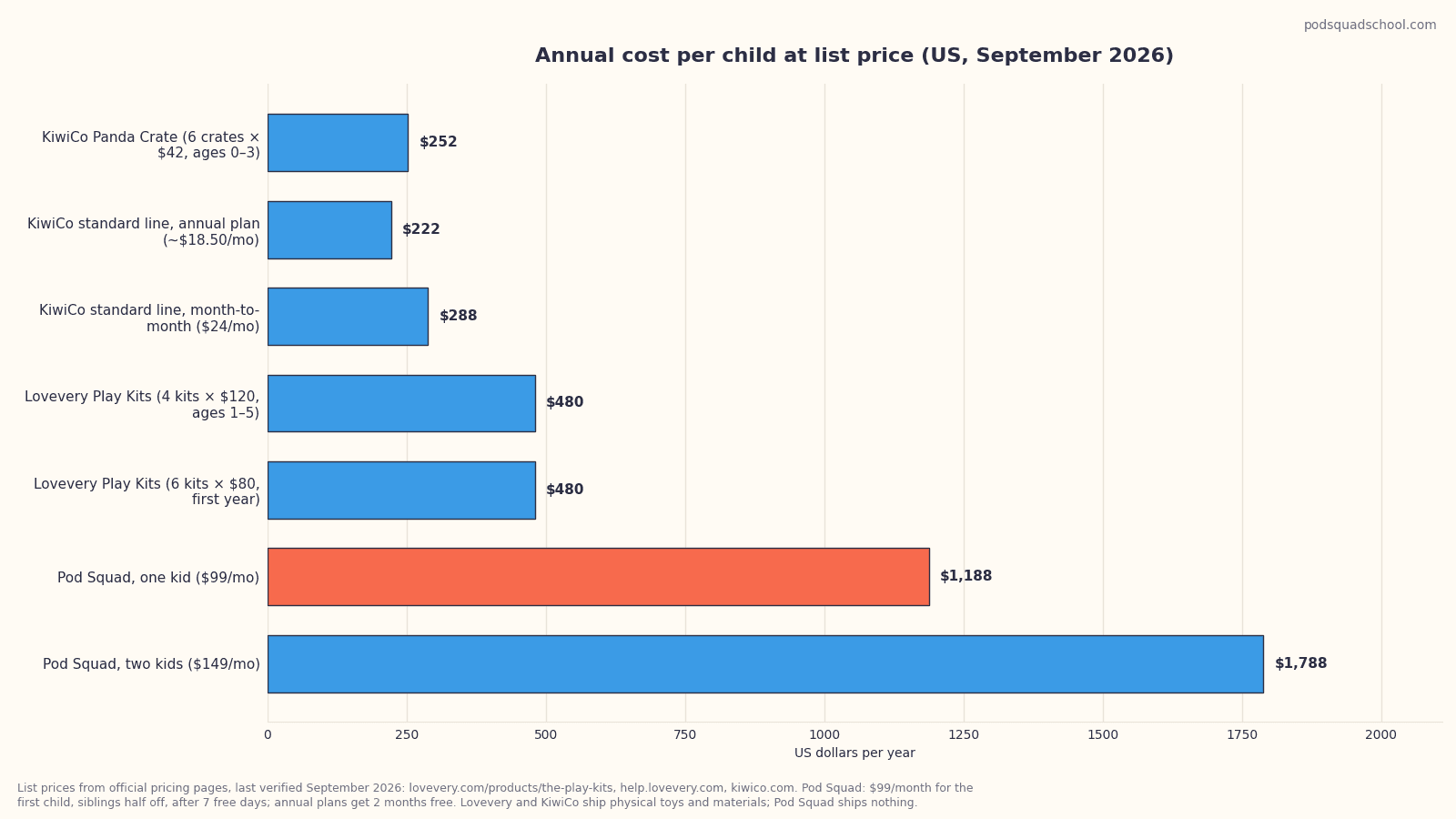
| Product | Per year | Ages 1 to 5 (four years) | What you end with |
|---|---|---|---|
| Lovevery Play Kits | About $480 | About $1,920 | 16 kits of wooden and cotton toys, resellable |
| KiwiCo Panda (1 to 3) then Koala (3 to 5), month-to-month | About $252, then $288 | About $1,080 | About 12 Panda crates and 24 Koala projects |
| Pod Squad, one kid, monthly | $1,188 | $4,752 | Four years of daily plans and a portfolio; no objects |
| Pod Squad, one kid, annual | $990 | $3,960 | Same |
| Pod Squad, two kids, monthly | $1,788 | $7,152 | Same, for both kids |
| Do it yourself | About $30 to $100 in supplies plus a library card | About $200 to $400 | Bins, scoops, tape, crayons, and whatever you built |
Last verified: September 2026.
That table is the whole argument against Pod Squad, and we are putting it in our own post on purpose. Over four years, Pod Squad costs two and a half times Lovevery and more than four times KiwiCo. On price alone, we lose. The next section is why price alone is the wrong comparison for some families and exactly the right one for others.
What you get per dollar
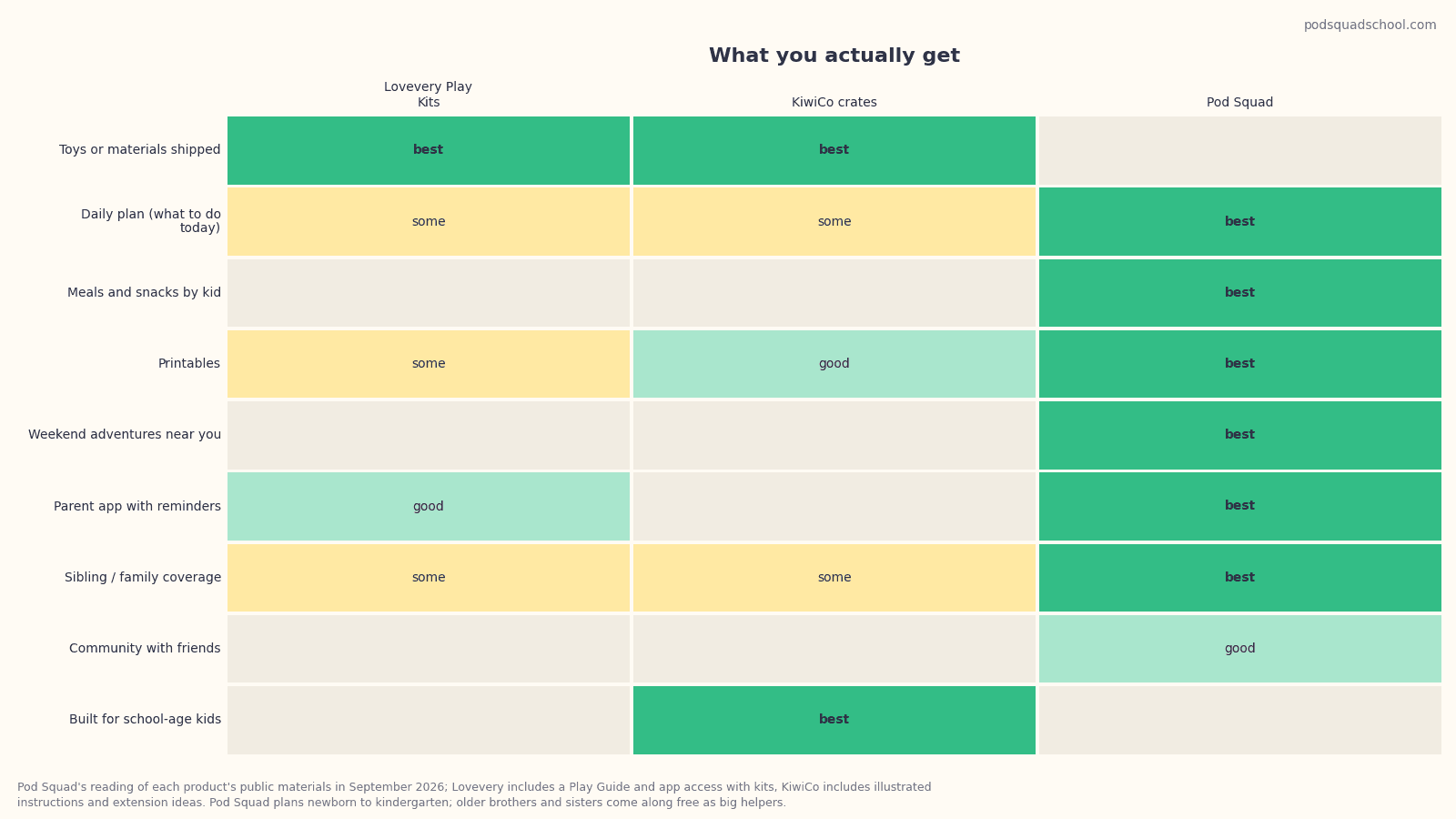
Each product converts your dollars into a different currency.
Lovevery converts dollars into objects you keep. About $40 a month becomes, over a year, roughly 20 to 30 well-made playthings and four Play Guides. They have resale value, pass to a sibling at no extra cost, and sit on a shelf inviting play. What Lovevery does not give you is a plan for Tuesday. The Play Guide tells you what the ball drop is for; it does not tell you to set it out at 4:30 with a bowl of quartered grapes and then walk to look at trucks.
KiwiCo converts dollars into finished projects. $24 becomes one afternoon of focused building and a thing your kid made. For a 6-year-old who loves making, that is a very good $24. What it does not give you is the other 29 days of the month, anything about food, or anything for a younger sibling unless you buy a second line.
Pod Squad converts dollars into decisions made and hours planned. $99 a month becomes roughly 25 hours of planned play if you run it after daycare and on weekends, or about 40 hours on the home rhythm. That is between $2.50 and $4 per planned hour, and the same subscription produces a weekly menu, five to eight printables, one outing, and the reminders that get it done. Add a second kid for $50 and the per-hour number roughly halves. What Pod Squad does not give you is a single object. You supply the rice, the tape, the muffin tin, and the truck; the weekly shopping list runs $5 to $15 in household items, most of which you already own.
Age coverage: who stops where
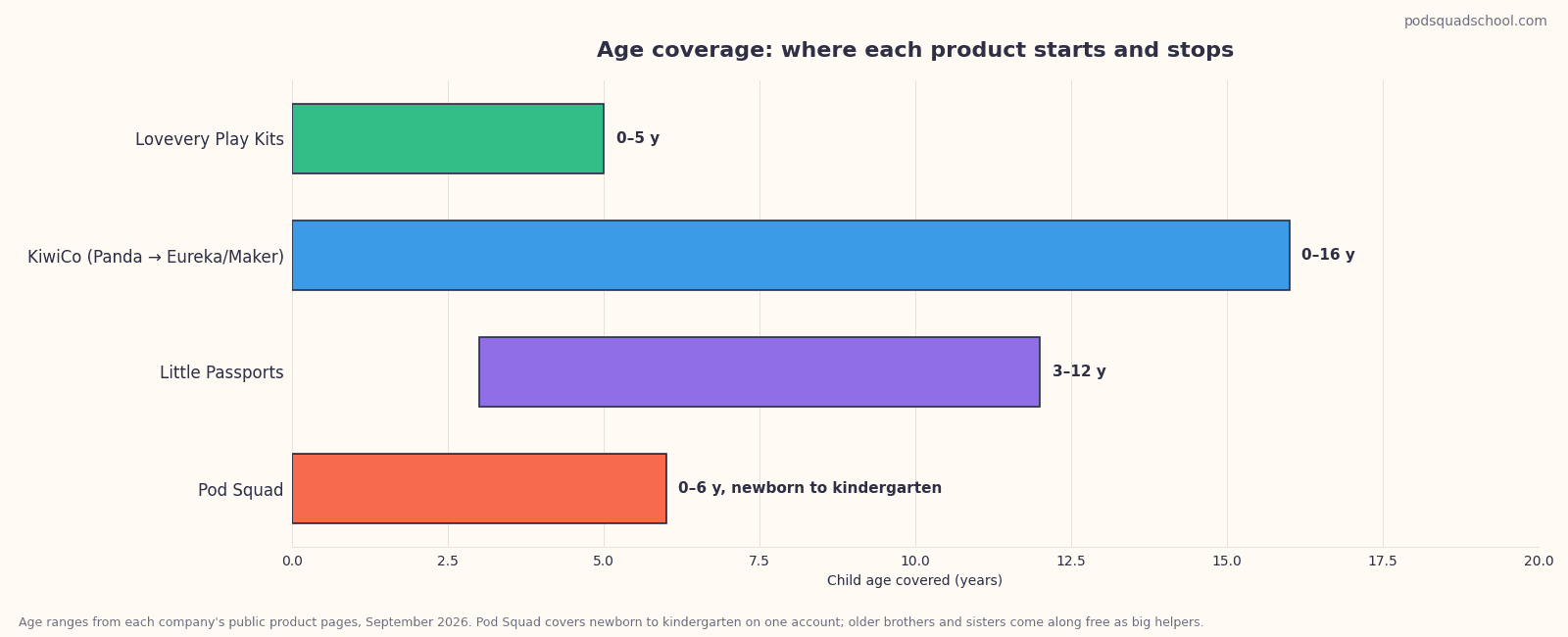
Lovevery Play Kits stop at age 5. That is a design choice, not a flaw; by kindergarten most kids have moved on to friends, books, sports, and building sets they choose themselves. If your kid is 4 and a half, you are buying two more kits and then you are done.
KiwiCo starts at birth with Panda but is strongest from about 5 to 9. A 14-month-old does not build from instructions, so Panda is really a curated toy delivery with a guide. From Kiwi Crate up, the projects get genuinely interesting: mechanisms, circuits, simple chemistry, art techniques. If you have a 7-year-old who takes things apart, KiwiCo is the best value in this post.
Pod Squad runs from the newborn weeks to the first day of kindergarten on one account. Each stage is made for exactly how long a kid is in it: 13 weeks for a newborn, 26 for a crawler, three years of preschool. Toddler Squad (about 20 months to 3 years) is the deepest program, and Preschool shifts toward project weeks, real jobs, and interest lanes (Builder, Naturalist, Chef, Storyteller, and more). Brothers and sisters 6 and up come along free as big helpers, with a real job in each block but no plan of their own. A family with a baby and a 3-year-old gets one plan for both, one menu, one calendar. Like Lovevery, it is built for the years before school; past 5, KiwiCo is the one that keeps going. The full list is at /programs.
Can you combine them? Yes
The most sensible setups mix a physical product with a plan.
Lovevery inside a Pod Squad block. Toddler Squad's Week 8 is "Build It!" Its Tuesday block calls for blocks, a strip of painter's tape on the floor as a road, and a grown-up at kid height saying "I wonder how tall we can go before it falls." If a Lovevery stacker or block set is on your shelf, that is the material. The block supplies what to say and what to watch for (stacking, lining up, and knocking down are all learning), and the Block Timer runs the 20 minutes. The plan gets easier because the toy is already there.
KiwiCo as the Sunday project. For a 5-to-9-year-old, a Kiwi Crate is a ready-made Sunday project once a month. Run the Saturday adventure from the app, build the crate on Sunday, log a photo into the portfolio.
Lovevery for the baby, Pod Squad for everyone. A family with a 6-month-old and a 3-year-old might subscribe to Lovevery for the baby year (six kits, about $480) while running Toddler Squad for the 3-year-old and letting the baby ride along with the one-line notes the program gives for a baby on every block. The baby is a $50 sibling seat from the start, and moves into Toddler Squad at about 20 months.
The make-it-yourself path, costed out
Here is the option that beats all three of us on price.
The $30 starter bin
A Busy Toddler-style DIY setup for a 2- to 4-year-old, at typical big-box and dollar-store prices:
| Item | Approximate cost | What it is for |
|---|---|---|
| 6-quart clear latching bin | $5 | The sensory bin base; also storage |
| 5-pound bag of rice (dye it with vinegar and food coloring) | $4 | The first filler; taste-safe |
| 1-pound bag of dried chickpeas | $2 | Second filler; taste-safe, loud, satisfying to pour |
| Set of scoops and measuring cups | $3 | Pouring, filling, transferring |
| Roll of painter's tape | $4 | Floor roads, shape outlines, lines to walk on |
| Jumbo crayons, 8 pack | $3 | Pre-writing, big marks |
| Construction paper, 50 sheets | $3 | Cutting, gluing, tracing |
| Muffin tin (thrift store) | $2 | Sorting mat for colors and counts |
| Pom-poms or large buttons (over 3 only) | $3 | Sorting and tweezers work |
| Library card | $0 | Books, storytime, often free museum passes |
| Total | About $29 |
Supervision rules apply from the first minute: anything smaller than a toilet-paper tube stays out of reach of a child under 3 (so the pom-poms and buttons wait), rice and chickpeas are taste-safe but you sit within arm's length, and any water play means an adult within arm's length the whole time. The AAP's choking prevention guidance is the standard, linked in the sources.
What the DIY path actually costs
The supplies are not the cost. The planning is. To run a decent play week for a toddler yourself, you decide on five to seven activities, check the materials, think about what to say and what to do when it goes sideways, pick a book, plan snacks and dinners, find a place to go on Saturday, and then remember to do all of it. Parents who do this well tell us it takes three to five hours a week. If you enjoy that work, the DIY path is the best value in this post by a wide margin and you should take it. Start with sensory bin ideas, activities for 2 year olds, and healthy snacks for kids, all free, and download the free sample for one worksheet and one Wonder Lab card.
Which one for your family: three scenarios
One toddler, 2 to 3, both parents working, daycare weekdays
This is Pod Squad's core family, and also where the price is hardest to justify. You have about 45 minutes between pickup and dinner and a weekend that currently disappears. Pod Squad gives you a 30-to-45-minute after-daycare block with everything decided, a Saturday adventure near you, a Sunday project, and a menu: about 25 planned hours a month for $99. If your alternative is scrolling for ideas at 4:45 with a toddler on your leg, the $99 buys back an hour a day of not deciding. If your alternative is a partner or grandparent who already plans the week, keep your money and buy a $42 Panda Crate every two months for the novelty.
One toddler, 2 to 3, one parent home, considering homeschool preschool
Run Pod Squad's home rhythm for the free 7 days and then decide. About two hours a day in short blocks, with the Letter of the Week, Squad Job, Wonder Lab, Spanish Play Day, and Thursday adventure, is a complete preschool rhythm, and the printables and menu cover the two other things a home-preschool parent spends hours on. If you like planning and would rather spend $40 to $70 once on a PDF curriculum, our homeschool preschool curriculum comparison prices those out. If you do not want to plan, $99 is replacing 5 to 10 hours of your week.
Two kids, 2 and 6
Pod Squad plans the 2-year-old's day for $99 a month, and the 6-year-old comes along free as a big helper: a real job in each block (reading the story aloud, running the timer, setting up the bin) but no plan of their own, because Pod Squad is built for the years before kindergarten. Lovevery covers only the 2-year-old and stops in three years. KiwiCo covers both as two separate lines at roughly $24 plus $21 a month, one project per kid per month, nothing daily. A reasonable combination: Pod Squad for the 2-year-old with the 6-year-old as the helper, plus a Kiwi Crate for the 6-year-old as the once-a-month Sunday project.
A decision flow
Work through these in order and stop at the first yes.
- Is your kid under 12 months? If what you want is the toys, Lovevery: the Play Guides are a gentle developmental education in six installments, and the baby year is where its model is strongest. If what you want is the day planned (the feeds, the tummy time, the first tastes, what is normal this week), Pod Squad, from the newborn weeks. The two do different jobs and work well together.
- Is your kid 6 to 9, and is your main goal one great hands-on project a month? KiwiCo Kiwi Crate on the annual plan.
- Do you have a spare three to five hours a week and enjoy planning play, or is money tight? Do it yourself with the $30 bin, the library, and the free guides here. Pod Squad is a paid membership; if $99 would strain the budget, do not buy it.
- Do you have two or more kids of different ages? Pod Squad: every kid under 6 gets a plan for their own age, and a big brother or sister 6 and up comes along free as a helper. Add an optional KiwiCo crate for any kid 5 and up.
- Is your daily bottleneck the decision (what to do, what to feed, where to go), not the objects? Pod Squad, free for 7 days. If you already have a closet full of boxes, this is you; the toys become the materials.
- Is your bottleneck the objects (you have a plan, you lack good open-ended toys)? Lovevery for a toddler; KiwiCo Panda if you want to spend half as much.
- Still unsure? Do the free things first: the free sample, a library card, one bin of rice. Then buy the one thing that fixes what was still hard.
A worked week
Here is one week a family could run starting Monday with a 2-and-a-half-year-old, using Toddler Squad Week 3, "Wheels & Roads", and a few objects that might have come from a Lovevery kit or a Panda Crate. Materials from the shopping list: painter's tape ($4), toy vehicles you already own, a shallow bin, a bag of rice, a library trip. Every activity is supervised at arm's length; anything smaller than a toilet-paper tube stays put away.
Sunday night, 10 minutes. The app taps you on the shoulder: Week 3 starts tomorrow, here is the shopping list and the menu. You add grapes to the grocery order and print the Letter C tracing page and the Words of the Week poster (car, road, stop, go, wheel) with one tap.
Monday, 35 minutes after daycare. Tape roads: three lines of painter's tape across the floor into a loop with a garage square. What to say: "This is our road. Where should the truck go?" and then let the kid decide. What to watch for: following the line, crossing it, or peeling the tape; all three are fine, and peeling tape is fine motor work. Letter C: two minutes of tracing with a jumbo crayon, then done. Dinner from the menu: pasta with peas and shredded chicken, grapes quartered lengthwise, water.
Tuesday, 30 minutes. Rice-bin car wash: rice in the shallow bin, three vehicles buried, a scoop. What to say: "I see a wheel poking out." Two hands in the bin, rice stays in the bin; when it falls apart around minute 12, the block says to pull one truck out, drive it slowly along the tape road, and name what it passes. Library book from the list at bedtime.
Wednesday, 35 minutes. Wonder Lab: sink or float with the toy cars in an inch of water in a bin on a towel, adult within arm's length. What to say: "What do you think will happen?" before each drop; you are building prediction language, not teaching physics. Letter C review: find three things in the house that start with C. Squad Job: Pit Stop Crew, a damp cloth and wiping wheels on the ride-on toy.
Thursday, adventure, 60 to 90 minutes. The app suggests a place near you, sorted by distance from home: a fire station open house if one is listed, a bus or train ride, or a quiet parking lot to look at wheels up close. What to say on the way: "How many wheels does a bus have? Let's count." Log one photo into the portfolio when you get home.
Friday, 30 minutes, Spanish Play Day. Same tape road, five words: coche, camión, rojo, alto, vamos. You say them; you do not quiz. The block ends with a song. Snack from the menu: cheese cubes and cucumber moons.
Saturday, adventure morning, 2 hours. A playground with a paved path where the ride-on toy can be driven on a route. Pack the go bag (water, sunscreen, a snack box, a change of clothes, wipes, a towel, one book); our things to do with kids guide has the packing list and nap-safe timing.
Sunday, project, 45 minutes. Cardboard box car: a box big enough to sit in, four paper-plate wheels, tape, crayons. The kid decorates while you assemble. If a Koala or Kiwi Crate is in the house for an older sibling, this is their slot too. Log a photo. Sunday night the app pings with Week 4, "Water & Weather".
Total grown-up planning time for the week: about 10 minutes and one grocery add. Total materials bought: about $6. Total planned play: about six and a half hours.
Where Pod Squad fits, stated plainly
Pod Squad is a paid membership at $99 a month for the first kid ($50 for each sibling), and it is the most expensive option in this comparison by a wide margin. We think it is the right buy for a specific family: one where the hard part is not the toys and not the ideas but the daily decision and the follow-through, where there are two or more kids of different ages, or where a parent is home with a new baby or a toddler and wants a complete rhythm without three hours of Sunday planning. For those families, $99 buys back roughly 25 to 40 planned hours a month, the meals, the printables, the outing, and the reminders that make it happen.
With a new baby it is a different thing from Lovevery, not a replacement: Lovevery ships age-matched toys, and Pod Squad plans what to do each day from the newborn weeks, so the two sit well side by side. It is the wrong buy for a single school-age maker (KiwiCo is better; Pod Squad plans the years before kindergarten), for a family that enjoys planning and has the hours (DIY is better and nearly free), and for any family where $99 would strain the budget. We would rather you read our free guides and come back in a year than sign up and resent the charge.
If you want to see a week before spending anything, the free sample has a Week 1 worksheet and a Wonder Lab card, and the 7-day trial at /start costs $0 today and cancels in two taps. If you want a plan for Tuesday and someone to tap you on the shoulder about it, that is what we built.
Mistakes that cost the most
-
Buying two physical subscriptions for one toddler. A Lovevery kit and a Panda Crate in the same quarter is more objects than a 2-year-old can bond with. Fix: one physical product per kid at most, and rotate what you own before buying anything.
-
Paying month-to-month for KiwiCo when you already know you are staying. The annual plan is about 23% less (about $18.50 versus $24 a month). Fix: try one crate at $24; if the kid loves it, switch to annual the same day.
-
Buying Lovevery at 4 and a half expecting years of use. The Play Kits end at 5. Fix: at that age, buy a single kit at $144 if you want one, or move to KiwiCo, which keeps going past 5, or Pod Squad, whose preschool plan runs until kindergarten starts.
-
Judging Pod Squad by the sticker price alone. $1,188 a year is a lot next to $252, but it is a different product; the right comparison is against the hours you spend deciding and the takeout you order because dinner was never planned. Fix: run the free 7 days with the reminders on and count the hours it saved. If the number is small, cancel.
-
Letting the guide, booklet, or app replace the grown-up. All three products work through you. A Lovevery toy on a shelf with no one at kid height is a shelf. A crate built by the parent while the kid watches is the parent's project. Fix: sit down, say the "what to say" line, and let the kid keep the choices. Harvard's Center on the Developing Child calls this serve and return, and it is where the learning happens.
-
Skipping the supervision rules because the product is for toddlers. Siblings' crates, KiwiCo parts, and every DIY bin need the toilet-paper-tube test for kids under 3 and an adult within arm's length of any water. Fix: one rule on the fridge: small parts up high, water means arm's length.
Who this is for, and who it is not for
Lovevery is for first-time parents of a baby or young toddler who want stage-matched toys and a gentle explanation of what their child is working on, and who plan to keep or resell the toys. It is not for families with kids past 5, families who already own a shelf of open-ended toys, or families whose real problem is deciding what to do each day.
KiwiCo is for kids roughly 5 to 9 (and older lines beyond) who love to build, and parents who want one reliable project a month for about $18.50 to $24. It is not for a toddler who needs open-ended play rather than instructions, or a family looking for daily structure, meals, or outings.
Pod Squad is for families who want to know what to do with their kid today, what to feed them, what to print, and where to go this weekend, planned for the kid's exact age from the newborn weeks; families with two or more kids of different ages; and parents home with a baby or a toddler who want a full rhythm without planning it themselves. It plans the days and ships no toys, so it pairs well with Lovevery. It is not for a single school-age maker, a family that enjoys planning and has the hours, or any family for whom $99 a month is a strain.
Frequently asked questions
Is Lovevery worth it?
For a first baby in the 0-to-12-month year, yes for most families who can afford about $40 a month: the Play Guides teach you what your baby is working on, and the toys hold value for a sibling or resale. From 13 months to age 5 it is still a good product, but the case weakens if you already own open-ended toys or have a plan for using them. Lovevery lists Play Kits at $80 per kit every two months for the first year and $120 every three months after, at the time of check in September 2026.
Is KiwiCo worth it?
For a child roughly 5 to 9 who likes to build, KiwiCo is the best value in this comparison: about $18.50 a month on an annual plan or $24 month-to-month at the time of check in September 2026, with free US shipping, for one to three well-designed projects a month. For a child under 3, the Panda Crate at $42 every two months is a curated toy delivery, not a project, and a rice bin plus a library card does much of the same work for less. Try one crate at $24 before committing to a year.
What is Pod Squad, exactly?
Pod Squad is an app and website for parents that tells you what to do with your kid today, what to feed them, what to print, and where to go this weekend, planned for the kid's exact age, from the newborn weeks to the first day of kindergarten. Nothing is shipped. Every kid in the family is on one account (brothers and sisters 6 and up come along free as big helpers), up to four grown-ups have logins, and kids never use the app. It costs $0 for 7 days, then $99 a month for the first kid, siblings 50% off, with a 30-day money-back guarantee on the first paid month. Families use it at home with a baby, after daycare, and on weekends.
Can I use Lovevery toys with Pod Squad?
Yes, and it is one of the best combinations here. Pod Squad blocks call for household materials and open-ended objects: blocks, a stacker, a ball drop, cups, a shallow bin. If Lovevery pieces are already on your shelf, they become the materials, and the block supplies what to say, what to watch for, and how long. Toddler Squad's Week 8, "Build It!", is essentially a week of block play with a plan around it. You do not need both, but if you already own the toys, the plan gets them used more.
Which is better for a 2-year-old, Lovevery or KiwiCo?
For a 2-year-old, Lovevery is the stronger physical product: its toddler kits are open-ended, stage-matched, and built for a child who explores rather than follows instructions. KiwiCo's Panda Crate is cheaper ($42 every two months versus $120 every three, at the time of check in September 2026) and is a fine curated box, but KiwiCo's real strength starts at Kiwi Crate for ages 5 and up. If your 2-year-old already has good open-ended toys, neither box is urgent; a plan for what to do with them matters more.
Do I have to homeschool to use Pod Squad?
No. Families with a kid in daycare or preschool use the program for the 30 to 45 minutes after pickup, for a Saturday adventure and a Sunday project, for snacks and meals, and for printables. There is also a home rhythm of about two hours a day for families doing preschool at home, and the same account runs either. Nothing in the program assumes you are home during the day.
What do I keep if I stop paying?
With Lovevery and KiwiCo, you keep every toy and every finished project; that is the strongest argument for a physical product, and Lovevery toys in particular resell well. With Pod Squad, you keep whatever you printed and the portfolio of logged wins, but the daily plan stops when the subscription does. If ending with objects matters to you, weigh that honestly against the hours Pod Squad saves during the months you use it.
Sources & methodology
- Lovevery, "The Play Kits" product page, https://lovevery.com/products/the-play-kits, and Lovevery Help Center, https://help.lovevery.com. Prices and cadence as listed at the time of check, September 2026.
- KiwiCo, official site and line pages (Panda Crate, Koala Crate, Kiwi Crate), https://www.kiwico.com. Prices, ages, and shipping as listed at the time of check, September 2026.
- Pod Squad, pricing and program pages, /pricing and /programs, September 2026.
- American Academy of Pediatrics, HealthyChildren.org, "Choking Prevention", https://www.healthychildren.org/English/health-issues/injuries-emergencies/Pages/Choking-Prevention.aspx (the toilet-paper-tube rule, quartered grapes, no whole nuts, popcorn, or hard candy under 4).
- American Academy of Pediatrics, HealthyChildren.org, media and screen time guidance for families, https://www.healthychildren.org/English/family-life/Media/Pages/default.aspx.
- American Academy of Pediatrics, Yogman M. et al., "The Power of Play: A Pediatric Role in Enhancing Development in Young Children", Pediatrics, 2018, https://doi.org/10.1542/peds.2018-2058.
- Centers for Disease Control and Prevention, "Learn the Signs. Act Early." developmental milestones, https://www.cdc.gov/ncbddd/actearly/milestones/index.html.
- Harvard University, Center on the Developing Child, "Serve and Return", https://developingchild.harvard.edu.
- National Association for the Education of Young Children, "Developmentally Appropriate Practice" position statement, https://www.naeyc.org.
- LEGO Foundation, learning through play research, https://www.legofoundation.com.
- USDA, MyPlate, https://www.myplate.gov (portion and food-group guidance behind the Nourish menus).
- Search demand: DataForSEO Labs, Google US, September 10, 2026; volumes for many child-related keywords are suppressed by Google Ads and are shown as clickstream estimates where labeled. In this post's keyword set, "toddler activity app" is suppressed with no estimate available.
- Methodology: cost-over-time figures multiply the listed price by the listed cadence (Lovevery: 6 kits a year at $80 for the first year, 4 kits a year at $120 after; KiwiCo Panda: 6 crates a year at $42; Koala and Kiwi: 12 months at $24 or about $18.50; Pod Squad: 12 months at $99, or 10 months on the annual plan). The ages 1 to 5 total covers four years. DIY costs are typical US big-box and dollar-store prices in September 2026. Planned-hours estimates assume 30 to 45 minutes on five weekdays plus about three weekend hours (the short daily rhythm) or about two hours a day plus weekends (the full home rhythm). We have no affiliate relationship with Lovevery or KiwiCo and receive nothing if you buy from them.
Bottom line
Lovevery, KiwiCo, and Pod Squad are not three answers to one question. Lovevery answers "what toys should my baby or toddler have, and why"; KiwiCo answers "what should my 5-to-9-year-old build this month"; Pod Squad answers "what do we do today, what do we eat, what do we print, and where do we go on Saturday, for every kid in the house". At list prices in September 2026, KiwiCo is the cheapest, Lovevery is the middle, and Pod Squad costs the most and ships nothing.
Pick by your bottleneck, not by the price tag. If it is toys, buy Lovevery. If it is one good project a month for a school-age maker, buy KiwiCo. If you have the hours and enjoy the planning, spend $30 on a bin and use the free guides. If your bottleneck is the daily decision and the follow-through, especially with two or more kids, that is the problem we built Pod Squad to solve.
Try it free for 7 days at /start; $0 today, cancel in two taps.
Keep exploring
- Homeschool preschool curriculum: how to choose in 2026
- Sensory bin ideas: 75 fillers, tools, and themes by age
- Activities for 2 year olds: 60 ideas by age, room, and mood
- Play-based learning: what it is and how to run it at home
- Screen time for toddlers: what the AAP says and what to do instead
- How Pod Squad works and the Toddler Squad program
Questions parents ask
Is Lovevery worth it?
For a first baby in the 0-to-12-month year, yes for most families who can afford about $40 a month: the Play Guides teach you what your baby is working on, and the toys hold value for a sibling or resale. From 13 months to age 5 it is still a good product, but the case weakens if you already own open-ended toys or have a plan for using them. Lovevery lists Play Kits at $80 per kit every two months for the first year and $120 every three months after, at the time of check in September 2026.
Is KiwiCo worth it?
For a child roughly 5 to 9 who likes to build, KiwiCo is the best value in this comparison: about $18.50 a month on an annual plan or $24 month-to-month at the time of check in September 2026, with free US shipping, for one to three well-designed projects a month. For a child under 3, the Panda Crate at $42 every two months is a curated toy delivery, not a project, and a rice bin plus a library card does much of the same work for less. Try one crate at $24 before committing to a year.
What is Pod Squad, exactly?
Pod Squad is an app and website for parents that tells you what to do with your kid today, what to feed them, what to print, and where to go this weekend, planned for the kid's exact age, from the newborn weeks to the first day of kindergarten. Nothing is shipped. Every kid in the family is on one account (brothers and sisters 6 and up come along free as big helpers), up to four grown-ups have logins, and kids never use the app. It costs $0 for 7 days, then $99 a month for the first kid, siblings 50% off, with a 30-day money-back guarantee on the first paid month. Families use it at home with a baby, after daycare, and on weekends.
Can I use Lovevery toys with Pod Squad?
Yes, and it is one of the best combinations here. Pod Squad blocks call for household materials and open-ended objects: blocks, a stacker, a ball drop, cups, a shallow bin. If Lovevery pieces are already on your shelf, they become the materials, and the block supplies what to say, what to watch for, and how long. Toddler Squad's Week 8, "Build It!", is essentially a week of block play with a plan around it. You do not need both, but if you already own the toys, the plan gets them used more.
Which is better for a 2-year-old, Lovevery or KiwiCo?
For a 2-year-old, Lovevery is the stronger physical product: its toddler kits are open-ended, stage-matched, and built for a child who explores rather than follows instructions. KiwiCo's Panda Crate is cheaper ($42 every two months versus $120 every three, at the time of check in September 2026) and is a fine curated box, but KiwiCo's real strength starts at Kiwi Crate for ages 5 and up. If your 2-year-old already has good open-ended toys, neither box is urgent; a plan for what to do with them matters more.
Do I have to homeschool to use Pod Squad?
No. Families with a kid in daycare or preschool use the program for the 30 to 45 minutes after pickup, for a Saturday adventure and a Sunday project, for snacks and meals, and for printables. There is also a home rhythm of about two hours a day for families doing preschool at home, and the same account runs either. Nothing in the program assumes you are home during the day.
What do I keep if I stop paying?
With Lovevery and KiwiCo, you keep every toy and every finished project; that is the strongest argument for a physical product, and Lovevery toys in particular resell well. With Pod Squad, you keep whatever you printed and the portfolio of logged wins, but the daily plan stops when the subscription does. If ending with objects matters to you, weigh that honestly against the hours Pod Squad saves during the months you use it.
Written by
Christopher McGinnis
Founder, Pod Squad. We write the daily plan families run, so every post is built from what actually works with a real kid on a real Tuesday.
Keep reading
Activities
Activities for 2 Year Olds: 62 Ideas by Age, Room, and Moment (From a Program That Plans Them Daily)
43 min read
Nourish
Healthy Snacks for Kids: 75 Ideas by Age, With Portions, Prep Times, and the Picky-Eater Playbook
52 min read

Out & About
Things to Do With Kids This Weekend: The Parent's Playbook for Parks, Museums, Libraries, and Free Days Out (By Age)
43 min read